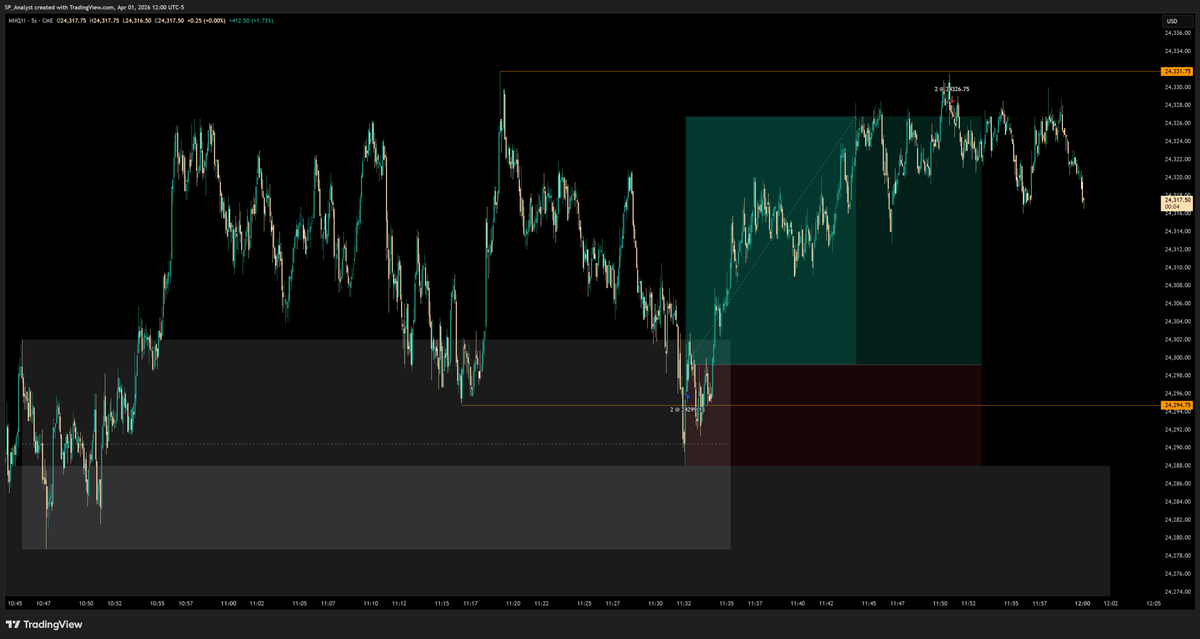
$MNQ | April 08, 2026
Bullish continuation📈
Classic SBS Pattern:
1. Sweep of 1st tap ✅
2. 50% Zone mitigation ✅
3. 5m DB + Rejection for entry ✅
Targeting the Old High. Trust the narrative.
#MNQM26#SBS
My simple way to anticipate what the daily candle will look like.
Plus, what to expect during the Asia and London sessions.
HINT: Apply this to the daily chart, then scale it to the hourly—and boom, you've got my full trading plan for nailing bias.
Roadmap: 🛣️🔽
as a trader, you need to realize
you cannot control the market,
but you can control your decisions
you cannot control feeling emotions,
but you can control your reaction to them
you cannot control individual outcomes,
but you can control the edge of your system
the reality is that you have more control than you know
just not in the way that most traders think,
because they have it backwards
they chase control where it does not exist,
and ignore it where it matters most
all to be left feeling helpless and confused
so take real control of what you can
forget about what cannot be
and results will follow
that clarity changes everything
If you’re going into 2026 telling yourself, “This is my year—this is when I turn my trading around,” here are a few things you should consider.
⸻
1. Shift Goals
-Remove PnL goals and replace them with process-driven goals. Instead of “I want to make $500 this week”, change the goal to “I want to take three trades this week that fully follow my process.”
This shift helps you build the mindset and habits needed for long-term success.
⸻
2. Simplify Things
-If you’re trading multiple concepts across multiple assets and you’re not consistently profitable, reduce your process to one concept or strategy on one asset. If you can’t turn a profit with one strategy on one asset, adding more complexity isn’t going to fix the problem.
⸻
3. Build Emotional Control
-The bulk of traders struggle or fail not due to a lack of edge, but due to a lack of self-control. Create an emotional trigger plan. In this plan, assign a specific action to each emotion you struggle with. This will require time, reflection, and self-awareness.
If you struggle with FOMO, maybe you step away for 10 minutes when you feel it coming on. If you’re mid-trade and starting to feel doubt, perhaps you cut half your position so risk is reduced and the fear of loss subsides.
Whatever emotional factors you struggle with, create a plan for each.
⸻
4. Backtest Any Changes
-If you make a change to your process, backtest it. A backtest is a free way to see if something is viable. For example, if you modify how you manage your stop loss, backtest it over a few dozen trades to at least determine whether the change is worth implementing. If the change makes your trading worse in backtesting, it will likely be worse live.
⸻
5. Adjust Risk
-If you’re blowing accounts in a single trade, single day, or even a single week, you’re risking too much—or trading too much (which is still risking too much). Start by cutting your risk in half and observe the difference it makes in both your mindset and your trading.
Restrict yourself to two trades per leg of movement. This allows you to be wrong and try again. After the second loss, however, your read may simply be off. Let price work through whatever range it’s in and form a new pivot, creating a new leg of movement. You’re now in a different scenario instead of chasing the same move.
⸻
6. Map Out Your Process
-Write out your entire process or strategy: entry criteria, entry triggers, emotional trigger plan, risk management, trade management, and everything from opening a trade to closing it. If you can’t quantify your process this way, you’re not trading—you’re gambling.
A defined process means you’re applying logic, not rolling the dice. A defined process is repeatable, and performance can be tracked. An undefined process means every trade operates under a different set of rules.
This defined process is the law. You follow it no matter what. That’s how consistency is built. Whether that consistency leads to losses or wins depends on your edge—but you’ll never know if your process is good or bad unless you can execute it the same way every time.
⸻
Some of these points may seem obvious or even juvenile, but they are foundational principles that can make all the difference—and they are what separate a successful trader from a losing one. Feel free to ask questions below snd good luck.
. @jai_kalro I've made at least 3 videos on the H4 stats, probably more. I quickly went to check:
https://t.co/2qmsDsDPyy
https://t.co/SuvV6Ky0uO
https://t.co/vZ0T1Hily4
why trading should never be your only purpose:
one of my members recently asked me:
“how can you say trading shouldn’t be your only goal - when back then, it was clearly yours?”
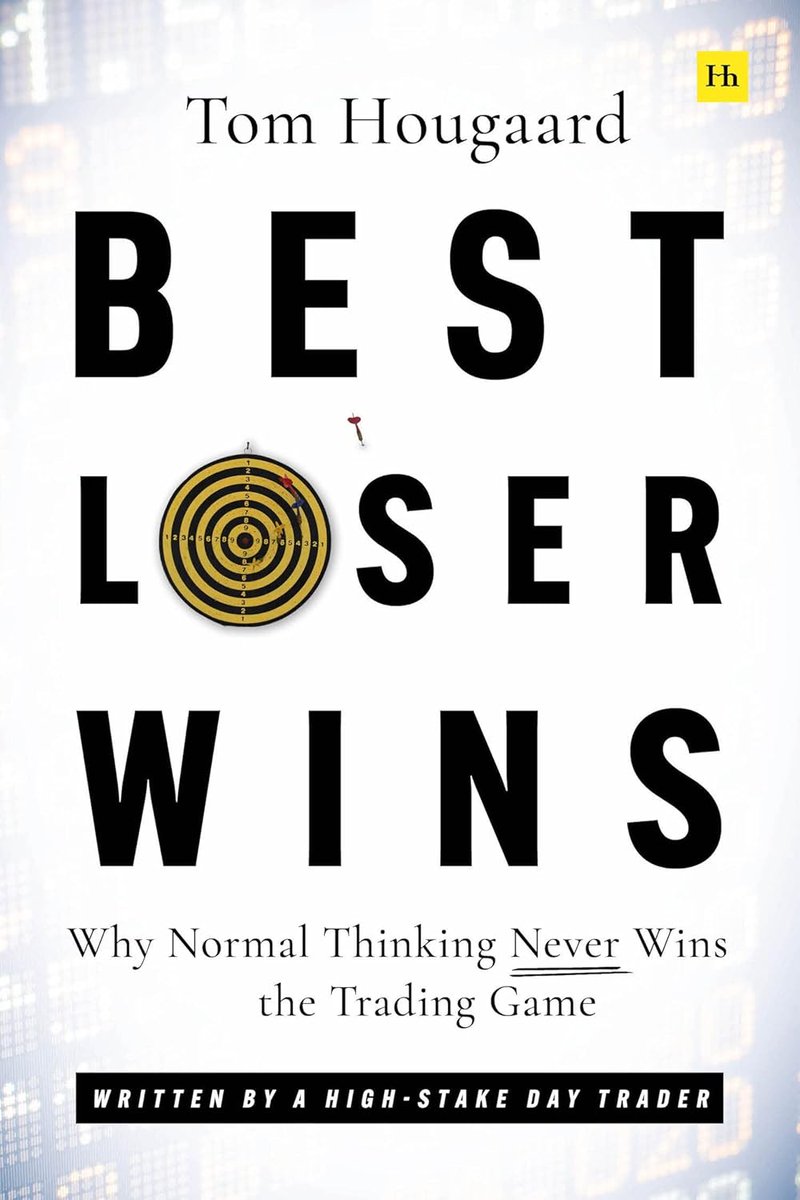
Best Loser Wins
Tom Hougaard’s Best Loser Wins will change how you think about trading.
Here’s a full breakdown - so you don’t have to read all 250 pages.
Save it & study it 🧵
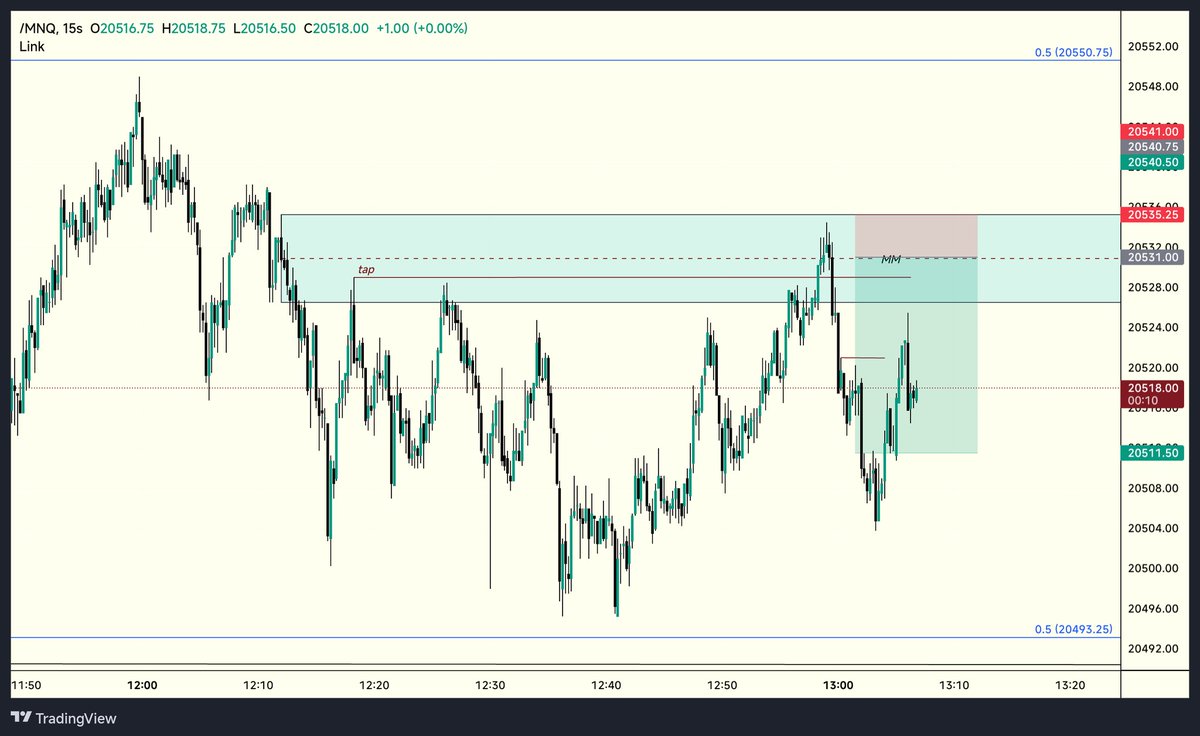
Here it is: THE EASIEST, SIMPLEST, JUICIEST TRADING MODEL THERE IS IN 5 SIMPLE STEPS 🔥
- check chart from 13:15/30
- is price at move origin?
- did it sweep a first tap, itl, unicorn there?
- displaced towards lunch’s high?
- FIND YOUR ENTRY MODEL and ride it to lunch’s high
THIS IS IT, EASY 30/40/50+ HANDLES ALMOST EVERYDAY 💸💸💸
I’ll attach some exemples in comments but more importantly check on your charts
It’s not there everyday but almost and it’s the easiest free sim moneyyyyz there is no headache nor Astro science PHD needed
*not financial advice*