the book is: visual group theory, by nathan carter
read if you wanna see the soul of group theory
very minimal prereqs. being inquisitive is enough
10/10 fully recommended
El próximo semestre voy a impartir un curso en la UNAM de cálculo integral de varias variables con inclinación hacia las ciencias de la computación.
El curso será en línea.
Todo interesado será bienvenido.
Stanford's CS336 — Language Modeling from Scratch is one of the best courses for understanding how LLMs are built end to end. The catch: 17 lectures, ~22 hours of video.
So I built a companion notes site for the full Spring 2025 series:
👉 https://t.co/xTyOz89TYU
For all 17 lectures:
Written notes across tokenization, architectures, MoE, GPUs & Triton kernels, parallelism, scaling laws, inference, evaluation, data, and alignment (SFT/RLHF/RL)
~200 slide screenshots pulled at the key moments
Rendered math, syntax-highlighted code, and timestamps back to the source
The goal: turn ~22 hours of lectures into something you can skim in an afternoon and return to as a reference.
Feedback welcome — and always happy to connect with others building or learning LLM systems. 🙌
#LLM #MachineLearning #CS336 #Stanford #AI
"Pattern Recognition and Machine Learning" by Christopher Bishop is one of the best books in modern machine learning (almost 800 pages of content).
Although it was published in 2006, it remains a standard reference on the subject. It develops machine learning from first principles, with a strong emphasis on probability, statistics, optimization, graphical models, neural networks, kernel methods, mixture models, and Bayesian inference.
It also includes one of the clearest mathematical introductions to multinomial logistic regression and the softmax function. Microsoft Research makes the complete PDF freely available:
https://t.co/k54s7sKCQ5
@utathegame it looks much better than last trailer...characters floating movements need to be fixed (a bit of heaviness would do) ..also the boss arena looks DEAD ...a bit of life in backdrop too would be great ...looking forward to how the project grows...keep it up
While reviewing the entry on the concavity and convexity of functions and the role played by the second derivative, I stumbled upon "Convex Optimization", a free and, I have to say, monumental book (more than 700 pages) by Stephen Boyd (Stanford) and Lieven Vandenberghe (UCLA).
The book develops the mathematical foundations of convex optimization, covering topics such as convex sets and functions, duality theory, linear and quadratic programming, geometric programming, semidefinite programming, interior-point methods, and a broad range of applications in approximation and fitting, statistical estimation, geometric problems, and signal processing.
This book is another resource worth adding to your bookmarks and consulting whenever needed, as it offers a broad, comprehensive, and remarkably rigorous treatment of the subject.
https://t.co/la29yRW2Nn
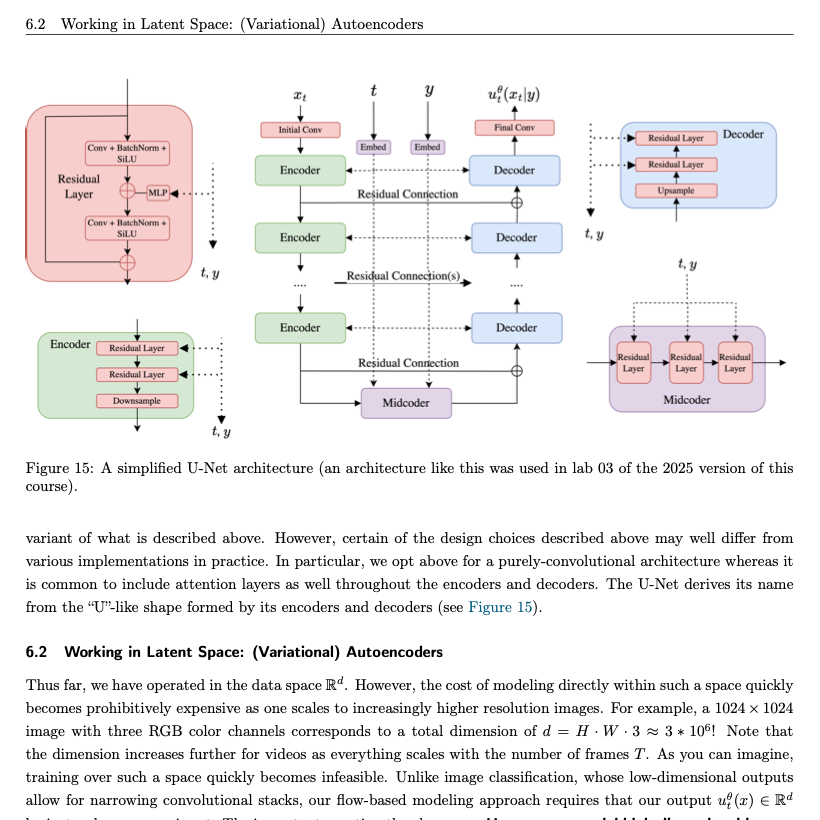
"An Introduction to Flow Matching and Diffusion Models" is a set of MIT lecture notes for the course "Generative AI With Stochastic Differential Equations" (2026) that provides a clear introduction to the mathematics behind modern generative AI.
The notes discuss flow matching and denoising diffusion models as core techniques behind many advanced generative systems, with references to models such as Stable Diffusion 3, FLUX, VEO-3, and AlphaFold3.
They develop the mathematical foundations of generative modelling, covering topics such as sampling from probability distributions, ordinary and stochastic differential equations, Brownian motion, diffusion processes, flow matching, score matching, classifier-free guidance, architectures for image and video generation, latent spaces, autoencoders, and discrete diffusion models for language generation.
What I particularly appreciated is the teaching style. The notes first build geometric and probabilistic intuition and only then derive the complete mathematical formulations. The result is a treatment that is rigorous, visual, and remarkably approachable.
This is probably one of the best freely available resources for understanding what is actually happening under the hood of diffusion models from a mathematical perspective.
https://t.co/J96rHCBPrb