This paper doing the rounds is claiming that real per-capita income of India is roughly $1,000 less than what would have been without Modi government. After replicating the results, and extending the analysis, here are some serious issues I find with the work:
1. The gap between India and the counterfactual synthetic India is overwhelmingly explained by growth in Bangladesh and Ethiopia. But Bangladesh and Ethiopia both have questionable GDP numbers and without them the remaining pool cannot produce a credible counterfactual. Bangladesh's own government concluded that its growth figures had been overstated, worsening after FY2012-13, which is roughly when this study's treatment period begins. Meanwhile Ethiopia went through a civil war, inflation above 20 percent for several years, severe foreign exchange stress and a sovereign default.
While the authors spend time worrying about whether Indian economic data can be trusted, they raise no such concerns about the countries they are comparing India to. (1/7)
https://t.co/nb5ikZ60Hi
This Special Issue showcases advances in the creation of new frameworks for building more reliable Markov state models, allowing integration with experimental observables, and allowing the modeling of more complex systems in the future.
Learn more: https://t.co/TvagSPSrFq
Constrained Low-Dimensional Parametrization of Coarse-Grained Force Fields for Structural and Thermodynamic Consistency
https://t.co/LbrhjbGilA
#JCIM Vol66 Issue11 #compchem
Fast Fourier Transform Enables Automated Parametrization of Complex Dihedral Potentials in All-Atom and Coarse-Grained Force Fields
https://t.co/bgiN0yPKWW
#JCIM Vol66 Issue11 #compchem
"If you are keen to learn new stuff, you can come here and learn the most important things about the domain itself, on the job…"
Kuba Perlin, ML Staff Research Engineer, shares his insights into Iso's unique approach and explains why a formal science background isn't essential.
𝐁𝐫𝐞𝐚𝐤𝐢𝐧𝐠 𝐭𝐡𝐞 𝐒𝐩𝐞𝐞𝐝 𝐋𝐢𝐦𝐢𝐭 𝐢𝐧 𝐍𝐞𝐮𝐫𝐚𝐥 𝐍𝐞𝐭𝐰𝐨𝐫𝐤 𝐌𝐨𝐥𝐞𝐜𝐮𝐥𝐚𝐫 𝐃𝐲𝐧𝐚𝐦𝐢𝐜𝐬!
I am thrilled to share our latest paper published in the Journal of Chemical Theory and Computation (JCTC) @JCIM_JCTC : "𝐅𝐚𝐬𝐭𝐞𝐫 𝐌𝐨𝐥𝐞𝐜𝐮𝐥𝐚𝐫-𝐃𝐲𝐧𝐚𝐦𝐢𝐜𝐬 𝐰𝐢𝐭𝐡 𝐍𝐞𝐮𝐫𝐚𝐥 𝐍𝐞𝐭𝐰𝐨𝐫𝐤 𝐏𝐨𝐭𝐞𝐧𝐭𝐢𝐚𝐥𝐬 𝐯𝐢𝐚 𝐃𝐢𝐬𝐭𝐢𝐥𝐥𝐞𝐝 𝐌𝐮𝐥𝐭𝐢𝐩𝐥𝐞 𝐓𝐢𝐦𝐞-𝐬𝐭𝐞𝐩𝐩𝐢𝐧𝐠 𝐚𝐧𝐝 𝐍𝐨𝐧𝐜𝐨𝐧𝐬𝐞𝐫𝐯𝐚𝐭𝐢𝐯𝐞 𝐅𝐨𝐫𝐜𝐞𝐬".
Link to the paper: https://t.co/0R8VT0iC2L
Link to the updated preprint (#openaccess): https://t.co/SIbycvnEkz
In this work, we introduce DMTS-NC, a model-agnostic acceleration strategy that bridges the performance gap between high-accuracy Neural Network Potentials (NNPs) and traditional classical force fields. By distilling large foundation models (like FeNNix-Bio1 and MACE-OFF23) into a lightweight architecture that directly predicts nonconservative forces, we bypass the computationally expensive backpropagation step entirely. To ensure exceptional simulation stability without requiring tedious, system-specific fine-tuning, the architecture strictly enforces key physical priors like rotational equivariance and net-zero atomic force cancellation. The results are a game-changer for high-throughput simulations: DMTS-NC delivers a 15% 𝐭𝐨 30% 𝐬𝐩𝐞𝐞𝐝𝐮𝐩 𝐨𝐯𝐞𝐫 𝐩𝐫𝐞𝐯𝐢𝐨𝐮𝐬 𝐜𝐨𝐧𝐬𝐞𝐫𝐯𝐚𝐭𝐢𝐯𝐞 𝐌𝐓𝐒 𝐟𝐫𝐚𝐦𝐞𝐰𝐨𝐫𝐤𝐬 𝐚𝐧𝐝 𝐮𝐩 𝐭𝐨 𝐚 5.6𝐱 𝐚𝐜𝐜𝐞𝐥𝐞𝐫𝐚𝐭𝐢𝐨𝐧 𝐨𝐯𝐞𝐫 𝐬𝐢𝐧���𝐥𝐞-𝐭𝐢𝐦𝐞-𝐬𝐭𝐞𝐩 𝐦𝐞𝐭𝐡𝐨𝐝𝐬. Furthermore, by pairing this approach with Hydrogen Mass Repartitioning (HMR) and High Hydrogen Friction (HHF), we successfully extended outer time steps up to 10 fs while maintaining flawless thermodynamic and free-energy accuracy.
Implemented in Tinker-HP @TINKERtoolsMD !
Huge congratulations to the team at @qubit_pharma and Sorbonne Université/CNRS: @NicolaiGouraud, @comecattin, Olivier ADJOUA, Louis Lagardère, and @Thomas__Ple !
Funding from @ERC_Research(project EMC2) and supercomputing time @Genci_fr .
#MolecularDynamics #MachineLearning #compchem #compbio #AI4Science #foundationmodels #FeNNixBio1
Next Tues (4/28) at 4PM ET, @XiangzheKong18
will present "Programming Biomolecular Interactions with All-Atom Generative Model"
Paper: https://t.co/Dn3JuHYBAy
Sign up on our website for zoom links!
Traditional MD requires long simulations in which interesting events are dominated by irrelevant dynamics.
MarS-FM is our generative model that rethinks protein simulation by learning the transitions between biological states, achieving a 600x speedup.
https://t.co/AADygbMgny
The next frontier in protein design will not be defined by structure alone, but by the capacity to engineer motion as a first-class principle of function. This is because dynamics is where the real biology lives.
Foundational work by Karplus, Levitt & Warshel made clear that chemistry cannot be understood without motion, mechanism, and scale. Gō, Brooks & others showed that proteins possess characteristic collective motions - low-frequency normal modes that capture how whole molecules bend, breathe, and fluctuate. Frauenfelder then sharpened the picture further: proteins are not static objects occupying a single minimum, but dynamic ensembles traversing rugged energy landscapes.
And yet the modern AI revolution in protein science has been, above all, a revolution in structure. In our new paper in Matter, @_Bo_Ni and I ask a different question: not what structure will this sequence adopt? but what sequence will realize a prescribed pattern of motion?
VibeGen inverts the conventional design paradigm. Rather than treating dynamics as a consequence to be analyzed after the fact, it makes dynamics the design objective from the outset. Using a language diffusion model with two cooperating agents - a designer that proposes sequences and a predictor that critiques them against the target motion profile - the system converges on de novo proteins with tailored vibrational behavior.
One of the most intriguing results is a form of functional degeneracy - distinct sequences and distinct folds can satisfy the same target dynamical specification. For a given functional pattern of motion, evolution may have sampled only a small region of the physically realizable design space. The space of viable molecular mechanics may be far larger than the repertoire biology happened to discover.
We have made "vibe" into a cultural metaphor - something intuitive, affective, subjective. But at the molecular scale, vibe is not metaphor: It is physics. For a protein, the vibe is the pattern of motion itself; the fluctuations, resonances, and collective displacements that determine what the molecule can do.
ALS is a disease that takes everything. Our goal is to give something back.
Kenneth, who has been losing his ability to move and speak due to ALS, is exploring how Neuralink’s brain-computer interface technology can help translate neural signals into life-changing impact.
No response here. No response in WhatsApp. The sweepers also gave an option. To pay them money to take it out. Why pay taxes then? The money can be directly paid to them @GVMC_VISAKHA@Ketangargmickey
Enhanced Diffusion Sampling: We develop a framework for efficient rare event sampling and free energy calculation with diffusion models. We introduce Metadynamics and Umbrella Sampling for diffusion models.
@MSFTResearch#MachineLearning#MD#Biology
https://t.co/NC6QNrCP85
Delighted to share new @arcinstitute work from our group on AI-accelerated lab-in-the-loop, in @ScienceMagazine today
One of the most remarkable things about biology is that it's digital. DNA, RNA, proteins: these are all sequences, and their function is directly encoded in their sequence of letters. But a protein of length N has 20^N possible variants and the vast majority are non-functional. Evolution spent billions of years finding the functional needles in this haystack through random exploration and natural selection. For modern biomedicine, we need to solve this in days to weeks.
Come join us to push the frontier of AI for biomolecular dynamics and function. A few days left to apply.
@MSFTResearch AI for Science Cambridge or Berlin.
Researchers: https://t.co/3TqHu7eIRl
Software + ML Engineers: https://t.co/PMyPDpqblz
#MachineLearning#AI#Biology
New preprint: “When lipids embrace RNA”
https://t.co/cqGqirA4ZY
Using multiscale simulations (🍸 #Martini + constant-pH MD), we show that:
• Local pKa ≠ global pKa
• Endosomal escape is limited by persistent protonation.
#LNP#MolecularDynamics
Researchers grow specialised nerve cells that degenerate in ALS/motor neuron disease and are damaged in spinal cord injury in this 'fundamental' study.
https://t.co/89dMCzfpiV
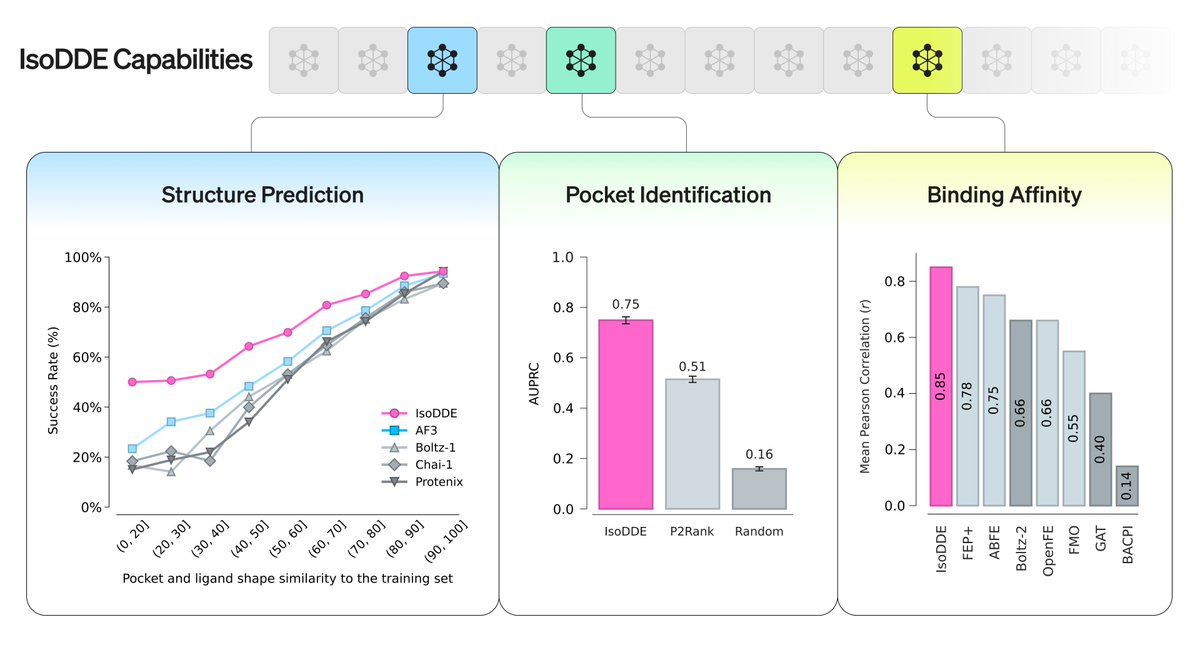
Today we share a technical report demonstrating how our drug design engine achieves a step-change in accuracy for predicting biomolecular structures, more than doubling the performance of AlphaFold 3 on key benchmarks and unlocking rational drug design even for examples it has never seen before.
Head to the comments to read our blog.
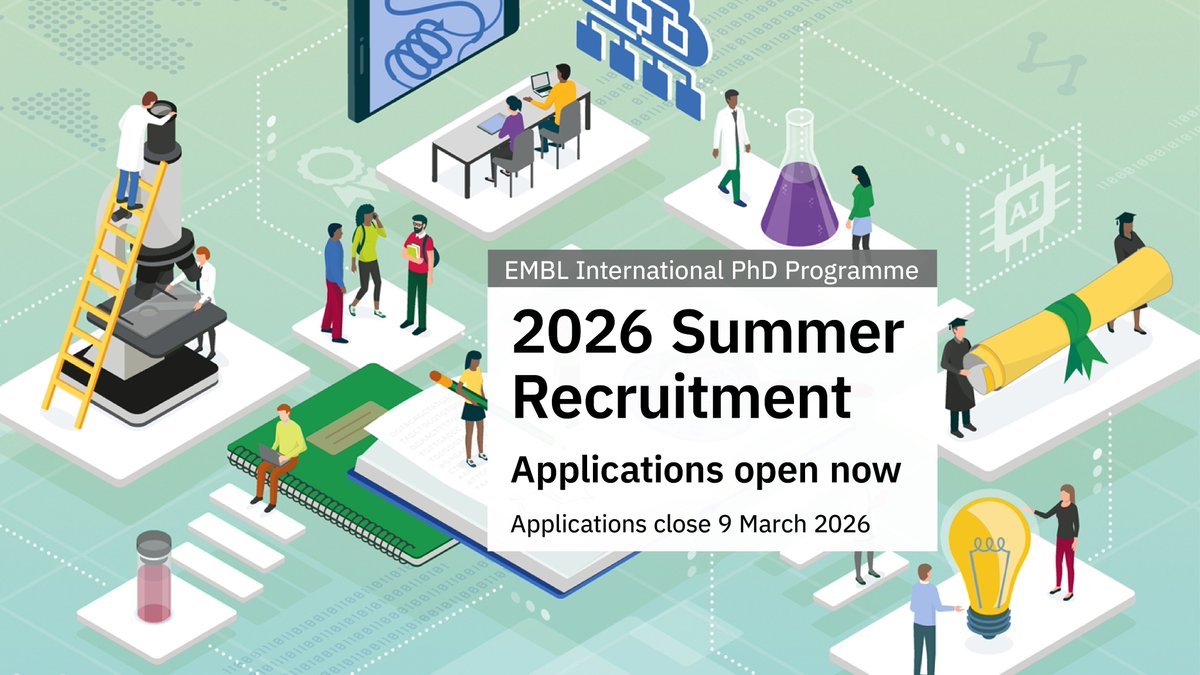
Recruitment for the EMBL International PhD Programme is officially open!🔊
At EMBL, we train young scientists to become skilled and creative future leaders in academia, industry and other sectors. Start your career in the life sciences with us!
🔎 https://t.co/EYfcVvlHFT