Happy Int'l Women's Day 🎉🌸✨
This #WomensDay, I celeb resil, empow & amaz women uplifting others! 🌸 Keep rising, insp daily! ✨
Read my story: [ https://t.co/SKBp5EXCKA ]
Happy Int'l Women's Day 🎉🌸✨
#icwiewomensday#icwiephotocontest#happywomensday2025
Thank you,TheCEOVerse for this wonderful recognition and for featuring my journey. I'm truly honored and grateful. It's a privilege to contribute to the evolving conversation around AI, digital innovation, and enterprise transformation. Looking forward to continuing this journey and creating meaningful impact together...
TheCEOVerse is proud to recognize Dr. Satyasri Akula, Digital Innovation Leader & AI Researcher at SritechStudio, as the "Visionary AI & Digital Innovation Leader of the Year 2026".
Read her full feature:
https://t.co/gb6AT9ITUW
#ArtificialIntelligence#Innovation#TheCEOVerse
Super El Niño 2026: The Climate Storm India Can’t Ignore
The heat doesn’t feel normal anymore.
Summers are stretching longer, lakes are shrinking faster, and the monsoon behaves like a guest who can’t decide whether to show up or not. Now scientists warn that a possible Super El Niño in 2026 could push the climate crisis from “concerning” to knocking at our doorstep.
And India may stand right in the line of fire.
A Super El Niño is not just about hotter weather. It can trigger:
brutal heatwaves,
weak monsoons,
crop failures,
water shortages,
and rising food prices.
When the Pacific Ocean warms abnormally, countries like India often pay the price. As the saying goes, when it rains, it pours except during El Niño, sometimes it doesn’t rain at all.
States like Rajasthan, Maharashtra, Telangana, Andhra Pradesh, Karnataka, and Tamil Nadu could face severe heat and water stress. Cities already struggling for water today may find themselves “between a rock and a hard place” tomorrow.
The scary part?
Climate change is pouring fuel on the fire.
Farmers may take the hardest hit.
A delayed monsoon can destroy crops before they even get a fighting chance. Rice, wheat, pulses, and sugarcane production may suffer, affecting millions of families and pushing food prices sky-high.
Climate change is no longer a future problem.
It has entered our kitchens, our farms, and our daily lives.
The truth is harsh:
Nature is sending warning signals, but humanity keeps hitting the snooze button.
We cannot control El Niño.
But we can control our habits.
Save water.
Plant trees.
Reduce waste.
Use energy wisely.
Because Earth isn’t asking for perfection anymore, it’s asking for responsibility.
If we continue treating nature like a bottomless pit, future generations will inherit a planet running on empty.
And by then, no technology in the world will be able to negotiate with a collapsing climate.
@ClimateReality@climate
Every Drop Counts — Before It’s Too Late
When Diesel Stopped, Life Changed Overnight
A few months ago, when diesel supply was disrupted across Telugu States Andhra Pradesh and Telangana, everyday life quickly slipped out of balance. Travel plans were cancelled, emergencies became difficult, and transportation slowed down. As goods stopped moving, prices of vegetables and essentials increased, putting pressure on households. Petrol bunks were crowded, arguments became common, and uncertainty grew due to lack of clear communication.
In the middle of this, some people began selling fuel in the black market, turning crisis into profit.
Now Imagine If Water Disappeared Like That
If a fuel shortage could cause this much disruption, imagine waking up to a day with no water. No drinking, no cooking, no basic hygiene. This is not hypothetical, as millions already depend on contaminated water in countries like Pakistan, Bangladesh, Yemen, and Afghanistan.
India Is Already Under Stress
India holds only 4 percent of the world’s freshwater but supports 18 percent of its population. With most water already contaminated or polluted, pressure is rising. States like Jharkhand, Odisha, Bihar are already facing shortages, and cities like Ranchi are under severe stress.
Scarcity Creates Exploitation
Just like diesel, water scarcity is also leading to exploitation. In cities like Bhopal, tanker mafias control supply and charge high prices, showing how quickly scarcity can create inequality.
How AI Is Helping and Why It Matters
Artificial intelligence is helping address the real issue, which is inefficient usage. AI systems can detect pipeline leaks in real time, preventing large scale wastage. In agriculture, AI based irrigation uses soil and weather data to supply only the required amount of water, reducing overuse. Satellite driven AI tracks groundwater levels and provides early warnings before depletion becomes critical. AI also helps predict contamination, allowing action before people fall sick. These solutions matter because they prevent loss, improve efficiency, and enable timely decisions.
Responsibility Still Starts With Us.
Even with technology, daily habits make the biggest difference. Simple actions like turning off taps, fixing leaks, and reusing water can significantly reduce wastage when practiced consistently.
Every Drop Is Still In Our Hands
The diesel crisis showed how quickly life can be disrupted, but water is far more essential because it affects survival itself. The choices we make today will decide how secure our future is, and every drop we save contributes to that balance.
#climatechange @ClimateReality@ClimatePower
Aravallis on Sale. When Ancient Mountains Are Put on the Auction Block
They say you never miss the well until it runs dry.
India may be about to learn that lesson the hard way.
Let us talk about the Aravalli Hills. Not as a textbook topic, but as a natural system that has protected this land for two billion years.
And today, that system is being dismantled.
What Are the Aravallis, and Why Should You Care
The Aravallis are older than dinosaurs and older than continents as we know them. Stretching nearly six hundred and ninety two kilometres from Delhi through Haryana, Rajasthan, and down to Gujarat, they are not dramatic mountains.
They simply exist. And that existence matters.
For Delhi NCR, they slow dust storms from the Thar Desert, reduce airborne dust, and help recharge groundwater. Without them, pollution and water stress would worsen sharply.
For Rajasthan, Haryana, and Gujarat, they act as natural water storage. Rainwater filters through ancient rock, feeding aquifers and rivers like the Chambal, Sabarmati, and Luni.
In simple terms, the Aravallis hold back the desert. Remove them, and the balance breaks.
The Decision That Changed Everything
On November 20, 2025, the Supreme Court of India accepted a revised definition. Only hills taller than one hundred metres would now be recognised as Aravalli Hills.
On paper, it sounded technical. In reality, it stripped protection from over ninety percent of the range.
In Rajasthan alone, out of more than twelve thousand mapped hills, barely a thousand still qualify. Nature does not function in compartments. When one part loses protection, the whole system weakens.
When Protection Ends, Damage Begins
The newly unprotected areas sit on valuable minerals like limestone, marble, granite, copper, and zinc. Mining interest followed quickly.
In Haryana’s Bhiwani and Charkhi Dadri districts, hills formed over billions of years have been flattened within decades. Stone crushers have turned solid rock into dust. Forest cover in central Aravallis fell sharply between nineteen seventy five and twenty nineteen.
The results are visible. More dust storms. Falling groundwater. Rising respiratory illness. Villages are left with bare hills, rubble, and disease. The desert continues its slow eastward push.
People Are Protesting, but Mining Is Faster
In December 2025, protests erupted across Gurugram, Udaipur, Jodhpur, Sikar, Alwar, and Delhi. Citizens marched under banners reading “No Aravalli, No Life.” Groups like People for Aravallis, Aravalli Bachao, and Youth4Aravallis continue to file petitions and mobilise communities.
Several leaders raised concerns. Sonia Gandhi called the ruling almost a death warrant for the hills. Yet mining activity continues, driven by strong economic interests and weak enforcement.
So Here Is the Question That Remains
This is not just about hills. It is about the future we are shaping.
When water grows scarcer and dust storms harsher, this moment will matter.
Did we recognise the warning signs in time.
Or did we look away.
The Aravallis are still standing today.
What happens next is a human choice.
#CLIMATE @ClimateReality@climate@UNFCCC@SUSTAINABILITY
🌍💰🌱🔥⚖️
What is carbon pricing and how can it help fight climate change?
You’ve probably come across #carbonpricing everywhere.
The @IMFNews has released a short and informative video on this topic. It is widely discussed in many contexts.
You can access it via the link below
https://t.co/4oWtp7UwI9
🌱 🟩🌲🥬🟢
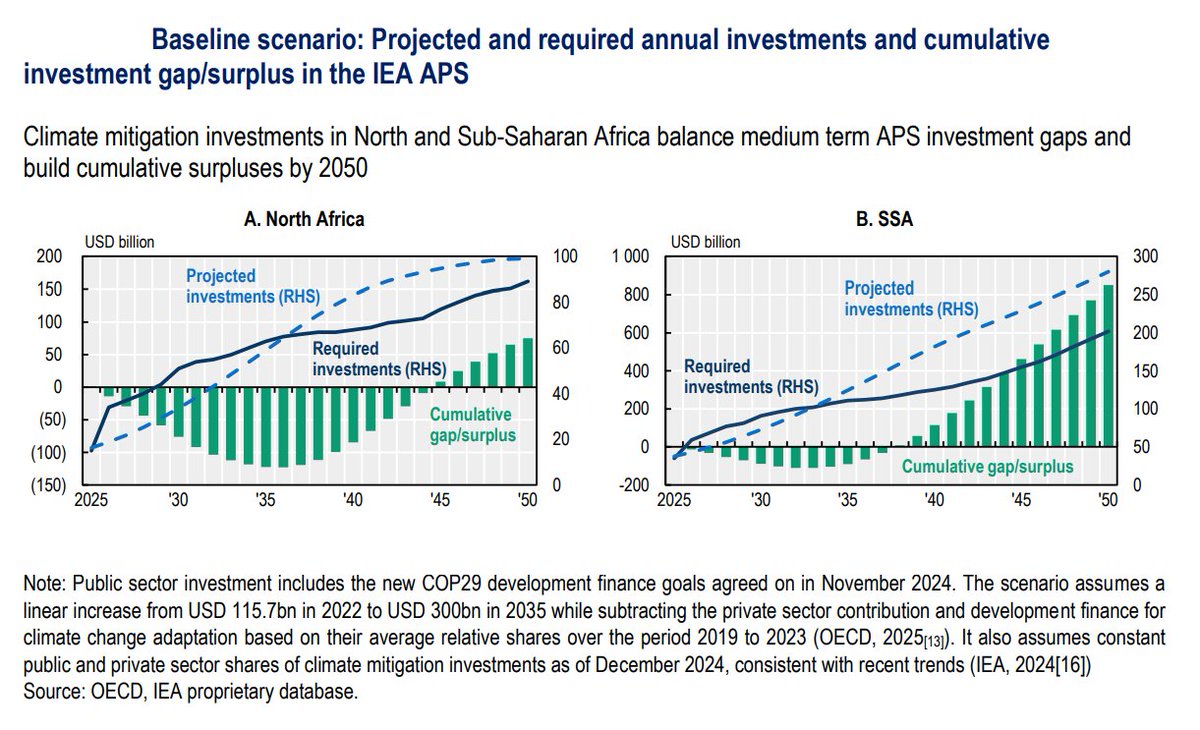
Africa’s Climate Investment Gap Turns into a Surplus by 2050
📌Both North Africa and Sub-Saharan Africa close medium-term gaps and build long-term surpluses in the APS scenario.
🟩 1. North Africa: Medium-term gap, long-term surplus
* 2025–2038: Required investment > projected >> annual gaps (negative green bars).
* After ~2040: Projected investment overtakes needs >> surpluses accumulate.
* By 2050: Total cumulative surplus climbs steadily.
➡️ Region gradually over-invests relative to the #APS requirement.
🟦 2. #SubSaharan #Africa: A similar but delayed pattern
* 2025–2035: Clear investment gaps as required levels rise sharply.
* 2035–2050: Surpluses begin to appear and accelerate.
* By 2050: Surplus is large and rising quickly.
➡️ SSA catches up later but ends with significant positive balance.
📈 3. Required vs projected investments diverge over time
* Required investments (dashed line) grow faster in the early years.
* Projected investments (solid line) gradually accelerate and surpass requirements.
➡️ The APS pathway assumes strong financing momentum in later decades.
💡 4. Why the transition from gap to surplus?
* COP29 development finance targets raise public sector contributions.
* Private sector climate #finance grows based on past 5-year averages.
* Adaptation finance is maintained at previous shares.
➡️ Combined effect: investment momentum outpaces requirements after mid-2030s.
➡️ A rare case where #climate #investment gaps close and reverse, generating surpluses by 2050.
Source: @OECD
Beyond Code Generation: How AI and Low-Code Are Reshaping SAP Development
The Maintenance Challenge Nobody Talks About
Here's a common scenario: An application works perfectly after the initial build. Six months later, you're trying to update it, and you're dealing with thousands of lines of auto-generated JavaScript. It works, but understanding and modifying it? That's another story.
The promise of AI-generated code is appealing, describe what you need, get instant results, deploy to production. But there's a catch: generated code without proper structure becomes difficult to maintain over time.
This is why we took a different approach and started focusing on the long game.
Understanding the Code Generation Challenge
The concept is straightforward: describe what you want, an LLM generates SAPUI5 code, and you have an application. It's fast and looks impressive initially, but it creates several challenges:
Complexity: Understanding auto-generated code can be difficult
Maintenance: Modifications often have unexpected ripple effects
Security: Auditing code you didn't write requires extra effort
Support: Finding developers willing to maintain generated code becomes harder over time
The solution isn't to avoid AI,it's to use it differently.
A Different Approach: Structure Over Code
Here's the key idea:
Generate specifications, not code.
Instead of having AI create JavaScript files that need constant maintenance, we use AI to understand requirements and create structured specifications.
These specifications are then processed by a controlled, standards-compliant runtime environment.
This approach separates concerns effectively: AI handles the interpretation and specification, while proven frameworks handle the execution.
Three Core Components:
The architecture is built on three integrated parts that keep ABAP developers in control:
1. The Builder: Configuration Environment
This is where ABAP developers model data sources, design screen layouts, and define business behaviors. The focus is on familiar SAP concepts: CDS Views, annotations, and ABAP logic—no frontend coding required.
2. The Viewer: Standards-Compliant Renderer
Instead of generating custom SAPUI5 code for each application, a smart renderer interprets an extended vocabulary of annotations and presents everything in a Fiori-aligned interface automatically. Every application follows SAP guidelines consistently.
3. The Data Layer: Performance Foundation
CDS Views are modeled directly by developers with proper pushdown optimization. Data stays performant, logic stays clean, and everything remains in ABAP.
Keeping ABAP Developers Central
SAP has been strengthening the ABAP developer's role in S/4HANA extensibility through enhanced CDS capabilities, Fiori Elements, and modern frameworks. This approach aligns with that direction.
ABAP developers continue doing what they do best:
Modeling data with Virtual Data Models (VDMs)
Defining business rules through validations and determinations
Configuring screens using familiar tools
Delivering production-ready Fiori experiences
AI handles the translation of business requirements into technical specifications, while developers maintain full control over the implementation and quality.
How It Works in Practice:
Let's walk through how this actually works in the real world.
Step 1: Describe the Requirement
You describe what you need in plain language to the AI assistant. For example: "I need a dashboard showing overdue purchase orders with approval workflows."
No technical specifications needed—just the business requirement.
Step 2: AI Analyzes the Landscape
The LLM uses Retrieval-Augmented Generation (RAG) connected to a knowledge graph of your SAP system. It activates specialized tools through the Model Context Protocol (MCP):
Package Tool: Identifies the appropriate ABAP package
Data Source Tool: Finds relevant CDS Views in your system
Field Retrieval Tool: Selects the necessary data elements
Floorplan Tool: Recommends the optimal Fiori layout pattern
KPI Selection Tool: Determines relevant key metrics
Action Button Tool: Maps user actions (Approve, Reject, Download) to ABAP logic
The AI analyzes requirements and maps them to your existing SAP architecture.
Step 3: Specification Generation
The LLM creates a consolidated technical specification based on its analysis. A dedicated tool then uses this specification to generate CDS definitions and annotations.
These aren't arbitrary files,they're structured, organized, and ready for the viewer to interpret.
Step 4: Developer Refinement
You open the Builder and find everything the AI created, ready for refinement. Need to adjust a field? Modify a validation? Add a custom determination? It's all standard ABAP and CDS work.
The AI provides the foundation, typically 80% of the work in minutes instead of weeks.
Step 5: Rendering the Interface
No custom JavaScript compilation needed. The viewer reads the annotations and renders a Fiori-compliant interface automatically.
Every SAP guideline is followed, every interaction pattern is standard with zero custom frontend code to maintain.
Step 6: Execution in ABAP
When users interact with the application submitting, approving, processing execution happens in the ABAP runtime.
Validations, determinations, and action handlers all run in ABAP classes, function modules, or OData actions. Everything stays within the familiar ABAP environment.
The Results:
This approach delivers measurable improvements:
Time to Production: Weeks → Hours
Lines of Code to Maintain: Thousands → Hundreds
Developer Context Switching: High → Minimal
SAP Standards Compliance: Variable → Consistent
Long-Term Maintainability: Uncertain → Predictable
Developer Empowerment Through Automation:
AI in development isn't about replacement, it's about removing repetitive tasks so developers can focus on meaningful work.
This architecture doesn't reduce developers to button-pushers. It eliminates routine work: boilerplate code, repetitive patterns, and tasks that have been done countless times before.
What remains is the valuable work:
Solving business problems
Creating effective data models
Optimizing performance
Building features that deliver real value
In competitive markets where speed and flexibility matter, this capability becomes essential.
The Long-Term View:
The initial appeal of AI-generated code will eventually give way to concerns about maintenance and sustainability.
Organizations are recognizing that rapid initial development at the cost of long-term maintainability isn't sustainable. Successful approaches will be those that:
Deliver quickly (AI-assisted specification)
Stay maintainable (controlled runtime, minimal code sprawl)
Remain secure (standard execution, auditable logic)
Evolve smoothly (structured annotations, clear architecture)
This requires thoughtful engineering rather than quick code generation.
Core Principles for Modern SAP Development
For building enterprise SAP applications going forward, these principles apply:
✅ Use AI for specification generation, not code generation
✅ Keep execution in proven, controlled runtimes
✅ Maintain ABAP developers in control
✅ Default to standards over custom code
✅ Build for sustainability, not just speed
Tools and languages evolve, but the fundamentals of good software engineering remain constant.
Closing Thoughts:
As an techie, I prefer writing code to writing articles. But some approaches are worth documenting. (And yes, I used an LLM to help structure these thoughts which seems appropriate given the topic.)
The key point: AI becomes most valuable when applied strategically. It's not a magic solution, but rather a tool that, within the right architecture, can transform enterprise application development.
The goal isn't to replace ABAP developers, it's to enhance their capabilities and remove obstacles that slow them down.
In an environment where delivery timelines keep shrinking while complexity increases, this matters.
The central question: Are you building applications that will be difficult to maintain, or are you ready to build for long-term success?
The future isn't just about faster coding,it's about smarter development practices.
ABAP developers who understand this approach don't just adapt to change, they drive it forward.
#SAP #SAPBTP #AI #SAPJOULE @SAP
2025 spoke up about climate. Did we listen? Here is what this year taught us. 👇
A year-end reflection on the climate lessons we cannot afford to ignore
2025 did not whisper. It spoke clearly.
Heatwaves pushed systems to their limits. Floods exposed weak infrastructure. Ice kept melting. Food and water security tightened.
But innovation fought back. Communities acted. Solutions emerged.
Here is what we learned. 🌍
🔥 HEATWAVES THAT WOULD NOT QUIT
Record heat became routine. Power grids strained. Communities suffered.
The takeaway? What we called "extreme" is now "expected."
The goalposts moved. We need to move faster.
🌊 WHEN IT RAINS, IT POURS
2025's floods were not just weather. They were wake-up calls.
Weak infrastructure crumbled. Inequality got exposed.
Lesson: Nature does not grade on a curve. Fix the weak links now.
🧊 THE SLOW GOODBYE OF ICE
Glaciers kept shrinking. Sea levels kept rising.
Not dramatic. Just persistent.
Like watching paint dry, except the paint is your coastline disappearing.
Slow damage is still damage. ⏰
🌾 FOOD, WATER & THE CLIMATE LINK
Droughts stressed crops. Water got scarce. Supply chains wobbled.
Climate security IS food security.
When the climate shifts, everything shifts. Including dinner.
BUT HERE IS THE GOOD NEWS 💡
For every problem 2025 threw at us, innovation fought back.
And communities? They did not wait for permission to act.
Progress happened. Real progress.
⚡ ENERGY GOT SMARTER
Solar, wind, and batteries did not just grow. They got better, faster, more efficient.
Smart grids cut waste. Renewables became reliable.
We learned to work smarter, not just harder.
🤖 TECH BECAME OUR ALLY
AI predicted weather with remarkable accuracy.
Sensors tracked water in real-time.
Digital twins helped cities build resilience before disasters struck.
Tech is not the villain. It is the toolkit.
🌱 COMMUNITIES TOOK THE WHEEL
Local tree planting. Water conservation. Climate-aware planning.
Change did not wait for global summits.
It started at home. Many hands made light work.
SO WHAT CAN WE DO?
🏠 Individuals: Waste less energy. Choose smarter transport. Consume consciously.
🔧 Engineers: Design for resilience. Optimize everything. Think climate-first.
🌍 Society: Support smart policies. Invest in education. Build with nature.
2025 TAUGHT US THIS:
Hope survives heatwaves. Innovation thrives under pressure. Change does not wait for someday.
It starts NOW.
The clock is ticking. But it has not run out yet.
The Earth gave us the receipt. Time to settle the bill.
When we act collectively and innovate responsibly, the future is ours to shape.
Let 2030 say: "2025 was the year they finally got to work."
What will YOU do differently in 2026?
Reply with your climate action for 2026. Let us build this future together. 🌍
#ClimateAction #SustainableEngineering #ClimateInnovation #ClimateResilience #RenewableEnergy #CleanTech #sustainablefuture
@ClimateReality@UNFCCC@NASAClimate
From Forbes to Dr. Satyasri Akula — the journey behind the title 🧵
The last few weeks have felt surreal.
Being featured in Forbes (Nov–Dec 2025) was an honor I’ll always cherish. It validated years of work at the intersection of technology, strategy, and purpose-driven leadership.
But if I’m honest…
That recognition pales in comparison to what came next.
On Dec 17, 2025, I cleared my Viva Defense.
I earned the title I’ve chased, doubted, and fought for:
Dr. Satyasri Akula.
The PhD journey isn’t glamorous.
It’s late nights. Self-doubt. Feedback that hurts before it helps. Progress that feels like moving mountains with a teaspoon.
I chose a research topic many warned was too broad.
Too ambitious. Too risky.
But I’ve never been wired for the easy road.
Because real growth doesn’t live in comfort zones.
And meaningful work rarely comes from playing it safe.
This journey tested my resilience, my patience, and my belief in myself.
It also reminded me of something powerful:
👉 You don’t walk hard paths alone.
I’m deeply grateful to my mentor and constant support, Dr. Pritam Bhattacherjee.
To anyone on a PhD or any long, uncertain journey:
It will be hard.
You will doubt yourself.
And you can still make it.
Just keep showing up. Consistency beats perfection.
From Forbes recognition to becoming Dr. Akula this is just the beginning.
Here’s to purpose, perseverance, and people who lift us when the road gets steep.
✨ Your journey matters.
https://t.co/md4FoNshvb
#DoctorateJourney #WomenInLeadership #PurposeDrivenLeadership
#PhDJourney #ForbesRecognition
#LifelongLearning #ForbesUnder30
@ForbesIndia@Forbes #Resilience
The Thirst Behind the Cloud: A Candid Conversation on Data Centers, Water, and What We Should Really Be Asking
When the Cloud Gets Thirsty:
If innovation drinks first and community drinks last, the future arrives dehydrated…
You know, every time someone says “our data is in the cloud,” I can’t help but smile. We imagine this fluffy, magical sky full of our photos and emails, but in reality? That cloud is sitting on the ground in gigantic buildings that are so power‑hungry and heat‑packed they gulp down water like there’s no tomorrow. I’m talking about millions of liters a day, almost as if a small town had turned on every tap at once.
I’m not anti‑tech, don’t get me wrong. I love the digital world; it’s what keeps us connected. But I can’t turn a blind eye when innovation starts sipping water while some communities are left with dry throats. My recent trip to Hyderabad made me laugh and not in a good way. A real estate agent was showing me apartments and said, with so much pride, “These flats are near a big data center, it’s such a secure area.” I nearly choked on my coffee. Secure area? Because there’s a data center? What’s next claiming your neighbor’s Wi‑Fi password adds to your home security??? They’re just cashing in on people who aren’t tech‑savvy, spinning this narrative like it’s some VIP neighborhood, while the real story : water consumption, noise, energy drain gets swept under the rug.
And here’s the thing : some of these data centers are popping up in regions where water is already scarce. Do you see the irony? We’re in 2025, and there are still underprivileged areas where people can’t get clean drinking water. But data centers? Oh, they’re hydrated like royalty, with fresh groundwater and all. We even heard whispers ,false whispers, by the way that the California fires were because of data centers sucking water. Not true. Wildfires are complicated beasts, and blaming them on servers is lazy. But here’s what’s real: these facilities still put immense pressure on ecosystems.
I’m not saying we should stop building them. No. Tech should evolve, but organically, with respect for nature. We’ve got options. Why not use treated wastewater for cooling??? Why not capture rainwater, or build data centers in cooler climates where they don’t guzzle as much? There’s liquid immersion cooling technology now that can save almost all the water. But companies love shortcuts, and communities often don’t ask enough questions.
So here’s my little nudge to everyone, don’t fall for the “it’s near a data center, so it’s secure” sales pitch. Ask the real questions: Where’s the water coming from? Is it recycled? Is the company giving back to the community, or just taking? We have to be smart buyers and smarter citizens. Because like I always say, “If innovation drinks first and community drinks last, the future arrives dehydrated.” And trust me, no amount of digital evolution is worth a thirsty future.
So, the next time someone brags about “everything being safe in the cloud,” maybe pause and ask, safe for who? Our data might be locked up tight, but what about the people living around those massive server farms? I’m not saying let’s ditch tech or go back to the stone age, but maybe it’s time we stop being dazzled by the shiny word “cloud” and start asking what’s fueling it. Because in the end, if our progress leaves the planet parched, what’s the point of all those gigabytes and glowing screens? What do you think — shouldn’t the future of tech be less about speed and storage, and more about balance and survival?
I’m here for tech that coexists with life, not tech that bulldozes it. The cloud is cool but it shouldn’t leave the ground beneath it dry.
What are your thoughts, guys?
#CloudComputing #DataCenters #TechForGood #SustainableTech #ClimateAction #DigitalResponsibility #WaterCrisis #GreenTech #InnovationWithPurpose #FutureOfTech #SustainableInnovation #TechEthics #SaveWater #SmartTech #TechAndPlanet