We all know what the three biggest problems with common printers are:
1) Ink rip-offs
2) Planned obsolescence
2) Unrepairable hardware
Today I stumbled upon 'OpenPrinter', a fully repairable, open-source inkjet that uses cheap refillable HP cartridges (no DRM), prints sheets or rolls with auto-cutter, Raspberry Pi powered + no drivers needed on any OS.
If I ever get a printer again, this will be the one:
It is natural to feel overwhelmed (and borderline stupid) when you are learning something difficult and new. To be honest, this is an indication that you are on the right path.
When you already know something, recall is easy. There is nothing new to build or learn, so there is no strain. Learning is the opposite. Your brain is forming new connections, and that is slow and effortful.
This is why struggling with a new domain, blog, paper, concept, or a new system design pattern feels weird, even when you are making real progress.
When something seems confusing, and you go like, "Wait, I do not get this," it does not mean you are failing. It just means that the material has not clicked yet and has not become a mental model.
So the next time you are three hours into a new concept, codebase, video, course, whatever, and everything feels foggy, that fog is not proof that you are bad at it. It is proof that you are doing it right, so long as things are becoming easier along the way.
To put this more succinctly, feeling good is what learning feels like after it is done, not while it is happening.
Hope this helps.
One thing I do not like about prompts is how we hardcode them in code. Every prompt change leads to a code change, followed by a redeployment.
Hence, today I am launching px0 - an open-source prompt infrastructure toolkit that lets you version, update, and govern prompts in production, eliminating the need to hardcode prompts or redeploy your application.
It is ready to use with a complete API suite, management console, and SDKs in languages that we typically use to prompt LLMs - Python, Node.js, and Go. Here is a gist of the benefits
- no hardcoded prompt strings
- deploy-free prompt updates
- 5-line SDK integration - py, js, and go
- prompt versioning and lifecycle management
- self-host in your own cloud or VPC
- fully open source under the MIT license
Also, many more features are coming out in the next few weeks.
If you decide to give it a shot (link below) and run into any issues or have feature ideas, feel free to open an issue or a feature request. I would love to hear.
If you like the project and find it useful, please star the repo and show some love :) It would mean a ton.
Not every fight is worth fighting.
The sooner you understand this, the better your life will be. Your energy is finite. Use it well.
Win the battles that matter. Ignore the ones that do not.
The data we store on S3 is replicated multiple times to make sure it is never lost (even in the event of a disaster). If they simply stored multiple copies of the data, it would get expensive very quickly at the exabyte scale.
This is where erasure coding gives you the same durability for a fraction of the storage cost. Let me explain...
The idea is simple: split your data into k chunks, then compute m extra parity chunks from them, for a total of n = k + m chunks spread across different disks or nodes. You can lose any m of those n chunks and still reconstruct the original data.
Standard storage class of S3 uses an erasure coding scheme, around 9 data shards and 4 parity shards, spread across multiple availability zones. That gives 99.999999999 percent (eleven nines) durability while using roughly 1.5x the actual data size.
This would have been 3x for a naive triple replication, and thus, the additional cost is pretty low with erasure coding.
The parity math comes from Reed-Solomon codes, the same technique used in QR codes. Given any k of the n total chunks, you can solve a system of linear equations to recover the rest. You can read the Reed-Solomon wiki page for more details, or ask your fav LLM.
By the way, here, the tradeoff is compute.
Reconstructing missing chunks needs CPU cycles to run the decoding math, while replication just reads a copy. Reconstruction also gets slower as you increase the number of parity shards, since the math involves larger matrices.
This is why systems tune k and m carefully. Too few parity shards and durability suffers; too many and reconstruction becomes more expensive.
By the way, Erasure Coding is the reason cloud storage is both cheap and durable at the same time. Just a bunch of encoding math at play.
Hope you found this interesting.
The India Glucose Calendar.
It's not just about the sugar you add to your tea.
The total glucose your body sees throughout the day often comes from a combination of added sugars and carbohydrate-rich foods.
Increasing proteins while lowering overall carbohydrates will benefit all.
Awareness is the first step toward better metabolic health.
Note:
This poster illustrates the approximate glucose equivalent produced from commonly consumed carbohydrate-rich foods and added sugars. Actual values vary with portion size and preparation.
Skills that have nothing to do with money but are worth dedicating an immense amount of practice to:
- Charisma
- Metacognition
- Critical thinking
- Sitting with discomfort
- Articulating what you believe and why
- Changing your beliefs when presented with new information
Almost nobody actually practices these and it shows.
✨ I think I've been coding almost solely on my VPS with Claude Code for almost a year now
All I can say it's just fantastic:
- no need to keep laptop open ever
- no laptop battery drain
- can switch to phone or any other device you like whenever you want to continue (like when you're outside)
- it just keeps going all night while you sleep (esp with /goal)
- you can start hacky projects from scratch and go live in seconds because you're already on the server which is great to ship things and get it used by people fast (not stuck on your local laptop webserver)
- it just feels like living in the future
I used to code on my laptop, test locally, then push to GitHub, then it auto pulled and deploy to production, that'd take me ~1 minute to get a new feature out
But then when I bought a new Mac Book Pro a few years ago I was too lazy to install a local Nginx environment, so I just started pushing to prod and everything went fine, and I sped up deploying to about 3 seconds from laptop to server, which people called me crazy for too
But now with Claude Code on my VPS in the last year, it just live edits on my production server, which sounds like it should go wrong but it just doesn't, it's very careful and only twice in 12 months messed up which meant my site didn't load for 10 seconds which is OK
If I wasn't working solo, like at a big company, I' think I'd recommend the same workflow but with a staging server, so it wouldn't touch production, for safety and regulatory reasons etc. but for me it's fine
I agree with @theo completely, it's clear to me this is where it's going, also seeing @karpathy with Claude moving to the cloud (via Slack etc), I think AI "agents" and AI coding will operate on servers / from the cloud first
P.S. I have 3-2-1 backups, multiple on-site and off-site backups which you should also even if you wouldn't code with AI, safety first!
Looking back, three shifts in how I think and learn had an outsized impact. I wish I had made them on day one.
1. became more data-driven
2. started seeking contrary opinions
3. started learning tougher topics
Start doing this as early as you can; it directly impacts your career growth, acceleration, output, and outcomes. The sooner the better.
Hope this helps.
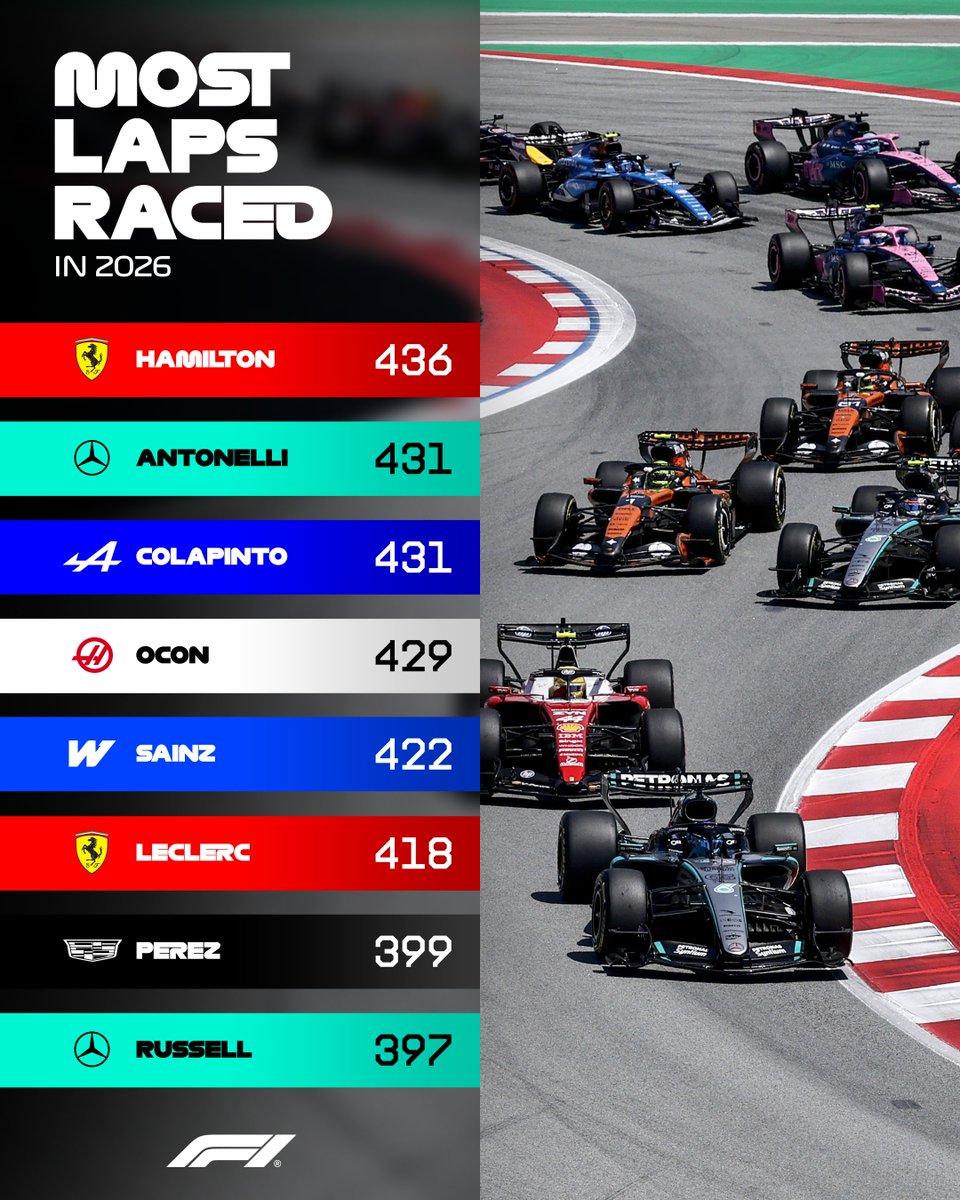
Another one for the history books ✅
Lewis moves clear of the legendary Michael Schumacher with the most wins around Circuit de Barcelona-Catalunya 🏆
#F1#BarcelonaGP