I’m convinced this is the best and right time to build that idea that you have been thinking for a while.
That’s what @JucelyMarie and I did.
Today marks my first month as a startup co-founder and I’m having way too much fun building @almibarapp with her. The AI-driven development improvements, especially those by @claudeai and @OpenAI make it almost impossible to stop building and shipping (and having a good sleep hygiene). Every idea, improvement, bug fix, prototype is just a worktree and a prompt away.
Last weekend, I added gstack to my local Claude env, and after using it for 2 days, I ended up including it into the project so that Jucely (and future hires) can also benefit from it. Loved how it pushes back and keeps you focused on the goal.
Since then, we are averaging 18-20 PRs per day (5-8 before that), and just a few minutes ago submitted the mobile app to the App Store for review.
The future of support and customer success will be issues/requests to solutions/features deployed in minutes instead of quarters (if prioritize by product managers).
For example, two weeks ago, we ran our first activation and tested one of the core features of the app, guest shift/pop-up planning from proposal to event, learned from the experience, and right after the event ended, polished the rough edges. Improvements were added in a matter of days, not months.
Read more about our first activation here: https://t.co/qbWcjVfYrt
Claude Code and Claude Design now sync both ways.
Run /design-sync to pull your design system into your repo and build against your real components, or push what you've built back into Claude Design and keep editing on the canvas.
At @ParchaHQ we saw coding costs explode so we built our own IDE that does routing at the harness level e.g. Claude Code for planning, Codex for long running execution, Cursor for bugs. Plus custom routing, remote sessions, a browser inspector and voice interface.
Now it's open-source! 👇
Personal update: I've joined Anthropic. I think the next few years at the frontier of LLMs will be especially formative. I am very excited to join the team here and get back to R&D. I remain deeply passionate about education and plan to resume my work on it in time.
Sanders and AOC introduced a bill to pause ALL AI data center construction. 300+ local bills filed. Half of planned 2026 data centers facing delays or cancellation. Each one brings billions to local economies.
The people who say they want American jobs are trying to block the biggest job creation engine since the interstate highway system.
As an EM, running engineering standups where everyone's dead-eyed and reciting what they worked on is, in @ryannystrom words, a huge waste of time.
So he built a @NotionHQ AI agent that preps his team's standup before the meeting starts, so he can code right up until it begins.
In this ep he walks us through:
- The "Hot Potato" 🥔 custom agent that scans Slack, GitHub, Honeycomb, and yesterday's meeting transcript every morning at 9am
- How he @-mentions Codex from inside a Notion task and gets a full PR back in 10 minutes
- Spec-driven development: talking into Whisper → spec → one-shotted implementation
- Why CI speed is now your AI adoption ceiling
Plus he shares why this is his favorite prompt: "I literally don't know what I'm doing. Explain it to me."
ty to our sponsors!
💼 @WorkOS - Make your app enterprise ready today
🔀 @orkesio - The enterprise platform for reliable applications and agentic workflows
Full episode: https://t.co/LCZnrUTaX4
Effective today, we are:
1) Doubling Claude Code’s 5-hour rate limits for Pro, Max, and Team plans;
2) Removing the peak hours limit reduction on Claude Code for Pro and Max plans; and
3) Substantially raising our API rate limits for Opus models.
The Design mode in @claudeai is 🤯
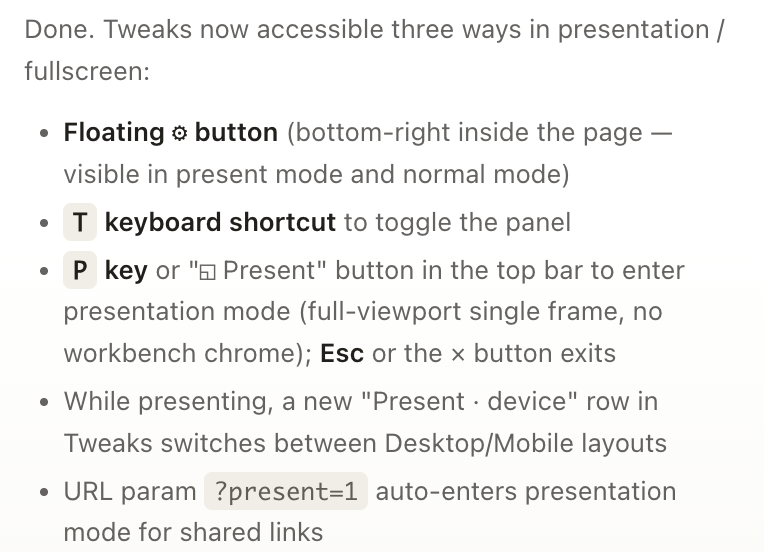
I wanted to have the Tweaks available during Fullscreen Present mode. There isn't a way to get this out-of-the-box, so I asked in the Chat for it and it was implemented with a key shortcut and a floating button in less than a minute.
Thank you @bcherny@trq212 and team!
Introducing Claude Opus 4.7, our most capable Opus model yet.
It handles long-running tasks with more rigor, follows instructions more precisely, and verifies its own outputs before reporting back.
You can hand off your hardest work with less supervision.
Opus 4.7 feels more intelligent, agentic, and precise than 4.6. It took a few days for me to learn how to work with it effectively, to fully take advantage of its new capabilities.
Will post a few more tips throughout the day, starting with this blog post: https://t.co/XQrH8P28yo