Secure AI from code to deployment. Across 13 courses, tackle threat modeling with MITRE ATLAS and hands-on labs with Bandit, Semgrep, PyRIT and MLflow. Cover prompt injection and data poisoning. https://t.co/7mHJq8uC48 #AD#AISecurity
90% of your adult problems will be eliminated if you just:
1. Workout regularly.
2. Eat real food (home-made).
3. Find 1-2 real friends.
4. Live below your means.
5. Do what you love for work.
6. Fix your sleep cycle.
7. Prioritize discipline over motivation.
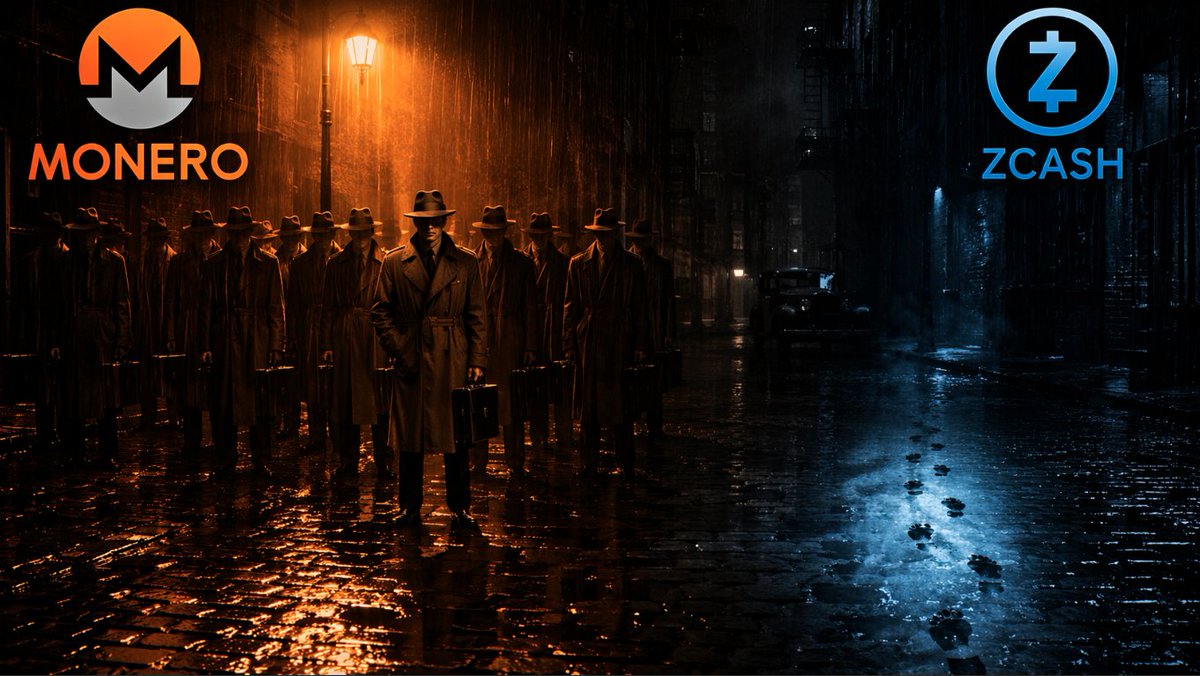
What most people miss about privacy coins: Monero and Zcash give you fundamentally different guarantees, and AI is about to make the difference brutal.
Monero says "maybe it wasn't me, you can't prove it."
Zcash says "there is nothing to prove."
Monero's privacy today is probabilistic. When you send a transaction, the protocol builds a ring of 16 possible senders - your real output plus 15 decoys pulled from historical on-chain data. An observer can't say which one you are. That's plausible deniability. But it's statistical, not cryptographic. Chain analysis can narrow the ring down using timing, known-spent outputs, and temporal heuristics. The anonymity set is 16 on paper and often smaller in practice.
Zcash Orchard's privacy is cryptographic. When you send a shielded transaction, a zk-SNARK (Halo 2) proves you own a valid note, that the note hasn't been spent before, and that the math balances - without revealing which note, which sender, which receiver, or which amount. An observer doesn't see a ring of 16 candidates. They see nothing. The anonymity set isn't 16. It's every shielded note ever created in the Orchard pool since 2022.
One is a crowd. The other is a mathematical void.
Here's why this matters now. AI is a pattern matcher at scale. Give a modern model the full Monero chain, every ring member, every timing signature, every mempool observation, every known-spent output, and combine it with external metadata - exchange KYC data, IP logs, behavioral patterns. Statistical privacy degrades fast under that kind of pressure. It was designed for humans doing chain analysis, not for foundation models running millions of correlation queries per second.
Zero-knowledge privacy doesn't degrade under AI because there's nothing to correlate. The proof reveals zero bits of information about the transaction. A model with infinite compute and every byte of the chain still sees nothing. You can't pattern-match absence.
Two honest caveats.
Monero is shipping FCMP++ (Full-Chain Membership Proofs) in 2026, which effectively replaces the ring-of-16 with proof-of-membership over the entire chain. That's Monero's answer and it closes a lot of the gap. Monero holders waiting for it aren't wrong.
Zcash has a different problem: privacy is opt-in. About 31% of ZEC is in the shielded pool. The other 69% sits in transparent addresses. Monero is mandatorily private by default - everyone's shielded, so nobody sticks out. Opt-in privacy can be cryptographically stronger per transaction but weaker in aggregate if most users don't use it.
When AGI starts doing chain analysis at scale, statistical privacy degrades. Cryptographic privacy doesn't. You can't deanonymize a void.