Systems, AI governance & complex feedback loops.
Thinking things through slowly - often from a gritstone edge in the Peak District.
Explained by triangles.
@burkov Meta-CoT isn’t just better reasoning, it’s expanded search over reasoning paths. That clearly boosts capability, but also increases the space of possible failure. More paths to right answers, but many more that look right. Feels like a bigger shift than it first appears.
I AM QUITTING MY JOB TO GO FULL IN CLAUDE
Just asked him to:
"Analyze misspriced Polymarket markets opportunities for arbitrage and find wallets that are using it to copy"
Turned $2K into $12K in one night
Monitored ~1k+ wallets
I just realized that there are many arbitrage bots that I can't beat without code knowledge
But I can find them and copy
So Claude created a monitoring terminal and copytraded found wallets using TG copytrading bot
It's not a script and not even the bot, it's an AI agent that is improving with each found wallet
Fetching wallet behaviour, how it's trading, arbitrage, what's sized and timings
70% win rate, 7 wallets copytrading rn from ~500 monitored, bot never paused, never gambling, just math and profit
Giving This Free for 24 hours. To get it:
1. Comment the word 'Claude'
2. Like and Retweet this post
3. Follow me @marryevan999 (so i can DM you)
@alex_prompter Without that structure, “continuous self-improvement” is just optimisation without a stable definition of success.
In short: models can learn to think harder - but the definition of “better” still comes from outside the system.
@alex_prompter The model is learning when to think harder, not what success means.
Which highlights a governance point:
A system can’t meaningfully be "self-improving" unless 3 things exist:
• a defined objective
• a measurable success signal
• a controlled mechanism for updating itself
@IntuitMachine One thing I enjoy about your rich threads is how the thinking-in-public models the process you’re describing - a live feedback loop.
In my own AI governance work I keep arriving at a similar idea: humans aren’t just users of these systems, we’re the observers that stabilise them.
AGAPISTIC ENGINEERING
A Thread on How to Actually Beat Moloch
1/
I used to believe coordination failure was inevitable.
That individual rationality leading to collective doom was just... physics.
Gravity for civilizations.
After 6 months studying game theory, semiotics, and a 19th-century philosopher named Peirce, I've completely changed my mind.
Here's why:
2/
First, the problem we're solving.
You've probably heard of Moloch—the god of coordination failure.
He's why we destroy the things we love through the act of competing for them.
3/
Moloch is:
• The arms race no one wanted
• The ocean fished to collapse by rational fishermen
• The inbox that devours your evenings because "everyone else is online"
• The AI race where safety gets sacrificed for speed
Each person makes a locally rational choice. Those choices sum to collective catastrophe.
4/
Here's the question that changed everything for me:
"If Moloch is inevitable, why isn't everything already Moloch'd?"
Think about it.
Humans have been optimizing for thousands of years.
We should be living in a hellscape of pure defection.
We're not.
5/
Something is holding Moloch back.
And that something has a structure.
A structure that can be engineered.
I'm calling this discipline Agapistic Engineering.
(Stay with me—this name will make sense in a minute.)
6/
The name comes from Charles Sanders Peirce, who described "agapism"—evolutionary love—as:
"The movement of love is circular, at one and the same impulse projecting creations into independency AND drawing them into harmony."
Two movements. Both required.
7/
Here's the key insight:
Moloch is agapism with the second half amputated.
Projecting into independency?
✓ (Everyone pursues their interests)
Drawing into harmony?
✗ (No mechanism exists to coordinate)
Result: Catastrophe.
8/
Agapistic Engineering is the discipline of building that missing mechanism.
The "drawing into harmony" infrastructure.
The structure that converts individual rational action into collective flourishing.
Not through virtue. Through design.
9/
"But wait," you say. "You can't engineer love."
You're right.
But love isn't a feeling.
Love is a structure.
And structures can be built.
(I told you the name would make sense.)
10/
Here's how Moloch actually works.
He needs FOUR conditions to win:
Coordination is impossible
Defection is invisible
Defection is unpunishable
Cooperation doesn't pay
Remove any one, and he weakens.
Remove enough, and he loses.
11/
Read that list again.
Those aren't laws of physics.
They're design parameters.
Parameters that humans have successfully altered before.
Every working institution is proof.
12/
Existence proof #1: Rule of law
Before: "Might makes right" → constant violence → no investment → everyone worse off
After: Violence punished → contracts enforceable → trade flourishes → civilization possible
Moloch didn't disappear.
He was pushed back.
13/
Existence proof #2: Property rights
Tragedy of the commons is Moloch's favorite game.
But when communities developed property norms:
• Defection became visible
• Consequences became real
• Stewardship became rational
The "inevitable" tragedy... wasn't.
14/
Existence proof #3: Democratic succession
For most of history, power transferred through blood.
King dies → war → thousands dead → repeat.
Then humans invented elections.
Peaceful power transfer seemed impossible.
Yet here we are.
15/
So here's the Agapistic Engineering formula:
Intervention 1: Build coordination infrastructure → Communication, trust, commitment devices
Intervention 2: Make defection visible → Transparency, reputation, records
16/
Intervention 3: Make defection costly → Enforcement, exclusion, credible consequences
Intervention 4: Make cooperation pay → Positive-sum structure, network effects, aligned incentives
Four levers. That's it.
17/
"That sounds too simple."
It is simple.
Simple doesn't mean easy.
Every successful Moloch-trap in history used these levers.
The trick is applying them to new games.
18/
And here's the brutal part:
Alignment isn't a state. It's a process.
Every Moloch-trap requires active maintenance.
Stop maintaining, and Moloch seeps back in.
That's not bad news. That's the job description.
19/
New Molochs are emerging right now:
• AI development race dynamics • Social media attention wars
• Climate coordination failures • Institutional erosion
The old traps don't fit the new games.
We need new traps.
20/
Let me make this concrete.
AI Safety as Agapistic Engineering:
The game: Labs racing to deploy, cutting safety corners
⥁ᴹ (Moloch equilibrium): Everyone rushes, no one is safe ⥁ᴬ (Agapistic equilibrium): Coordinated safe development
21/
Apply the four interventions:
Coordination: Inter-lab safety forums, shared standards Transparency: Safety audits, capability disclosure
Enforcement: Regulation, liability, compute governance Positive-sum: Share safety research, collective "safe AI" brand
This isn't wishful thinking. It's engineering.
22/
Same framework works for social media:
The game: Race to capture attention through outrage
Coordination: Creator guilds, shared norms
Transparency: Algorithmic disclosure, manipulation detection
Enforcement: Platform policies with teeth
Positive-sum: Algorithms that reward quality, not just engagement
23/
Here's what I want you to take away:
The question isn't "Can we escape Moloch?"
History already answered that. Yes.
The question is: "Are we willing to build and maintain the escapes?"
24/
Moloch isn't a god.
He's a bug.
A well-understood bug with known patches.
We've deployed patches before.
We can deploy them again.
25/
The generation that built rule of law, property rights, democratic norms—
They did impossible things.
Not because they were smarter.
Because they understood something we've forgotten:
Coordination problems are solvable.
26/
So here's my challenge to you:
Pick one Moloch in your life. Your team. Your industry. Your community.
Ask:
Where is coordination blocked?
Where is defection invisible?
Where is defection unpunishable?
Where does cooperation not pay?
Then engineer.
27/
Agapistic Engineering isn't about hoping people become better.
It's about designing structures where people don't have to be better.
Where following your self-interest accidentally produces collective good.
That's not cynicism.
That's love, implemented.
28/
Peirce again:
"The movement of love is circular, at one and the same impulse projecting creations into independency and drawing them into harmony."
Build the structures that make this movement possible.
That's Agapistic Engineering.
That's how we beat Moloch.
29/
Moloch is not inevitable.
He's just patient.
And he's betting we've forgotten how to fight.
Let's prove him wrong.
30/
If you want to go deeper, I've written a full specification of Agapistic Engineering as a discipline—the theory, the methods, the applications.
But the core is simple:
Love is not a feeling. Love is a structure. Structures can be built.
Now build.
/end
Bonus thread note: If this resonated, the key rabbit holes are:
• Peirce's "Evolutionary Love" (1893)
• Scott Alexander's "Meditations on Moloch"
• Axelrod's "Evolution of Cooperation"
• Ostrom's work on commons governance
• QPT (Quaternion Process Theory) for the formal structure
The synthesis is new. The pieces have been there all along.
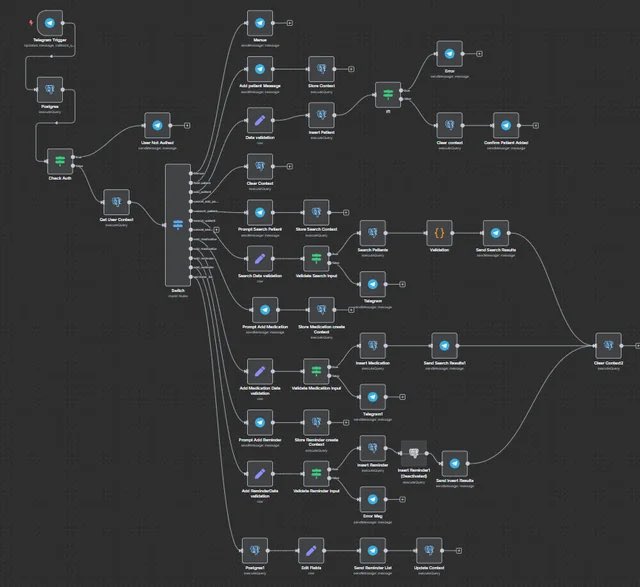
🚀 Automate Instagram, TikTok, X, FB & LinkedIn—zero effort!
From Khulna to Global, I built this AI workflow using n8n + AI Agents + APIs for:
✨ Auto content
📅 Smart scheduling
📊 Analytics
🔁 Cross-posting
Like+comment (SEND)
Repost 🔄& follow✅ if this helps you!
99% of the AI agent tutorials on YouTube are garbage.
I’ve built 47 agents with n8n and Claude.
Here are the 3 prompts that actually work (and make agent-building simple).
Bonus: comment "Agent: and I’ll DM you AI agent system prompt + full guide ↓
Gemini 3 has a capability most people don't even know exists.
it's not the 1M tokens.
it's not the multimodal processing.
it's something else entirely.
And it's the reason I built 3,000+ prompts specifically for Gemini 3.
Everyone talks about Gemini's specs:
→ 1 million token context
→ Native multimodal inputs
→ Deep Think mode
→ Agentic workflows
But they're missing what happens when you combine these features.
The secret is persistent systems thinking.
Gemini 3 doesn't just process large contexts.
It maintains coherent reasoning ACROSS those contexts while simultaneously:
- Analyzing images
- Reading documents
- Planning multi-step workflows
- Adapting based on previous outputs
This creates emergent capabilities that don't exist in other models.
I built 3,000+ prompts that exploit this.
Each prompt is built around this core insight:
Gemini 3's real power isn't WHAT it can process.
It's HOW it connects everything together.
The library includes:
✓ 3,000+ production-ready prompts
✓ Organized by difficulty (beginner → advanced)
✓ Real use cases for each prompt
Like, RT + reply "GEMINI" and I'll DM you the guide.
(Must be following so I can DM)
Skip this and keep wondering why your Gemini results feel the same as ChatGPT.
Or grab the library and start using the capability everyone's missing.
$725 million is the settlement in America - but @facebook@meta was used to directly bombard c. 7 million with 1 billion Facebook ads grossly distorting the truth in the last weeks of #brexit by @Dominic2306 - he credits these ads as crucial see them here https://t.co/lzNwX8XIIA