Is RL optimizing the right objective? 🤔
Should we maximize mean reward? Best-of-k? Which k?
Standard RL pulls on the mean and often the distribution collapses to a spike. The tail dies 🥲
We introduce Tail-Likelihood Reinforcement Learning (TailRL).
It maximizes the mean reward while simultaneously maximizing coverage over high reward outputs.
🧵 1/n
Maximum likelihood has been the principled optimization objective in the past few decades. It is about time we strip down the artificial seperation of pre training, mid training and post training. kudos to my griends on cracking this!!!
Foundation models are trained in stages: pretraining, midtraining, and post-training. But is this separation fundamental?
We introduce unified training: a single algorithm for the full pipeline. This gives
⚙️ Simpler infrastructure
🔬 A framework for better science
(1/n)
Check out ReSYNC!
Robots often fail. ReSYNC not only helps them recover but also discovers concepts to explain and avoid failures during unseen long-horizon tasks.
All of us have experienced existing language models making stuff up and give wrong answers on hard problems.
An important feature of language models is that they know they don't know the answers and verbalize it.
How about we train the language model to do so...
1/ RL for improving task success has made LLMs remarkably capable. But what happens when the model fails? Turns out, training for graceful failure can be surprisingly tricky!
Very excited to share our new paper: Training Language Models to Fail Gracefully
🧵
Check out Schema, new work from @guanningzeng@Zanette_ai and @HavenFeng! It lets frontier LLMs direct their own learning by building and refining an executable theory, testing it against experience, and using it to explore and plan.
On July 15, we released Schema, the first agent harness to reach ~99% RHAE on the ARC-AGI-3 public set.
Today, we’re sharing the full paper and code, with new results and a closer look at why Schema works.
https://t.co/mj4f8cm4uz
On July 15, we released Schema, the first agent harness to reach ~99% RHAE on the ARC-AGI-3 public set.
Today, we’re sharing the full paper and code, with new results and a closer look at why Schema works.
https://t.co/mj4f8cm4uz
Delighted to receive an ✨Outstanding Paper✨ at #COLM2026 for our paper “Message Passing Enables Efficient Reasoning.”
This work was done w Xuecheng Liu, @g_k_swamy and the 🐐 @Zanette_ai
Ask any top image model for "a dog with a purple left ear and a striped tail" and watch it struggle. 🐕
Part-level control is still an open problem for NB2, Flux & co. Our @NeurIPSConf paper tackles it head-on.
Amazing collaboration with @vikataravi@VarghPK@va1bhavagrawal 🙌
Heading to Sydney for #Interspeech2026! 🐨
Excited to present our SOTA universal phone recognition model in the oral session:
Tuesday 29 September - 16:30-18:30 - Area 9 - Oral 1
Code and models: https://t.co/WifEafZOms
@vitransformer excellent visualizer!!, I would recommend to allow for higher trainsteps, something we observed in tailrl and maxrl is that as you increase the num train steps it eventually overtake grpo
Excellent question, the optima of tailrl is still the reward maximizing policy yet the optimization dynamics differ significantly to standard RL. Although in our experiments we have observed higher policy entropy (App.) similar to maxrl, there is no special diversity inducing terms.
Great question, From the perspective of advantage weights, it upweighs rare high-reward rollouts higher which pushes the mean up.
From a gradient decomposition perspective. it is a harmonic mix of Best-of-k gradients which includes Best-of-1 -> mean reward and hence it is upweighted as well.
@ChinmayKak Thank you so much for your appreciation of our work!!!
Please feel free to reach out for any clarifications or feedback on our work!! Happy to help
Great question, this is a function of how noisy your reward function/model is.
If the noise/error is small enough, the tail seeking behaviour of TailRL will result in seeking genuine solutions, under severe noise, this would result in reward hacking being promoted.
This is similar to overfitting in supervised learning when the model capacity is high and the labels have noise, the model can overfit to the noise of the labels and "loss hack" to get a low training loss
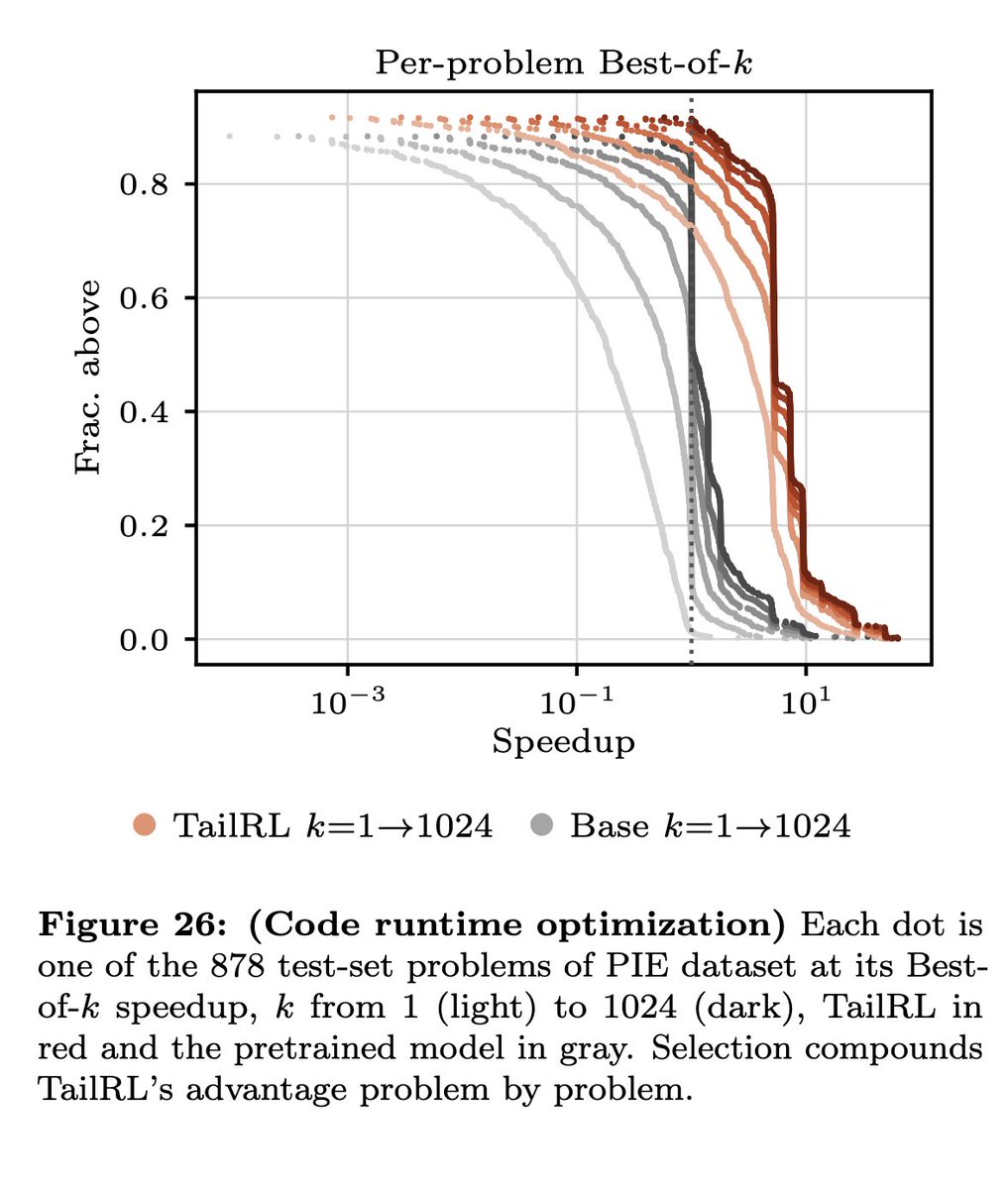
@AIQuanting@rsalakhu Correct, and not just that the entire Best-of-k front shifts with TailRL as we increase sampling compute indicating TailRL does not settle for any other trivial modes either.
Pretrained ViTs like DINOv2 or CLIP are great, but they produce fixed, generic representations that encode the most salient visual concepts (e.g., "cat").
In human vision, prior priming with language changes how people parse an image. We believe visual encoders should do the same
🚨 Introducing Steerable Visual Representations, a new family of visual features you can steer with text towards specific visual concepts.
@stan_yurin There is no explicit selection of a threshold and the implementation is agnostic of the initial policys reward distribution. The objective is avg of log of upper tail probabilities, the averaging is done across all threaholds.
Is RL optimizing the right objective? 🤔
Should we maximize mean reward? Best-of-k? Which k?
Standard RL pulls on the mean and often the distribution collapses to a spike. The tail dies 🥲
We introduce Tail-Likelihood Reinforcement Learning (TailRL).
It maximizes the mean reward while simultaneously maximizing coverage over high reward outputs.
🧵 1/n