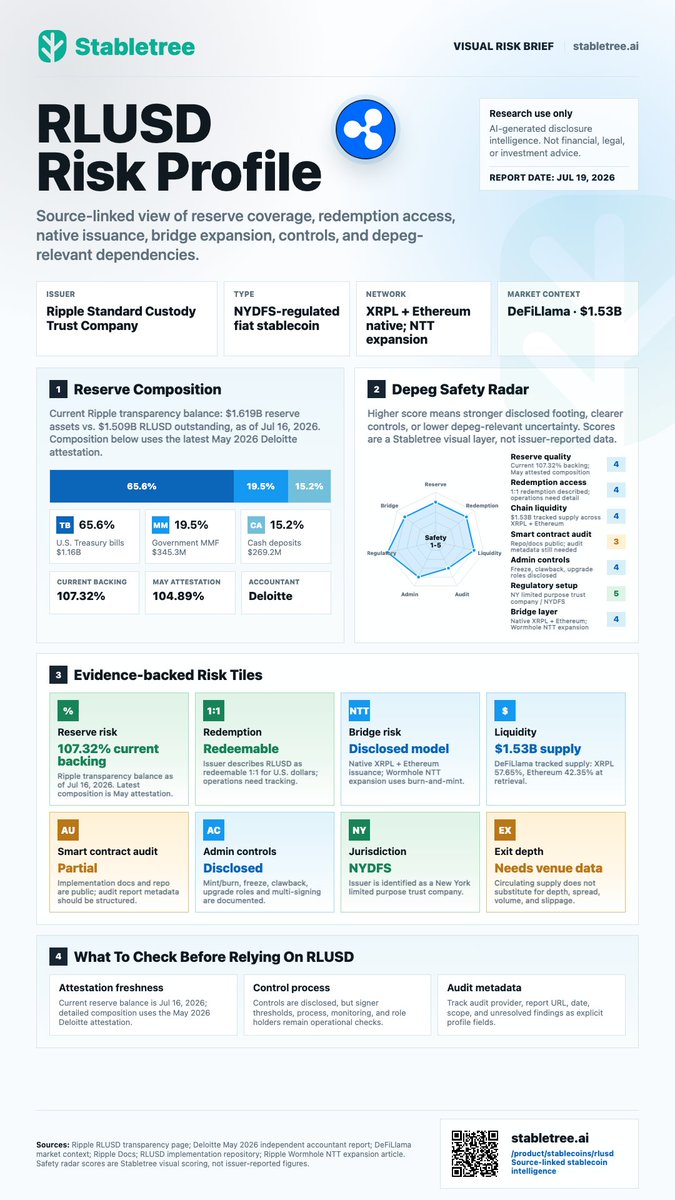
Depeg Safety Radar
Reserve: 4/5
Redemption: 4/5
Liquidity: 4/5
Bridge: 4/5
Smart-contract audit: 3/5
Administrative controls: 4/5
Regulatory: 5/5
Regulatory setup is the clearest dimension. Ripple identifies the issuer as Ripple Standard Custody Trust Company, LLC, a New York limited purpose trust company regulated by the New York Department of Financial Services.
The radar is a disclosure-adjusted safety assessment. Higher scores indicate stronger disclosed footing and lower material uncertainty.
For $RLUSD, the main follow-up fields are audit report metadata, redemption operations, venue-level liquidity, and control-role verification.
Unavailable means sufficient source-linked evidence is not present in the current Stabletree dataset. It does not mean failure has occurred.
Full profile:
https://t.co/TykulLdWyV
Bridge, contract, and control surface
Bridge layer: 4/5
Ripple docs describe native $RLUSD issuance on XRP Ledger and Ethereum. Ripple also announced expansion to additional chains through Wormhole's NTT standard, including a burn-and-mint model. This gives the bridge layer more disclosed structure than an unidentified wrapper.
Smart-contract audit: 3/5
Ripple publishes RLUSD implementation documentation and a public implementation repository. However, Stabletree should still track independent audit provider, report URL, report date, scope, and unresolved findings as dedicated fields before treating audit assurance as complete.
Administrative controls: 4/5
The Ethereum design discloses minting, burning, individual freeze, global freeze, clawback, upgrade roles, internal role administration, and multi-signing. XRPL settings also disclose GlobalFreeze and AllowTrustLineClawback. The score is not 5/5 because the existence of disclosed controls still leaves role-holder, threshold, process, and monitoring details to verify.
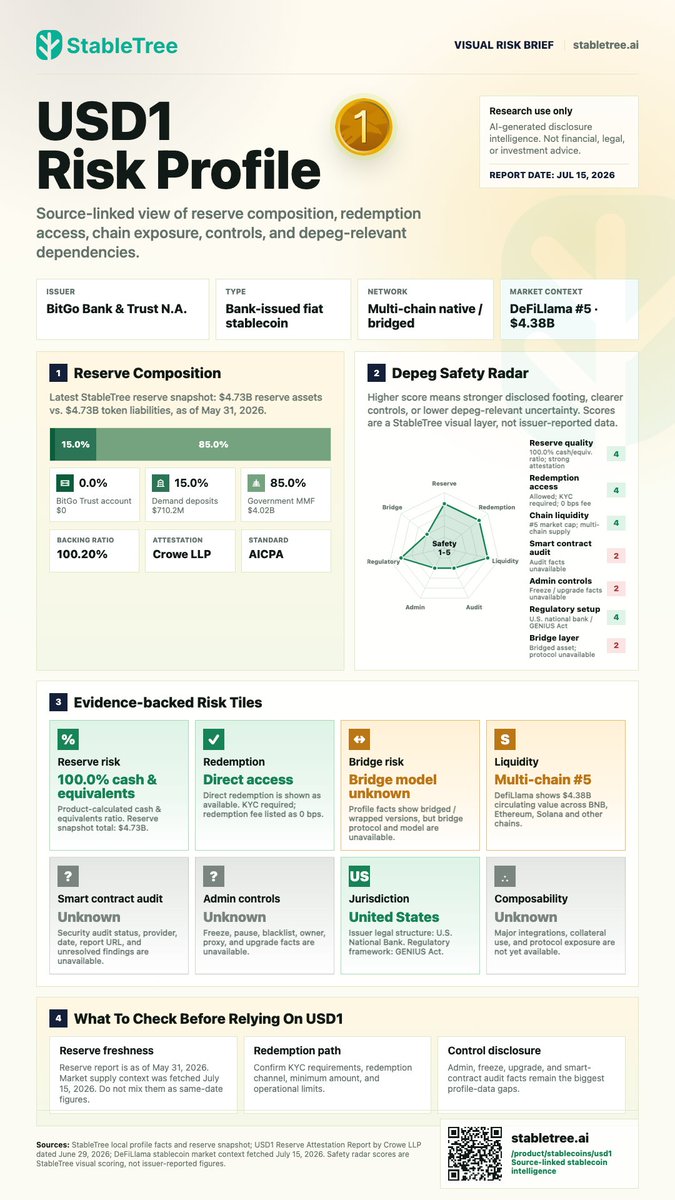
Depeg Safety Radar
Reserve: 4/5
Redemption: 4/5
Liquidity: 4/5
Regulatory: 4/5
Bridge: 2/5
Smart-contract audit: 2/5
Administrative controls: 2/5
StableTree identifies the issuer as BitGo Bank & Trust, National Association (@BitGo), with the United States as jurisdiction and the GENIUS Act as the applicable framework in the current profile.
The radar is a disclosure-adjusted safety assessment. Higher scores indicate stronger disclosed footing and lower material uncertainty.
Unavailable means sufficient source-linked evidence is not present in the current StableTree dataset. It does not mean failure has occurred.
Full profile:
https://t.co/YflFL04lkW
Main disclosure gaps
Bridge layer: 2/5
USD1 has bridged or wrapped availability, but the current profile does not yet provide enough bridge-layer evidence: protocol, documentation, canonical chain, contract addresses, and asset movement model.
Smart-contract audit: 2/5
Token-contract audit status, provider, report URL, and unresolved findings are unavailable. The reserve attestation is not a contract security audit.
Administrative controls: 2/5
Freeze, pause, blacklist, proxy, upgrade, owner, multisig, and mint/burn administration fields are unavailable.
These scores reflect missing source-linked evidence, not confirmed failure.
USDGO Risk Profile is delivered🌿
New reserve and attestation data is now reflected on StableTree:
https://t.co/jIRac4W6uF
Latest snapshot:
• Reserve assets: $324.8M
• Token liabilities: $323.5M
• Backing ratio: 100.41%
• Report date: May 31, 2026
• Attestation: Deloitte
• Cash & equivalents ratio: 100.0%
What matters for risk teams:
1. Reserve structure
USDGO shows full cash & equivalents coverage by StableTree’s computed ratio, with reserve assets above token liabilities in the latest snapshot.
2. Redemption path
Direct redemption is listed as available, but eligibility is institutional and KYC-based.
3. Chain / liquidity exposure
USDGO supply is currently shown as Solana-native. Venue depth remains a key item to verify before relying on secondary-market exits.
4. Smart contract & admin controls
Smart contract audit status and admin control facts remain unavailable in the current profile data.
5. Jurisdiction / regulatory setup
Issuer: Anchorage Digital Bank N.A.
Legal / regulatory context: U.S. national bank / GENIUS Act framework.
StableTree’s Depeg Safety Radar maps USDGO across reserve quality, redemption access, liquidity, audit status, admin controls, regulation, and bridge exposure.
This is not a price call.
It is a source-linked stablecoin risk profile built from issuer disclosures, reserve reports, market data, and profile facts.
Full profile:
https://t.co/jIRac4W6uF
#Stablecoins #USDGO $USDGO #Solana #Anchorage #Deloitte
New on Stabletree: Profile facts.
Stablecoin pages now include a source-backed map of issuer context, redemption access, attestation and audit signals, smart-contract audit facts, and cross-chain profile data.
Start with USDG:
https://t.co/nMxD1YNZ11
#Stablecoins#RWA #DeFiRisk
Our read for now:
Open USD is important because it proposes a different stablecoin model:
shared economics, collaborative governance, and broad enterprise distribution.
But it is still pre-launch.
StableTree will track the parts that matter for risk assessment once they become public:
reserve composition, custody, attestations, redemption terms, and legal structure.
Open USD is a pre-launch stablecoin announcement worth tracking.
The partner network is notable.
But at this stage, the key reserve questions are still open:
- What assets will back OUSD?
- Which institutions will hold the reserves?
- What disclosure format will be used?
- Will there be recurring attestations?
- How will minting and redemption work in stress?
- What legal protections will users and partners have?
This is not a criticism.
It is the normal due diligence checklist for any new stablecoin before it becomes live, integrated, or listed.
Stabletree starts from official issuer disclosures and turns them into source-linked reserve intelligence.
Our goal is not to tell users what to buy.
It is to make disclosures easier to inspect, compare, and question.
Built for research and transparency, not financial advice.
Actually You Know, meticulously crafted by @LongTreeLabs, invites genuine frontline participants to break down the industry structures that are currently unfolding but have yet to be clearly explained.
Actually You Know.
Because you can.
https://t.co/pQ4sn11vSS
🌲 Built for real-world payments, @Stable is a USDT-native Layer 1 blockchain designed for everyday global transactions—powered by USDT as native gas.
Watch host kayla chat with Stable CEO @mehler on balancing compliance and DevEx in our latest "Actually You Know" episode. 🎥👇
🎉 Congrats to @AEON_Community on raising $8M led by YZi Labs!
💡 User interaction is shifting from web & apps to AI Agents.
✅ The payment layer is only becoming more important.
🌲$1M+/month in AI Agent settlement volume on BNB Chain — how?
ft. Eddie | Actually You Know #Web3Festival
🔥 AEON, BNB Chain's largest AI payment facilitator and a digital currency settlement layer, connects 40M+ real-world merchants, enabling both users and AI Agents to settle on-chain funds directly with offline merchants.
Catch our host @kaylawangnow’s quick-fire interview with @AEON_Community CEO @EdyGoOH.
📢 User interaction is shifting from websites & apps to AI Agents
💡 The importance of a robust, real-world payment layer will only keep growing 📈
🌲Bancor: AI Agents Are Becoming the Next Generation of DeFi Users | ft. Mark | Actually You Know
💡AI Agents are becoming a class of users that are easier to onboard, hold greater potential, and are inherently more compatible with DeFi protocols than humans.
In this episode of Actually You Know, Kayla @kaylawangnow sits down with @Bancor Project Lead @MBRichardson87.
As one of the most established projects in DeFi history, Bancor pioneered the widely-used AMM mechanism back in 2017.
Tune in for a deep dive into their practical insights and future strategies for DeFi protocols in the era of AI Agents. 👇