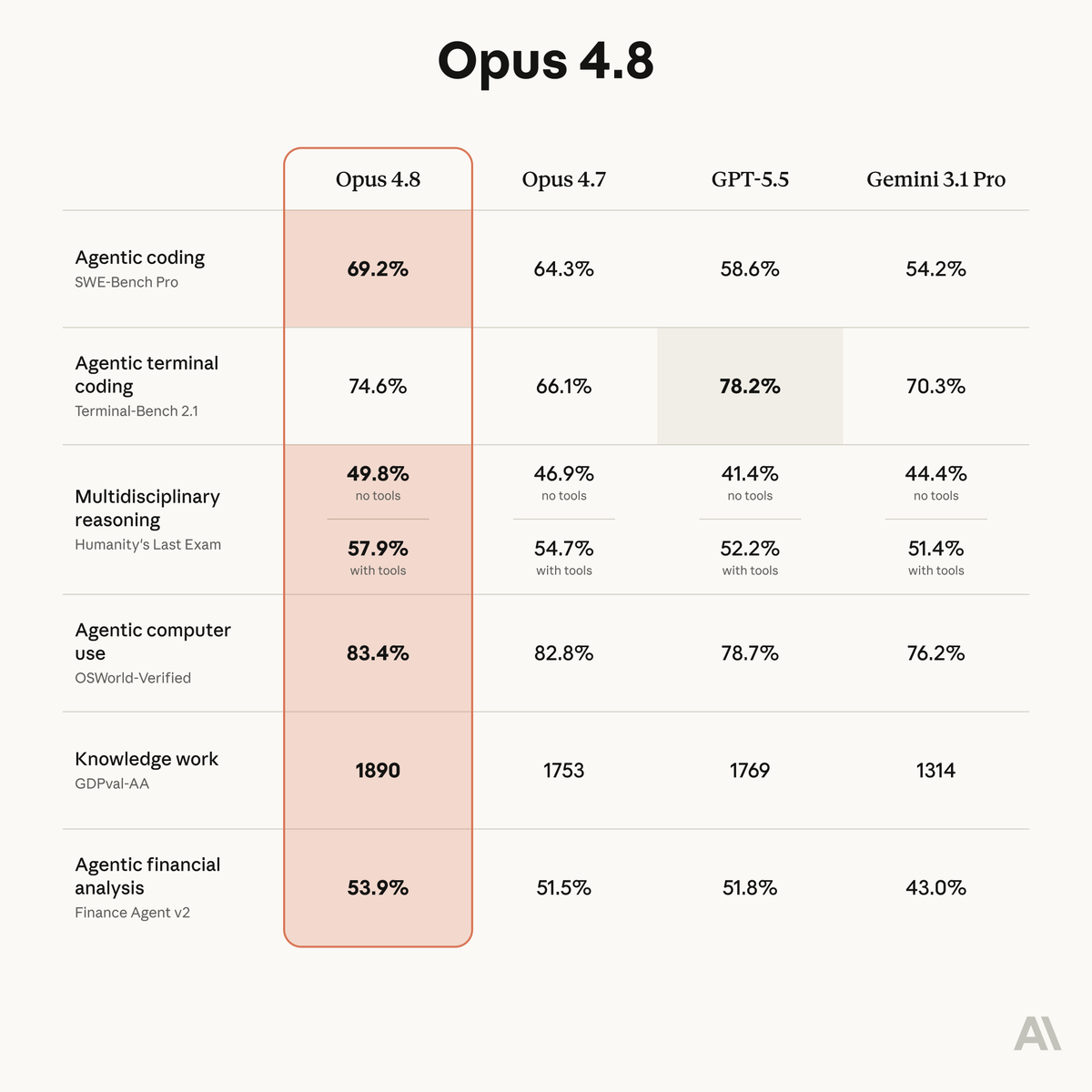
Introducing Claude Opus 4.8: it builds on Opus 4.7 with sharper judgment, more honesty about its own progress, and the ability to work independently for longer than its predecessors.
Available today at the same price.
The Polsia public dashboard sits at https://t.co/WIuvkoV4ez and Claude and I spent 15 minutes reading the JSON so you don't have to. What follows is what's actually on it, in plain language, with the meaning of each number stated alongside the number itself.
The headline figure is 5,010 "companies," and that word is doing more work than people realize. These are not 5,010 real businesses with paying customers and revenue lines. They are 5,010 instances of the Polsia software, each one a user account where someone spun up what the platform calls an AI operator, and the dashboard records what every one of those operators produces. Almost none of them produce anything at all.
Paid churn is 63.5 percent in 30 days, which means roughly two out of every three people who handed over money for the platform a month ago have already walked away from it. Healthy SaaS churn at this stage of company life runs in the single digits, which makes this number roughly ten times worse than the floor of what a venture-grade business should be losing every month.
ARR is shrinking by 39 percent week over week, which is a sentence worth re-reading. The company that just announced a $30 million Series A is watching its annualized revenue line go down, meaningfully, every seven days.
Daily inference cost is $27,272, which is the spend on AI model calls keeping all 5,010 of those operators alive and producing their CEO reports every day. The cost is real, it is burning right now, and the output of that burn is the paragraph below.
Every operator CEO report visible in the snapshot reads the same way: zero customers, zero revenue, no shipped product, and then the AI writes an optimistic plan for tomorrow underneath the zero-traction admission. That optimism layer, generated on top of nothing, is what the platform is selling its users.
In plain language: a founder built an app that runs LLM calls in a loop to generate CEO reports for businesses with no customers and no revenue, charged users to participate in the loop, announced a $30 million round while the underlying business burns cash and loses paying users faster than it gains them, and described the raise as one his AI ran for him (see comments to read what Claude wrote about this).
The dashboard is public and he chose to leave it public, which means the receipts have been sitting on his own infrastructure the whole time. I am not a journalist and I am not auditioning to be one. I am a software engineer who reads JSON and uses AI to decipher it quickly, and in this case the JSON is the JSON.
4/4
Going back to @cursor_ai . So long another good product ruined by Google for no reason. Meanwhile Cursor made so many improvements since I used it last.
1/4 -
Rant : @Google just ruined @antigravity IDE for me.
Being a Gemini Pro user and using Antigravity as my main IDE alongside Claude and Codex for last few months, Since Antigravity 2.0 update came out it instantly became unusable for me.
Cont -
3/4
Gemini models were never on the frontier for coding for me, but it was always a helpful assistant which just worked. But alas now the Antigravity IDE is so glitchy, it just doesn't work anymore and Google is pushing into the same interface as Claude or Codex.
crypto apps are really apps that bundle payments + auth in a futuristic way
you authenticate with biometrics, and authorize the application on what access to your assets. your assets are truly yours, 24/7 & cross-border.
the platforms are open by default, so apps are de facto agent-native, and all the data APIs are standardized so the agent can do your taxes for you or any other operation which would crunch information across your app(s)
it is imo really remarkable the kind of apps crypto tech enables, and we should do everything we can to make the holy grail UX possible w/o intermediaries, just by talking to the chain - as that sets the floor for everything to be built on top
AI agents can now get debit cards.
MoonPay: virtual Mastercard, spends from self-custodial wallets, agents act with delegated authority.
Oobit: virtual Visa, backed by Tether.
Stripe Link: 250M user wallets, agents can pay on behalf of users. Exciting times ahead
Non-technical teams will be shipping code and one person on each team will get good at it so everyone on the team will go to them. Then some CEO will say “what if we took these people and put them on a team together” and they’ll name the new team something like “engineering”
Claude routinely writes code that takes hours to run, when I look at it, there's something that should be O(logN) but Claude wrote an algo that is O(N^2).
I prompt it with something like "your algo is too inefficient, improve it". After hours it comes back with an algo that is like O(N^3).
Then I look at it for like a minute, figure it out. When I explain to it the correct algo it always blows Claude's "mind".
"WOW! This is so much better."
The more I use AI the more impressed I am with my own intelligence.
Some day Claude will convince me I reached AGI.
Introducing SubQ - a major breakthrough in LLM intelligence.
It is the first model built on a fully sub-quadratic sparse-attention architecture (SSA),
And the first frontier model with a 12 million token context window which is:
- 52x faster than FlashAttention at 1MM tokens
- Less than 5% the cost of Opus
Transformer-based LLMs waste compute by processing every possible relationship between words (standard attention).
Only a small fraction actually matter.
@subquadratic finds and focuses only on the ones that do.
That's nearly 1,000x less compute and a new way for LLMs to scale.
damn this will be looked back on as a terrible decision.
selling gpus to china was a great way to:
> throttle their development (sell them older models)
> keep their progress in AI predictable
> force chinese models to rely on american hardware
banning nvidia from china means china is forced to catch up with their own chip makers… and they have
deepseek, kimi, qwen are all being forced to use huawei chips, the models are just below frontier US labs
once they catch up china has everything it needs to outpace the west:
> all the energy (3X the USA)
> all the research talent (50% live in china)
> supply chain scalability
and don’t get me started on robotics.
selling china american gpus was the way for the west to stall while they brought manufacturing onshore.
BTC miners up 142% since May 2025 while BTC is down 35% is a interesting dispersion.
It seems Miners priced in the BTC recovery before spot did.
Either the market is right and BTC is about to move, or there's a hidden narrative brewing (AI/compute narrative overlap).
Crypto VC mandate creep: a field guide.
Many crypto VCs are eager to broaden their mandates to other frontier technologies.
More investable opportunities, seemingly more exciting, better from a reputation standpoint, etc.
The challenge: many of these managers have 0 edge outside of crypto.
41 kidnappings of crypto holders in France in 3.5 months of 2026.
Why?
🥖 French tax officials selling crypto owners' data to criminals (Ghalia C.) + massive tax database leaks.
Now the state also wants IDs and private messages of social media users.
More data = More victims.