Looking back over the past 5 years here at @STARLing_lab, we see a tree that has remained steadfast, growing stronger with each passing season. Many of our incredible members have moved on to build their own nests, while new minds have joined us, bringing new perspectives and energy. Thanks to all of their efforts, we've achieved remarkable milestones in these 5 years — publishing over 75 papers and gathering 2500+ citations across diverse fields spanning Human-Allied AI, Precision Health, Probabilistic Modeling, and Reinforcement Learning.
As we kick off the new academic year, we’re thankful for what has been and excited for what lies ahead. Here’s to a journey of never-ending growth, learning, and discoveries!
Interested in learning how to build generative models that can reason probabilistically? Checkout our @IJCAIconf survey paper on Building Expressive and Tractable Probabilistic Generative Models!
Joint work with the amazing @Sriraam_UTD@STARLing_lab .
https://t.co/0NG9dQVAI2
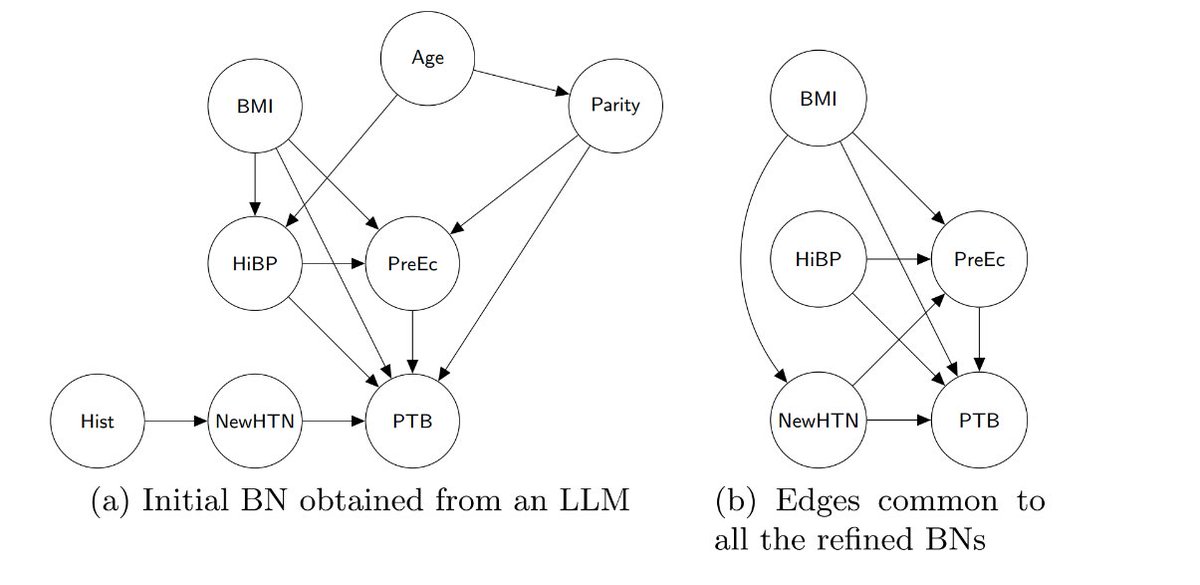
In prior work, we argued that LLMs recite causal knowledge embedded in the data. At #AIME2024, we now show how to combine this with structure learning and dedicated new data to induce medical models!
Causal Parrots 👉 https://t.co/RWBTzOyztR
AIME 👉 https://t.co/DTo12ba3pd
Humbled and honored to be recognized for my efforts in teaching by the President's award for excellence in graduate teaching and professional education! This is dedicated to ALL my students in my ML and AI classes in the past 13+ years.
Our work on learning Bayesian Networks to model adverse pregnancy outcomes from diverse data sources has been accepted to AIME 2024 (#AIME2024)! :
Preprint: https://t.co/FA9U63qnus
Code: https://t.co/SuWX1132eV
While sum-product networks guarantee tractable inference, their internal nodes don't correspond to any observable variable. This makes them hard to explain. We use 30 year old work on context specific independence to propose a new data structure & use it to explain SPNs #PGM2022
Glad I had the opportunity to present our work on explaining sum-product networks using a tree-structured representation of context-specific independencies encoded by the SPN. Thanks to @mathursaurabh96, Dr. David Haas, @pedjagogue, @kerstingAIML and my advisor @Sriraam_UTD.
The RePReL framework is a fusion of high-level symbolic reasoning with lower level signal-based learning. It constructs effective task-specific abstractions to accelerate learning in structured domains. https://t.co/RuVj7Av6SF
Happy to share that our work on learning to act in domains with structured and unstructured (hybrid) data, Hybrid Deep RePReL, is now accepted at the IEEE FUSION 2022.
Nikhilesh Prabhakar, @ravi_iitm, Erik Blasch, Prasad Tadepalli, @Sriraam_UTD, @STARLing_lab
One of the small pleasures of being an academic is taking out the lab for lunches and having wonderful discussions. The pandemic had taken that out of the equation. We finally, had our first lab lunch in 2 years. @STARLing_lab@harsha_kokel
The CLeaR (https://t.co/GxLajdL6Wu) workshop will start soon (Feb 28th, 8:45 am EST), check out our exciting schedule, excellent diverse speakers, and papers. Join us if you are at AAAI-2022! @RealAAAI, #AAAI2022, @hfaghihi15, @Sriraam_UTD , @sebdumancic, @H_Karimian,@GaryMarcus
The fellows, Dr Srinivasan Parthasarathy, Dr Sriraam Natarajan, Dr Krithi Ramamritham will engage in long-term collaborations with the Centre, by inspiring, mentoring and initiating meaningful collaborations. Good luck to all of them & #IITMadras.
https://t.co/6cvopbvBD4
AAAI is delighted to announce the elevation of these nine members to the AAAI Senior Member status. The 2021 cohort made significant contributions to multiple areas of #AI. They come from both academic and industrial labs in multiple continents. Congratulations!🥳