Their data aggregation and means of ontology is a strong moat. Could Fable build the application layer and parts of a synthetic dataset -- yes. Could it build a clone of Palantir -- no. That takes significant resources, trust, expertise that takes time to aggregate and build. Their moat is real. The opportunity is to do it in other ecosystems. It needs to be done in other ecosystems.
That's totally fair. But you could also say that about the entire AI era. There are more unknowns than knowns about how AI will play out. What will the frontier labs choose to do on IP ownership? What regulation is coming? How will AI vs. individual rights play out? So in terms of supply chain risk, there are many. I agree with your point but I also think some of those risks are offset with open weights models. The most important thing for enterprises today is mitigating the risks as much as possible today - ensure AI is safe, accurate, and compliant - and take a proactive approach to implementation across the organization.
Legacy Media types are calling this Alex Karp interview a “crash-out” so that’s your first clue that he is actually saying something extremely insightful. He is articulating what real “AI safety” looks like in the enterprise.
Not abstract alignment research or certification by a government-run DMV for AI. Real AI safety for businesses is the ability to control their own data, model weights, and compute — so a frontier lab can’t hoover up their proprietary knowledge and turn it into their next product.
As Karp explains, technical customers want “control over their compute, their models, their data stack, and their alpha. They want to know they own the means of production, and it’s not being transferred to someone else.”
Don’t think that can happen? Just look at Figma. According to The Information, Anthropic “blindsided” its then-business partner with the launch of Claude Design. Figma’s founder said Anthropic had not been “consistently honest” with them. Anthropic’s chief product officer had even served on Figma’s board until three days before the launch of Claude Design. Figma’s stock has fallen sharply this year while Anthropic’s valuation has surged.
This isn’t an isolated example. Anthropic has launched Claude Science, Claude Security, Claude Legal, and of course Claude Code — each expanding into categories previously served by companies building on top of their models. The pattern is consistent: watch where value is being created, then move in directly. Dominate the model layer, then use that position to capture the most lucrative verticals.
Dario has argued that open source models powerful enough to compete with Anthropic are “dangerous.” But dangerous to whom? Not to enterprises that want to retain control over their data and workflows. Dangerous to a business model that benefits from customers having few real alternatives at the model layer.
As Karp exposes, true enterprise safety isn’t trusting that a lab’s future roadmap won’t include your business. It’s retaining the ability to choose — at the model layer — who gets to see and use your alpha.
For the record, I’m not endorsing Chinese models by any stretch. I’m very much a fan of American-made AI models for a number of reasons but it is important for leaders of corporations to know how this technology really works so they can make the best decisions for their organizations.
Companies are making a lot of bad decisions because of executives who have no idea how this technology works. Painful but I see it every day. And I’m not too sure that the next generation is being educated to solve the problem. There will be a small percentage of young people with a really big opportunity just because they chose to go and figure it out themselves.
Im not sure if by foreign you mean actually foreign or if you’re just referring to AI as a whole but given the context I’ll assume the former. No companies I know are using Chinese controlled or Chinese hosted versions of the models. They are all hosted in American-owned data centers and can even be air gapped to prove there’s no backdooring of data. Then you might say well how do we know they are good enough to trust with our business decisions/processes/outcomes in which case I would say you have to ask that of any AI models and that’s where a great application layer and implementation strategy is required. This is all exactly why Palantir is getting paid so much to do this for war organizations.
Palantir CEO Alex Karp on what customers actually want, the real business of frontier labs, and the importance of open source models:
“What the technical customers want is control over their compute, their models, their data stack, and their alpha. They want to know they own the means of production, and it's not being transferred to someone else.”
"Who owns the data? Are the prompts secure? Is this being transferred to you?"
"If it was so valuable, and I can make you a billion dollars, wouldn't I say I'll make you a billion dollars and I want 30%? Why are they charging for tokens if it's so valuable?"
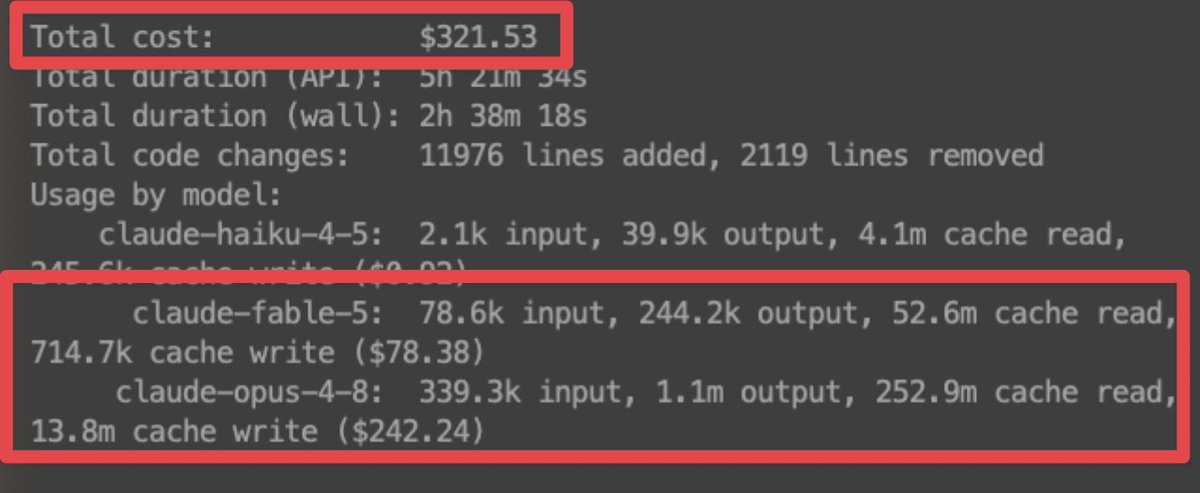
I just paid $321 for a coding session where Fable 5 refused to do the work.
Here is where the work actually went:
Fable 5: $78
Opus 4.8: $242
75% of the session got routed to Opus because the new classifiers kept flagging routine coding work as cybersecurity risk.
The model I chose did a quarter of the job.
The fallback did the rest.
Anthropic said a small fraction of tasks would fall back.
My receipts say otherwise.
"At this very moment China is giving its AI technology away.
It's releasing open-weight AI models that are cheap, capable, and they're fast becoming the world's default."
We can overcome this. @neil_chilson testified before @HouseCommerce@EnergyCommerce today to explain how.
Alex Karp: enterprises are unhappy with the frontier labs
The application layer that makes the LLM safe, useful, and precise is what makes the LLM valuable.
In other words: the frontier labs need the enterprise application layers but the frontier labs are eroding trust of the enterprises as they blur the lines of IP while charging premiums for token consumption.
My friend Dr. Tyler VanderWeele and the team at @HFHarvard continue to be among the world’s strongest champions and producers of rigorous research on human flourishing and human values.
The AI community still has much to learn from VanderWeele’s work. As we build more powerful systems, we need a clearer understanding of what human flourishing actually requires, not just what technology can optimize.
Their research continues to prove the undeniable link between America's founding values and what contributes greatest to our flourishing.
AI is not perfect but neither are humans.
We can’t pretend either one can operate without error but when there’s an opportunity to build systems where human judgment and AI capability compensate for each other’s weaknesses, we must be judgmental of anything that falls short of that reality.
If we solve governance, auditability, escalation, and accountability well, we can get much closer to reliable decision-making than either humans or models can achieve alone.
8090 will not be the last company built around this problem. It may be one of the first signs of a much larger category.
“That makes the round feel less like a meme and more like a serious breakout candidate with a very high weirdness tax. It also puts 8090 in the same broad economic weather system as the cloud-landlord phase of AI: sooner or later, the glamorous layer cashes out into governance, infrastructure, and invoices large enough to gain personality.
My verdict is that 8090 looks smarter than the average giant AI round and more fragile than its rhetoric would prefer. The product thesis is coherent. The buyer pain is real. The capital intensity is not a side note; it is the plot. If this works, it could become one of the more important enterprise wrappers around coding agents. If it fails, it will fail in the most 2026 way imaginable: beautifully governed, strategically ambitious, and buried under a mountain of tokens, controls, and meeting invites.”
@quxiaoyin@BillAckman Mostly agree here but Google still has the edge with not relying on other people’s chips. Elon’s compute is almost entirely dependent on Nvidia.