3/ The Rise of Super Apps.
Super apps didn't work pretty well in the US. Elon Musk is building X as a super app. So there is a lot to witness in the US markets in the future.
But super apps worked really well in some Asian countries. Super apps brand themselves as a "one-stop solution," which incorporates different services into one platform or app.
The idea of super apps became popular because of the huge success of WeChat in China.
Grab's moat is its positioning as a super app.
Grab operates a super app ecosystem integrating ride-hailing, food delivery (GrabFood), digital payments (GrabPay), financial services (GrabInsure, GXS Bank), and logistics (GrabExpress). Its platform connects over 35 million monthly active users with 2.8 million drivers and merchants across eight Southeast Asian countries.
One of our team members has advised policies to a South Asian country. One of the biggest challenges he faced in his country was banking the huge unbanked population.
Most people in the Southeast and South Asia region do not even have a bank account. That's where the FinTech revolution comes in.
Various FinTech companies have been massively successful in these countries only because they simplify user onboarding and transfer of money.
And Grab has digital banks!
We will publish our signals 📡 in detail pretty soon.
2/ The bullish public sentiment surrounding $GRAB may cause worries among some investors about whether the stock is overhyped.
How do we look at this? Our analysis says Grab's fundamentals are pretty strong.
This is the company that beat $UBER in its own game. Uber had to shut down its operations in Southeast Asia and sold its Southeast Asian operations - including ride-hailing and UberEats - to Grab in exchange for a 27.5% stake in Grab and a board seat.
Toyota, SoftBank, BlackRock, and Ray Dalio have invested in $GRAB.
1/ Before we publish our signals 📡 on $GRAB, we felt it's important to touch base right now so that you can stay ahead of the market. Here's a "big picture" overview of $GRAB:
A friend of one of our team members had to attend a policy conference in Malaysia. Before she traveled from Bangladesh (where Grab is not operational), she downloaded the app on her phone and jumped on the plane to Malaysia.
Grab's mobile app is ranking 46th in the "travel" category in the US App Store.
This is super important because Grab is not operational in the US. So how can an app, without being operational in a country, get so many users or general attention?
This is primarily because the countries Grab is operational in right now are tourist destinations, along with their business and other significance.
Grab operates in 500+ cities across 8 Southeast Asian countries: Singapore, Malaysia, Indonesia, the Philippines, Thailand, Vietnam, Myanmar, and Cambodia. All these nations are established tourist destinations.
- Singapore attracted over 19 million visitors in 2024, driven by its reputation as a safe, clean, and efficient destination.
- Tourists visit Kuala Lumpur, Penang, and Borneo (Sabah) in Malaysia. Ecotourism is rising, with destinations like Taman Negara National Park gaining traction for biodiversity tours.
- Post-pandemic recovery saw Bali’s (Indonesia) tourism surge by 40% in 2024, driven by digital nomad visas and wellness tourism.
- Thailand remains Southeast Asia’s most visited country, with 35 million tourists in 2024.
- Visa exemptions for European travelers and expanded flight routes increased 2024 arrivals by 25% in Vietnam.
Every time a tourist visits any of these 8 countries, they download Grab on their phones in most cases. That explains Grab's rank in the US App Store.
In contrast, let's revisit what our @albd1971 government has accomplished in the last couple of years despite the prevalence of religious extremism 👇
1. Elimination of VAT & Tax on Imported Raw Materials Required for Manufacturing Sanitary Napkins.
@ALBDMedia
At the Amar Ekushey Boi Mela (Bangladesh's main annual book fair), two stalls promoting menstrual hygiene awareness were forced to remove products like sanitary napkins after objections from a group claiming they were “indecent.”
Fearing a mob situation, event organizers complied, and Bangla Academy, rather than defending public health, used a technicality to shut them down.
This isn’t new. The same fair saw a radical mob attack a stall for displaying a book by feminist and secular writer Taslima Nasreen. A writer was assaulted, yet Bangla Academy stayed silent - then banned the book and shut the stall down instead.
#BangladeshCrisis #PublicHealth #Terrorism
@paulocasaca1@theAshleyMolly@realDonaldTrump@elonmusk@TulsiGabbard@State_SCA@StateDRL@UtsavSanduja
The only thing left for these extremists to do is to restrict women’s access to the book fair!
Read my article and/or the thread below to see how the interim government in Bangladesh is providing a safe haven for radicals. 🧵👇
https://t.co/D1mZ1b3PhN
I will soon share my in-depth analysis on $GRAB, $BABA, and $TEM.
I have 10-20 pages long research on all of my investment picks. Would love to share the insights with the world in a more digestible way and how I made the investment decisions.
Note: This is not investment advice.
Super apps haven’t really taken off yet in Bangladesh. I am excited to see whether companies succeed in building a super app like $GRAB or WeChat in Bangladesh.
I am also excited to see whether super apps succeed in the U.S. X is working on building one, and I think X has the potential to become a super app. Let’s see!
12/12
Secretary of Bangladesh Islami Chhatra Shibir’s University of Dhaka Unit, S M Farhad, stated in a public event:
"Whenever I see Asif Bhai (SAD Coordinator and currently Adviser in Yunus-led Interim Govt), I am reminded of one incident. When the quota movement was losing its steam, he came to our house and drew a map discussing which 5/6 points around Ganabhaban needed to fall for us to take over the establishment. I still have that map preserved with care. In that paper all the points which needed to be captured are drawn."
🔍 Assessment
The recent revelations from multiple SAD coordinators, BNP, and Shibir leaders made it evident that in so many cases the preconditions of self-defense were absent. Instead, violence, arson attacks, destruction of both public and private property, lynchings, and killings were an integral part of the movement aimed at unseating a constitutionally elected government.
11/12
Hasib Al Islam, one of the student movement coordinators, said that
"The revolution would not have been achieved easily if the metro rail had not been set on fire and the police had not been killed. We call it a revolution or a mass uprising, no matter what we call it, it did not follow any constitutional rules, it did not follow the law. If we had followed the law, then these revolutions would not have happened.”
🔍 Assessment
As one of the coordinators takes credit for the attack on the police and metro rail, we can reasonably conclude that the Students Against Discrimination (SAD) group didn’t carry out these acts in self-defense; instead, they killed police and set fire to metro rail with the intent to destabilize Bangladesh.
10/ 12
One of the leaders of the far-right Islamist political party publicly admitted that they killed the police officers of Enayetpur Police Station.
"The people of Bangladesh know that we killed the police officers of Enayetpur Police Station. We, the Tawhidi citizens, attacked the station, resulting in the deaths of 17 police officers. We also lost four young men from Enayetpur, who embraced Shahadat.”
🔍 Assessment
According to the statement, it is evident that radical groups also participated along with BNP in the police killings of Enayetpur.
As the perpetrators are disclosing their crimes and bragging about their "accomplishments” in killing law enforcers, legal actions must be taken by the interim government instead of citing “self-defense to absolve them from their crimes against humanity.
9/12
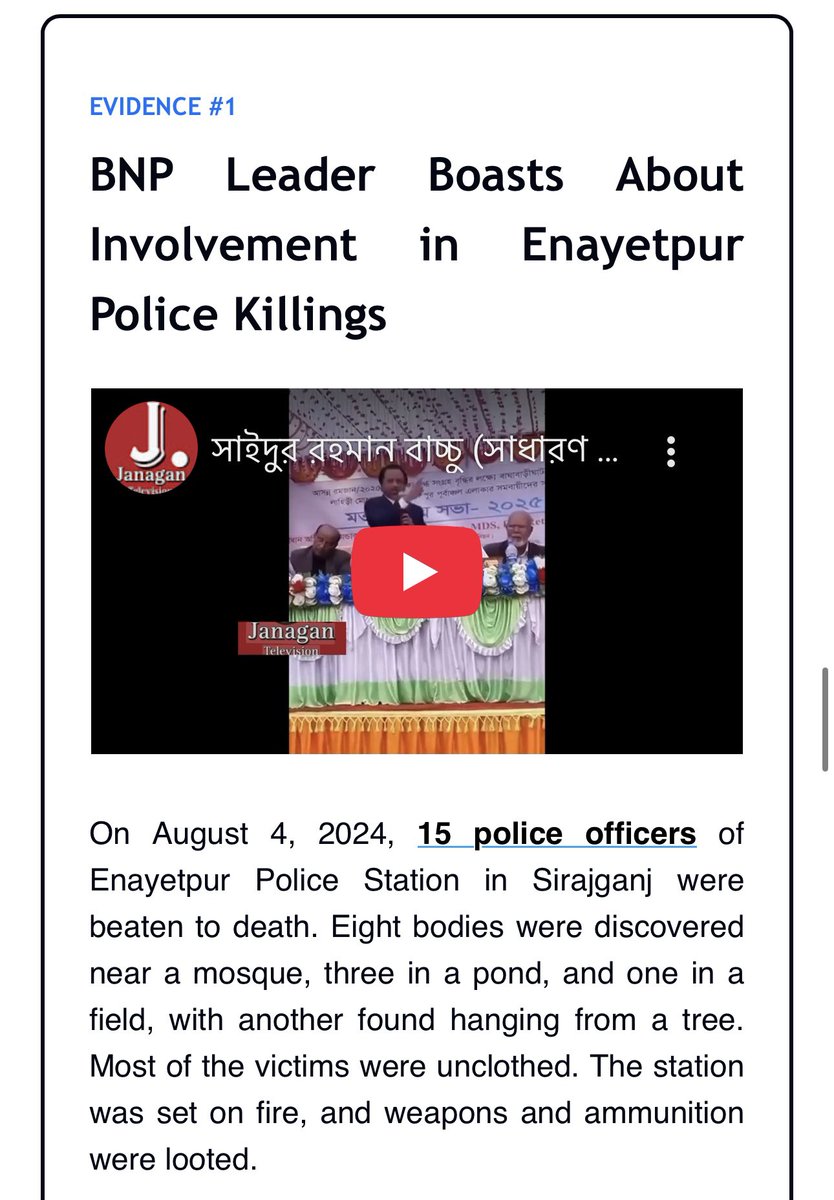
BNP's Sirajganj District Unit General Secretary Saidur Rahman Bachchu bragged about BNP’s pivotal role in the brutal police killings of Enayetpur:
"During the quota movement, if 15 police officers were not killed in Sirajganj's Enayetpur, then the morale of police across the nation would not have been broken... In Sirajganj, what we did destroyed the backbone of the police and strengthened the movement".
🔍 Assessment
A large crowd led by BNP (as substantiated by Saidur Rahman Bacchu) attacked police officers who were performing their legal duties in the police station and did not pose any threat to any protester.
Therefore, this event cannot be considered “self-defense,” and the perpetrators should be prosecuted instead of offering them immunity. Despite Bacchu’s confession, no legal action has been taken by the interim government.