After six years, NFTfi is winding down.
When I was 20 I had to pick a path in life. Coder or artist? Ultimately I chose coding. When I first heard about NFTs in 2019 I realized I could combine those two paths into a single project, @NFTfi. I was all in.
In the six years since, this project has been my sole focus. In the early days I was the first lender and learnt a number of painful (and expensive) lessons on how to lend against NFTs safely. I still own Founder Kitty #72 that I got in a default for the low, low price of 30 ETH. The Meebit I use as my profile picture was minted in a hospital chair watching my sleeping wife and first born hours after his birth.
Together, we helped pave the way for the NFT lending industry. From doing the first fully trustless on-chain NFT backed loan to facilitating more than $730 million in peer-to-peer loans. Without losing a single NFT. In an industry that often struggled with trust, that's something I'm incredibly proud of.
In the end, the market that made NFTfi possible, became too small to support the company we had built.
What pulled me into this was never the promise of profit. It was the possibility that artists and collectors could truly own the things they cared about. I still believe that matters.
Looking back there are some things I would do differently. However, if I had to go back to 2019, I would do it all again. What we had as a community in that moment will stay with me.
To my co-founders, Jonathan, Mads and Charlotte and the team who built NFTfi, from the first year to the last: you gave years of your lives, your craft, and your belief to this project. You took a chance on an idea that was never guaranteed to work and built something real alongside me. NFTfi only existed because of that. Thank you, and thank you to the community and investors that kept it real alongside us.
All those years ago I chose coding as a path. Six years next to passionate artists and collectors has made me curious about the other side of that path again. Who knows, maybe next time we meet I will be sitting on the artist's side of the table.
Hope to see you in Marfa.
@ptr_ujvr@JNFTfi@NFTfi Thanks @ptr_ujvr you should be proud of what you built. Not many protocols have this kind of safety record over so many years. Thank you
@NCortesao@NFTfi@JNFTfi Thanks @NCortesao, I'll always remember our long conversations in random cities, from Singapore, to Paris. Hopefully next time we get to have a kite or go spear fishing together.
Will be following what you are up to next!
@0xAriAstra@NFTfi@JNFTfi Thanks @0xAriAstra, the feeling is mutual. Would go into battle with you at my side again any day. Thanks for the incredible work you have done, you made a real impact.
Imagine replacing 90% of your employees with a team of geniuses who have no idea how your company operates.
Total chaos. Nothing works.
That’s what AI feels like today.
The missing piece is extracting all the domain knowledge from people’s heads and providing that as structured context to the models.
@simonw I mean, the way you justify spend is by measuring ROI on that spend. By definition not seeing any ROI does make it hard to justify.
In fact that's pretty much the only way you can justify it: If I spend X we get back 2X
@nbaschez Claude code + markdown files for all context, specs, meeting transcripts, stored and version controlled in github, viewed/edited using Obsidian
I keep seeing this kind of stuff from people who should know better. Number of diffs committed is a terrible metric.
Ask any large tech team who tried using this as a KPI.
More code != beter product.
We learned this lesson the hard way with people, what makes AI difirent?
Uber CEO Dara Khosrowshahi said earlier that currently, 90% of Uber’s engineers use AI, but the top 30% (power users) are seeing unprecedented productivity gains.
These power-users of AI are pushing the maximum number of "diffs" to the codebase.
He predicts in 5 Years the ROI of a human engineer is surpassed by the ROI of adding more AI agents and GPU power. So at that time he will just hire more AI agents and pay for NVIDIA GPUs instead of human software engineers.
---
From 'The Diary Of A CEO' YT Channel (link in comment)
@ghita__ha More lines of code was never the bottleneck in value maxxing. Actually understanding customers and ruthlessly saying no to things so you can focus on the real value was. AI makes this even more critical because useless code becomes (almost) free to produce.
"The conclusion from the people running the experiment is that tokens consumed and value shipped are not the same number"
Shocking!
Oh wait, didn't we figure this out years ago when it became clear that lines of code was a bad KPI in software dev?
🦔Uber's COO Andrew Macdonald said on Saturday that the company is having a harder time justifying its AI spend. After CTO Praveen Neppalli Naga went viral in April for admitting Uber burned through its 2026 Claude Code budget in four months, senior engineering leaders concluded higher token usage was not translating into proportionally more useful product.
Macdonald said the link between AI consumption and shipped features is "not there yet." CEO Dara Khosrowshahi confirmed on the earnings call that Uber is slowing hiring to fund its AI spend. Duolingo also walked back its decision to include AI usage in performance reviews last month.
My Take
Uber is the first major enterprise where the C-suite has publicly admitted, on the record, that the AI productivity story is not closing for them. That matters because Uber is not a skeptic. The company went all-in on AI tooling, set internal targets, and burned through its annual research and development budget in four months trying to make it work. The conclusion from the people running the experiment is that tokens consumed and value shipped are not the same number, and management is finally noticing.
Duolingo's reversal lands in the same week for a reason. CEO Luis von Ahn said employees were asking whether they needed to use AI just to use AI, which is Goodhart's Law showing up in a performance review system. When usage becomes the metric, employees optimize for usage, not output. Microsoft canceled internal Claude Code licenses, Google AI Pro stripped credits from paid subscribers, and now Uber is admitting the ROI does not close at scale.
The narrative has shifted in the last 30 days from "AI productivity is here" to "AI productivity is harder to measure than we thought." The companies pushing tokenmaxxing internally are now the same companies signaling cost pressure externally. The IPO calendar for OpenAI and Anthropic is going to get a lot more complicated if the largest enterprise customers keep saying this out loud.
Hedgie🤗
@AriDavidPaul Pretty much 1:1 matching on symptoms here (except I kite surf instead of rock climb but really anything dynamic enough and high consequence enough to force ultra present moment focus works eg surfing, snowboarding, etc).
After 25 years building software one of the things I believe deeply that others don't is this:
Code is a liability, solving real problems is an asset.
More code is not the goal.
Less code with more problems solved per line of code is.
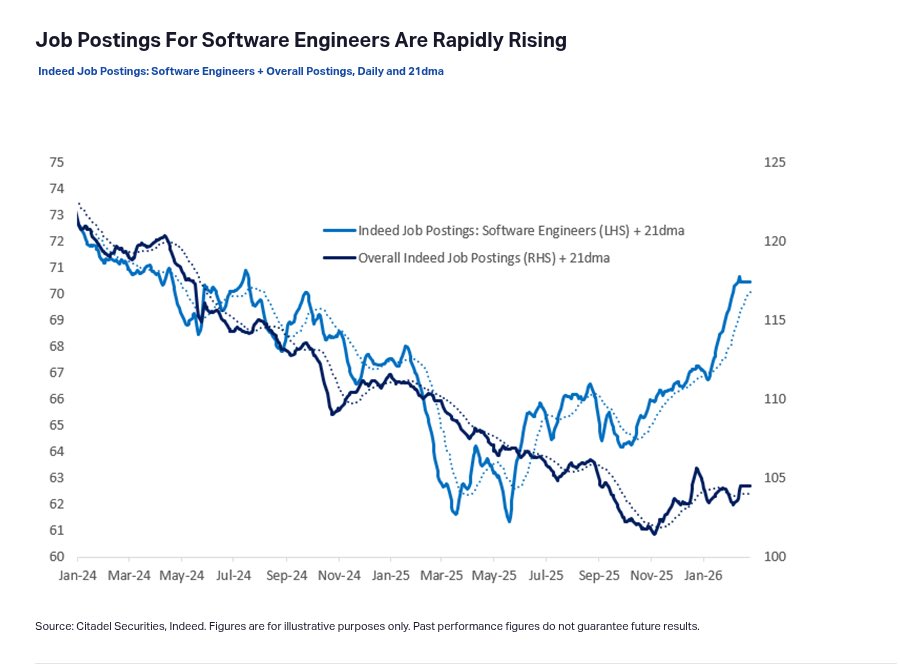
Q: How are job postings for software engineers rising rapidly despite AI agents automating coding?
A: Because there’s far more code to manage than ever before. We’re already seeing a 14x YoY increase in GitHub commits, and it’s accelerating.
AI has dramatically lowered the cost of writing code, so it’s now being used across far more businesses, applications, and use cases.
We’re at the beginning of a massive productivity boom driven by the proliferation of bespoke software throughout the entire economy.
Coding has been AI’s breakout use case this year. The fact that it’s increased demand for software engineers — rather than decreased it — should call into question the entire “AI will cause mass job loss” narrative.
@aquariusacquah More lines of code are a liability not an asset. You want to maximize user value per line of code. This is a very dangerous metric to optimise for.
@raymondmarkable@nicbstme Agree, those are def interesting problems to solve. Hallucinations are also a major problem. I've dabbled a bit on this topic and Auditability and Latency are real problems I have run into
@nicbstme@raymondmarkable LLM chats become the new super app. Over time they generate custom UI's for specific tasks based on multi-modal user input (text, voice, images, video).
Some early AI generated UI projects already out in the wild: https://t.co/VYb1qRcYRU (Eventually this moves into the LLM chat)
I don’t think self vibecoded software is the future for businesses
A couple of months ago I vibecoded a tool for a friends business
his entire staff has been using it for six months now (37 people)
the thing is, he’s constantly sending me feature requests, bug fixes
The app is pretty complicated since it deals with insurance benefits verification
so for someone that doesn’t have software development experience you can’t just prompt to fix it (believe me, he tried)
recently, the API provider changed something that broke everything
he’s getting really tired of dealing with it
and as Peer points out that’s why saas was built in the first place
somebody who’s not in the software business will find it really annoying to now have to deal with all the maintenance
saas is not dead
Congrats to the @Arcade_xyz team on everything you’ve built in NFT lending. Originating ~$300M in loans over four years truly helped shape and advance the NFT finance space.
You brought real innovation to lending, from rollover-focused features to vaults and a sleek, intuitive UX.
Best of luck with the launch of Arcade Distribution Markets on @Base.
Still leveling up!