Comics will always be free, but I massively appreciate the support if you can! Link in the comments. Just £1 a month, which is cheaper than a cup of coffee or a Ferrari.
Crazy...this is Kubernetes moment for AI Agents.
Run millions of agents on Kubernetes. Idle agents go to sleep and wake up in under 500ms. 10x more agents on the same hardware.
100% Opensource.
https://t.co/s3LFYZX4mP
You can admire people who are miles ahead, but the best people to get advice from are just a few steps ahead. They're much closer to your reality, your situation, and your condition. They may have done less, but there's a good chance the know a lot more.
...- --. .-. Can you decode this message? 🔦
On Nov. 17, celebrate Voyager 1 reaching one light-day from Earth by flashing this message toward the night sky.
Join the celebration: https://t.co/un5jS48qv8
Since @typecraft_dev didn't use hallmark skill (https://t.co/7WeGPMgHdL), I used it to rebuild my personal site 🙃
https://t.co/KF5oGWQhcT
I should write more and better blogs 😅
Thanks for tweeting about the skill, @typ
What happens when you combine embedding models with System 1 decision models? You get the intersection, which is VENN —> Vector Decision Models, a very cool OSS research project from Mark Russinovich that I was fortunate to review early and am excited to support.
Since 1985, your computer has asked the network what time it is and simply believed the answer.
Meta's public time service now speaks NTS (Network Time Security, RFC 8915) at https://t.co/PEcqx89wCv. Every packet is authenticated, so a device can verify the time came from us and wasn't modified in transit. It’s free, public, and open source.
Read the full technical write-up on our Engineering Blog: https://t.co/ZddbMgJRzR
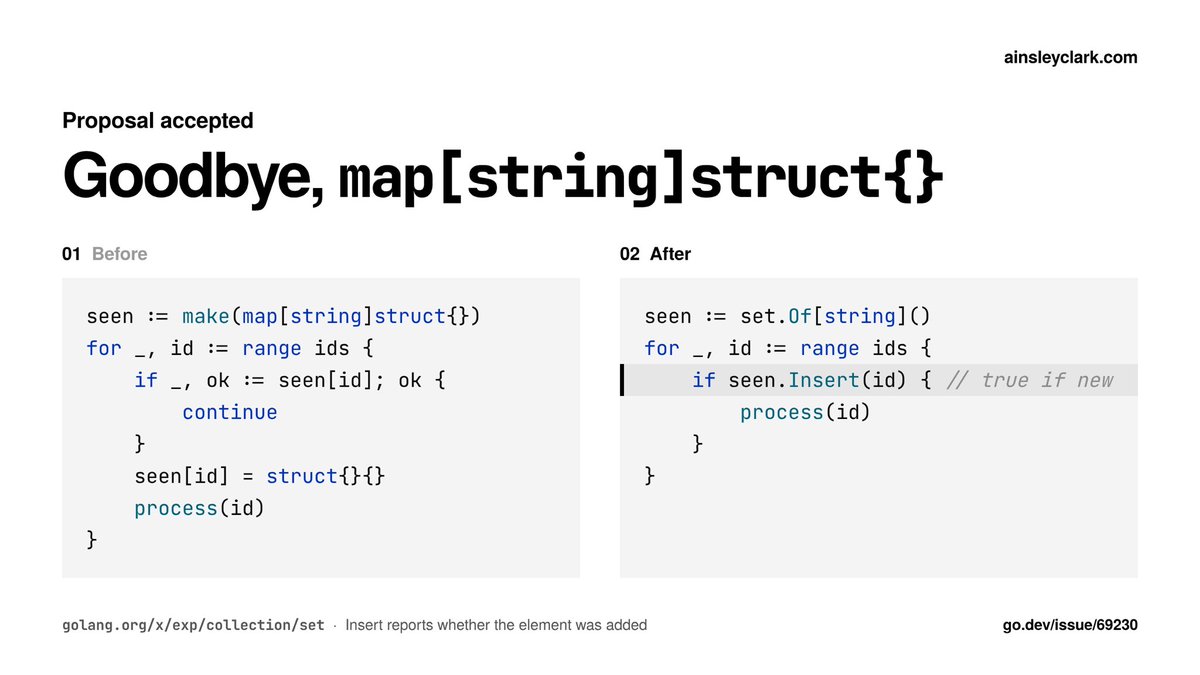
Goodbye map[string]struct{} 👋
Go's generic set proposal was just accepted. set.Set is still a map underneath, so range just works, but you get Insert, Contains, Union, Difference and more.
It lands first in https://t.co/XiamJpX8Sb
https://t.co/XKL1bbRXDl
Our TPUs just phoned home... from space.
ICYMI, on October 1, we sent four TPUs into orbit to test whether our AI hardware could operate in space. The initial goal was to see if our chips could turn on, process a prompt, and transmit a response back to Earth.
This week, we got our answer. ✨
This milestone brings us one step closer to understanding if space-based compute is possible. We’re sending two more TPU-equipped satellites to orbit in 2027 for our next milestone.
Watch this space 👀 and learn more about the first milestone of our long-term moonshot with Project Suncatcher ↓