If there was anything the Stoics would have 'crashed out' about, it was corruption and injustice...I don't know what has to happen to a person that you find yourself defending this family that is in the middle of robbing our Republic blind and making a mockery of every tradition and value that Founders (and the ancients) held sacred, but I am glad not to be one of those people. Don't be quiet. Don't be an enabler. Don't be a bootlicker. (Also for the record, it’s perfectly possible to say/do this calmly and with self-control.) https://t.co/i3gahUrO1W
“Acı gerçek şu ki…
Barışçıl bir insan bile gerektiğinde şiddetin ne olduğunu bilmeli.
Aksi halde sahip olduğu huzur, onu tehdit eden kişinin insafına kalır.”
— Miyamoto Musashi
@Supersonic_Red Thank *you* Ms. Redhead.
I've read about this in-between notion of my version of "bloomer" but never so well as how you put it. It explains a lot of where I come from, and how I ended up.
"Generation Jones"! I never heard that before.
Post like this is why I'm still at Twitter
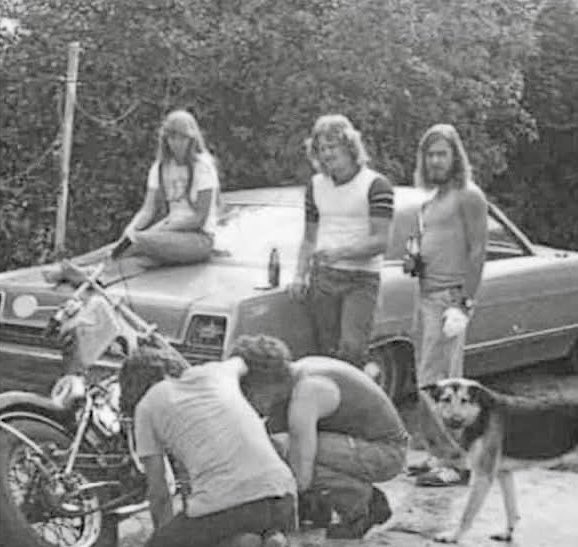
There’s a generation a lot of people forget exists. We were born at the tail end of the Boomers, but we are not culturally the same as people born in the 40s and early 50s. We are Generation Jones.
And honestly, it explains a lot.
We grew up in a world that still felt fundamentally analog, but we were young enough to be dragged headfirst into the digital revolution. We are the bridge generation between rotary phones and smartphones, between slide rules and AI, between Walter Cronkite and algorithm driven media.
We remember when there were only a few television channels and the entire country watched the same thing at the same time. We also adapted to the internet, email, forums, social media, streaming and now artificial intelligence. We lived before and after the technological singularity hit everyday life.
That is not a small thing.
People born in the 40s came of age in a post World War II America that was still industrial, deeply hierarchical and institutionally stable. Their formative years were shaped by the Cold War, Vietnam, the civil rights era and a society where information moved slowly.
Generation Jones came later. We inherited the aftermath of all of that.
We were the kids who watched Watergate destroy blind trust in government. We watched manufacturing begin to collapse. We saw divorce rates explode. We were the first truly latchkey generation in massive numbers. We learned independence early because many of us had to.
We grew up with one foot in old America and one foot in whatever this new thing was becoming.
We played outside until the streetlights came on but we also learned DOS commands. We learned cursive and keyboarding. We had card catalogs and Google searches. We went from vinyl records to cassette tapes to CDs to MP3s to streaming in one lifetime.
We remember maps. We remember memorizing phone numbers. We remember life before GPS and before every human interaction became filtered through a screen.
And because of that, I think Generation Jones developed a very unique perspective. We are adaptable because we had no choice but to adapt. We learned technology as adults instead of being born into it. We remember a slower world but were forced to survive in a rapidly accelerating one.
That creates a very different mindset than either older Boomers or younger Gen X and Millennials.
A lot of us also reject the caricature people now associate with “Boomers.” We were not buying houses for the cost of a sandwich in 1965. The interest rate on my first house was over 14% and that was after buying down a point. Many of us got hit by recessions, outsourcing, pension collapses and economic instability just like younger generations did. We watched promises evaporate in real time.
We understand older generations because we were raised by them. We understand younger generations because we had to evolve alongside them.
That’s why the Jones generation often feels culturally homeless. We are rarely discussed, rarely defined and usually lumped into categories that don’t actually fit us.
But we exist.
We are the human transition point between the industrial age and the digital age.
And frankly, there will probably never be another generation quite like us again.
The Trump phenomenon:
why did half of America believe a liar?
Many people keep asking the same question: how did Donald Trump come to power?
Why did such massive support go to a man widely seen as uneducated, irresponsible, and narcissistically self-obsessed?
Why did intelligence, competence, and experience suddenly carry so little political weight — and what does that say about democracy itself?
• Populism always sells simple answers.
Where experts talk about complexity, risks, and nuance, populists shout slogans. “Build the wall.” “Bring back greatness.” A slogan is always shorter than analysis — and therefore more effective for masses tired of thinking, or who never wanted to think deeply in the first place.
• Emotion defeats argument.
Trump, like every demagogue, spoke not to reason but to emotion. His rhetoric was built on anger, resentment, and fear. He created enemies, promised revenge, and avoided complicated explanations. Like many populists before him, he relied less on programs and more on outrage and emotionally charged narratives.
• Simplicity becomes the language of the “common people.”
Intellectuals almost always lose in mass politics. Complex language irritates people. Many feel uncomfortable when they do not understand something, but instead of admitting it, they blame the speaker. The person who speaks more simply is seen as “one of us.”
• Confidence is mistaken for competence.
Human nature has not changed. People still confuse decisiveness with wisdom and confidence with knowledge. Trump became a perfect example of the Dunning–Kruger effect: a man with limited understanding who presents himself as a genius. Yet this blind self-confidence is exactly what many voters perceive as strength.
• Populists surround themselves with weaker people.
Demagogues and authoritarian-minded leaders fear intelligent independent thinkers. That is why they often surround themselves with loyal but less competent figures. Trump’s first administration was partially restrained by institutional inertia and traditional Republicans. Later, many critics argued he increasingly preferred loyalists, conspiracy theorists, and ideological fanatics over experienced professionals.
• History keeps repeating itself.
A society searching for easy answers repeatedly opens the door to demagogues. Instead of embracing the difficult reality of democracy — compromise, institutions, responsibility — people choose the illusion of simplicity. They want a “strong leader” who supposedly “knows how” and will finally “tell the truth,” even if that truth is largely fiction.
• Knowledge itself becomes a disadvantage.
One of the paradoxes of modern politics is that intellect often appears weak. Thoughtfulness creates doubt, and doubt annoys people. The one who analyzes seems uncertain. The one who promises certainty sounds convincing. For many voters, appearance matters more than reality.
The lesson is simple and brutal: democracy without thoughtful voters is only a shell.
As long as large parts of society continue believing in easy answers to complex problems, the Trump phenomenon — or something very similar to it — will keep returning in different countries and under different faces.
And every time, it comes with the same promise:
“I alone can fix it.”
That is why democracy requires more than voting.
It requires thinking.
Without that, anyone with a slogan can become your master.