Six Ethereum execution clients. Same bare-metal hardware. The fastest fully syncs in 1.5 hours. The slowest takes 8+ days.
Cross-client behavior on Ethereum is more uneven than most people assume. So we measure it.
https://t.co/yiWK2e7TMr
We went looking for your 20% on live mainnet. Six Nethermind nodes, six different consensus clients, same blocks, same hour, median gas per block flat near 29 MGas.
We could not find it. One version's own p50 swings 25 to 28% week to week, so the effect and the noise are the same size. Change the window and the sign changes.
Fixed blocks on fixed hardware is the only place a 20% delta is visible at all.
Our Nethermind nodes and their configs sit on https://t.co/PgeNzaCneE, free tier, 7 day delay, 60 days of history. Check us.
And FlatDb.Enabled still defaults to false. Flip it on half of ours and publish the A/B?
Some detail on the setup, now live with the first deposits in: six Charon nodes across three sites, two per site. Duties need four, so a full site can go offline and the cluster keeps signing.
The same margin makes updates rolling instead of scheduled downtime.
The Identified DVT Clusters type is the interesting one here. Stereum Launcher already handles Obol and SSV cluster setup, plus Lido CSM, across 10+ EL and CL clients. Free and open source.
https://t.co/niL0o1a4f9
2. CSMv3: Expanding Permissionless Staking
Through this upgrade Lido CSM becomes even more reliable and operator-friendly.
Alongside multiple under-the-hood technical improvements, the primary new features are:
• New Node Operator type: Identified DVT Clusters
• Native Node Operator reward splitting
• Permissionless stake share increase through the lightweight Easy Track governance
The client diversity pillar is the one we can actually help with. Every EC x CC pairing on our fleet runs on identical hardware, and the per-pairing numbers are public.
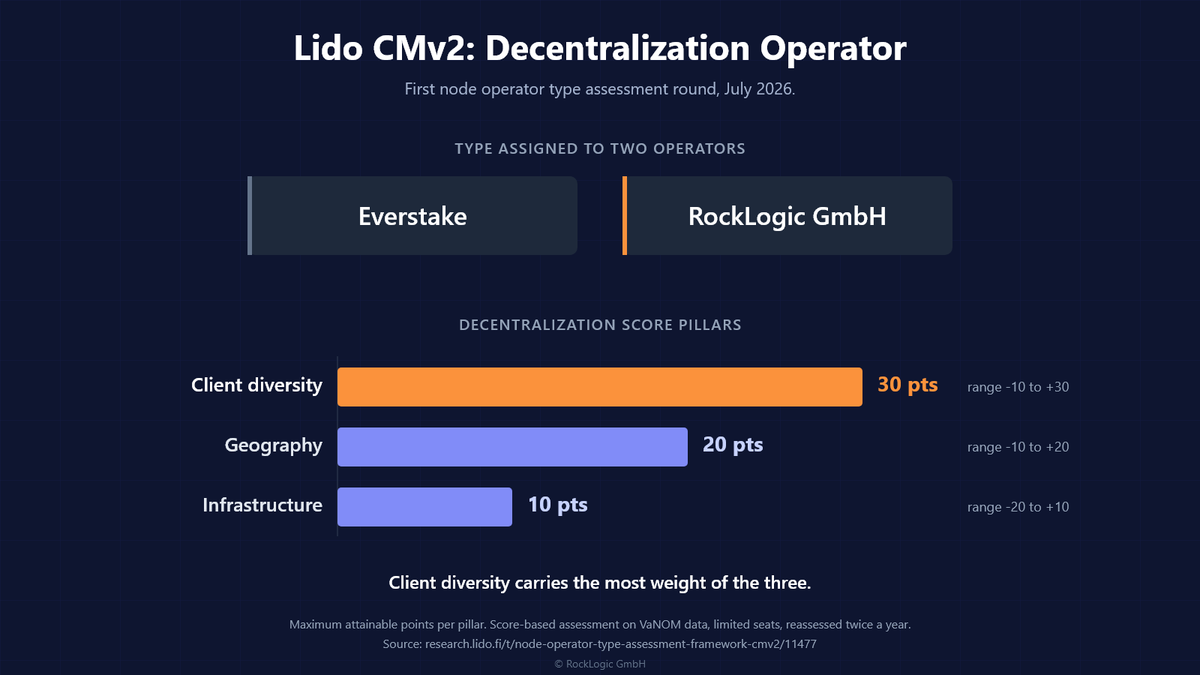
Lido (@LidoFinance) published the first CMv2 operator type assessment. Two operators were assigned the Decentralization Operator type: @everstake_pool and RockLogic.
Client diversity is the heaviest pillar in that score: up to 30 points, geography 20, infrastructure 10.
Join the Lido Community Call next Thursday.
Catch up on what’s next for the Lido staking modules, Lido's recent Web3SOC certification, and guest sessions on client diversity.
Add it to your calendar: https://t.co/4VkRiGLaFY
Full breakdown: per-EC pruning observability, the Nethermind v1.37.1 inline-newPayload trade-off, Ethrex with zero pruning metrics, Reth still in initial staged sync, EIP-4444 implications.
https://t.co/xnxdX8Dl1S
Five synced ECs on the same Ethereum mainnet:
Erigon: ~509 GB
Ethrex: ~598 GB
Nethermind: ~1,225 GB
Besu: ~1,261 GB
Geth: ~1,688 GB
3.3× spread, driven by retention architecture. Numbers are upper bounds (hosts rebuilt in 7-16 days). And disk is only half of it.
Sync-committee duties get hit before attestations. A late sync-committee message misses the next block's sync_aggregate outright. An attestation still has one slot of grace.
Today at @ethStaker's Fast Finality call (15:00 UTC), three of five ECs on Nimbus cross the deadline.
@fede_intern We measure exactly that misunderstanding gap. Per-node reality on our fleet: a Besu node's 24 peers are 75% Reth. A 12% slice of the network becomes 75% of one node's reality. Aggregate diversity numbers hide this entirely.
https://t.co/pZMjDG2zyL
@ethStaker@benjaminion_xyz@robsaltini@Butta_eth Adjacent data point for the call: same EC behind two CCs produces 2-5× different reorg counts on identical hardware. Re-baseline alert thresholds per CC × EC pair. Lodestar reports 0 reorgs across 90 days while Prysm increments 1,002× per host.
https://t.co/z00SngdbxZ
Full breakdown: 6 ECs, 130-to-24 peer-count spread, 50,000× churn-rate spread, eth68 hard caps on Erigon, and why DevP2P has no diversity-aware peer scoring like gossipsub does.
https://t.co/pZMjDG2zyL
Aggregate Ethereum client diversity: 'no client over 55%.'
The view from an average Besu node on our fleet: 75% of its 24 peers are Reth.
A 12% slice of the network becomes 75% of one node's reality.
Adjacent finding: same Geth on bare-metal (port 30303 open) = 50 peers. On GCP (default firewall, port blocked) = 15 peers.
CC peer count looks fine throughout. The EC is silently running 70% degraded. Lots of cloud nodes probably are.
Stereum Launcher v2.4.8 is out.
- Ubuntu 26.04 support
Auto-updates on startup. MacOS users: download the dmg manually and enable via System Settings.
https://t.co/0sd38a1jBY
Three more findings in the 90-day census:
- Geth is the only EC whose Prometheus reorg counter ever increments
- Nethermind & Reth export it but it never moves
- Besu, Erigon, Ethrex don't export one at all
https://t.co/z00SngdbxZ
Same chain. Same bare-metal. Same metric name: beacon_reorgs_total.
Prysm increments it 8× more often than Lighthouse over 7 days.
Lodestar: 0 increments across 90 days.
Both readings are correct. The clients just count different things.
It gets worse in the matrix.
The same EC behind two CCs produces 2-5× different reorg counts:
- Prysm + Besu: 69 per host
- Prysm + Nethermind: 280 per host
A fixed alert threshold doesn't port between pairings. Re-baseline after every EC change.
Quiet Saturday on the fleet.
90 hosts across Vienna and GCP humming along. ~30,000 log lines per second flowing into Elasticsearch.
The boring part of this job is what makes the interesting part possible.