Beginning in the fall of 2024, Johns Hopkins University will provide tuition-free Medical School for most medical students and expand aid for future nurses and public health pioneers. Learn more: https://t.co/QuBluT7CWo
It was a pleasure to host @ElonMusk at @BarrowNeuro recently. We look forward to our continued partnership with @Neuralink to advance brain-computer interface technology for our patients…
.@MountSinaiNYC announced a team of Mount Sinai neurosurgeons and neuroscientists are the first in New York to study a new brain-computer interface (BCI) that’s engineered to map a large area of the brain’s surface at resolutions hundreds of times more detailed than typical arrays used in neurosurgical procedures.
Read how the device was temporarily implanted in a patient, moving it one step closer toward becoming a standard of care via @WSJ (subscription required): https://t.co/f67EgjKIeH
Video Credit: Wall Street Journal
@MountSinaiNeuro@MountSinaiPsych@SinaiBrain@SinaiBioDesign@MSHSNeurology@JoshBedersonMD@IgnacioSaezPhD #BCI #Brain #Neurosurgery
We're launching a multi-year research study of long-term outcomes of COVID-19 among New Yorkers. We'll recruit up to 10,000 participants for the study when it launches in 2024 and follow up with them over several years.
Learn more: https://t.co/vPhFTlWABP
In case you forgot, Florida State earned the right to play in the College Football Playoff and were SNUBBED. That’s not a conspiracy theory, it’s a bonafide fact. #FSUTwitter
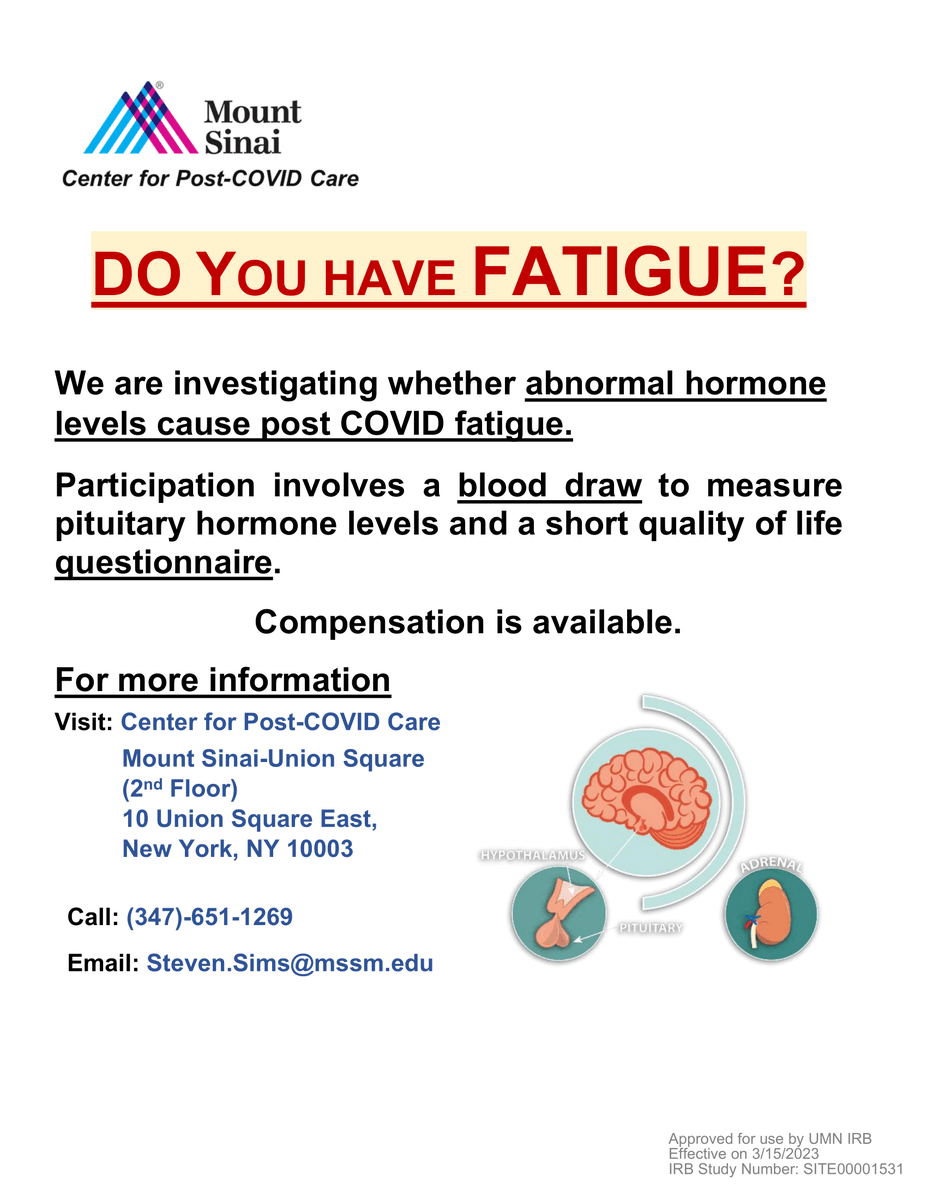
Mount Sinai’s Center for Post-COVID Care is part of a novel, multisite study that is investigating whether abnormal pituitary hormone levels are implicated in post-COVID fatigue: https://t.co/8jKvn27NjH
Now recruiting nationwide. Must have access to a Labcorp or Quest location.
The U of M is studying hormone levels and fatigue of people who have recently had COVID-19 in hopes to determine how COVID-19 affects hormone levels and the pituitary gland. Learn how you can participate: ➡️: https://t.co/lMxdzqjgMZ.
BREAKING NEWS
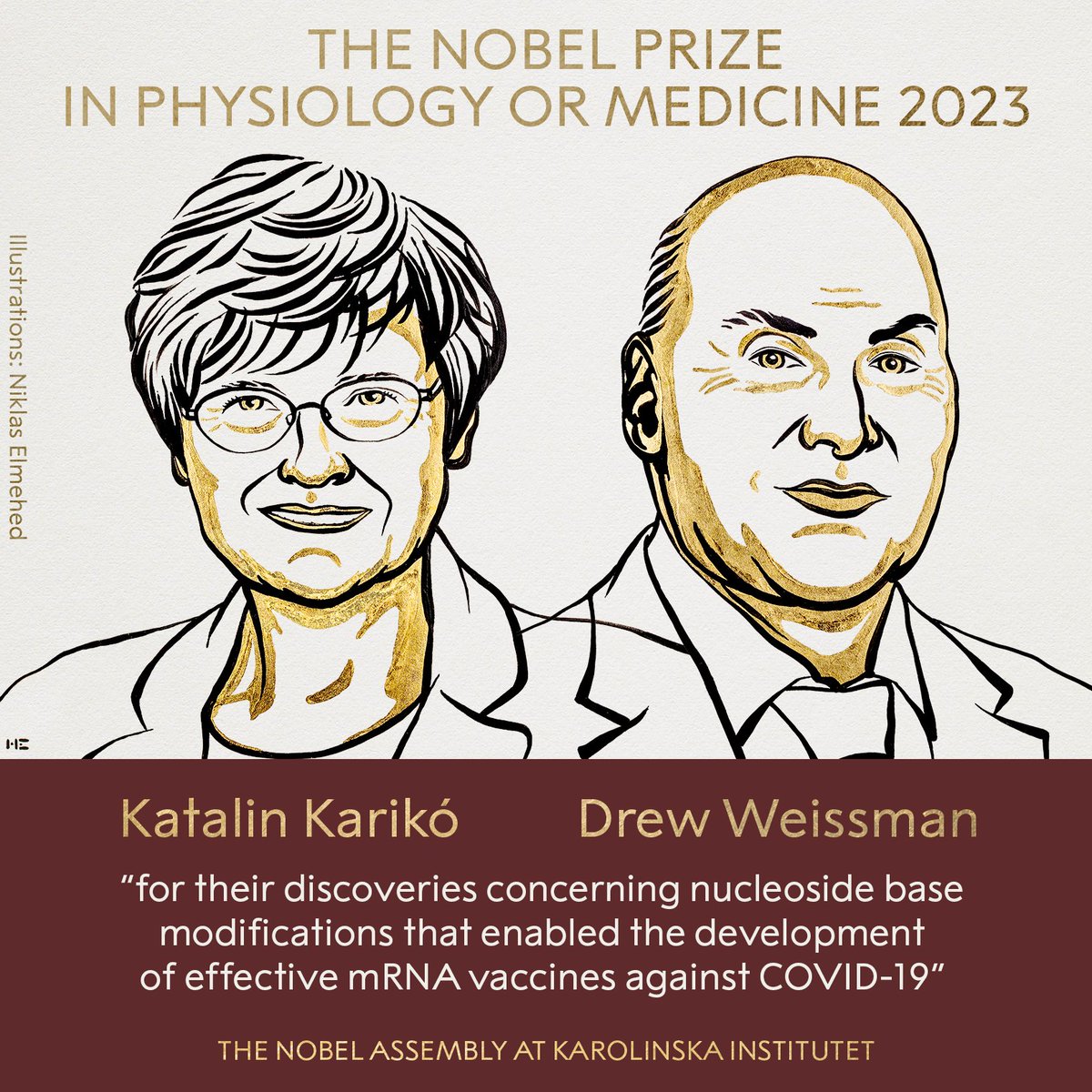
The 2023 #NobelPrize in Physiology or Medicine has been awarded to Katalin Karikó and Drew Weissman for their discoveries concerning nucleoside base modifications that enabled the development of effective mRNA vaccines against COVID-19.
In 2009, Stanford business professor Tina Seelig split her class into groups and issued a challenge:
Each group had $5 and 2 hours to make the highest return on the initial money.
At the end, they'd give a short presentation on their strategy.
The results were fascinating...
Most of the groups followed a basic approach:
• Use the $5 to buy a few items.
• Barter or resell those items.
• Repeat
• Sell final items for (hopefully) more than $5.
These groups made a modest return on their initial $5.
A few groups ignored the $5.
They thought up ways to make the most money in the 2 hours of allotted time:
• Made and sold reservations at hot restaurants.
• Refilled bike tires on campus for $1 each.
These groups made a better return on their initial $5.
The winning group took an entirely different approach.
They had three core realizations:
1. The $5 was nothing more than a distraction.
2. The 2 hours of time was not enough to make an attractive, outsized return with a mini-business (like selling restaurant reservations or filling bike tires).
3. The most valuable "asset" was actually the presentation time in front of a class of Stanford students.
Realizing the value of this hidden asset, they offered the presentation time to companies looking to recruit Stanford students.
They struck a deal to sell the time slot for $650, netting a monstrous return on the $5 of initial capital.
The losing groups thought in linear, logical terms and achieved a linear, logical outcome.
The winning group thought differently.
So, what can we learn from this story?
There are two types of problems:
1. Low-Stakes: Lower potential, linear rewards. Decisions are easily reversible.
2. High-Stakes: Higher potential, asymmetric rewards. Decisions are not easily reversible.
With low-stakes problems, given the reward potential is low and the decisions are easily reversible, we can use shortcuts and heuristics to choose our path. We can take a logical, linear approach.
With high-stakes problems, the high, asymmetric reward potential means we need to think differently. We want to take a creative, non-linear approach.
Three steps to start thinking differently:
Step 1: Avoid the Distraction
There will always be an "obvious" solution that is simple, clear, and entirely wrong.
In the challenge, the $5 was nothing more than a distraction. It was a trap.
To find the best path, you have to avoid the distraction.
Step 2: Ask Foundational Questions
Ask and answer questions that expose and vet underlying assumptions and logic.
• What's the real problem you are trying to solve?
• What's your hypothesis? Why?
• What are your core assumptions? Why?
• What evidence do you have?
• What are your core options?
• What alternatives exist?
This takes time, but it's an essential exercise when facing a problem with the potential for non-linear rewards.
Step 3: Select the High Leverage Approach
Slow down and evaluate the options on the table.
Select the path most likely to generate the asymmetric, attractive risk-adjusted returns.
If the story teaches us one thing, it's this:
Creative, non-linear, asymmetric thinking generates creative, non-linear, asymmetric outcomes.
If you enjoyed this or learned something, follow me @SahilBloom for more in future.
“Researchers found an association between maternal stress & the landscape of their children’s gut microbiome at 2 years old … a correlation between certain inflammation-related gut microbes in the toddlers at 2 & increases in mental health problems at 4.” https://t.co/LP85LVddFc
UCSF and @Cal_Engineer researchers successfully translated a woman’s brain signals into speech and facial expressions of an avatar. https://t.co/w26bKqW5jC
Applications for The Junior Academy have reopened! Do you know a student aged 13-17 who's passionate about making a difference in the world through #STEM? The Junior Academy is accepting applications for its virtual STEM mentoring program. Apply by 8/27: https://t.co/uRiza6qsJt
With only a single genetic modification—and no experimental medications or devices—a pig kidney xenotransplantation at NYU Langone Health led by Dr. Robert Montgomery continues to function optimally after 32 days.
Learn more about this new milestone: https://t.co/bL29j3HrQN
TRISH is currently accepting applications for our spring 2024 space health communications internship!
Who should apply? Undergraduate and graduate students interested in #SpaceHealth#communications. This is a virtual paid #internship.
APPLY HERE: https://t.co/vYPRmZenvA
@Mrsyumahotrod@hannahba94 @Dakota_150 Please contact us and do not schedule anything without our consent as the labs know nothing about the study without me providing you with the proper documentation to give them. You need to be formally screened, meet the study criteria and offered to join the study.