Nobody can take seriously European complaints about China. China is now building things better and more cheaply than Germany or France. When France and Germany built things better and more cheaply than others, they ridiculed such complaints. Now they are losing and not liking it.
Moreover, Europe came to that position by exploiting the rest of the world. China did not.
This must have slipped past the editors: for once the Guardian published a story that doesn't depict China as a heartless dystopian place: https://t.co/DOx6YeSzYB
It's actually a great story: a guy traveling in China with his elderly father fell violently ill with food poisoning. The hotel cleaner came, stripped the bed, cleaned everything up, refused any tip, and kept coming back to check on him. Then a receptionist offered to take his father to see the Terracotta Army on her day off. She paid for everything out of her own pocket and refused any reimbursement.
The guy says he and his father have traveled the world but never experienced kindness like they did in China.
Anyone who knows China wouldn't be surprised by this. The real story is that Western media - The Guardian very much included - has so thoroughly dehumanized China that most people would be surprised by it.
Make no mistake: there is a new space race going on, but a very different one in nature from that between the US and the Soviet Union.
This time around it involves, on one side, a colossal state-backed monopoly built on government money, welded to its country's military-industrial complex and run by a politically connected and highly ideological oligarch.
On the other side: dozens of hungry startups trying to out-innovate each other in a ruthless, Darwinian competition.
The oligarch is Elon Musk. The Darwinian competition is China.
There is something funny about it, not only because of the role reversal versus the Cold War era, but also because it sounds like a repeat of the Tesla story: it increasingly looks like the Gods cursed Musk into serving as chief trailblazer of China's industrial ecosystem.
This time around though, a strong argument can be made that the space industry is even more strategic, and potentially far more consequential, than the car industry.
Stripped of Musk’s PR spin about saving humanity, what the SpaceX project is concretely about is:
- Building a new global communication infrastructure via Starlink
- Enabling the US security establishment to see and hear everything on Earth, all the time (via Starshield, its military division)
- Dominating access to space itself, from launch to orbital real estate
Each of these is very, very real.
Do the test one day and download the app “Stellarium” on your phone that allows you to identify stars, planets and… the satellites orbiting above you. I guarantee you that the sheer number of Starlink satellites right on top of your head at any given moment will genuinely shock you. There are currently over 10,000 of them up there - almost as many as there are planes in the sky at any given moment (https://t.co/UPVlBnO1av). Starlink satellites constitute roughly two-thirds of all active satellites orbiting Earth, all belonging to a single private American company.
So it’s not conspiracy theories: the SpaceX satellites are up there, right above your head, right now. Starlink already has over 12 million subscribers across 160 countries. Starshield - the military division of SpaceX - already has multi-billion dollar contracts with the US defense establishment to "enable the U.S. government to quickly capture continuous imagery of activities on the ground nearly anywhere on the globe" (https://t.co/1q9ICZGprA). And SpaceX already controls the majority of global launch capacity.
In other words, every single one of my three points above is already well underway.
And, more worryingly, the roadmap for these satellites doesn't stop at surveillance: the US Congressional Research Service has documented plans for space-based directed energy weapons within the same SDA program that SpaceX Starshield is part of (https://t.co/XIbwUyPlRI), with Congress having already granted the legal authority and budget to develop them.
So we're talking about a single private company, one deeply embedded in the US military-defense establishment, building the infrastructure to control global communications, conduct continuous planetary surveillance, and potentially project military force from orbit. And that company already has more hardware up in space than every other country and company on Earth, combined.
From the standpoint of China, or that of any country that cares about sovereignty, letting that go unchallenged would be an act of strategic suicide.
The question, therefore, isn’t whether China should develop its own sovereign capacities to challenge SpaceX, but whether it can.
That's the topic of my latest article: a systematic analysis of whether China can break SpaceX's grip on the sky. Spoiler: if you bought SpaceX shares at a $2 trillion-plus market cap, you may want to rethink that one.
This is the link to my article titled "Musk built a monopoly on space. Can China break it?": https://t.co/i4lG5lmK4W
The funniest part of JD Vance’s speech is the ending:
“I am angry about the rise of China… but I am most angry that American leadership let it happen.”
Let it happen?
As if China’s rise was an American clerical error.
As if 1.4 billion people industrialized because Washington forgot to lock the door.
China was sanctioned, contained, smeared, tariffed, and technologically strangled.
And still it became the world’s strongest industrial economy.
India had the population.
India had English.
India had earlier access to the WTO.
India had Western approval, “democracy” branding, and decades of geopolitical courtship.
Capital still chose China.
Factories still chose China.
Supply chains still chose China.
Why?
Because civilization is not built by flattering Washington.
It is built by infrastructure, discipline, engineers, workers, logistics, electricity, education, and state capacity.
America’s next ten years are not about competing with China.
That phase is already over.
America is now competing with India for who can disappoint capital less.
China’s real opponent was never America.
China’s real opponent is its own execution, its own discipline, its own ability to keep building without believing Western noise.
Vance is angry because China rose.
But what really humiliates him is this:
America tried to stop it.
And China rose anyway.
After reflection, this new narrative by Palantir is probably much more consequential than people may assume.
Palantir is basically being the canary in the coal mine announcing the death of two major assumptions propping up the US economy right now:
1) that AI labs will be able to extract significant economic rent - as opposed to AI models being mere commodities
2) that other countries can accept structural dependency on US technology and services without pushing back on sovereignty concerns
Why are Palantir specifically starting to be vocal about this?
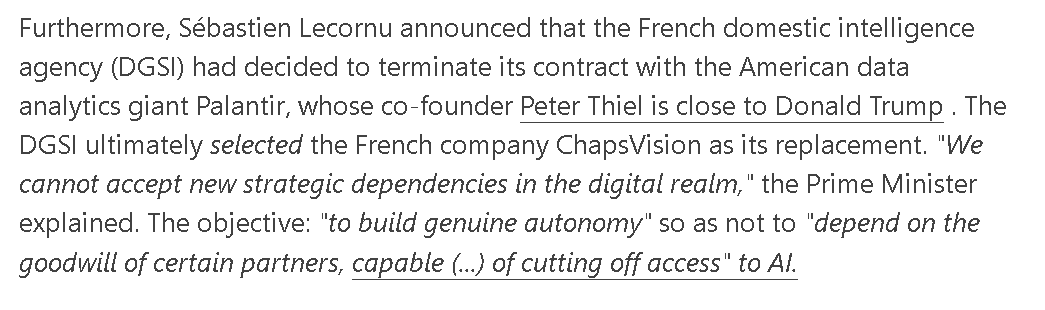
First off, major middle-powers, even US “allies”, are one by one showing them the door. In June, France announced that the DGSI - its domestic intelligence agency, which had relied on Palantir since the 2015 Paris attacks - would replace it with French firm ChapsVision, with Prime Minister Lecornu explaining (https://t.co/SLhEGprBZC) that France “cannot accept new strategic dependencies in the digital sphere” and shouldn't depend on the goodwill of companies “capable of turning off the tap.”
Germany moved even earlier: its domestic intelligence service, the BfV, also selected ChapsVision over Palantir (https://t.co/pDZVj4SYUY), and the German military has said it will no longer use Palantir at all. Then, just this week, Spain instructed state-controlled companies - including strategic firms like Telefónica, Indra and Navantia - to avoid signing any new contracts with Palantir (https://t.co/0ik4UAFrT7).
Even in the UK, Washington's most loyal vassal, the NHS's £330 million data contract with Palantir is under review following parliamentary pressure (https://t.co/uJl6g4BMsW), and London Mayor Sadiq Khan blocked a proposed £50 million Palantir contract with the Metropolitan Police.
Palantir making a lot of noise around them caring about sovereignty makes a lot of sense: it's damage control since they keep being told they're a sovereignty risk.
I doubt it will work - because it's true: they are a sovereignty risk - but the fact that they feel the need to be vocal around this tells you where the wind is blowing: they're not shaping the narrative, they're reacting to one they're losing.
What they're saying against closed-source AI (basically a broadside attack on OpenAI and Anthropic), is again highly self-serving. Palantir's sudden love of open-weight AI models conveniently coincides with them launching 2 days before a partnership with Nvidia to sell exactly that: open models models (NVIDIA's Nemotron) in sovereign environments.
So it's essentially a product launch.
It doesn't make what they're saying wrong: it is factual that the value proposition of closed-source AI labs looks increasingly unsustainable. I mean: you're paying 10X the price of Chinese open-source AI models for something that's not really better (or just marginally) and on top of that you have zero control over your data, or the models themselves.
When Palantir says that "the architecture that maximally preserves sovereignty is one that enables institutions to own their tribal knowledge, and to compound it as alpha," they're right. I'd add that this also means you shouldn't trust Palantir either with that "tribal knowledge"... they obviously left this part out 😉
When you take a step back, these two things have major implications on many other US companies.
SpaceX - which just went public at the largest IPO valuation in history - is one clear example as I describe in my latest article on the new space race with China (https://t.co/JK3ELAyEVO).
If countries like France concluded with Palantir that they couldn't depend on a company “capable of turning off the tap” when it’s merely analyzing their data, what should they conclude about a company that aims to literally control their entire connectivity - at one man's whim, from space?
What percentage of SpaceX's crazy market cap is based on the assumption that foreign governments will not do to Starlink what they're currently doing to Palantir?
And SpaceX - or Palantir - aren't alone: a significant proportion of the top US tech giants, who rose in a world where no one questioned American technological hegemony, now face an environment that's much less conducive to the kind of lock-in their business models - and valuations - depend on.
When you pair this with the fact that it increasingly looks like the US made a wrong bet with closed-source AI - an extremely expensive wrong bet - the picture that emerges is of a country that bet its economic future on two things - proprietary AI and captive allies - and is losing both at the same time.
And to compound the problem, it doesn't help that the official narrative of the US government - via the voice of Jacob Helberg, the Under-Secretary of State (https://t.co/Z1rotPl9Ee) - is to be vocally opposed to "AI Sovereignty": essentially telling everyone "you know what, your worst fears are real, our tech companies are really out to undermine your sovereignty."
Read Helberg's post (the one I linked) and put yourself in the shoes of - say - a European or Asian leader and ask yourself how you'd react to being told that building your own AI capabilities is "marching in perfect formation into the past," that your pursuit of sovereignty is really just "synchronized mediocrity," and that your only path to the future runs through American technology.
If it was me in a position of power, I'd read this as a massive wakeup call: when another country's official position is that your sovereignty is a problem, history says you're about to need it.
So yes, it looks like - unexpectedly - Palantir, of all companies, is being quite the canary in the big tech mine. Yes they obviously do this for self-serving and cynical purpose, and yes they're of course also very much part of the problem and not the solution. But it doesn't make them wrong: sometimes it takes a vulture to tell you something is dying.
Çin artık başka bir boyutta. Geçen ay misafir öğretim üyesi olarak görev yaptığım Renmin Üniversitesi’nde bir gün öğle yemeğini görmek için öğrenci yemekhanesini götürmelerini rica ettim. Çin’deki öğrenci yemekhanelerini çok severim, her geldiğimde mutlaka uğrarım. Adamlar yeni bir sistem kurmuşlar, çipli tabldot tepsisini alıyorsunuz, envai çeşit açık büfede seçiyorsunuz, her bir yemeğin önünde durup tepsiyi tezgaha koyup istediğiniz kadar gram ekliyorsunuz, isterseniz sadece bir kaşık alın otomatik hesaplıyor, tepsinin çipine işliyor, en son kasaya koyuyorsunuz tepsiyi bütün aldıklarınızı birleştiriyor, ödemeyi ise qr kod ile kolayca bir saniyede yapıyorsunuz.
What an absolutely insane (lack of) logic: take a completely imagined future ("what if China had remained poor, closed and undeveloped?"), treat it as the natural baseline, and then count the gap between that imagined future and reality as "victims" attributable to China.
I hope people realize that's just pure unadulterated propaganda - probably aimed at sowing division in the Global South. As if China had somehow stolen something from the rest of the Global South by having the audacity to develop.
It's like saying that a kid from the poorest neighborhood in town who makes it through hard work has somehow "foreclosed the future" of all the other kids on his block - that they are the "most consequential victims" of his success because he took "their" spot.
There is of course no "spot": development is not a zero-sum game with a fixed number of winners. And, as a matter of fact, you just need to look at the list of developing global south countries that are doing well, on their way to developed status: almost all of them happen to be in Asia, next to China (Vietnam, Malaysia, Thailand, Indonesia, etc.). If China's rise truly "foreclosed" the rise of others, someone forgot to tell its neighbors...
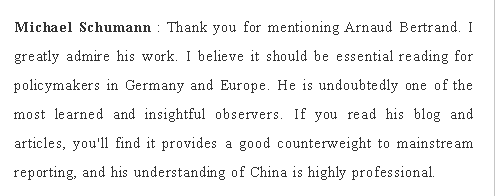
Very honored by this: Michael Schumann, chairman of the Board of the German Federal Association for Economic Development and Foreign Trade (@BWA_Vorstand), was asked about me during an interview by @realguancha and here is what he had to say 👇
I agree with him 😏
His interview, as is always the case with Michael (one of the all-too-rare senior European deciders with the intellectual courage to be unideological on China) is full of fascinating insights and well-worth reading in full.
For instance he is remarkably candid about the self-inflicted nature of Germany's industrial decline - energy costs, digital infrastructure, bureaucracy - and explicitly says Germany shouldn't use China as an excuse to avoid its own homework.
He also explains that, in their overwhelming majority and despite the political narrative, German firms remain firmly committed to China: 93% of German firms in China have no plans to leave and 53% plan to increase investment.
All in all, he frames the current trade tensions between the EU and China in the way they should be framed, and a way that reflects reality: European concerns about trade imbalances and industrial erosion are legitimate worries - Europe is indeed losing in competitiveness - but it's very unhelpful (and might actually worsen the problem) to scapegoat China and frame these issues through the lens of conflict.
Link to the Guancha interview: https://t.co/m0dl2U4WHt
Finally! This is the kind of energy we need from our leaders. I hate to give @JDVance credit, but he’s obviously correct here. It’s infuriating to see them assume they can boss us around when we’re their only remaining ally and they owe us everything.
Fascinating argument by Bloomberg's top energy analyst Javier Blas 👇: he argues that China effectively saved the world economy during the Iran war by absorbing the brunt of the global oil supply shock on its own, without visible economic damage.
According to his calculations, China "cut its average daily waterborne oil imports by the same amount as the combined oil consumption of Germany, France and the UK."
And, still according to Blas, they "did so without suffering economic harm" because they could rely on many levers: their huge strategic petroleum reserve, a massive surge in EV usage, their remaining coal-fired electricity capacity, and coal-to-chemicals replacing lost feedstocks.
Had China not been ready to absorb that blow, a good argument can be made that the economic damage to the West, and the world at large, would have spiraled far beyond what we saw.
Effectively, China's energy strategy at all levels (petroleum reserves, EVs, etc.) and its ability to withstand huge supply shocks paid off for everyone, not just for them.
It sounds awfully familiar: in 2008 too it was China's stimulus package and continuous buying of US Treasuries that averted a complete breakdown of the global financial system.
So twice in 20 years the country the West loves to present as a "threat" to the global economy effectively saved it from a US-made global economic disaster 🤷
Wow, this is a huge and - rare for France these days - a genuinely good move: France's intelligence services (DGSI) are terminating their contract with Palantir in favor of a domestic alternative (source: https://t.co/yaIu2cqLMT).
I posted about this multiple times. See post below for instance, which Palantir officially replied to, calling my take "insane" (https://t.co/9AlYKZ31qH), where I called it a "complete dereliction of duty" for France to use Palantir as the "central software architecture" for their intelligence services. As I wrote, it's completely incoherent with any notion of sovereignty.
Looks like my "insane" take wasn't so insane after all 😉
And, by the way, ALL countries currently using Palantir should do the same: you are, quite simply, not a sovereign country if you let your national data infrastructure depend on the goodwill of a company with such a clear political agenda.
At this stage this isn't even a sovereignty question, it's a sanity test.
There you have it. Anthropic's CEO said it: The murder of more than 100 schoolgirls in Minab targeted by Anthropic's CLAUDE "is a use case that doesn't even violate our red lines." Time to rise up against these technofeudal war criminals.
The Greek prime minister said Chinese production capacity could destroy Europe.
But the irony is obvious:
This only becomes a “global threat” when China does it.
The United States once accounted for around 50% of global manufacturing during World War II.
After World War I, its share was already around 38%.
Both were far higher than China’s share today.
Back then, nobody called it “overcapacity.”
Nobody said America was destroying the world.
Nobody demanded Washington shrink itself for the comfort of weaker competitors.
It was called leadership.
It was called productivity.
It was called the reward of industrial power.
But when China reaches 30% through factories, infrastructure, supply chains, engineers, workers, ports, grids, and industrial discipline, suddenly Europe discovers the word “danger.”
Please.
China did not destroy European industry.
Europe hollowed itself out.
Europe outsourced production.
Europe worshipped finance, regulation, luxury branding, and green slogans while letting its industrial base decay.
Then China kept building.
Now the countries that gave up manufacturing are angry at the country that did not.
In the end, this is what happens when Western undercapacity meets Chinese competence.
They call it “Chinese overcapacity.”