I estimate it will take less than 10 years for $STRC to be larger than the median S&P 500 company.
Today #250 is a $40.3 billion company. Given an average appreciation rate of 8%, in 10 years the median market cap would be about $87 billion.
Assuming:
- Bitcoin has 15% ARR
- Strategy grows stack size by 3% per year
- STRC settles into a long term BTC Rating of 2x
Then $87 billion market cap for STRC can be achieved in 7 years. It can be achieved in 9 years with a BTC Rating of 3x.
Higher ARR or accumulation rates can easily accelerate this timeline. Major underperformance by the median S&P 500 company can do so too.
And just like that $STRC flips $MSTR ATM and we are selling a billion a week in prefs.
A new $21 billion ATM program is needed to meet the demand in 2026.
Also isn't it funny that now we are buying in an uptrend and so the avg purchase price is less than the market price?
What happened to everyone complaining about "Saylor buying" at 7% premium to spot?
Sharpe 3 is incredible. Also, consider that it is all tax deferred gains. Most high sharpe strategies have a high turnover and short term capital gains.
Basic portfolio theory shows that intelligently levered Digital Credit will outperform everything.
Many things are cooking under the hood.
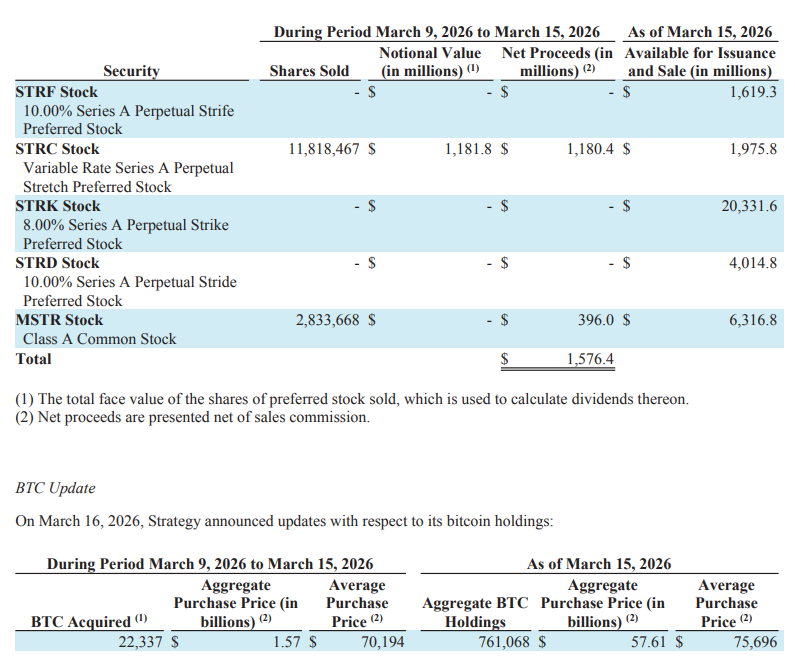
This week's 8-K showed the power of STRC. On average, $STRC pulled in about 1063 BTC per day.
Since $MSTR was strong in the early-week but weak in the later-week, we can assume that most of the MSTR ATM usage was from the first 2-3 days of the week. In total, the MSTR ATM pulled in about 4-6k BTC per day. The range is because we cannot get a good assessment of what days the common ATM was actually used. If we assume first two days, then we get over 6k BTC per day. If we assume first three days, then we get about 4.2k BTC per day.
This would align with prior patterns, where MSTR could do about 5-10x more than what STRC did in the same time.
But now we are clearly breaking the lower end of that range. As STRC scales, its ATM will become the primary fundraising mechanism for Strategy.
STRC was above par for all the days last week, so we can assume its ATM was used on all days. Hence the estimation for BTC per day is also very specific.
Another interesting note is the average purchase price of about $71k per BTC. BTC went to about $74k on Wednesday and and this was likely when a large portion of the MSTR ATM was used.
This drags the average purchase price higher since you have a big clusters bought at around $74k.
On the other hand, the STRC ATMs were used fairly evenly throughout the week.
So one conclusion from this is that STRC enables more "true DCA" while MSTR enables more "local top" concentrated buying.
As STRC scales, it is certain that these 8-Ks will look very different in a year from now.
My research notes from Strategy World @BitcoinForCorps
- $STRC is an easier pitch than Bitcoin
- 'L3' path to mass distribution
- Levered Digital Credit & Portfolio theory
- Secondary-market carry trades
- Digital Ouroboros Risks
Read full note here: https://t.co/4wqBmiD0qP
This week's 8-K + last week's unique price action actually gives deep insight into how @Strategy runs its $MSTR ATM.
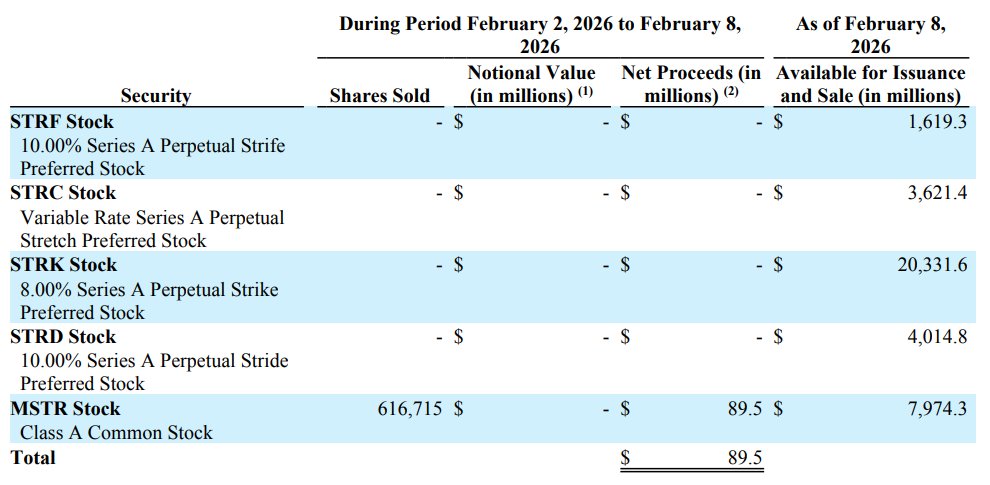
$89.5 million raised by selling 616,715 shares is an average price of $145.12 per share.
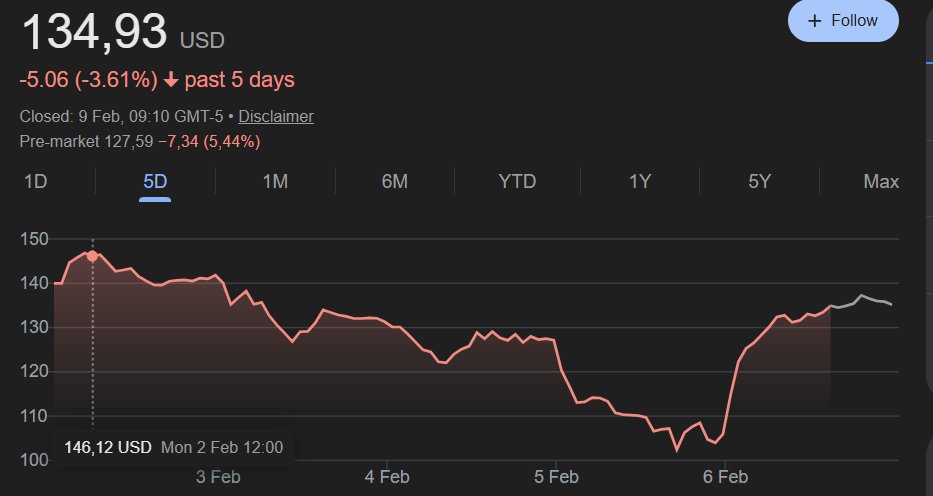
The only time these could have been sold is the early session on Monday Feb 2, because in all other times, the spot price was below $145.
Incidentally, the $78,815 per BTC purchase price was only available through the rest of the Monday Feb 2 trading session. There, $IBIT traded from $44.1 - $44.9, which is BTC at $77465.178 - $78870.442 (~1756.58 IBIT is 1 BTC).
It is effectively like Strategy did not sell any stock after Monday and did not buy any BTC after Monday.
BTC had two record days back to back later that week on Thursday and Friday (records for both price action and volumes) and Strategy basically sat through both days without moving.
Importantly, even though $MSTR had one of its strongest days on Friday, rallying 30% off of much higher volumes than in the prior week, no shares seems to have been sold.
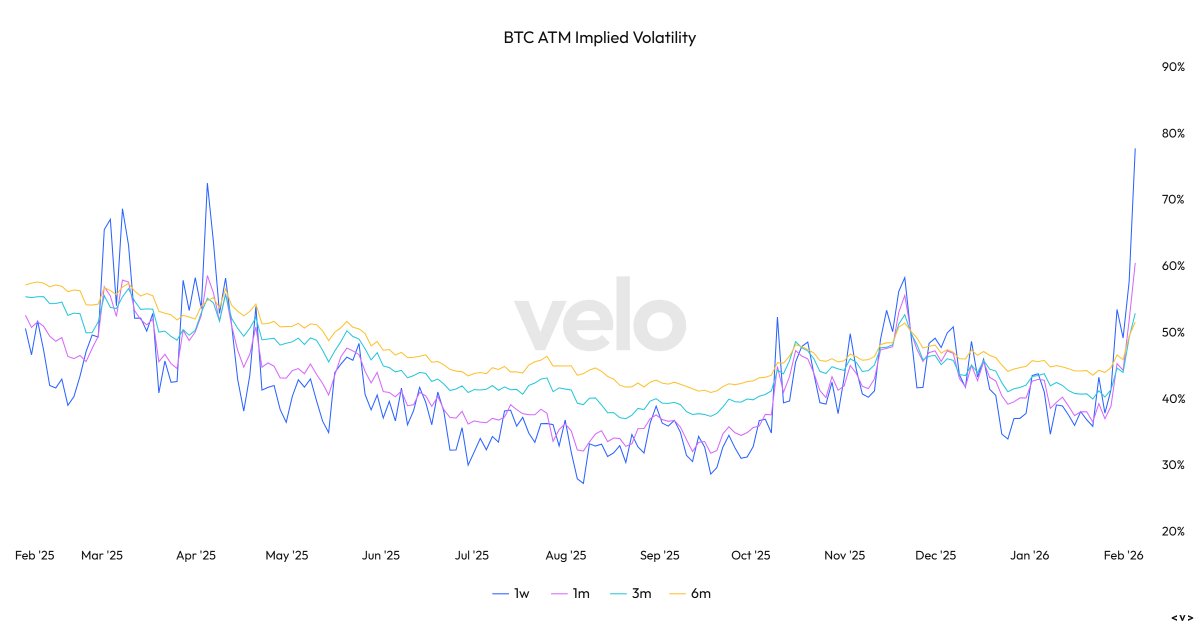
EXTREME FEAR: ATM implied vol for 1w and 1m at 52w highs.
The difference between the 1m IV and the 6m IV is 9%. The term structure is in very steep backwardation.
This was where things were at during FTX (Nov 2022)
Some indicators haven't gone there yet, but term structure has.
This bear market seems so bad because many suffered a huge revision of expectations.
ETFs, SBR, treasury companies, Trump's crypto support = SUPERCYCLE
People expected "stairway to heaven" for years and years.
Instead, the 4 year cycle materialized exactly on time. This shattered expectations.
Current price action is closely tracking that of prior bear markets. This bottom will be shallower just as this top was shorter. But the timing of events has been the same as before.
This report took me a while to compile and write. I put major effort into it, trying to stay as objective and as comprehensive as possible, while keeping the language, terminology, and industry jargon at a very understandable level.
I tried to make it clear where clarity was questionable and to be attentive to the details. I don't think it is perfect, but I think most readers will find it useful, even if they aren't deeply familiar with Bitcoin or finance.
I hope you enjoy! Link is in the post below.
Here is the growth of the 'Digital Credit' asset class since inception in February 2025.
It took Bitcoin almost 6 years to get to ~$7 billion market cap. Bitcoin backed credit took a few months.
Digital Capital = '0 to 1'
Digital Credit = '1 to N'
Big things ahead in 2026
People don't understand how undervalued bitcoin is today. Let's put things into context.
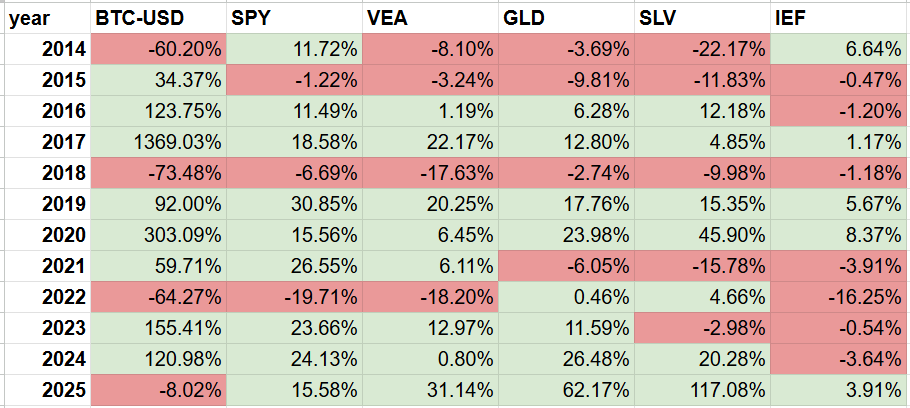
TLDR - 2025 is the worst year in Bitcoin's entire price history.
Yes, it's only -8% YTD and -30% from the top.
However, there has NEVER been a year where bitcoin was the only major asset that was down.
This table shows the yearly performance for $SPY (US stocks), $VEA (international stocks), $GLD (gold), $SLV (silver), $IEF (US debt), and bitcoin.
As you can see, in all years where bitcoin was down, a number of other assets were down too. If the year ended today, then this would be the very first year where this pattern was broken.
On top of that, non-fiat hard monies like gold and silver have had the best year in many years. Yet bitcoin, which is inherently a non-fiat hard money, has underperformed everything.
Meanwhile, the catalysts and positive developments for bitcoin could hardly be better. The regulatory, institutional, and corporate acceptance have been incredible.
We are seeing a historic divergence in value and many who are fading this today will be regretful in a few years.
One day that credit spread for $STRF will hit 0. After that it will be negative.
BBYCs (Bitcoin backed yield curves) will set the risk free rates in all major fiat currencies.
I penned this letter of the BFC-led coalition asking MSCI to withdraw its proposal to exclude digital assets treasury companies from index inclusion.
I believe the case is very simple and it has been made complicated by bad information and interpretations. Two arguments against the proposal:
1- If DATs are classified as a new type of company (which will be singled out in the proposal), then this marks the first time a GICS category is defined not by revenue source but by balance sheet mix and capital raising activities. In this case, MSCI should define all new types of companies based on all possible mixes of balance sheets.
2- If DATs are classified as investment funds, then it ignores the legal and regulatory classification of DATs as operating companies. If we are not going off legal classification, then what classification should we follow? MSCI should create a comprehensive classification framework that details the the exact point when a legally recognized operating company is considered an investment fund despite not being a legally recognized investment fund.
Clearly both paths are absurd.
This doesn't even get into the fact that if we draw an arbitrary "50% of balance sheet" line, then normal volatility could cause the balance sheet to swing over and under the threshold, meaning a company's index eligibility can change day to day or hour to hour.
Another clear absurdity.
Please consider signing the petition. And yes, Bitcoin will be fine either way.
What comes after "then they fight you"?
So Mamdani won in NYC (my hometown). This looks like a political topic but it is really an economic one. Gen Z (my generation) and Alpha are 99% economically screwed based on objective data that are displayed in https://t.co/4AFocMWu1D
If enough young people are disenfranchised by the current system, they are going to vote for anyone that will overturn it. In NYC and SF, this looks like backing a communist, because NY and SF lean left. In other places, this looks like TPUSA and Trump, because other places lean right.
Ultimately most people are wrong about the true issue and solution. Economics is the real issue, not politics or religion or immigration or anything else.
The real problem is broken money, caused by central banking and fiat. All other "problems" are downstream from this.
Unfortunately AI has made this picture significantly worse for most young people.
Most Gen Z cannot own anything because they are unemployable in a world where GPT-5 Thinking ($21/month subscription) is more capable than an entry level human. So these Gen Z will never get any money to invest in anything until their parents die and pass some wealth to them.
The situation will get a lot worse as AI develops further and the cost of more and more labor approaches 0. For the first time ever, we will see over 60% of the younger generation living with absolutely zero hope for a better future while the capital markets soar because of the increased productivity offered by AI. That cutoff number will go from 60% to over 90% in the next decade.
This is the perfect powder keg for an explosion of socio-political change. No one knows what is going to happen exactly.
The volatile path is of course complete societal upheaval. These situations do not redistribute wealth down. Rather, they redistribute poverty up via chaotic capital destruction.
The smooth path is probably UBI via CBDC and social credit system for the masses. Those with wealth will enjoy unparalleled mobility and freedom and abundance.
In conclusion, Bitcoin, hard assets, and volatility are so underpriced.
Preston: "You're dealing with a socialist environment. This isn't just the US, this is literally any advanced G7 economy."
Minutes later...
Preston: "Natalie, your point is WE HAVEN'T HAD CAPITALISM!"
Larry: "That's right"
Me: *Taps sign*
It’s very impressive how @bitwise's $OWNB ETF avoided the carnage in smaller bitcoin-treasury names while remaining fully long equities that hold BTC.
$OWNB has even outperformed Bitcoin since inception. Here’s how:
- Miner Exposure: Miners staged a powerful 2025 rally with the AI pivot. Some names saw triple digit moves, so OWNB’s meaningful miner weights helped lift returns via holdings like $HUT $CLSK $BITF $CIFR $RIOT
- Quarterly lag time for rebalancing: The index is rebalanced and reconstituted quarterly, with the fund adjusting shortly after changes are published; eligibility relies on quarterly and annual corporate filings. That cadence avoids “hot” adds and can sidestep early volatility around newly announced deals.
- Sifting for scale and liquidity: To enter the index, a company must hold ≥1,000 BTC and pass liquidity screens (market cap ≥ $100M, 3-month ADV ≥ $1M, and ≥ 10% public float). Those filters exclude many tiny, illiquid “emerging treasury” stocks that have heavily underperformed.
- Avoiding early PIPE unlock pain: Many newer deals are financed via PIPEs, where resale unlocks often trigger heavy selling; the index’s quarterly schedule means it isn’t forced to add right at announcement, helping avoid those initial unlock windows.
- Up to 20% exposure to businesses that hold bitcoin but may not have bitcoin as their core identity (called "Tier 2"). This added some diversification benefit via holdings like $XYZ $COIN $TSLA
--
Overall $OWNB is a better index for Bitcoin equities than bitcoin. Bitcoin is raw money. Equities should be compared against equities, and they should definitely beat bitcoin.
The BTC/GOLD price is closing in on the April lows when the tariff scare was at its absolute worst: 24.8 troy oz per bitcoin.
In October alone bitcoin dropped 14% in gold.
To return to cycle highs (Dec 2024), bitcoin will need to go from 25.3 to 40.7 troy oz: a 61% jump. If gold doesn't move over this time, then that puts the bitcoin price at $174K.
I continue to stack sats.
This model will become more common for smaller bitcoin treasuries, particularly private companies.
Absent the ability to efficiently issue credit instruments, monetizing the treasury is the next best way to generate excess income from holdings.
Lightning is one source of yield but it has a clear carrying capacity that scales with Lightning usage. As other L2s develop, the bitcoin yield options will expand.
Btw, retail and small businesses can get exposure to Lightning sourced bitcoin yield via Rails by @ambosstech - it's pretty legit. The yield is a lot smaller though.