Terraforming Mars is a hard problem. You need to warm the entire planet by tens of degrees and make enough oxygen for humans to breathe. But you don’t need to create a magnetic field to live outside on a terraformed Mars.
I think the first successful virtual cells are going to model prokaryotes, not eukaryotes.
It’s technologies like BioBloom that are going to be the difference between being able to collect enough data and NOT.
Thoughts? @ChanZuckerberg@DBBurkhardt@arcinstitute@joncalles
When you evolve bacteria, you get a random smattering of mutations.
Now, you can measure fitness for every possible SNP mutation in the genome with a single experiment!
BioBloom Libraries available on Addgene now! 🧪👇
This tube is a library of bacteria with every single-base-pair genome mutation, all DNA-barcoded.🧪Growth + barcode sequencing = data on millions of mutations.
📄 Report: https://t.co/llvs1wUbVk
Retweet if you want more data, and read on if you want to use the library! 🧵
@owl_posting Oh, I talked to a Real Journalist at one point, and they told me what the process is like. Checking my notes, it's basically "email the editor," and they sent me this video https://t.co/GhPDb6jZk6
@owl_posting The success of the best PIs I knew was more about the lab culture they fostered than their own personal knowledge. That being said, the figures that stand out to me are Adam Marblestone & Rob Carlson.
Automation software is not written in normal languages, and you lose a lot of features because of that! There's really no reason for it either, other than vendors being able to lock you in. So we use @pylabrobot.
Most lab automation software is proprietary, expensive, and painful for anybody who codes, so we ditched it. Our liquid handler runs on Python + PyLabRobot, and we're sharing our protocols open-source.
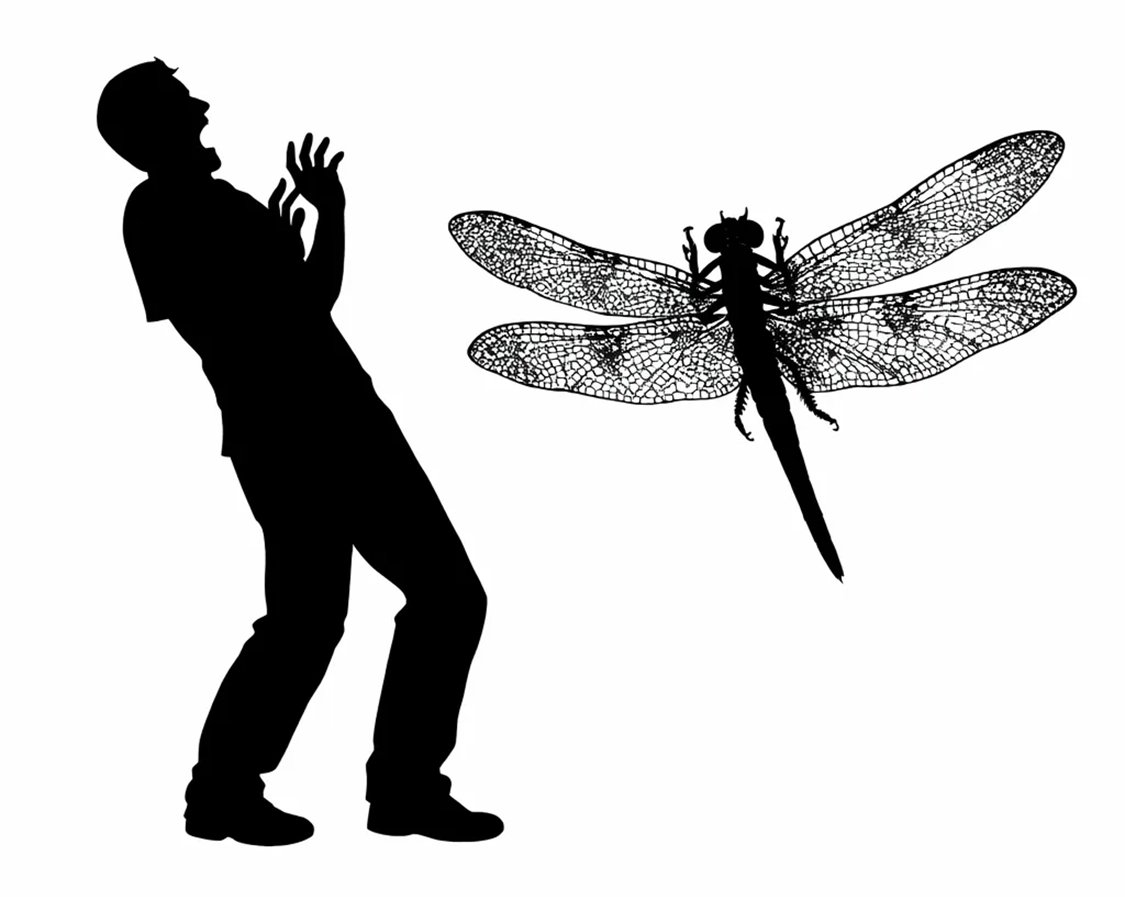
We spent months thinking about atmosphere models and climate calculations for a habitable Mars. We did not, until now, consider the maximum acceptable arthropod dimensions. 🦟
What if the key to becoming a multi-planetary species isn’t rockets, but microbes?
In the latest episode of Galaxy Balance, I sat down with Devon Stork, founder of the nonprofit Pioneer Labs, to explore a bold and necessary frontier: engineering microbes to support human life beyond Earth.
Devon’s work focuses ono microbial evolution as infrastructure, developing robust biological systems that can survive extreme environments and transform Martian regolith into usable soil. Rather than shipping everything from Earth, Pioneer labs is asking a deeper question: How do we let biology do the heavy lifting?
We discuss:
· Why microbes may be the first true settlers on Mars
· Designing evolutionary “chassis” for extreme environments
· Converting regolith into fertile soil using biology
· The role of open science in accelerating planetary-scale challenges
· What is really means to think about life support as a living system.
This conversation is about aligning evolution, engineering, and long-term human survival.
If you are interested in synthetic biology, space exploration, or how life adapts at planetary scales, this episode is for you.
#SyntheticBiology #SpaceBiology #Mars #MicrobialEvolution #OpenScience #LongTermFutures
In partnership with @Pioneer__Labs, we’re proposing Tesseract: a large-scale, open microbial phenomics dataset to functionally annotate microbial genomes at scale. 🧬🤖
✅5M diverse genes x 50 host strains × 100 conditions
🔗 Read the proposal: https://t.co/veVh0oPplB
@ramez As a scientist and author (under pen name) I think it's one part creative anxiety, one part torment nexus and one part clique mentality/solidarity. There's a couple people bullish on it - @alexanderwales has the best opinions here.
We learned something from each of these, and I hope that by sharing, we can help someone else learn the same lessons without the failure part.
Posting negative results publicly should be more normal!
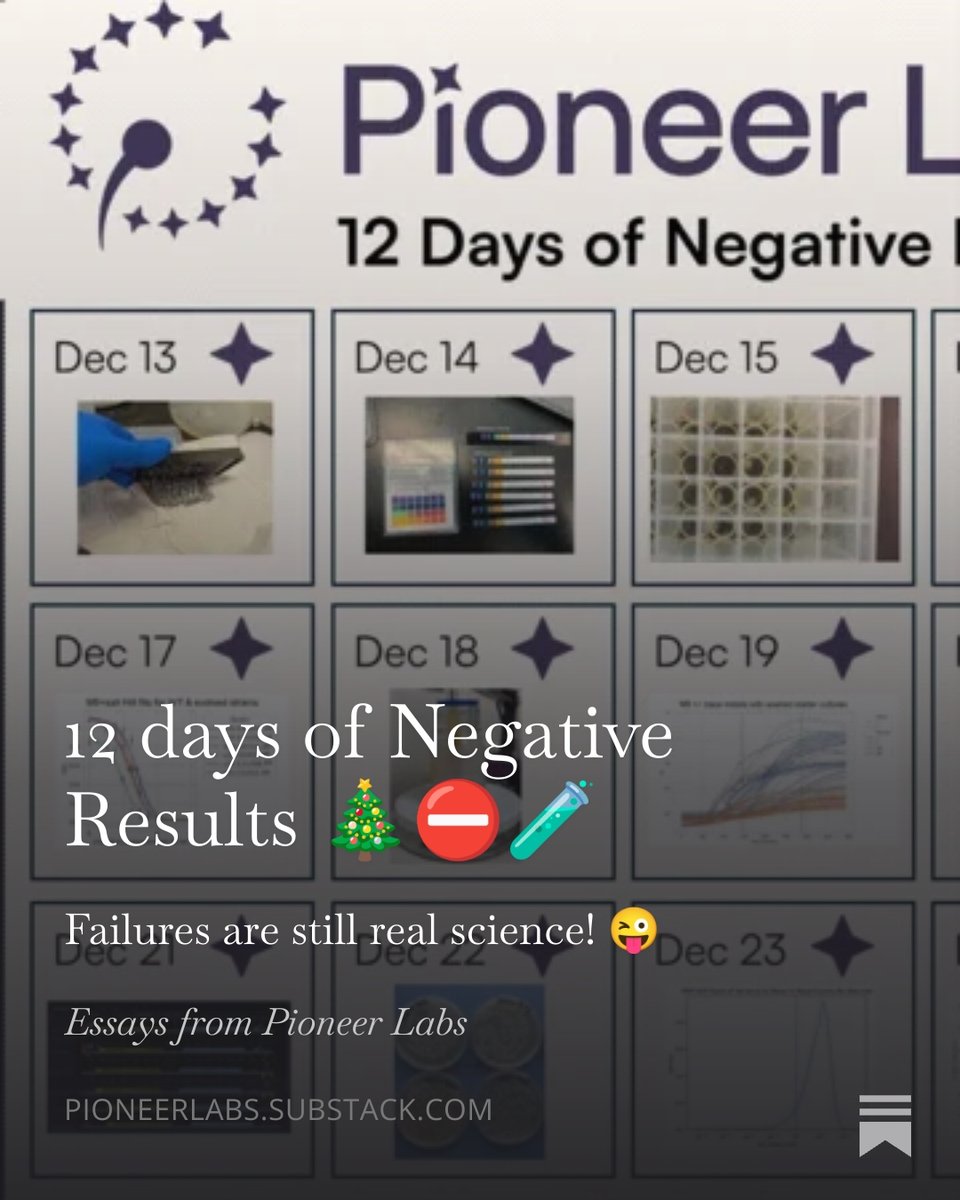
We just wrapped our 12-day Negative Results Advent Calendar 🎄⛔🧪 Now it’s all in one place, with extra context + a few runner-up failures we didn’t post the first time 📉🤦 Take a look for a behind-the-scenes look at how science happens. 🔬❤️https://t.co/l2poJytVem
That’s the end of our Negative Results Advent Calendar🎁🚫😜12 days of mistakes and weird data, and what we learned along the way🔬😅We'll post the collation of them all and a few honorable mentions tomorrow❤️
Not all libraries are created equal, and we're still figuring out which summary statistics and cutoffs to use when evaluating them. I'd love to hear any tips on Gini coefficients or Simpson indices, and how to apply them to large DNA libraries.
⛔ result 12: Some of our libraries are already pretty skewed before we start selection 😅📊 Not always bad enough to trash, but it means we need much bigger bottlenecks to avoid chopping off all the low-abundance members 🧬🔍🧵