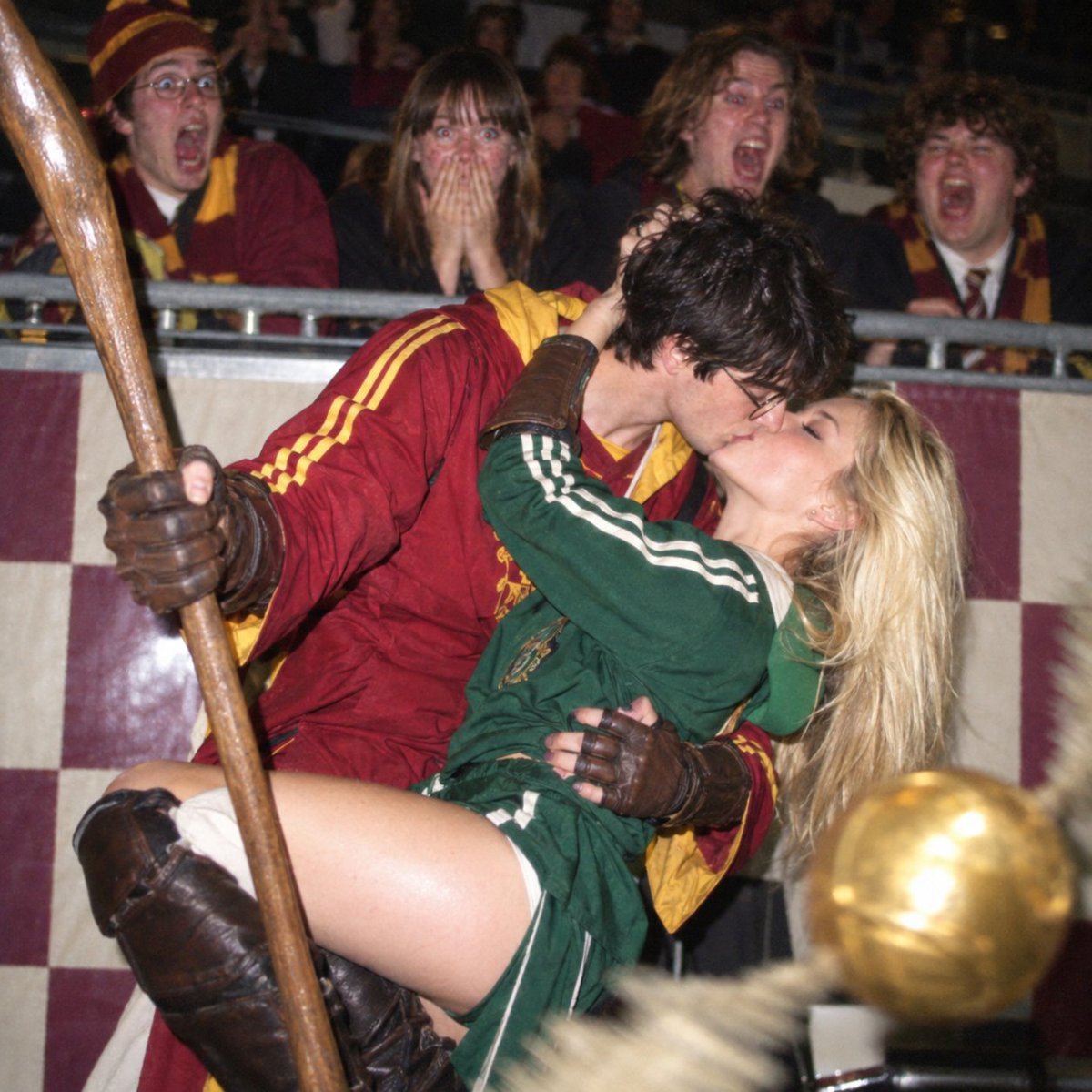
All the best people declare war on Hogwarts. Have you ever considered dividing your gender identity into separate pieces and storing it in hidden objects, so you can’t be invalidated to death?
After some recent trends, I finally decide to read the Harry Potter books.
And I came away with something I didn't expect.
I came away with an understanding of what makes a generationally beloved classic.
It isn't authorial skill. Rowling is certainly talented, but, at least at the time, she was also relatively unpolished, and the series has plenty of rough patches. Uneven pacing, awkward plots, exposition dumps, two-dimensional secondary characters. I could write quite a few lines about what might be fixed. And I probably will at some point.
But none of that matters.
Because a generationally beloved classic is almost never the best book of a generation. A generationally beloved classic is the book that most perfectly captures what that generation yearns for.
Hogwart's School of Wizardry did that for millennials, just as the quest to destroy the One Ring did so for the boomers.
Boomers grew up hearing tales of recent history, and the heroism of previous generations, who got us through the great depression, and the great war. Their father, or grandfathers, or both, were heroes. But they were left growing up in the 1950s, a near-ideal time of growth, happiness, and prosperity.
Near-ideal isn't ideal. Humans need goals. The boomers were left with no great struggles to fight, no great tasks to do, nothing that could make them feel like they measured up.
So they invented something. A new struggle. A moral struggle. They decided that, because the great depression, and the great war, had happened when the institutions of Western Civilization existed, therefore those institutions were responsible. That those institutions needed to be torn down, gutted, and rebuilt in the new Boomer Morality.
This was their great quest, what allowed them to imagine themselves heroes. As an added bonus, it allowed them to imagine that the men who fought WW2 were not. They were, after all, adherents of the old creed.
When the hippies took to the streets, chanting "fascist scum, your time has come", they meant the very same people who had fought the Nazis.
Lord of the Rings dovetailed perfectly into this narrative. Its central struggle, its great quest, is not a martial struggle or a political struggle, but a moral struggle... the quest not to seize an object of power, but to destroy one.
Frodo was not some great warrior, or wise wizard. He was an innnocent, whose virtue was moral worth. The young, unaccomplished, and very small man had to resist the temptations of power, and to destroy it, because it was wicked.
Is it any wonder that the boomers decided to tear down and hollow out the institutions of society, rather than inherit and incrementally improve them?
Even to this day, any younger person who seeks power, wanting to improve the world, is subjected to any number of brain-dead aphorisms about Boromir and the Ring.
Never mind that Tolkien never intended any of this. Never mind that the Ring wasn't a symbol of anything. It was a ring. It was evil not because it represented power... it was simply evil because it was made by evil for evil purposes, and possessed a malign will of its own.
LOTR, the way the boomers read it, fit perfectly into their worldview, and they imagine themselves perpetual revolutionaries, always fighting the evils of power, even now when they are 70 years old and own everything.
Which brings us to millennials. They grew up in the world that the gutting of Western institutions left us. They went to government schools run by characters straight out of a Franz Kafka novel, sent there by parents who inexplicably hated them from the time they were old enough to talk.
When they yearned, they didn't yearn for a great moral struggle, or to tear anything down, or to be revolutionaries.
They yearned for a society that cared about them, for parents who loved them, for a civilization that saw them as the future, and invested in them accordingly.
They wanted to go to Hogwart's. They wanted get a letter by owl, telling them that the reason they didn't quite fit wasn't because they were inadequate, but because they were special.
They wanted to be the special ones, the chosen ones, the boys and girls who lived. And that last sentence may sound a bit conceited... until you realized that when they wanted to be special, they wanted to be special in precisely the way that Harry Potter was special, the way that every child in a healthy family is naturally special... not because he is talented or great, but because his mother loved him.
This is what saved Harry Potter in the inciting incident of his young life. This is what millennials wanted for themselves. Not to be astronauts and war heroes and rock stars, but to fit into a place like Hogwarts. To be mentored by wise and caring elders like Dumbledore. To be part of a community. To have mothers who loved them.
To write a story like this isn't necessarily to understand a generation, because it never seems to happen except by accident.
It is, rather, to help a generation understand itself.
That's why fan fiction, with visions like this picture, matters. Not because it has so large a footprint as to change the world, perhaps, but because it represents the spirit of an age.
It tells us what people want. And if we look carefully, it tells us why.
Make no mistake. The Jensen Huang scandal isn't just a story about someone's private life.
It's a lever. And it's going to be used for one thing: taking control of AI.
I'm not saying the facts are made up. Jensen admitted the affairs, and the investigation should run its course. I'm saying: look at what's being built on top of it.
Look at the sequence.
Early November, Democrats win both chambers of Congress. Right after, they announce a flood of AI bills.
One congresswoman calls for a pause on advanced AI development and a ban on superintelligence, on day one. A bill introduced in the House would create a federal Department of AI with the power to decide which companies are allowed to build advanced models. A senator wants a federal AI Safety Board with mandatory standards. Others want mandatory testing before any model is released.
Translation: tomorrow, to release a model, you'll need permission.
And who was standing in the way? Jensen.
He fought export restrictions he saw as counterproductive. He fought the state-by-state patchwork of AI laws. His very first post on X was a letter signed by Nvidia on a single topic: why open models matter. Safety, innovation, sovereignty. The world needs both closed models and open models.
Nvidia is one of the most powerful companies on the planet publicly defending open weights.
And now, in Washington, analysts are saying it out loud: the scandal has broken Nvidia's ability to slow those bills down.
For those who want to lock everything up, the timing is perfect.
Why does this matter so much? Because open source is the only thing standing between AI and a tool of control.
If AI stays open, anyone can download a model, inspect it, modify it, run it on their own machine. A student in Lagos. A small business in Ohio. A dissident in Hong Kong. No one can switch it off. No one can decide for them what the machine is allowed to say.
Kill open source, and what's left?
A handful of closed models. Licensed. Tested, approved, monitored by a federal agency. And when an agency decides what an AI is allowed to say, it decides what billions of people will read, learn and think.
That's not a technology anymore. That's a Ministry of Truth with an API.
And don't believe for a second these rules will hurt the giants.
George Stigler, Nobel laureate in economics, showed it: regulation almost always ends up captured by the very players it claims to rein in. A multimillion-dollar license? The giants pay it without blinking. A ten-person open source lab can't. Bureaucrats write the rules, the biggest players write them alongside them, and everyone else disappears.
A caste of bureaucrats, backed by a few billionaires rich enough to buy their ticket in. That's what the closed world looks like.
Europe already went down this road. The result: models launch in the US and China, and reach Europe months later. If they reach it at all.
And while America gets ready to handcuff itself, China is shipping open-weight models one after another and giving them to the whole world.
My read: the Huang scandal will be the first pretext. Not the last. Every incident, every fear, every headline will be used to close one more door.
If AI stays open, it belongs to everyone.
If it closes, it belongs to whoever hands out the licenses.
And that day, it's game over.
@katie_campione Boys are fascinated with being warriors because someone has to be. You exist behind the security barrier of a network of men ready to do violence to ensure you get to sit peacefully in your living room and make the millionth post shitting on them.
@travis4nh Murdered a kind Muslim interpretor and his family by locking them in their home in the middle of the night and burning it to the ground, for the crime of helping the US Army build roads, remove lakes of sewage, and create the first trash collection service in Baghdad's history.
Cut off the head of my high school friend on video back in 2004 for the grave sin of trying to build radio/cell towers in a newly liberated country.
Murdered the (muslim! local!) manager of my favorite place to stay in Jalalabad for showing hospitality to foreign aid workers.
Hijacked American Airlines Flight 11 that my coworker Peter Hashem was a passenger on, and flew it into the North Tower of the World Trade Center, murdering him and thousands of other people.
@nisedo@steipete It’s just fear. The handcrafted artisan being replaced by a factory. Pretty old tale at this point.
Except actual software engineering doesn’t go away. I feel busier now than I did ever before in my career. It’s wild.
@FatBoyBreeder@nisedo@steipete All innovation starts with a copy of something existing.
Sounds like someone here at least hasn’t done something of value. Otherwise this would be known.
@Stammy@dhh Same here. I thought I saw an update that said it was fixed yesterday , but that didn’t work for me either. However it was able to remove the partially created partitions it made this time though.