Polymarket may be building the biggest upgrade prediction markets have ever seen
I’ve been digging through the new Polymarket v2 contracts and found something much bigger than “parlays are coming.”
Under the hood, this looks like infrastructure for trading entire probabilistic scenarios.
A new contract called Combinatorial Module was deployed and verified on Amoy testnet, and the deployer is linked to an address Polygonscan labels as Polymarket: Deployer 1.
So this does not look theoretical anymore.
The core idea is simple:
instead of trading isolated events, traders could trade entire chains of outcomes as a single position.
Right now prediction markets mostly work like this:
1. Trump wins
2. BTC above $150k
3. Fed cuts rates
4. Recession in 2026
Each market exists independently.
But real traders rarely think in isolated events.
They think in causal chains.
For example:
If Trump wins, crypto gets a regulatory tailwind, BTC rallies, risk-on returns, and capital rotates back into high-beta assets.
The interesting part is that the new module allows this exact structure to become one position:
1.1 Trump wins
1.2 AND BTC > $150k
1.3 AND Fed cuts rates
Not three separate bets.
One asset, one payout, one expression of a worldview.
And if all legs resolve correctly, the position pays out $1.
That means traders can buy cheap convex exposure to an entire macro thesis.
If the market prices the scenario at 8¢ and the full chain plays out, the position settles for $1.
This is where prediction markets start looking less like betting apps and more like probability derivatives.
What makes this even more interesting is that the module appears to work cross-category.
Sports, politics, crypto, macro, geopolitics — anything represented as binary/negrisk conditions can theoretically be combined.
The contract supports up to 50 legs in a single structure. And the positions are not static.
The code includes mechanics for:
– splitting positions
– merging them
– extracting legs
– recombining scenarios
– compressing resolved conditions
– and wrapping existing binary markets into combinatorial positions.
In other words:
this is not just “build a parlay and wait.”
It is closer to building dynamic scenario structures that evolve as the world changes.
The NO-side is where things become especially interesting!
There is a very important distinction here:
NO(A AND B AND C) is NOT the same thing as:
NO(A) AND NO(B) AND NO(C)
The first one is the complement of the entire scenario:
NOT(A AND B AND C)
meaning the structure fails if any part of the chain breaks.
That subtle difference is why these markets become much more sophisticated than standard YES/NO betting.
The market is no longer pricing isolated outcomes.
It is pricing the stability of an entire connected narrative.
This opens the door to a completely different class of products.
At that point, prediction markets stop being “Will X happen?”
They become:
“Which version of the future is currently mispriced?”
There are still two massive open problems.
The first is liquidity.
Every scenario gets its own conditionId / positionId, but the contract itself does not imply that every combination will have its own standalone orderbook.
And if liquidity fragments across millions of possible scenarios, the system breaks immediately.
Which means the real unlock is probably synthetic pricing and routing:
using liquidity from underlying markets to construct and price scenario positions dynamically.
The second challenge is UX.
Because probability algebra gets confusing very quickly.
Most users will not intuitively understand the difference between:
NO(A AND B) and: NO(A) AND NO(B)
So the challenge is no longer just building markets.
It is building interfaces that make complex probabilistic structures understandable to humans.
If Polymarket solves liquidity and UX, v2 may become much more than a prediction market upgrade.
It could become the first real probability trading layer for the internet.
Bullish.
Huge W @devjoshstevens@mustafap0ly@Polymarket@PolymarketDevs@SuhailKakar
Ever since Duncan Robinson was a little kid, his big brother, Eli, was his biggest fan. While Duncan carved out a career, Eli had his personal struggles. And last year, his suffering was just too much. This is their story of loss and love (told with the incredible @simonpb17)
@elonmusk Thank you, @elonmusk - the four of us glimpsed the red hues of Mars far in the distance as the sun slipped behind the Moon and there was zero doubt in our minds that the creative genius of our greatest minds will have us there very soon. LETS GO
You have no experience.
You’ve never started a company.
You’ve never had a full time job.
Nike is going to kill you.
You’re a kid.
You don’t have technical skills.
You shouldn’t build hardware.
Apple is going to kill you.
You can’t build hardware.
You can’t measure heart rate non-invasively.
Athletes don’t care about recovery.
Under Armour is going to kill you.
It won’t be accurate.
You don’t listen.
You’re an ineffective leader.
You can’t recruit great talent.
You’re going to have to pay every athlete.
You can’t measure sleep non-invasively.
It’s too expensive to research.
Athletes are a small market.
The product costs too much to make.
The product costs too much to sell.
Your valuation is too high.
Consumers aren’t going to want it.
Hardware is too hard.
You should measure steps.
Fitbit is going to kill you.
You can’t build a marketing engine.
You can’t raise enough money.
You need a real CEO.
Google is going to kill you.
You can’t be a subscription.
You can’t build a brand.
You can’t do consumer in Boston.
Your valuation is too high.
You shouldn’t make accessories.
You shouldn’t make apparel.
Lululemon is going to kill you.
You can’t predict Covid.
Stay in your niche.
You are going to run out of money.
You can’t build a health platform.
Amazon is going to kill you.
You can’t measure blood pressure.
You can’t get medical approvals.
The market is too small.
You don’t understand AI.
The market is too competitive.
It won’t work internationally.
The supply chain is too complicated.
You can’t build an AI.
You can’t raise enough money.
It’s too competitive.
Healthcare isn’t going to want it.
…
Just keep going ✌️
Mr Beast lined up one person from each age 1-100 and had them race to a finish line, and the overhead camera is an oddly beautiful data visualization of speed by age.
When we write a check, we're usually the first people to believe in a founder. (After their mother, of course.)
And that belief had value beyond the money.
Having "Draper" next to your name opens doors. It gives you credibility. It signals to other investors, customers, and partners that someone serious believes in your vision.
Just know:
We are venture capitalists, not operators. You will have to do that yourself.
Now go build something that makes me look like a genius for believing in you.
Founders building in public: be early on this.
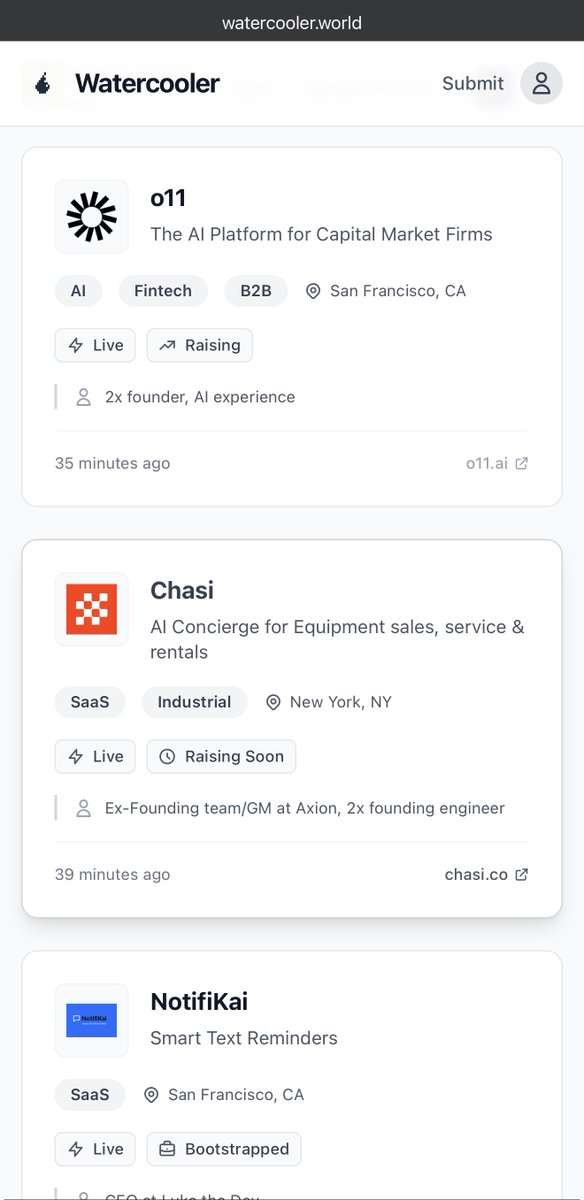
Just launched watercooler - a platform for founders building startups to get discovered. VCs, scouts, angel investors, and more all are hungry to find the next unicorns.
Join now and show off while the platform grows
https://t.co/uF0nCo7vlD