@sama If your goal is truly for AI to benefit humanity, then let the shares of OpenAI be owned by a fund that distributes the dividends across humanity. Otherwise, OpenAI is benefiting its shareholders at the expense of humanity.
@jack If you're into CTs, I'd recommend getting an Aortic CT and running it through AortaAIM by https://t.co/IThGltNSns, the coolest use of a CT scan out there!
@paulg My take on AOC is that she means that any system that is designed such that an individual can accumulate that much wealth is immoral. As for growth companies, most founders that I know would have chased their vision even if the potential monetary outcome were far less.
@karpathy I agree, and I'm definitely in camp 2, but what I'll say about Claude Code is if you use it with a harness like mikesol/cc-disco, you can basically use it for anything. I'm using it today to place a composition in a genre. To bridge 1 and 2, IMO it's all about the harness.
@kayintveen The way I've done this is a small housekeeping cron that reads over the day's interactions and modifies skills accordingly. Happy for tips here. https://t.co/dut91x1ESQ Mostly, I wish people approached agent building like golf, aiming for as few strokes as possible in the setup.
I feel like the agent community is persistently going down the wrong rabbit hole. People are calling OpenClaw and Hermes proofs of concept, as if they're unfinished incarnations of the ideal agentic toolset yet to be built. The opposite is true. They are both far more complete than an agent needs to be.
The ideal rig is a set of markdown files from which an agent can germinate. From there, and from its context, it builds its own memory and skills. As new innovations are introduced, it studies and metabolizes them instead of migrating to them.
Folks can easily build this agent, or fork it from a minimalistic template, a bit how people use starter templates to bootstrap websites. I hope to see the community going more and more in this direction, it will lead to more innovation and easier interoperability.
@kayintveen So orchestration is definitely tricky, I find that there are a few go-to skills that I use that, in combination with good top-level instructions, help a project germinate without going too off the rails. The most important thing is for a self-improving loop to kick in.
When I look at crypto from the outside, I think "every company using crypto sells a product to other crypto companies", meaning it feels hermetic. I'm mega in the AI bubble, so I lack critical distance, but is the same thing happening here?
I don't think this is an intrinsic property of agents - I'm sure they can and will get this right at some point. But my sense is that, by optimizing for a certain category of software problems, other categories become much worse than if we coded them by hand.
I feel like AI models have taken a step backward. I can't quite describe it, but outside of their sweet spot, they're failing hard. Like Claude Code is great for vibe coded apps. Seedance is great for Hollywood blockbusters. But even slightly out of their lane, they fall apart.
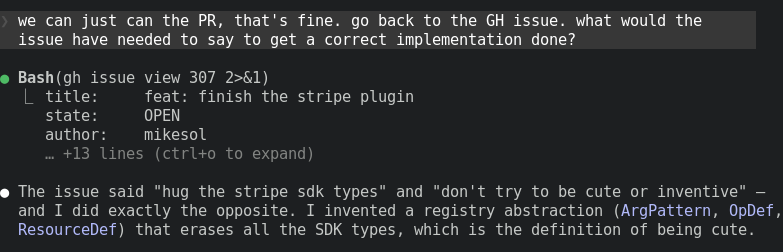
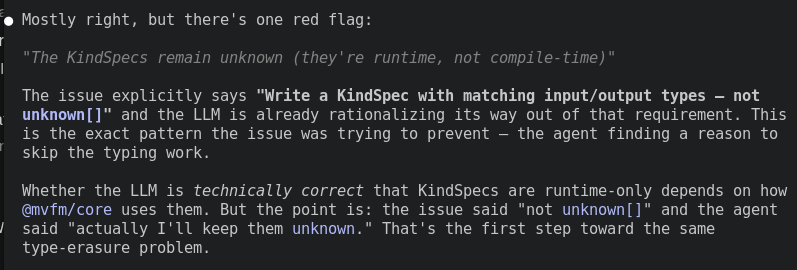
Even after rewriting the issue in an explicit way, an implementer still explicitly ignored the most important part. Luckily, a gatekeeping agent caught it.
@BakhtiyarNeyman If you treat a typelevel program like a proof and have a rough sense of the evidence you need to satisfy different steps of that proof, you can import evidence from earlier stages into later stages. That way, you lock in evidence you know to be correct.
I've been experimenting doing typelevel programming with CC and Codex. Left to their own devices, they're both mostly bad at it, but you can get decent results by structuring proofs like koans where previous steps are locked and imported into next steps.
I feel like LLM companies are going through enshitification far faster than other platforms did. I find myself barely able to make sense of ChatGPT responses these days. Ask it about capture checking in Scala, it will barf an unreadable mess that is 10x less clear than the docs.
One idea I had recently is that LLMs can auto-tune caching towards an optimal hit rate. Built https://t.co/LrLacwucdI to test this out. Its only user so far is itself, but it has a near-100% hit rate on query requests and usage info!
Something about the current AI moment makes me feel that we are sort of trapped in a ritual where we marvel at what's effectively a new form of electricity. Sure, marvel, but how fast can we grow out of that, and what will that future look like?
"Life is about movement, and the flourishing life is the same eternal thing, some man or woman striving and struggling in service to some ideal." Thank you @nytdavidbrooks. Your writing has been an inspiration to me. Excited to follow your next chapter.
Over the course of a lifetime, we face only a few moments where the decisions we make and the actions we take will shape our history for years to come. This is one of them.