Argentina’s behavioral crisis in the World Cup final has brought to light traits many of us in Latin America have internalized and that we need to come to terms with.
In many countries, emotional self-control and the ability to admit mistakes are seen as virtues. A behavioral problem in parts of Latin America is that there are social circles where the opposite is often celebrated.
This is the idea that someone who remains in control of their emotions is a coward or, depending on the situation, a traitor.
If someone offends you, your family, your team, the reaction that is celebrated in these circles is not restraint but flipping the table. The more berserk you go, the more you show that you care. That is a harmful value to hold, and also, one that many of us once shared. I certainly had it internalized when I left Chile 20+ years ago. In fact, I’ve spent much of my adult life trying to unlearn what I grew up believing was the socially acceptable behavior.
The second trait is an unwillingness to admit mistakes. You can always find an excuse, move the goalposts, or, once again, start a fight instead of publicly accepting that you’ve made a mistake. Admitting fault is a sign of weakness. Defending a losing position is a symbol of courage or, in sports, a test of loyalty.
Together, these two traits are behavioral dynamite. People explode because they cannot admit fault, and double down. Instead of learning from their mistakes, they become prisoners of them.
I grew up watching football with my father. When I was 10 or so, I was learning what was right and wrong from the way he interpreted the game. This included behavior both on and off the field. Only later in life did I realize that every penalty he called for, or contested, had little to do with the play itself. Whether a call was fair depended entirely on which team benefited. He was happy if his team received a nonexistent penalty or an opposing player got an undeserved red card.
These traits are among the things that pushed me away from the continent. They are certainly not exclusive to Latin America or the Southern Cone. I’ve encountered them in people all over the world. In an important sense, these are behaviors that all of us exhibit as children. What strikes me as unusual from the place I am from is having been part of social circles where these behaviors were not seen as flaws of character but as virtues to be admired, celebrated, and enforced.
These excessive forms of pride are not conducive to learning. They make it psychologically difficult to update one’s beliefs, accept responsibility, or improve. Although they become particularly visible in sports, they are by no means confined to them.
Something I am proud to have learned is to apologize quickly and often. Not because it is too difficult, but because it was like learning a new language at old age. That doesn’t mean becoming a pushover. But I’ve learned that a man who never apologizes cannot be a man of integrity, because we all make mistakes.
Argentina’s behavior on and off the field during the World Cup final was, to me, a particularly blatant expression of values that many people continue to defend. In some circles, these attitudes have become intertwined with ideas of national identity and loyalty. Yet they are shackles that ultimately limit our development, not because they make us lose a football match, but because they make it harder for us to learn from our mistakes.
The right thing to do now is the least likely: offer an honest apology. If my interpretation is even partially correct, we are more likely to see the opposite. Never back down. Never apologize. Never control your emotions. There is such a thing as having the wrong values. I hope that one day we can do better.
Det krävdes alltså att den europeiska industrin hamnade i respirator och uppvisade klinisk hjärndöd innan EU-byråkraterna lyckades lokalisera sitt eget förnuft.
EU-kommissionen har drabbats av en akut attack av verklighetsförankring och inser nu att Europa håller på att förvandlas till ett ekonomiskt u-land. Så de föreslår att mildra kraven i utsläppshandeln, en efterlängtad livlina för att stoppa det ekonomiska förfallet. Men i SVT-studion utbryter direkt landssorg. Reportern förklarar med darrande röst att detta minsann kommer att missgynna "svenska gröna satsningar". Det blottar ju hela bluffen: våra skattefinansierade fantasiprojekt är alltså så usla att de blir helt värdelösa så fort EU drabbas av minsta lilla uns av sunt förnuft. Vi har skapat en religiös sekt där framgång mäts i hur effektiva vi är på att avindustrialisera oss själva medan resten av planeten gasar på som vanligt. Sen toppar de eländet med att ta in Centerpartiets Emma Wiesner som gråter ut över att EU sänker ambitionerna och går "extremhögern" till mötes. Att vilja undvika ekonomisk härdsmälta är alltså en högerextrem konspiration nu. Man måste ju bara älska den totala opartiskheten.
Tänk att ingen i den där studion har intelligensen att förklara att när en fabrik stänger i Europa och öppnar i Kina, så försvinner ju inte utsläppen från atmosfären. De byter bara postnummer. Koldioxiden bryr sig liksom inte om ifall den släpps ut i Ludvika eller i Shanghai, men den lilla detaljen är tydligen överkurs för Public Service. Det enda vi uppnår är att vi flyttar utsläppen till andra sidan jordklotet, utraderar de jobb som finansierar vår egen välfärd, och rullar ut röda mattan för Kinas totala ekonomiska dominans.
Hur kan man sitta i en tv-studio med ett rakt ansikte och försvara en politik som gör oss fattiga utan att rädda ett enda gram koldioxid, samtidigt som Kina tar emot vår industri och bygger nya kolkraftverk för att fira?
Now, Class, repeat after me. I will never buy cyclicals at low PEs and record earnings. Say it again. I will never buy cyclicals at low PEs and record earnings.
You know what shook me when I was Muslim?
The story of Hosea. God tells a prophet to marry a woman He knows will betray him.
She does. She runs to other men. She ends up enslaved, sold, used up, worthless to the world.
And God tells Hosea to go BUY HER BACK.
To pay money for his own wife who cheated on him, and love her again. Hosea 3.
I thought it was the most humiliating command in the Bible. Why would any man do that?
Then I realized I was the wife.
I gave my heart to everything but God. I chased other masters. I sold myself cheap. I made myself worthless.
And God looked at me, the betrayer, and didn’t say “you’re not worth it.”
He said, “Name the price. I’m buying her back.”
That’s the Gospel. God doesn’t wait for the unfaithful to come crawling back clean.
He pays to redeem them while they’re still dirty.
Islam told me to make myself worthy of God.
Hosea showed me a God who pays to redeem the unworthy.
The cross was Him naming the price.
Praise the Lord.
Let me put in simple terms what BIS is saying here.
The Ai bubble is now a self-feeding disaster that can’t be rescued. Hyperscalers must borrow and keep increasing capex higher every quarter for eternity. Every quarter the situation grows more disastrous, but the entire financial system risks collapse the second the debt ends. It’s unavoidable.
$meta $orcl $soxx $dram
@WesleyLHuff "I lift up my eyes to the mountains— where does my help come from?
My help comes from the LORD, the Maker of heaven and earth." Be strong Wes! The LORD he will not be late nor will you miss out! "those who wait on him rise on wings like eagles!"
A Japanese immunologist spent 20 years proving that the chemicals trees release into the air walk into your bloodstream, hunt down your stress hormones, and arm your immune system in ways no therapist or pharmaceutical has ever matched, and most of the data has been sitting in Japanese medical journals for two decades waiting to be translated.
His name is Qing Li.
He is a clinical professor at Nippon Medical School in Tokyo and the president of the Japanese Society of Forest Medicine. The Japanese government has been funding his research since 2004, and the body of work he has produced is the reason forest bathing is now an officially prescribed clinical therapy in Japan and Korea.
The story actually starts in 1982, when the Japanese Ministry of Agriculture, Forestry and Fisheries coined the term shinrin-yoku to describe the practice of slow, mindful walking in a forest. They did it for a practical reason.
Japan was urbanizing fast, stress-related illness was climbing, and the country had thousands of square kilometers of forest sitting unused. The idea was to give people a reason to walk into the trees... They had no idea what was actually happening to the human body during those walks until Qing Li ran the first proper experiment in 2005.
He took twelve healthy adult men on a three-day, two-night trip to a forest park. They walked for a few hours each day. Nothing strenuous. No prescribed routes or breathing exercises. They simply walked slowly through the trees, breathing the air, looking at the forest.
Li drew blood and urine samples before the trip, on the second day, on the third day, on day seven after returning home, and again on day thirty.
The numbers that came back from the lab were not what anyone expected.
The activity of a specific type of immune cell called the natural killer cell, which is the cell your body uses to hunt down cancer cells and virus-infected cells before they can spread, had jumped by roughly 50 percent during the forest trip. The actual number of natural killer cells circulating in the bloodstream had increased significantly.
Three different anti-cancer proteins that those cells produce, called perforin, granzymes, and granulysin, had all risen sharply. And the effect did not disappear when the men went home. The immune boost was still measurable on day seven and was still partially present on day thirty.
Two hours a day in a forest had upgraded the immune system for a full month.
Li ran the same experiment with women a year later and found nearly identical results. Then he ran it with a control group who took a three-day trip through an urban area with the same amount of walking, the same hotel quality, and the same diet.
The urban group showed no measurable change in natural killer cell activity at all. The forest was doing the work, not the vacation.
The mechanism turned out to be a class of airborne molecules called phytoncides. Trees produce these compounds to defend themselves against insects, bacteria, and fungi. Pine, cedar, oak, and cypress trees release them in particularly large amounts, especially in warmer weather and after rainfall.
When you walk through a forest, you are inhaling those molecules into your lungs and absorbing them through your skin, and once inside your body they appear to directly stimulate the production and activity of the very immune cells Li was measuring in his lab.
Roughly 50 percent of the health benefit of a forest walk, according to Li's data, comes from the chemistry of the air itself. The other half comes from what the forest is doing to your nervous system.
This is where it stops being only about the immune system and starts being about stress.
A separate Japanese research team measured cortisol, the body's main stress hormone, in 84 participants across 35 different forest sites. They drew samples before and after a 30-minute walk in each forest and compared them to control walks in matched urban environments. The cortisol levels of the people who walked in the forest were lower than the cortisol levels of the people who walked in the city by a significant margin. Their heart rates were lower. Their blood pressure was lower.
The activity of their parasympathetic nervous system, which is the part responsible for rest and recovery, had gone up. The activity of their sympathetic nervous system, which is the part that drives fight or flight, had gone down.
Then a researcher at the University of Michigan named MaryCarol Hunter ran the cleanest version of this experiment ever done. She recruited participants from a city and told them to take a nature pill three times a week for eight weeks.
They were free to choose the time, the place, and the duration of the nature experience, as long as it was outside, in daylight, and free of phones, conversations, and aerobic exercise. They sent her saliva samples before and after each session so she could measure cortisol changes accurately and rule out the normal daily drop in stress hormones that happens to everyone.
The result was that participants experienced a 21.3 percent drop in cortisol per hour spent in nature, with the biggest payoff happening between minutes 20 and 30 of the walk.
After that, the cortisol kept dropping, but more slowly. The threshold dose for measurable stress relief was just 20 minutes outside in something that looked and felt like nature.
What none of this means is that nature is a substitute for therapy or for medication when someone genuinely needs them. Therapy treats different things than a walk does, and Li himself has been careful in interviews to call forest bathing a complementary intervention rather than a replacement for clinical care.
But what the research has settled is that the human body has a physiological response to being among trees that operates on the same biological systems modern medicine is trying to reach with drugs and clinical protocols, and that response is fast, measurable, and free.
The strangest part of Li's work is the implication he keeps repeating in interviews. The average person now spends more than 90 percent of their life indoors. Their cortisol stays elevated. Their natural killer cells stay sluggish.
Their parasympathetic nervous system rarely gets a chance to take over. The system that was tuned by millions of years of life under a canopy of trees is being asked to run permanently inside a box made of drywall and screens.
Your body has not forgotten what it is supposed to do in a forest. It is waiting for you to walk into one.
I have found the key to happiness is gratitude. The thankful are by nature humbled by the grace of others and cognizant of the miracles that surround us every single day.
Was there ever in those historic V bottoms any company or traders like Jane street, that systematically shorts and dumps instruments or commodities, or tools like the modern short selling? I appreciate your post, but todays comex feels so manipulated and systematically abused that idk if history actually will or can repeat itself in this case.
Andrew Jackson destroyed the Second Bank of the United States in 1836, delivering the single greatest blow to financial tyranny in American history. You won't hear this story told correctly in any economics textbook, because it reveals how central banking works: as a government-sponsored cartel that redistributes wealth from productive citizens to politically connected bankers.
The Second Bank held a 20-year federal charter starting in 1816. It controlled the money supply, issued currency, and held government deposits. Sound familiar? Nicholas Biddle, the bank's president, wielded more economic power than any elected official. He could trigger financial panics at will by restricting credit. He bought newspapers and bribed congressmen. When Jackson opposed recharter in 1832, Biddle deliberately crashed the economy to punish him.
Jackson called it "a hydra of corruption" and he was right. The bank created artificial booms through credit expansion, then triggered busts when politically convenient. Biddle openly bragged about manipulating markets. Free market economists and Jackson both recognized the core insight: this was legalized counterfeiting with government backing, not free market banking.
The political establishment united against Jackson. Henry Clay, Daniel Webster, and the entire Whig Party defended the bank. Biddle spent millions buying influence. The press attacked Jackson as an economic ignoramus. Every "respectable" voice supported recharter. Jackson stood alone with the American people.
After Jackson killed the bank, the country experienced the strongest economic growth in its history. From 1837 to 1862, America operated without a central bank. Industry flourished. Wages rose. Innovation exploded. This wasn't coincidence. When you stop subsidizing financial speculation and let productive capital find its natural home, prosperity follows.
Central banks don't stabilize economies: they destabilize them for private gain.
The Iranian navy, which has been destroyed eight times, has apparently closed the Strait of Hormuz again, because the United States, for the seventh time, won the war that wasn’t a war, so now the United States has to open the Strait of Hormuz that was already open before the not-war began.
The not-war began because Iran had uranium that was totally, completely, beautifully obliterated, so they can’t build the nuclear bomb they weren’t building, which is why the United States had to start the not-war it definitely didn’t start.
Now the United States, which has nuclear weapons, is threatening to use nuclear weapons to stop Iran from getting nuclear weapons, because nuclear weapons are far too dangerous for countries with nuclear weapons to allow other countries to have.
If the United States saw the United States doing what the United States does in other countries, the United States would invade the United States to liberate the United States from the tyranny of the United States.
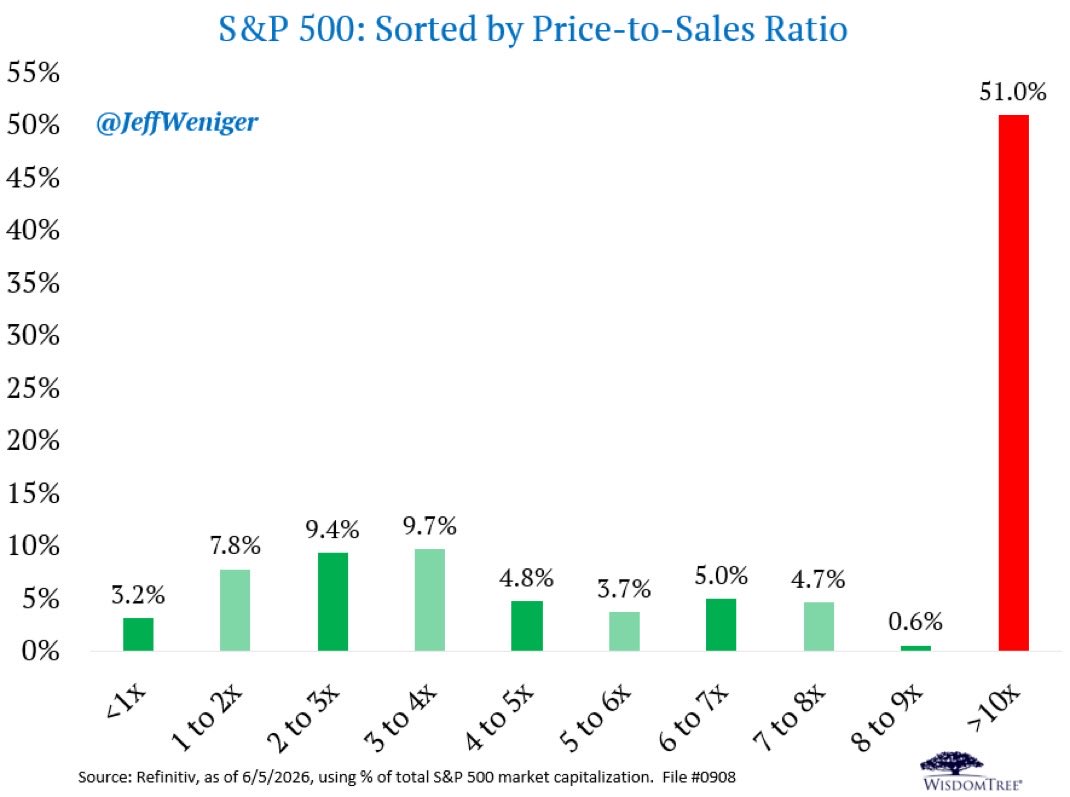
51% of the S&P 500's market cap is in stocks trading above 10x sales.
Half the index.
In 2002, after Sun Microsystems crashed 90%, CEO Scott McNealy famously said this about his own stock at 10x sales:
"At 10x revenues, to give you a 10-year payback, I have to pay you 100% of revenues for 10 straight years in dividends. Zero costs. Zero R&D. Zero taxes. Zero employees. What were you thinking?"
He was explaining why investors had been insane to pay it.
Today, half the S&P 500 trades there.
Different decade. Same math.
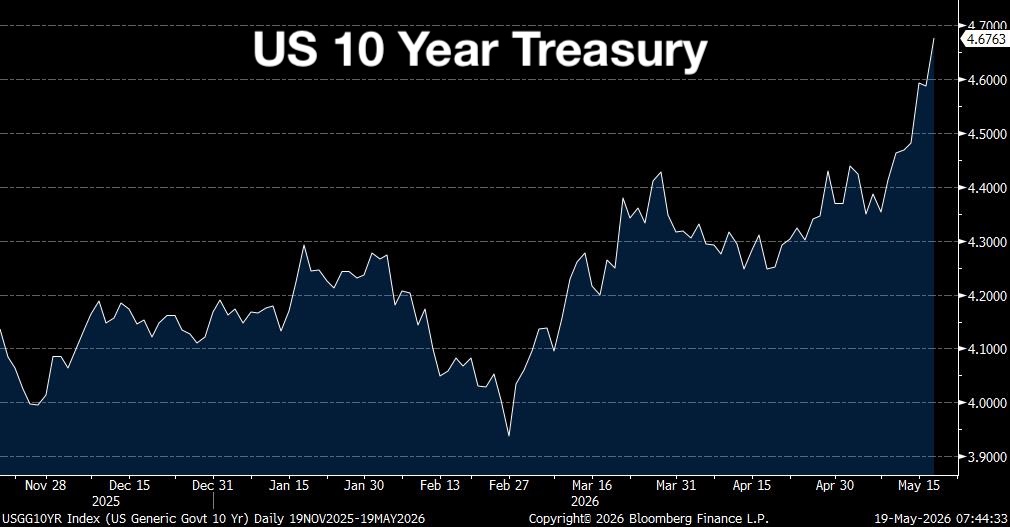
As the 10 Year US Treasury yield explodes higher, pay close attention to what new Fed Chair Warsh and other officials say in the coming days and weeks.
Why?
1. The 10 Year is the benchmark for just about all consumer borrowing rates in the US, including credit cards, auto loans, and mortgages.
2. The Fed controls the overnight rate by voting on the Fed Funds Target. But the 10 Year is set by the bond market itself. Buyers and sellers voting on inflation, credit risk, and Treasury supply in real time.
3. To keep consumer rates from following the 10 Year higher, the Fed has one tool left in the kit. Print money and buy the bonds themselves to force yields lower. Yield Curve Control.
And that is what drives excess money supply and the next leg of asset inflation.
Their words, and any fancy new acronyms, will be your first clue.
This is so legit. Do you want to be healed. Keep your eyes open and stay authentic Theo, we are rooting for ya. I’m very grateful that someone with his platform size is allowing people to see this level of authenticity. It really helps people more than most podcasters understand.