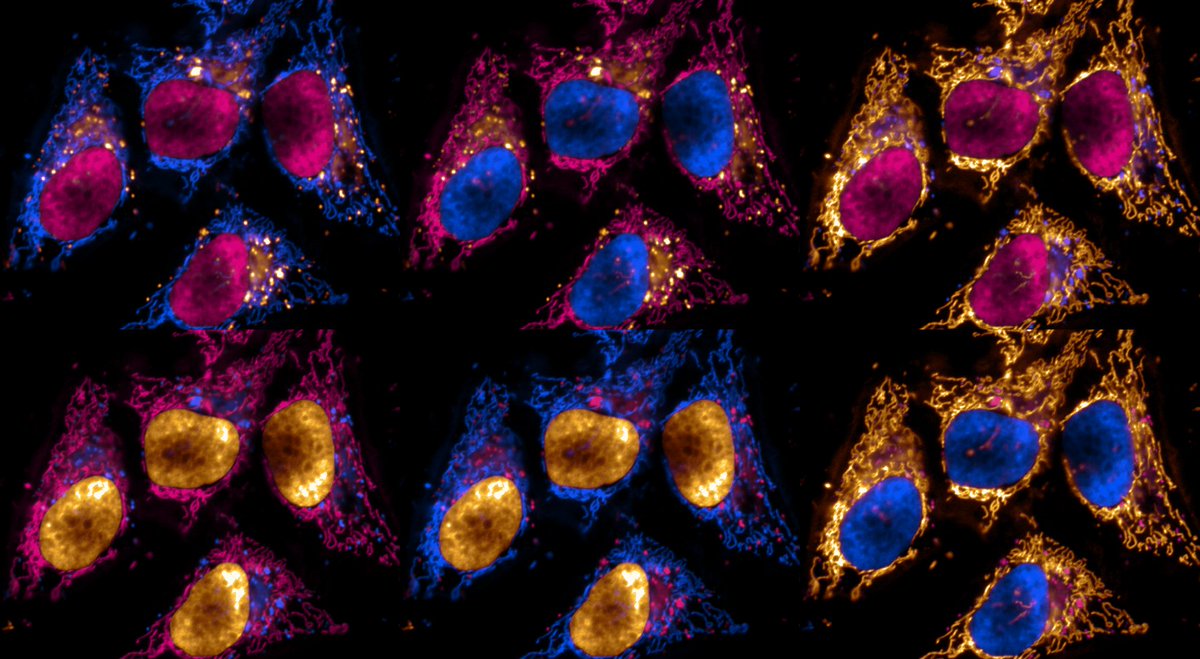
Just published in Science Advances: HITMAN, our new technology for treating one of the deadliest brain cancers.
Glioblastoma (GBM) is one of the most aggressive and treatment-resistant cancers, with a median survival of only 12–15 months even with the best available care—creating an urgent need for new therapies.
HITMAN — employs injectable nano-antennas approximately 150 nanometers in size. Activated wirelessly by a low-frequency magnetic field applied from outside the body, these nano-antennas generated highly localized electric fields that selectively killed glioblastoma cells and extended survival by more than 50% in pre-clinical animal studies.
#Glioblastoma #CancerResearch #Nanotechnology #Bioelectronics #magnetoelectric
@MIT@mit_nano@medialab@kochinstitute
How does a cell "decide" how strongly to respond to a signal?
We found that TNFR1 nanocluster density— not just ligand binding — controls its signaling strength. Tune the density alone, and you can trigger signaling without a ligand.
#ScienceAdvances
🔗https://t.co/Dxn5Sgvhzv
Potato evolved from tomato 9 million years ago. https://t.co/YZ2PSYtJns
@NHM_London Sandra Knapp
@UBC Loren H. Rieseberg
@SCUCN Jianquan Liu
#CAAS Sanwen Huang
@cellcellpress
Dipanjan Ray @DIPANJANRAY16 and Deepak Kumar Sinha @twitte_deepak@iacskolkata find that dynamic crosstalk between cytoskeletal filaments regulates dorsoventral cytoplasmic mechanics.
https://t.co/YIAqpPzZDT
Post-doctoral position available in our lab. If you are interested in cancer cell invasion and mechanobiology or have a physics/mechanics background and would like to make a jump in a friendly cell biology environment, please APPLY
Amazing work by John’s Hopkins Bloomberg Distinguished Professor Carl Wu and colleagues….this is 10 years of work
Molecular basis of global promoter sensing and nucleosome capture by the SWR1 chromatin remodeler - ScienceDirect https://t.co/yh5yaGSex9
What if you could measure the macromolecular crowding in live cells, in real time??? Check it out in this study published in @eLife: https://t.co/AuIvx2sO78. A thread…
Excited to launch our cloud-based image analysis platform today at https://t.co/sXb3CPV5B4! Analyze and interact with your data, all in the browser. Follow sign-up instructions to request an account.
We're not Einstein, but his methods are important!
As PhD advisors, let's not monitor the student entry or exit out of lab
Let them be creative besides feeling the pressure of 5 years
A timely report is important, be it failure or success
Let us create scientists, not laborers
7. Scite
• One of the most powerful apps currently available
• Gives you "Smart Citations:" number of citations that support/oppose and article's claims
• Has a Scite Assistant: it's like ChatGPT for academic research. Answers your questions with references to published papers
• Also visualizes connections between papers
• Integrated with Zotero
Pricing: €9.55/month (billed annually)
6. Iris
• Gives you maps that group papers by concetps
• Unlike all other apps that have a bottom-up approach to literature review, Iris uses a top-down app approach
• Lets you save papers and build reading lists
• Saves all your graphs
• No Zotero integration
Pricing:
Free: Limited functionality but still very useful
Paid: €75/month (access to over 200 million papers, search with free-text problem statement)
5. Elicit
• Helps you brainstorm research questions
• Ask it a question and it will answer with references to published papers
• Gives you a table of papers related to your search question
• Shows you interventions and outcomes measured
• Doesn't create any graphs
• Can't save your papers in a collection
• No Zotero integration
*The new Elicit Beta just came out and it's going to be more powerful than ever.
Pricing: Free
4. Litmaps
• Creates maps of papers related to a single (seed) paper
• Discover funtion lets you discover more papers related to papers in a map
• X-axis: articles old to new; Y-axis: articles with most citations at the top
• Lets you save papers in collections/folders
• Integrates with Zotero
Pricing:
Free: 1 Litmap, 100 articles per Litmap, Basic Discover
Pro: $12.50/month Unlimited maps, articles and advanced Discover filters
3. Inciteful
• Creates a graph of papers related to a single paper
• For best results, add five papers to the graph
• Prefers recently published papers over old ones
• Gives you most important papers, review papers, and top authors related to your search
• Shows you how two papers are related with each other
• Can't save papers in collections/folders
• Integrates with Zotero
Pricing: Free
2. Connected Papers
• Takes a single paper and creates a graph of related papers
• Also lets you add another "origin" paper. That way you it will show you new papers related to both of your origin papers
• Lets you save papers
• Saves your graph history
• Gives you prior works and derivative works
• Graphs are not interactive
• No Zotero integration
Pricing:
Free: 5 graphs/month
Paid plan: $3/month (billed annually)
1. Research Rabbit
• Helps you visualize connections between papers
• Can create interactive graphs with one or more papers
• Helps you discover author networks
• You can make collections/folders of papers for better organization
• Extracts all references and citations from a given paper
• Integrates with Zotero. For Mendeley, you can download a BibTeX and for Endnote an RIS file.
Pricing: Free
Forget Google Scholar. Here are seven AI-powered apps to fast-track your literature review.
1. Research Rabbit
2. Connected Papers
3. Inciteful
4. Litmaps
5. Elicit
6. Iris
7. Scite
Below is a comparison to help you choose the best one for your work:
Cellpose 2.0: how to train your own model
"State-of-the-art cellular segmentation does not require big data"😎
"Human-in-the-loop" protocol
#Cellpose
Dr. Marius Pachitariu & Carsen Stringer @naturemethods 2022 @marius10p@computingnature
https://t.co/OD18AFdxCW