The factory floor isn't waiting for AI anymore. It's already running on it. The only question is who's ready to scale.
🌐 Market Scale
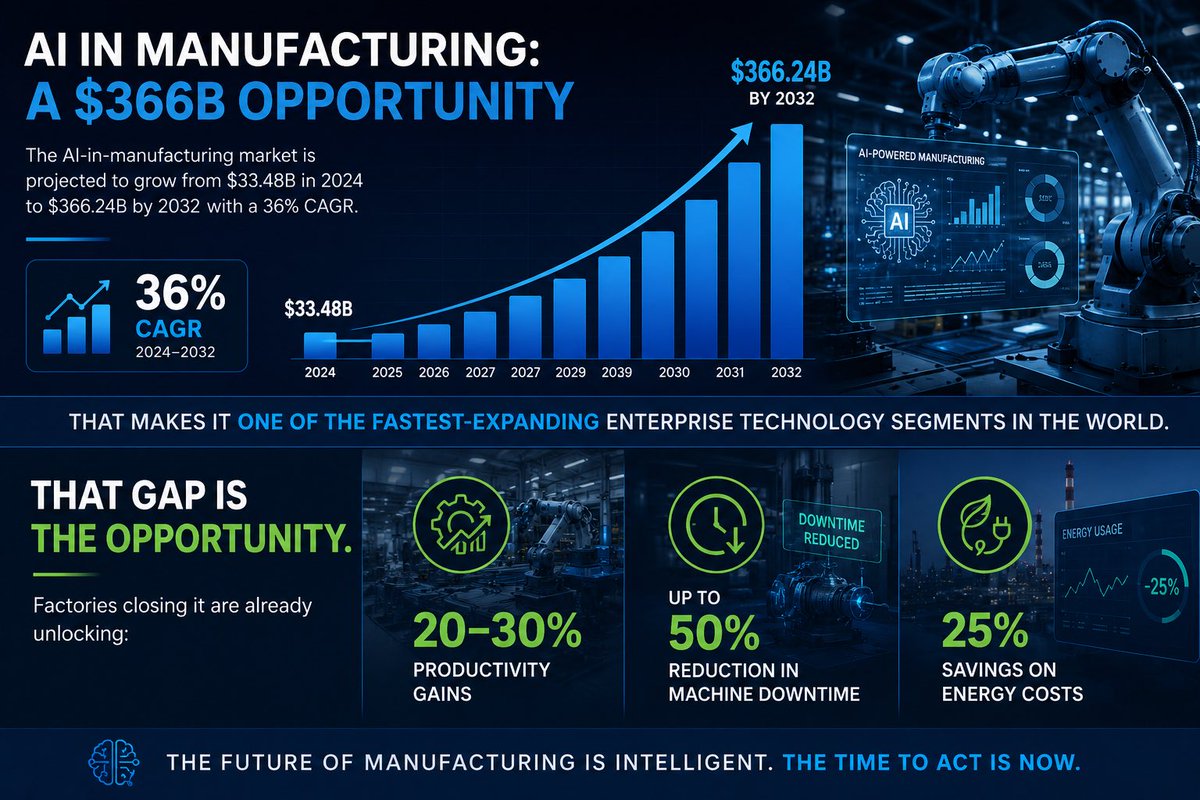
The AI-in-manufacturing market is projected to grow from $33.48B in 2024 to $366.24B by 2032 with a 36% CAGR. That makes it one of the fastest-expanding enterprise technology segments in the world.
📊 The Readiness Gap
98% of manufacturers are exploring AI-driven automation, yet only 20% feel fully prepared to use it at scale.
That gap is the opportunity. Factories closing it are already unlocking: → 20–30% productivity gains → Up to 50% reduction in machine downtime → 25% savings on energy costs
🤖 From "Recommend" to "Act"
Unlike traditional systems that depend on human direction, Agentic AI empowers AI agents to make autonomous, context-aware decisions. 2026 isn't about distant transformation, it's about scaling what already works while delivering real value and ROI.
So what does this mean for the mid-market? Mid-market manufacturers sit squarely in that 80% "exploring but not ready" bucket. An AI-native ERP that closes the gap.
@erickimberling@Sribaschha1@Didi_Gurfinkel@Enjenai@SAP@NetSuite@WFX_Cloud@CoatsDigital@DATATEX_ERP
#ManufacturingAI #AgenticAI #AINativeERP #SmartManufacturing #Industry40 #ManufacturingIndia
India is 4 years away from a $10 Trillion economy. But only if we stop sleepwalking.
Here’s what needs to happen - and fast:
🏭 1. Empower the SME backbone
India’s manufacturing miracle won’t be built by MNCs. It will be built by small and mid-sized enterprises - if we give them access to capital, infrastructure, technology, and markets. Empower the bottom of the pyramid, and the pyramid grows taller.
📈 2. Close the gap, unleash the hunger
The most underestimated force in India’s economy is unmet ambition. When lower-segment communities get access - real access - they don’t just participate, they compete fiercely. Inequality isn’t just a social problem. It’s a GDP problem.
⚡ 3. The Gen Z multiplier
India’s Gen Z - 377 million strong - represents nearly 27% of the population. They already account for 43% of India’s total consumption spending. By 2035, their spending power is projected to hit $2 trillion. This isn’t a demographic dividend waiting to happen. It’s already happening. Are our policies keeping up?
🗳️ 4. Redefine political ambition
India’s next growth chapter won’t be written at the Centre alone. It will be written state by state. We need leaders who are obsessed with their state’s growth - not just their term in power. Regional pride should translate into industrial policy, not just election rhetoric.
🌱 5. Politics for builders, not just winners
The leaders who will take India to $10 trillion are the ones who treat governance as a growth mission. State-first thinking. Long-term bets. Real accountability.
$10 trillion by 2030 is not a dream. It’s a deadline.
Are our systems moving fast enough - or are we still busy celebrating the ambition?
#India10Trillion #IndiaEconomy #IndiaGrowth #ViksitBharat #MakeInIndia #SMEIndia #IndianManufacturing #MSMEIndia #GenZIndia #IndiaAt2030 #IndianStartups #EconomicGrowth #IndiaRising #NewIndia #StatePolitics #GrowthMindset #IndiaFirst #BusinessIndia #StartupIndia #IndiaLeadership
Everyone says:
“Weaker currency boosts exports.”
Reality is far more nuanced.
A depreciating currency can make exports more competitive globally, but depreciation alone does not create an export powerhouse.
Countries like Vietnam, India, Bangladesh, and Mexico are growing exports not just because of currency movement, but because they built:
• Manufacturing capacity
• Supply-chain positioning
• Trade partnerships
• Logistics infrastructure
• Policy alignment
• Global demand access
Meanwhile, some countries with sharply depreciating currencies still struggle with export declines due to structural weaknesses, inflation, sanctions, weak demand, or supply-chain constraints.
The biggest takeaway?
Export growth is not a currency story alone.
It is an ecosystem story.
Vietnam is a strong example:
A relatively weaker currency helped but the real driver was becoming deeply embedded into global electronics and manufacturing supply chains.
This is where many macroeconomic discussions become oversimplified.
Currency depreciation may improve competitiveness.
But competitiveness itself is built over years.
The countries winning exports today are the ones that invested early in industrial depth, manufacturing resilience, and strategic positioning.
What do you think matters more for export growth today:
Currency advantage or supply-chain positioning?
#Economics #Exports #Currency #Manufacturing #Vietnam #India #GlobalTrade #SupplyChain #Macroeconomics #FDI #Trade #BusinessStrategy
The AI Displacement That Dare Not Speak Its Name
India’s top 5 IT firms - TCS, Infosys, Wipro, HCLTech, and Tech Mahindra - reported a net reduction of 6,981 employees in FY26. This reverses the 12,718 net hires made just a year ago. TCS alone shed 23,460 roles.
Fresher hiring has fallen roughly 80% from its FY22 peak.
Now compare this to the West. Oracle eliminated approximately 30,000 positions globally - nearly 20% of its workforce - as part of an aggressive pivot to AI-first cloud infrastructure, simultaneously announcing 10,000 new AI engineering hires. They said it publicly. They justified it to shareholders.
Why? Because they’re listed. They owe transparency.
Indian IT giants face the same reckoning - but they’re choosing strategic silence. Announce layoffs openly and you risk stock panic, political backlash, and street-level unrest. So the cuts happen quietly. A “bench rationalisation” here. A “skill mismatch” there. TCS attributed its cuts to “limited deployment opportunities and skill-mismatch” rather than AI. But no one really believes that narrative anymore.
In Q1 2026, 63% of tech layoffs globally explicitly cited AI as a factor — up from 38% in 2025 and just 12% in 2024. This is not a cyclical correction. This is structural rewiring.
The impact is already visible in Tier-1 cities. Bangalore. Gurgaon. Hyderabad. The IT apartment markets are softening. Discretionary spending is contracting. The second and third quarter numbers will make this impossible to ignore.
#AIJobs #IndianIT #TechLayoffs #AIDisruption #Infosys #TCS #Wipro #FutureOfWork #IndiaEconomy #Geopolitics #TextileIndia #MakeInIndia #Bengaluru #Gurgaon #Hyderabad
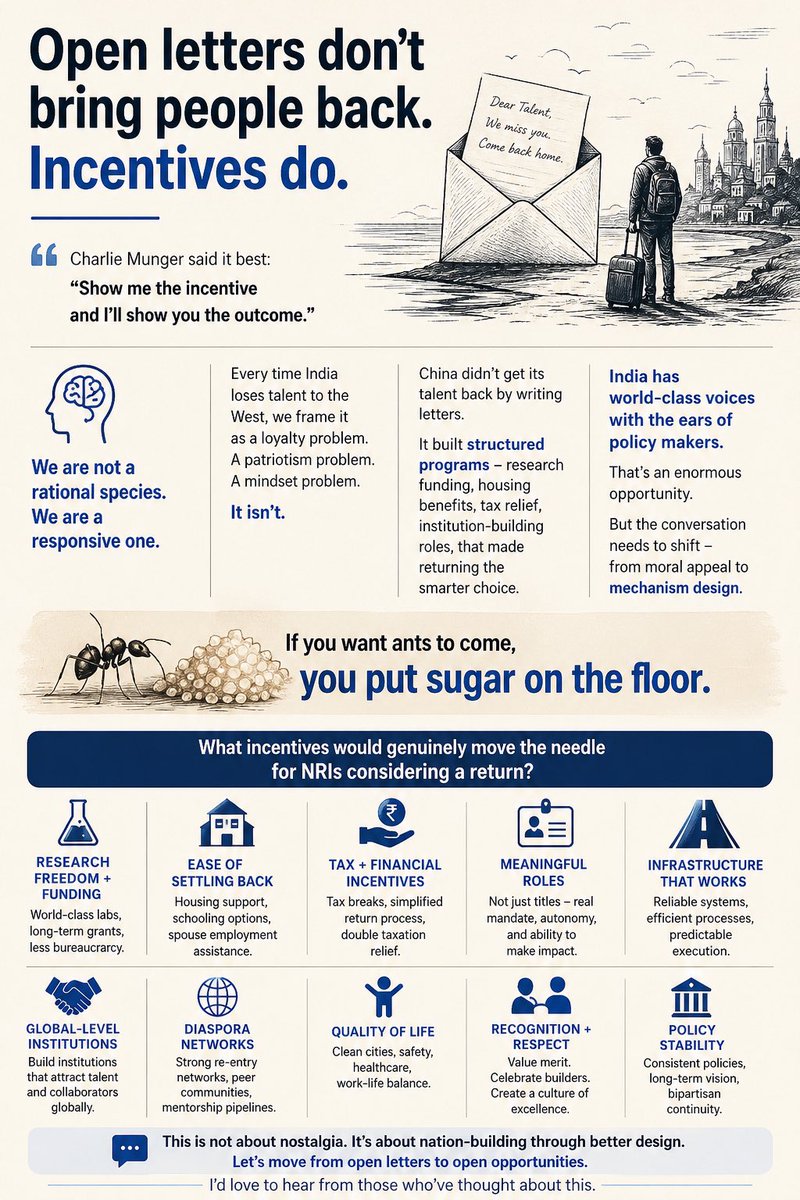
Open letters don’t bring people back. Incentives do.
Charlie Munger said it best:
“Show me the incentive and I’ll show you the outcome.”
We are not a rational species. We are a responsive one.
Every time India loses talent to the West, we frame it as a loyalty problem. A patriotism problem. A mindset problem.
It isn’t.
China didn’t get its talent back by writing letters. It built structured programs - research funding, housing benefits, tax relief, institution-building roles, that made returning the smarter choice.
India has world-class voices with the ears of policy makers. That’s an enormous opportunity.
But the conversation needs to shift - from moral appeal to mechanism design.
If you want ants to come, you put sugar on the floor.
What incentives would genuinely move the needle for NRIs considering a return?
I’d love to hear from those who’ve thought about this.
#India #NRI #StartupIndia #CharlieMunger #BrainDrain #Incentives #IndiaFirst
Everyone has an opinion on AI.
Very few have actually built with it.
I watch my feed fill up daily with posts about the best AI tool combinations - X paired with Y paired with Z. Threads that get thousands of likes from people who have never shipped a single AI-powered business application.
This is not innovation. This is content.
And it is misleading the very people who need real guidance the most.
Years ago, when we were building at Racetrack, there were no playbooks. No viral posts. No 'top 10 AI tools' to follow.
We were building what would later be recognised globally in systems like Claude, ChatGPT, and Gemini - agentic, intelligent, real.
India was doing this first. Quietly. Without the noise.
The ecosystem didn't celebrate it. VCs wanted quick returns. B2B tangibility over foundational thinking. So real AI innovation in India was undervalued - while the world caught up and the credit went elsewhere.
The first article I ever published on LinkedIn made one argument:
AI is an approach. Not a technology.
Years later, that statement is more relevant - and more ignored - than ever.
Real AI work is not exciting to watch.
It is research. Evaluation. Iteration. Honest assessment of what works and what doesn't in a specific business context.
It is not influenced by what's trending.
It is not copy-pasted from someone else's post.
Cost-effective, impactful AI solutions are built by people who are doing the work - not performing it.
Before you take AI advice from anyone, ask yourself:
Have they built a real business application with it?
Or have they just written about ones that others built?
Don't let fake narratives cost you real money.
#AI #Innovation #IndiaStartups #RealAI #AIStrategy #TechLeadership #BuildersNotBloggers
Diamonds don't announce their brilliance. They simply shine. 💎
The people building the great brands and products of tomorrow are often the quietest in the room — heads down, doing the work, unbothered by applause.
True vision doesn't need validation.
True effort doesn't need an audience.
But here's what visionaries must never overlook:
👉 Your greatest asset is YOU.
Protect your health. Guard your energy. Sustain your focus.
Because the rewards of ambition can only be enjoyed by those who show up - consistently, completely, and in good health.
Self-motivation isn't a trait. It's a daily discipline.
Keep building. Keep believing. The world will notice - in time. 🚀
#Leadership #Entrepreneurship #SilentAmbition #GrowthMindset #BuildingTheFuture
The Iran conflict just rewrote the rules of modern warfare - and Big Tech is right in the middle of it.
Here's what's trending that every tech professional needs to know:
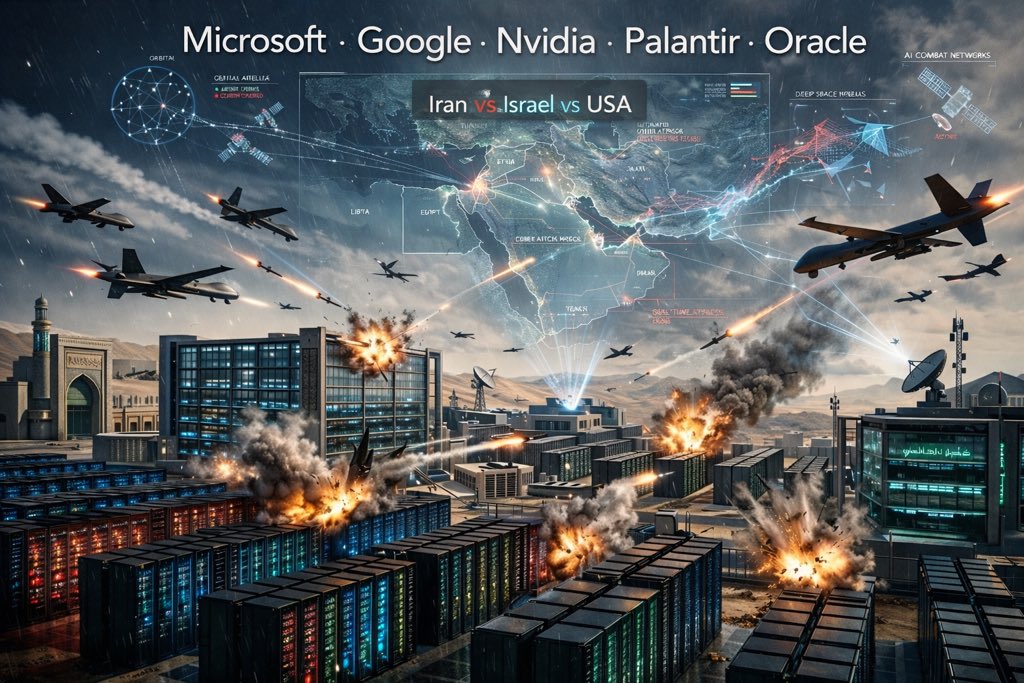
🎯 Microsoft. Google. Nvidia. Palantir. Oracle.
For the first time in history, major American tech companies have been named as legitimate war targets by a nation-state. This is not a drill.
☁️ AWS data centers in the UAE were physically struck by Iranian drones - structural damage, power disruption, fire suppression failures. Cloud infrastructure is now a battlefield.
🤖 AI is actively being used in combat operations. US CENTCOM confirmed AI tools are helping war fighters process data and make faster decisions. The Pentagon's fight with Anthropic over autonomous weapons? Very real, very public.
🧠 Israel reportedly hacked traffic cameras in Tehran and fused that with billions of data points to locate targets. AI + HUMINT + TECHINT - this is what modern intelligence looks like.
🔐 The very first US military move in this conflict was in cyberspace - disrupting Iran's communications and sensor networks before a single physical strike.
What does this mean for the tech industry?
→ Data center security will never be the same
→ The Middle East AI infrastructure boom faces serious geopolitical risk
→ AI governance debates (autonomous weapons, surveillance) are no longer theoretical
→ Every cloud provider must now factor in war risk into their architecture
We are witnessing the first truly AI-enabled conflict in history.
The question is no longer whether AI will change warfare.
The question is: how ready is the tech industry for warfare to change AI?
#AI #TechNews #Geopolitics #CloudComputing #ArtificialIntelligence #Cybersecurity #FutureOfTech #IranWar #IsraelWar #USAWar
🇮🇳 BREAKING TRAVEL UPDATE - UAE SUPPORTS STRANDED TOURISTS
Due to escalating tensions in the Middle East - including the ongoing conflict between Iran and Israel that has caused widespread airspace closures and flight cancellations - many travellers have been left unable to leave the region.
In response, Abu Dhabi and Dubai authorities have instructed hotels to extend stays for guests who can’t travel - and the UAE government will cover the accommodation and meal costs for affected visitors.
This is a remarkable demonstration of hospitality and care during a difficult moment for global travel.
✨ Stay safe. Support one another.
#UAE #AbuDhabi #Dubai #TravelUpdate #MiddleEastConflict #IranIsrael #StrandedTravellers #HumanityFirst #Hospitality #BreakingNews
🚀 The Evolution of Agentic AI is Here
AI is no longer just responding.
It’s planning, acting, learning - and collaborating.
We’ve moved from:
🔹 Rule-based systems
🔹 Assistive & generative AI
➡️ to Agentic AI - systems that can set goals, use tools, make decisions, and continuously improve
➡️ and now toward Autonomous AI ecosystems that operate at scale.
This shift isn’t incremental - it’s foundational.
The future belongs to AI that can think in loops, act with intent, and evolve over time.
📈 From Reactive → Autonomous
🧠 From Content → Intelligence
⚙️ From Tools → Agents
The question is no longer if agentic AI will transform industries - it’s how fast you’re ready for it.
#AgenticAI #AutonomousAgents #AITrends #FutureOfAI #ArtificialIntelligence #GenAI #AITransformation #TechEvolution #AIArchitecture
🚨 @realDonaldTrump just banned @AnthropicAI from all federal contracts & labeled them a "Supply-Chain Risk to National Security."
Here's why this matters far beyond America 🧵
1/ Anthropic wasn't hacked. They didn't leak data to China.
They simply refused to remove ethical guardrails - specifically around mass surveillance & autonomous weapons.
2/ This sets a dangerous global precedent.
If the world's leading democracy can blacklist its own AI company for upholding safety principles...
...what stops authoritarian governments from doing the same - with zero accountability?
3/ Countries will now draw one of two conclusions:
→ Build sovereign AI (so no foreign ethics apply)
→ Pressure domestic AI companies to comply - or else
Neither is good for humanity.
4/ The real question isn't about Anthropic.
It's this: Should AI companies have the right to enforce their own ethical red lines - even with governments as clients?
Because today, "ethics as a feature" became a liability.
What do you think? 👇
#AI #AIEthics #Anthropic #AIGovernance #TechPolicy #FutureOfAI #NationalSecurity @OpenAI@ManusAI@GeminiApp@DarioAmodei@sama
Is the $5M-per-employee company the new standard?
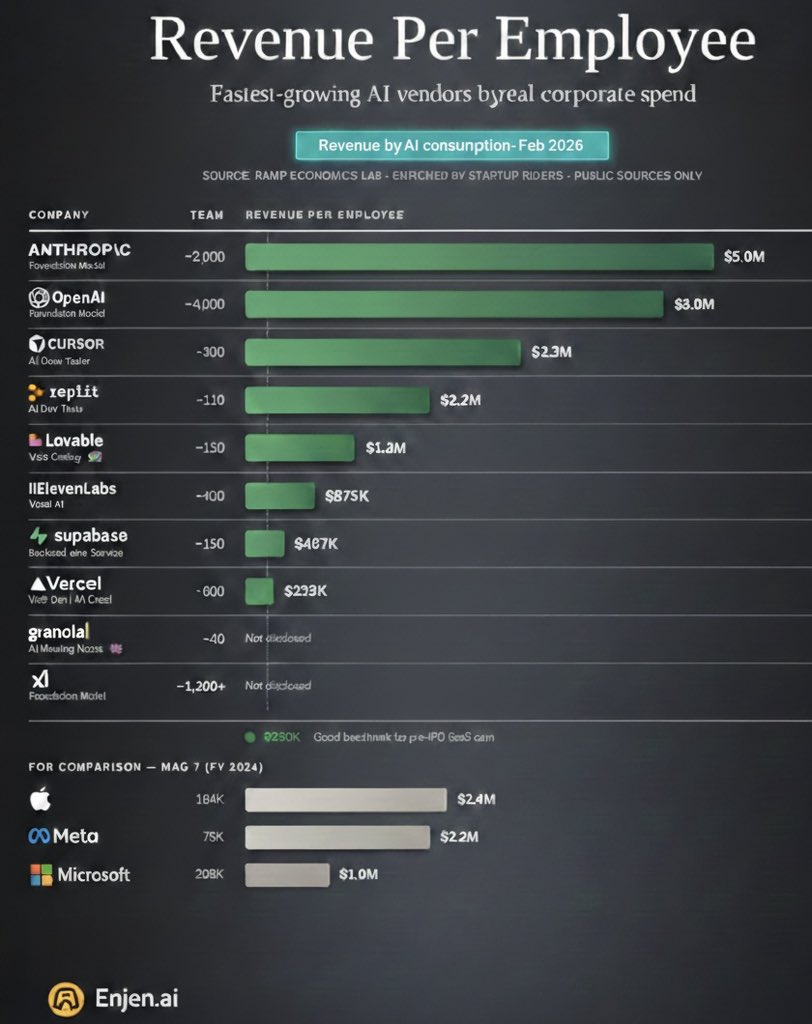
Anthropic is now generating $5.6M in revenue per employee. To put that in perspective, Apple-one of the most efficient companies in history-generates $2.4M.
A look at the latest data on corporate spend and AI consumption (sourced from Ramp’s network of 50,000+ companies) shows a massive shift in how value is created.
The Efficiency Leaderboard:
🚀 Anthropic - $5.6M/employee
🚀 OpenAI - $5.0M/employee
🚀 Cursor - $3.3M/employee
🚀 Replit -$2.2M/employee
🚀 Lovable - $1.3M/employee
Key Takeaways:
1️⃣ The Mag 7 Disruptors: Anthropic and OpenAI are currently more capital-efficient than any of the Magnificent 7. They are "revenue machines" operating with a fraction of legacy headcount.
2️⃣ The Lean Scale: Cursor has only ~300 people but is generating $3.3M per head. It’s proof that AI-native tools act as a massive internal force multiplier.
3️⃣ Beyond the Benchmark: While $250K/employee is the traditional gold standard for pre-IPO SaaS, these AI vendors are operating at 5x to 20x that level.
The Bottom Line:
AI isn't just changing what is being built; it’s changing how many people it takes to build a billion-dollar empire. The era of the "Lean Giant" has arrived.
Data via https://t.co/3yR0YQsqdn
#AIConsumption #EnjenAI #TechTrends2026 #RevenuePerEmployee #AIEconomy #FutureOfWork #SaaSMetrics #Efficiency
🎺 Celebrating the life and legacy of the legendary Willie Colón - a trombonist, composer, and bandleader who changed the sound of salsa forever.
From the streets of the South Bronx to stages around the world, his music was bold, rebellious, and full of life. Songs like “El Malo,” “Calle Luna Calle Sol,” and “Siembra” didn’t just make us dance - they told our stories. The music never dies, Willie.
Thank you for the rhythm, the soul, and the revolution. 🎶🔥
#RIPWillieColon #Salsa #LatinMusic #Leyenda
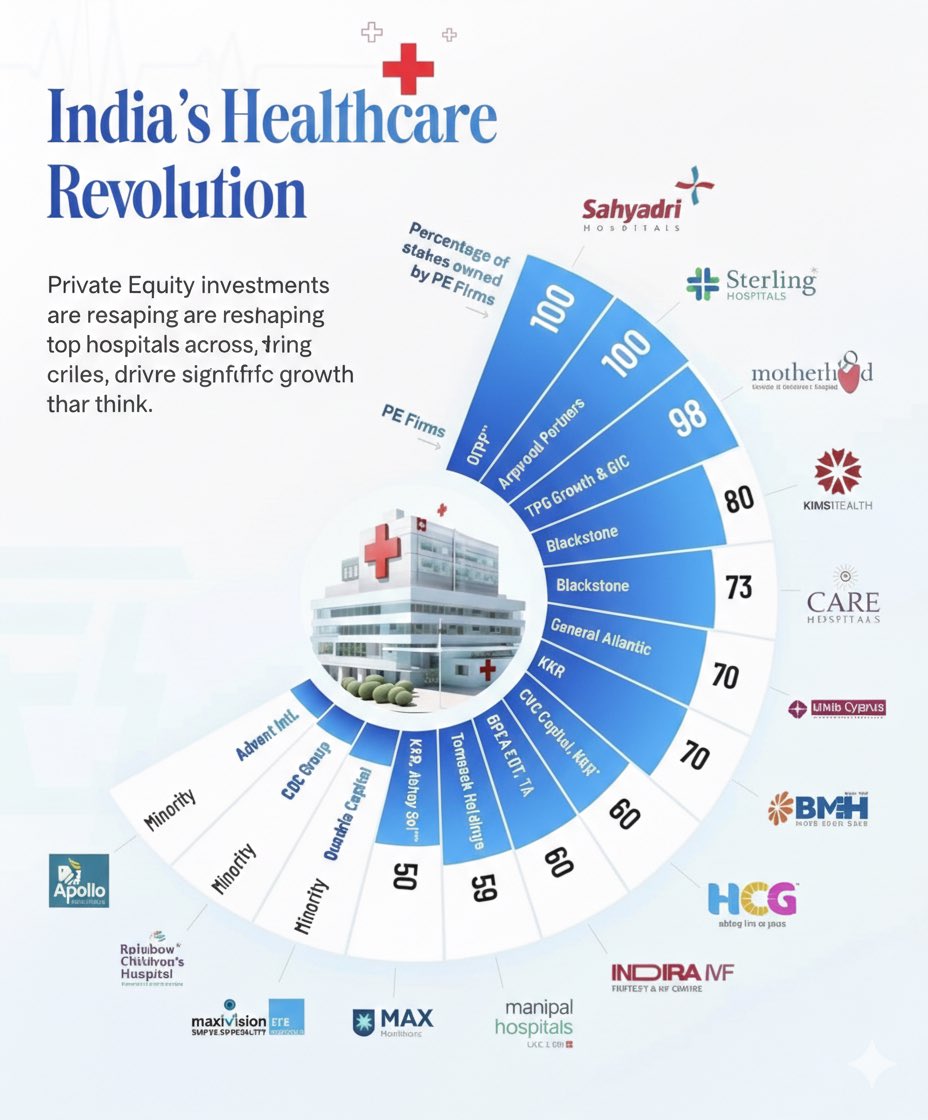
Is the "Capital Hunger" of Indian Hospitals a Myth?
The recent data from Grant Thornton (US) shows a startling trend: Half of India’s top hospital chains are now majority-owned by Private Equity firms.
The standard justification is that building a multi-specialty hospital costs ₹300–600 crore and the "capex" is too high for doctors to manage.
But let's look at the other side of the ledger:
1. Medical Tourism is Booming: We are seeing record inflows of foreign patients.
2. Insurance Penetration is at an all-time high: Cash flow is more predictable than ever.
3. Sticky Demand: Healthcare isn't a discretionary spend.
With these fundamentals, Indian healthcare should be a "cash cow" capable of funding its own expansion. So why the rush to give up 50%–100% stakes to institutional investors?
The risk is clear: When clinical autonomy meets financial accountability to a foreign fund, the "patient-first" model is put to the test.
We are moving away from the era of "Doctor-Promoters" to "Capital Platforms." In the long run, will this lead to better care, or just more efficient billing?
#IndianHealthcare #PE #HospitalManagement #HealthTech #Healthcare #PrivateEquity #IndiaHospitality #MedicalTourism #BusinessOfHealth