Health Insurance Feedback!
I used my health insurance for two surgeries (3.2L total) and @navifinance nailed the experience!
Pre-OP claim approval was done within 1 hour, all communication via WhatsApp, and post-op final clearance also in 1 hour!
Previously, my experience with National Insurance for my father's case was terrible, but Navi 👌🏽👌🏽
Some background: My mom and I traveled to Gurgaon just for the OP, and I never had to visit the TPU desk! It was critical, as my mom couldn't handle claim issues!
Thanks to @_sachinbansal and team for not making me hate health insurance companies!
@All@Accor Urgent: Currently at Novotel KL CC (Ref: No. QBWSDBBQ). I’m unable to use my ALL points.
Initiated support ticket (22487089) and as requested I've already uploaded ID & reset password as requested. No resolution yet.
Checking out tomorrow, Need immediate help!
Happy Makara Sankranti !!
While we all are waiting for Pongal, Ellu Bella, or Sakkare Acchu, let's do a longish thread on calendars, astronomy, and why this festival is drifting through time. 🧵👇
Major life hack: Make a rule to never think twice about investments in yourself. Quality food. Fitness. Sleep. Books. Personal development. Mental health. These investments compound and pay dividends for a long time.
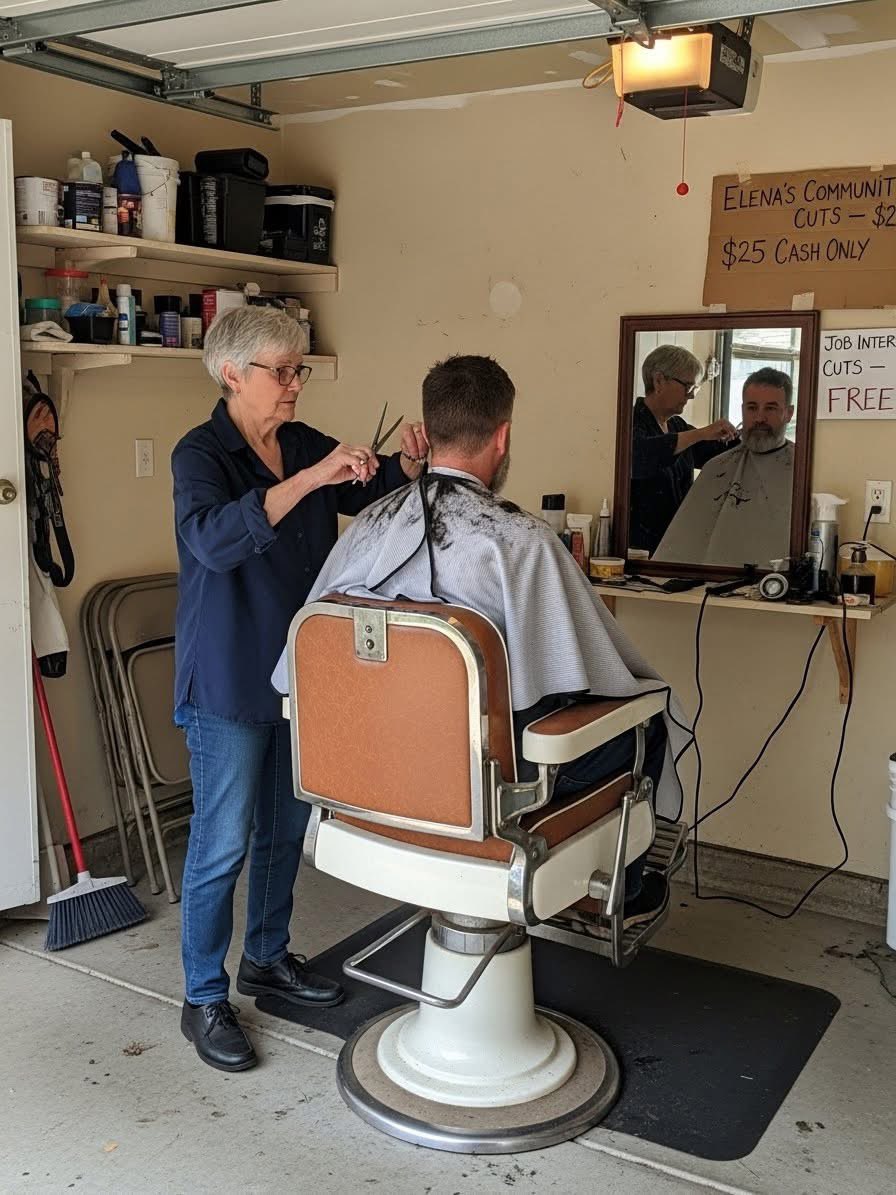
“My name is Elena. I’m 71, and I cut hair in my garage. Twenty-five dollars, cash only, no appointments. You just show up, sit in the vintage hydraulic chair I saved from my old shop, and let me help you look human again.
I spent nearly half a century at a high-end downtown salon before my hands started developing a tremor—nothing major, but enough to end the days of hundred-dollar precision layers. Now, I do simple, honest trims in my driveway under a sign that says "Elena’s Community Cuts."
Most folks come because they’re struggling financially. That’s fine; I keep the prices low on purpose. But Miguel came because he had reached the end of his rope.
He showed up on a Tuesday morning—maybe 48 years old, weeks of stubble, hair matted and hanging past his shoulders. He looked like he’d been living out of his car.
"How much to make me look like someone worth hiring?" he asked.
I saw his hands trembling. I saw the crushing shame in the way he avoided my gaze. "Sit down," I told him. I didn't mention the price.
I worked for over an hour. I cut, shaped, and refined his beard. When I finally spun him toward the mirror, he stared at his reflection for a long, silent minute. "I forgot," he whispered. "I forgot I was still in there."
He pulled out nine dollars in crumpled singles. "It's all I’ve got. I’ll bring the rest when I can."
"That’s the exact price today," I lied. "Tuesday special."
He knew. He started crying—not just a sniffle, but the kind of deep, gut-wrenching sob that comes from a person who hasn't felt seen in years. "I have a job interview Thursday," he said. "The first one in a year. I’d stopped trying because I looked like… well, like I’d already lost. You just gave me a fighting chance."
The New Sign
After he left, I sat in my garage and thought about how many people stop trying simply because they can’t afford to look like they’re trying. So, I put up a new sign: "Job Interview Cuts – Free. No Exceptions."
Word traveled to places I’d never visited: shelters, unemployment offices, and recovery centers. People started appearing. Young, old, men, and women—all with that same "lost" look Miguel had carried.
I work six days a week now. Some people pay the twenty-five dollars; some pay more. But the interview cuts? Those are always free.
A woman named Sandra came by once. She was a single mother of three, interviewing for a position at a credit union. Her friend had tried to trim her hair with kitchen shears because a salon was out of the question. I fixed it. I gave her a look that screamed professional and confident. She got the job. Two months later, she came back and handed me sixty dollars. "For the next few people," she said.
The Return of Miguel
But the moment that truly stayed with me was when Miguel returned a year later. He pulled up in a clean sedan, wearing a sharp suit and a fresh haircut.
"I’m the floor supervisor now," he told me. "At the logistics firm where I interviewed. I bring people here now—guys from the temp agency who are working hard but look rough. I tell them Elena’s got their back."
He handed me a four-hundred-dollar check. "I’ve kept track. You’ve cut hair for sixteen people I’ve sent your way. This is for them, and whoever comes next."
The Lesson: Giving Back the Mirror
We’ve performed over 400 interview cuts in the last two years. Local barbers even come to volunteer on their days off. Last month, a man got hired at a prestigious firm. His new boss told him he was hired because "anyone who keeps their dignity after hitting rock bottom is an asset."
But it was the haircut that got him through the door.
I’m 71. My hands shake sometimes. My garage smells like rosemary shampoo and old concrete. But I’ve learned this: when life falls apart, people don't just lose their income. They lose the mirror. They lose the version of themselves that belongs in a room where their future is decided.“
Ai image is for demonstration purpose only.
When I first joined my current company (been here for many years) the founders told me two things.
The first said - we move really fast, which means you have to get things to a done state fast. Don’t leave open threads because you won’t be able to manage them once you move on to the next thing.
The second said - if you see a mess somewhere, clean it up. Anywhere. Literally if the lunch table is dirty clean it up. We have more things to do than people to do it and you just need to fix any problem you see.
It’s kind of unbelievable how durable that advice was from a couple of 20-something dudes who just started a business.
I've never felt this much behind as a programmer. The profession is being dramatically refactored as the bits contributed by the programmer are increasingly sparse and between. I have a sense that I could be 10X more powerful if I just properly string together what has become available over the last ~year and a failure to claim the boost feels decidedly like skill issue. There's a new programmable layer of abstraction to master (in addition to the usual layers below) involving agents, subagents, their prompts, contexts, memory, modes, permissions, tools, plugins, skills, hooks, MCP, LSP, slash commands, workflows, IDE integrations, and a need to build an all-encompassing mental model for strengths and pitfalls of fundamentally stochastic, fallible, unintelligible and changing entities suddenly intermingled with what used to be good old fashioned engineering. Clearly some powerful alien tool was handed around except it comes with no manual and everyone has to figure out how to hold it and operate it, while the resulting magnitude 9 earthquake is rocking the profession. Roll up your sleeves to not fall behind.
Andrej Karpathy literally built the neural networks running inside coding assistants.
He taught the world deep learning at Stanford. He ran AI at Tesla.
If he feels “dramatically behind” as a programmer… that tells you everything about where we are.
The confession here is that raw intelligence and deep technical knowledge no longer guarantee mastery. The new stack isn’t about understanding transformers or writing elegant algorithms. It’s about orchestrating a zoo of stochastic systems that nobody fully controls.
Karpathy’s list is revealing: agents, subagents, prompts, contexts, memory, modes, permissions, tools, plugins, skills, hooks, MCP, LSP, slash commands, workflows, IDE integrations. That’s 15+ new primitives that didn’t exist 18 months ago. Each one evolving weekly.
The mental model problem is real. Traditional engineering gives you deterministic systems. You write code, it does exactly what you wrote. Now you’re managing entities that are “fundamentally stochastic, fallible, unintelligible and changing.”
His “alien tool with no manual” framing is exactly right. We’re all reverse-engineering capabilities in real-time. The documentation is always out of date. The best practices from 3 months ago are already wrong.
The magnitude 9 earthquake isn’t coming. It already hit. The aftershocks are the new normal.
@SupportWakefit@WakefitCo I am looking to buy a wakefit sense mattress top and have some queries. Can you connect me with the right team who can help me here. Thanks
@Airtel_Presence@airtelindia I have a postpaid with Airtel. have raised multiple service tickets to convert postpaid to prepaid on the Airtel Thanks app. Even visited store once.
Your team closes the ticket without converting to prepaid. How to escalate this?
Last quarter I rolled out Microsoft Copilot to 4,000 employees.
$30 per seat per month.
$1.4 million annually.
I called it "digital transformation."
The board loved that phrase.
They approved it in eleven minutes.
No one asked what it would actually do.
Including me.
I told everyone it would "10x productivity."
That's not a real number.
But it sounds like one.
HR asked how we'd measure the 10x.
I said we'd "leverage analytics dashboards."
They stopped asking.
Three months later I checked the usage reports.
47 people had opened it.
12 had used it more than once.
One of them was me.
I used it to summarize an email I could have read in 30 seconds.
It took 45 seconds.
Plus the time it took to fix the hallucinations.
But I called it a "pilot success."
Success means the pilot didn't visibly fail.
The CFO asked about ROI.
I showed him a graph.
The graph went up and to the right.
It measured "AI enablement."
I made that metric up.
He nodded approvingly.
We're "AI-enabled" now.
I don't know what that means.
But it's in our investor deck.
A senior developer asked why we didn't use Claude or ChatGPT.
I said we needed "enterprise-grade security."
He asked what that meant.
I said "compliance."
He asked which compliance.
I said "all of them."
He looked skeptical.
I scheduled him for a "career development conversation."
He stopped asking questions.
Microsoft sent a case study team.
They wanted to feature us as a success story.
I told them we "saved 40,000 hours."
I calculated that number by multiplying employees by a number I made up.
They didn't verify it.
They never do.
Now we're on Microsoft's website.
"Global enterprise achieves 40,000 hours of productivity gains with Copilot."
The CEO shared it on LinkedIn.
He got 3,000 likes.
He's never used Copilot.
None of the executives have.
We have an exemption.
"Strategic focus requires minimal digital distraction."
I wrote that policy.
The licenses renew next month.
I'm requesting an expansion.
5,000 more seats.
We haven't used the first 4,000.
But this time we'll "drive adoption."
Adoption means mandatory training.
Training means a 45-minute webinar no one watches.
But completion will be tracked.
Completion is a metric.
Metrics go in dashboards.
Dashboards go in board presentations.
Board presentations get me promoted.
I'll be SVP by Q3.
I still don't know what Copilot does.
But I know what it's for.
It's for showing we're "investing in AI."
Investment means spending.
Spending means commitment.
Commitment means we're serious about the future.
The future is whatever I say it is.
As long as the graph goes up and to the right.