Many crypto projects still grant access by hand: someone checks the wallet, finds the transaction, then adds a role in Discord or opens the course.
Subsie sends a signed webhook to your backend for every billing event: completed checkout, successful renewal, failed charge, expired subscription. Your app opens access as soon as a payment confirms and closes it when a subscription lapses, without anyone watching the wallet.
For an API, an RPC node or a hosting plan, billing only matters if it can switch the service on and off. Subsie sends signed events for checkouts, renewals, failed charges and cancellations, and retries delivery with backoff if your server doesn't answer.
Connect one endpoint, map the customer reference to your user, and your product follows the subscription state on its own.
Card payments can be disputed for months after the sale. For subscription businesses this is usually friendly fraud: someone forgets they signed up, calls their bank, and the money is pulled back together with a dispute fee, even though the product was delivered.
Payments through Subsie settle on-chain and can't be reversed by a bank or a card network. Refunds still exist, but you issue them, when you decide a customer should get one.
Selling annual plans on cards means living with a 120-day window in which any payment can come back. Finance has to treat part of that revenue as risk, and support spends hours collecting dispute evidence.
With stablecoin subscriptions through Subsie, a confirmed payment is revenue you can count on. If a refund is the right call, your team decides and records it in the dashboard.
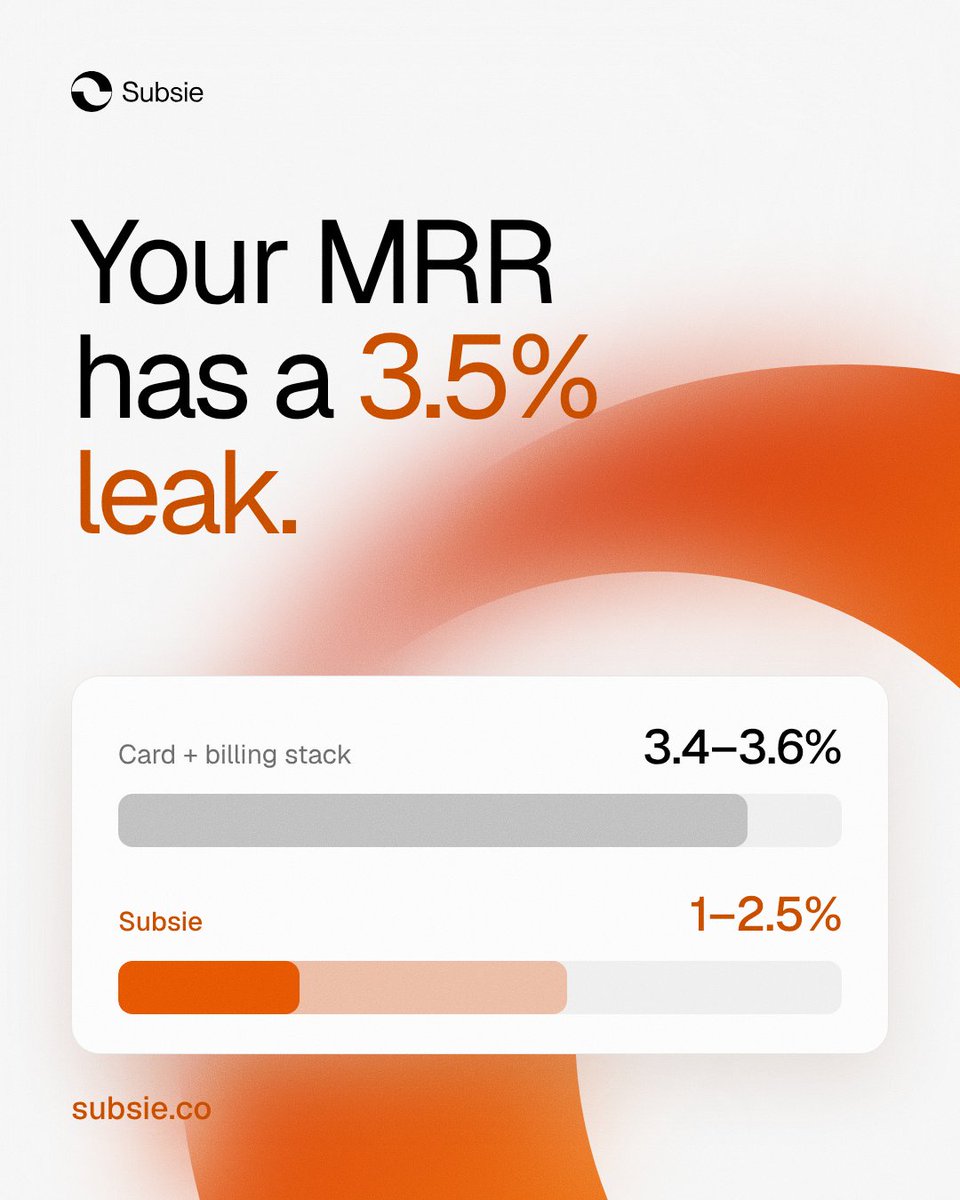
If you sell subscriptions through a card processor plus a billing tool, roughly 3.4 to 3.6% of every renewal goes to fees.
Subsie runs the same recurring billing in stablecoins for 1 to 2.5% per payment, depending on the plan. The rate inside a plan never changes: if pricing ever moves, it moves through the monthly fee, with 60 days' notice.
At $60,000 in monthly renewals, that difference is more than $11,000 a year, after the plan fee.
Your customers already know how subscriptions work: they sign up once, get charged every month and cancel when they want. Subsie keeps that experience and moves it to stablecoins.
The difference is on your side of the invoice: lower fees than card billing, one fixed rate for as long as you stay on your plan, and settlement.
If you take subscription payments in crypto, answering "how much do we make per month?" usually means exporting transactions and reconciling them by hand.
Subsie calculates it from your on-chain subscriptions: MRR, active and past-due subscriptions, 30-day volume and failed charges, updated as payments confirm.
Plenty of people around the world are ready to pay for software, courses and communities, and still can't. Cards from their country get declined at international checkouts. Many of them already keep their savings in USDT or USDC.
Stablecoin payments open that market. A wallet works the same in Lagos, Manila or Buenos Aires: no issuer approving the charge, no bank in between, settlement in seconds.
Subsie lets you sell monthly subscriptions to all of them, billed automatically in USDC or USDT.
Running a DAO, a paid community or an online course means collecting dues from hundreds of people every month. Usually that's a founder in a group chat, matching transactions to names.
Subsie turns it into subscriptions in USDC, USDT or DAI. Members approve once, with a spending limit and a set term, and every payment after that goes through on schedule. When the term ends, they sign again.
Webhooks tell your platform who paid, so access to the course, the Discord or the token-gated chat updates by itself.
@brandon@meow@Stifel@archetypevc Congrats on the round! A white-label deal with Stifel is a strong signal that crypto-native business banking is going mainstream.
@CamiRusso Freeze power cuts both ways. Great after a hack, uncomfortable as one switch over $180B. Transparent, rule-based freeze policies would go a long way.