Say goodbye to expensive software!
10 websites that can replace hundreds of dollars worth of PC software (for free)
Your wallet will thank you later! 💸
Key Concepts to Understand Database Sharding
Database sharding refers to splitting data across multiple database servers and is commonly used for scaling. However, sharding introduces major operational and infrastructure complexity that should be avoided until absolutely necessary.
Approaches to postpone sharding
Vertical Scaling: Use more powerful single database servers - more CPUs, memory, storage and I/O bandwidth. Much simpler to manage than sharding while allowing sizable expansion.
SQL Optimization: Tune SQL queries and database schema to maximize performance on a single server. Requires proper indexes, efficient SQL, etc.
Caching: Use in-memory caches like Redis to reduce database load by avoiding hitting it for every common query.
Read Replicas + Load Balancer: Adds horizontal read scaleability without full complexity of sharding. Directs reads across replicas.
These optimization approaches should be exhausted before sharding given the complexity.
Horizontal vs Vertical Sharding
There are two high-level approaches:
Vertical Sharding: Split database into columnar tables or sections vs rows. For example, having one table for names and another table for emails.
Horizontal Sharding: Split database into row partitions distributed evenly across multiple servers.
Some horizontal sharding methods:
1. Range Based: Segment rows based on range values like age groups. Can cause uneven data distribution and hot spots.
2. Directory Based: Use a lookup directory to locate rows. Allows flexibility but single point of failure risk.
3. Hash Based: Apply hash functions to spread rows uniformly across shards. Harder to rebalance.
When sharding, use the simplest approach that meets requirements to minimize complexity. Seek to avoid until necessary.
–
Subscribe to our weekly newsletter to get a Free System Design PDF (158 pages): https://t.co/kNfv0DVDdf
𝗧𝗼𝗽 𝟮𝟬 𝗦𝗤𝗟 𝗾𝘂𝗲𝗿𝘆 𝗼𝗽𝘁𝗶𝗺𝗶𝘇𝗮𝘁𝗶𝗼𝗻 𝘁𝗲𝗰𝗵𝗻𝗶𝗾𝘂𝗲𝘀
Here is the list of the top 20 SQL query optimization techniques I found noteworthy:
1. Create an index on huge tables (>1.000.000) rows
2. Use EXIST() instead of COUNT() to find an element in the table
3. SELECT fields instead of using SELECT *
4. Avoid Subqueries in WHERE Clause
5. Avoid SELECT DISTINCT where possible
6. Use WHERE Clause instead of HAVING
7. Create joins with INNER JOIN (not WHERE)
8. Use LIMIT to sample query results
9. Use UNION ALL instead of UNION wherever possible
10. Use UNION where instead of WHERE ... or ... query.
11. Run your query during off-peak hours
12. Avoid using OR in join queries
14. Choose GROUP BY over window functions
15. Use derived and temporary tables
16. Drop the index before loading bulk data
16. Use materialized views instead of views
17. Avoid != or <> (not equal) operator
18. Minimize the number of subqueries
19. Use INNER join as little as possible when you can get the same output using LEFT/RIGHT join.
20. For retrieving the same dataset, frequently try to use temporary sources.
Do you know what is 𝗤𝘂𝗲𝗿𝘆 𝗢𝗽𝘁𝗶𝗺𝗶𝘇𝗲𝗿? Its primary function is to determine 𝘁𝗵𝗲 𝗺𝗼𝘀𝘁 𝗲𝗳𝗳𝗶𝗰𝗶𝗲𝗻𝘁 𝘄𝗮𝘆 to execute a given SQL query by finding the best execution plan. The query optimizer works by taking the SQL query as input and analyzing it to determine how best to execute it. The first step is to parse the SQL query and create a syntax tree. The optimizer then analyzes the syntax tree to determine how to run the query.
Next, the optimizer generates 𝗮𝗹𝘁𝗲𝗿𝗻𝗮𝘁𝗶𝘃𝗲 𝗲𝘅𝗲𝗰𝘂𝘁𝗶𝗼𝗻 𝗽𝗹𝗮𝗻𝘀, which are different ways of executing the same query. Each execution plan specifies the order in which the tables should be accessed, the join methods, and any filtering or sorting operations. The optimizer then assigns a 𝗰𝗼𝘀𝘁 to each execution plan based on the number of disk reads and the CPU time required to execute the query.
Finally, the optimizer 𝗰𝗵𝗼𝗼𝘀𝗲𝘀 𝘁𝗵𝗲 𝗲𝘅𝗲𝗰𝘂𝘁𝗶𝗼𝗻 𝗽𝗹𝗮𝗻 with the lowest cost as the optimal execution plan for the query. This plan is then used to execute the query.
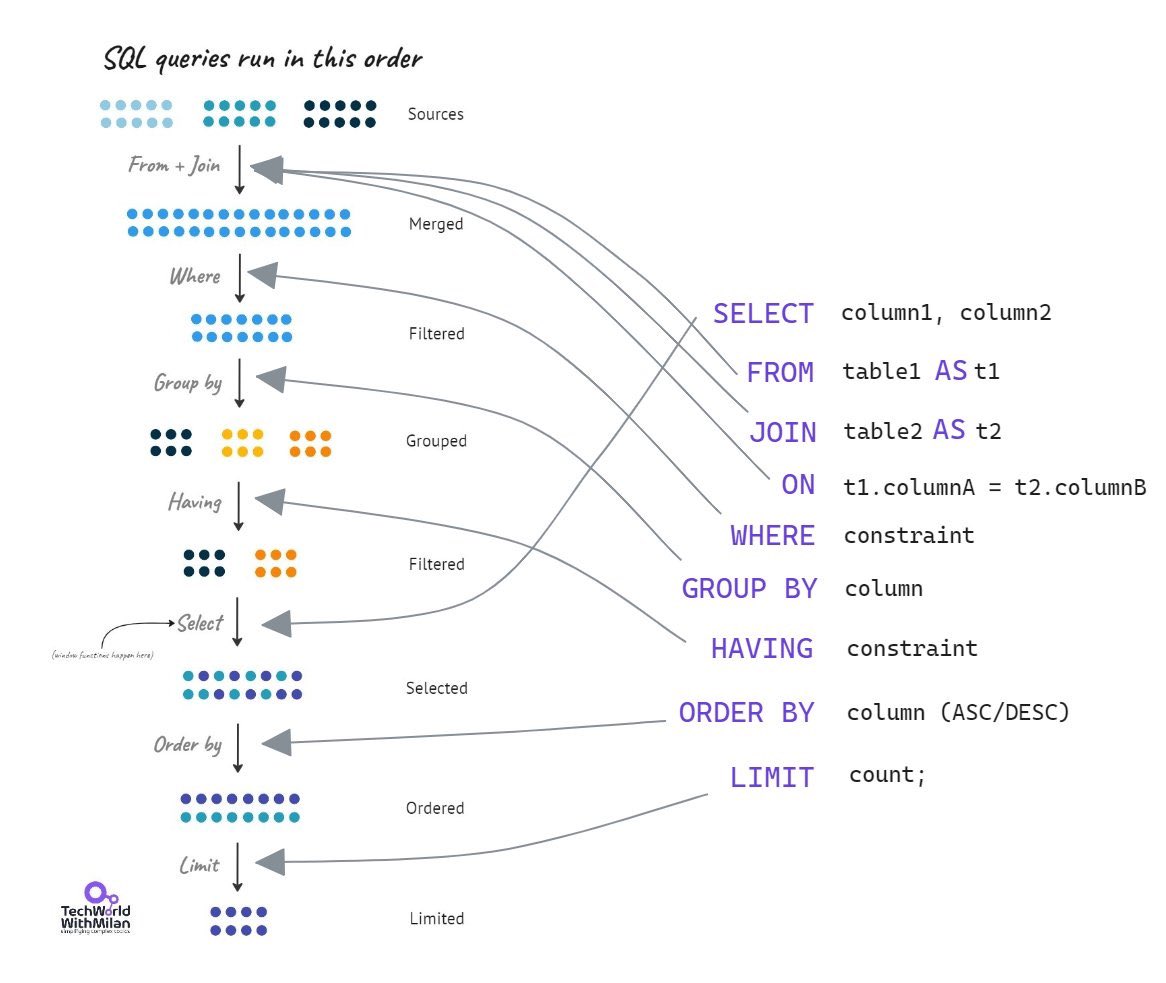
Check in the image the 𝗼𝗿𝗱𝗲𝗿 𝗶𝗻 𝘄𝗵𝗶𝗰𝗵 𝗦𝗤𝗟 𝗾𝘂𝗲𝗿𝗶𝗲𝘀 𝗿𝘂𝗻.
#technology #softwareengineering #programming #techworldwithmilan #sql
NEW PROJECT!
After 2 months of "silent" work, we present Filament Examples
https://t.co/Bfwdp4iz7u
We've created 22 Filament projects (many more to come), addressing its features and questions from Twitter/Discord/YouTube.
For 4 days only, 40% OFF!
Coupon FILAMENTFOREVER
This Google drive is a goldmine of resources on:
➡️ Project Manag
➡️ Product Manag
➡️ Software Eng
➡️Scrum
➡️PMP certification
➡️SQL
➡️UI/UX Design
➡️ Interview Docs
➡️ Data Analytics
➡️ Business Analysis
➡️Data Visualization
➡️Big Data
https://t.co/fbWXUUd9lb
SAVE & SHARE





![Kanojiyaaakash1's tweet photo. Stop paying for expensive PC Software's
10 Free Web Apps That Can Replace Your PC Software:
[🔖Bookmark for later] https://t.co/ZjJg7XytPL](https://pbs.twimg.com/media/GC5Qw4fa8AApLAH.jpg)