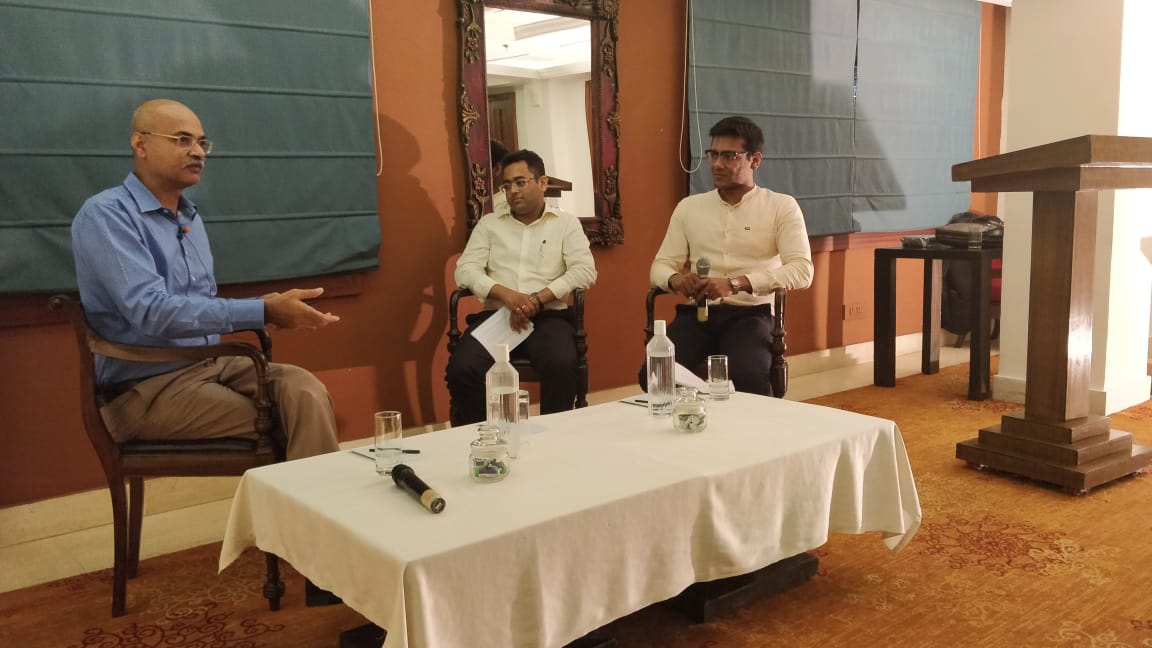
It was a pleasure hosting Kenneth Andrade with @saraf1994 for an event hosted by CFA Society, Kolkata. Enriching QnA where He spoke at length about the way he puts money to work.
Most investors sell their best compounders way too early. They see “fair value” in their mind and exit lock, stock, and barrel. Do NOT sell merely because something is fairly valued. Why?
As a great business compounds earnings and scales, it attracts big institutional money. Their required rate of return is much lower than yours. They happily pay higher multiples → your “fairly valued” stock keeps running. This is literally how multi-baggers are made after the initial re-rating.
Combine the 4 zones with Reverse DCF, instead of building a dreamy DCF to justify the price. Use reverse DCF — not to justify the price, but to interrogate whether the market’s embedded expectations can realistically come true.
Ask: “Under what conditions would the market’s current expectations actually come true?” If those conditions look unrealistic → you’re probably in Zone 3 or 4.
Liquidity and Interest rates are the gravity that pulls all these zones. When rates rise and liquidity dries, the zones shift left, and that's the time to sell.
Some practical aspects of invetsing and portfolio construction
Model 1: Use AI like a Ferrari, not autopilot
AI is incredibly powerful for retail investors — but only if you respect its limits.
• Data cleaning is 80% of the work (don’t dump raw 600-page PDFs)
• Create a curated “binder” document first
• Make the model confirm it understood context
• Run 4-5 LLMs as a “council” playing devil’s advocate
• Then apply human judgment, experience & justification.
AI narrows the search dramatically. It does not replace thinking.
Model 2: Ruthlessly eliminate 99.5% of stocks first. There are 4,000+ listed companies. You only need ~20 high-conviction ideas.
Eliminate top-down on fragility, leverage, stressed promoters, anything outside your competence or time horizon. This removes ~97% of the universe.
Then go deep, not wide. Missing some gems is a feature, not a bug. The science ends at 97-98%. After that, qualitative judgment (promoter behavior, runway, treatment of minorities) takes over. Investing is the last liberal art.
Model 4: Prepare for asymmetric bets (don’t try to predict).
You cannot predict black swans. But you can prepare. Best asymmetric opportunities appear when frightened or leveraged sellers are forced to sell (2008, 2020).
• Map the full range of outcomes + probabilities
• Seek disconfirming evidence (when you like a company, read only the bad reports)
• Do a pre-mortem before investing
• Fix a ruthless sell trigger in advance
• Keep a “tenth man” in your process
Downside should be finite and knowable. Upside can be open-ended.
Model 5: Portfolio construction & temperament. Concentration is powerful but behavioural, not scientific.
• Barbell: ~80% in 7-8 stable core compounders (sleep-well-at-night) + ~20% in 10-12 small optionality bets
• Only 16-18 genuinely non-correlated ideas are enough
• As your capital base compounds and you have more to lose → become more conservative (he now leans 20:80 instead of 80:20)
Invest bottom-up, but always worry top-down.
These 5 models work together: AI helps you process information faster →Ruthless filtering reduces noise →
Valuation zones + reverse DCF keep you disciplined →
Asymmetric bet thinking protects capital → Barbell portfolio + temperament lets you stay invested through cycles.
The goal isn’t to be right on every stock. It’s to build a process where good things happen more often than bad ones over decades. The biggest edge in investing today is not more information. It’s better filters, clearer mental models, and stronger temperament.
https://t.co/0etO30hyb0
Reflections on market cycles
Every market cycle teaches the same lessons.
You earn the right to attack by protecting first.
You can’t play offense unless your defense allows it.
Markets move in cycles. Emotions move faster.
Be conservative when crowds are aggressive — and brave when fear is loud.
Cycles don’t repeat because of numbers. They repeat because human behaviour does.
Prices move first.
Narratives follow.
Emotions peak last.
Bull markets reward confidence.
Bear markets reward humility.
Value investing is simple, not easy:
Buy pessimism from a pessimist.
Sell optimism to an optimist.
Value investing is simply exchanging emotions across time.
The job is not prediction —it’s positioning.
In the end, markets are just cycles of human emotion.
And sometimes, cash is the most patient position, waiting quietly for its moment without urgency. Optionality matters most when certainty feels highest.
That’s when flexibility is cheapest — and most ignored.
Returns come from decisions.
Longevity comes from restraint.
The market remembers both —
even if it rewards them at different times.
Selling decisions are usually deferred, not because of a lack of information, but because of excessive confidence.
Enough is written about what and when to buy, but not much about when and what to sell, or why exits are harder than entries at times. Over the years, I’ve written about selling not as an event, but as a discipline that becomes relevant when optimism peaks. Good investing is less about being right at turning points,
and more about being prepared for them.
This is not:
A market call
A prediction exercise
A timing claim
This is:
A behavioral framework
A risk-management lens
A philosophy for longevity
@DoBaniye I tried transferring 200 points as a sample and everything went smooth. I am just wondering if this route of transferring at double ratio accepted by airlines/card companies... And should I transfer my entire point balance?
Please advise/guide
Indian Amex MR to Qatar Airways (Avios) Transfer with 50% Bonus!
Indian Amex card holders usually transfer MR to Marriott at 1:1 for better value. Other partners including Qatar Avios can be transferable at 2:1 only.
How I transferred to Qatar Airways(Avios) at 4:3 (50% bonus). Check👇know more,
I just entered the @LoyaltyLobby giveaway for 100,000 Marriott Bonvoy Hotel Points. You can enter too and begin maximizing your travel! https://t.co/w2a55lYqWd
Axis Bank facing so called “technical issue”, for timely credit of Edge/Edgemiles reward points is not new…… but this time they have shown some courtesy to inform the customers about the issue and timelines. But isn’t 6th August is too late to inform about an issue which started on 11th July 🤔🤔🤔❓
Because of some greatly rewarding credit cards which Axis Bank still have after series of devaluations (e.g. Airtel card, Atlas, Ace etc.), customers are still hanging around. Otherwise, their customer service is trying its best to loose customers… 👎👎👎
What have been your experience with Axis Bank ? Mention in comments 👇👇👇.
Press Like button and Repost if you found it informative 😊.
Follow “SpendWisely” for updates, info and tips about credit cards and online shopping.
—————————————
For all ongoing Credit Card offers (First Year Free, Lifetime Free, Extra Joining Benefits Offers), visit Micro-website of SpendWisely.
Here is the Link 👉https://t.co/54MiLQFtWx
—————————————
Note: Always take a credit card basis your own need and personal spending pattern, not just because of an offer. Make your own assessment. Some of the Links in the post might be our referral links. If you apply through these links we might get some referral pay or referral benefits.
[credit card, spendwisely, spend wisely, credit cards] #spendwisely #creditcard #creditcards
Kindly find the link to my Interview with @N_Mahalakshmi_ at @moneycontrolcom for the investing process for Spotting Multibaggers, Detecting Frauds, and Checks & Balances Before Investing.
Link to video: https://t.co/5yZZms3SHm
Edited Transcript: https://t.co/n7HoPJOHeP
3rd #MAW | Sept 9th at Taj Bengal, Kolkata, as we dive into a day of learning from industry legends, mingling with brilliant minds, and connecting with industry titans.
👉https://t.co/LOgaPzkJnc.
@KB_360_ONE@amitsont
,
@SKScapital




![spendwiselyx's tweet photo. Axis Bank facing so called “technical issue”, for timely credit of Edge/Edgemiles reward points is not new…… but this time they have shown some courtesy to inform the customers about the issue and timelines. But isn’t 6th August is too late to inform about an issue which started on 11th July 🤔🤔🤔❓
Because of some greatly rewarding credit cards which Axis Bank still have after series of devaluations (e.g. Airtel card, Atlas, Ace etc.), customers are still hanging around. Otherwise, their customer service is trying its best to loose customers… 👎👎👎
What have been your experience with Axis Bank ? Mention in comments 👇👇👇.
Press Like button and Repost if you found it informative 😊.
Follow “SpendWisely” for updates, info and tips about credit cards and online shopping.
—————————————
For all ongoing Credit Card offers (First Year Free, Lifetime Free, Extra Joining Benefits Offers), visit Micro-website of SpendWisely.
Here is the Link 👉https://t.co/54MiLQFtWx
—————————————
Note: Always take a credit card basis your own need and personal spending pattern, not just because of an offer. Make your own assessment. Some of the Links in the post might be our referral links. If you apply through these links we might get some referral pay or referral benefits.
[credit card, spendwisely, spend wisely, credit cards] #spendwisely #creditcard #creditcards](https://pbs.twimg.com/media/GUWH1GHXsAIRrTy.jpg)


