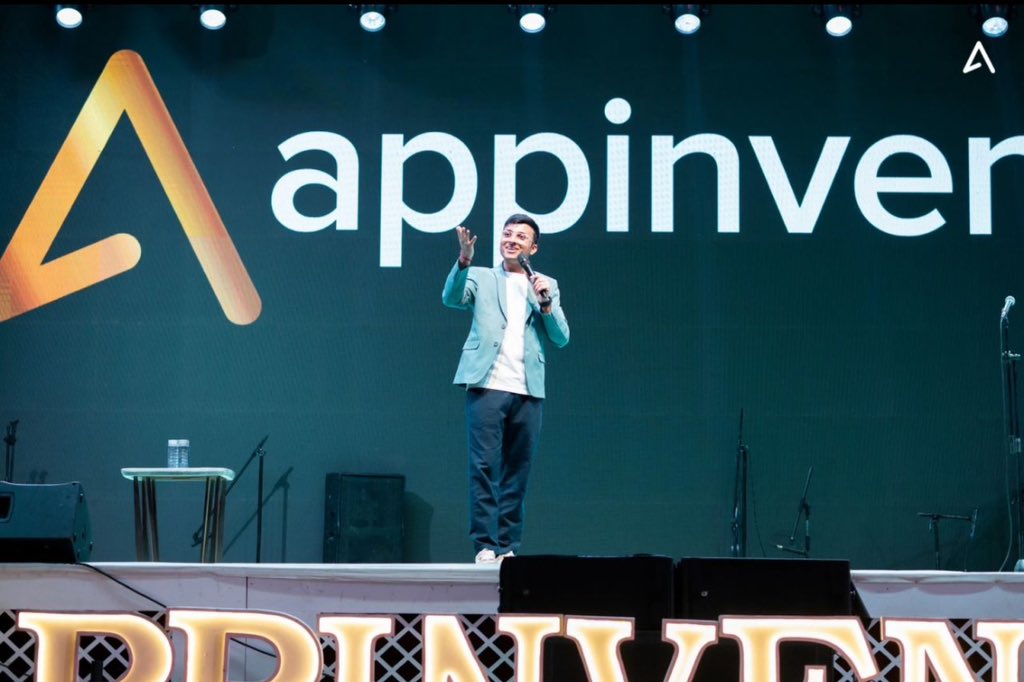
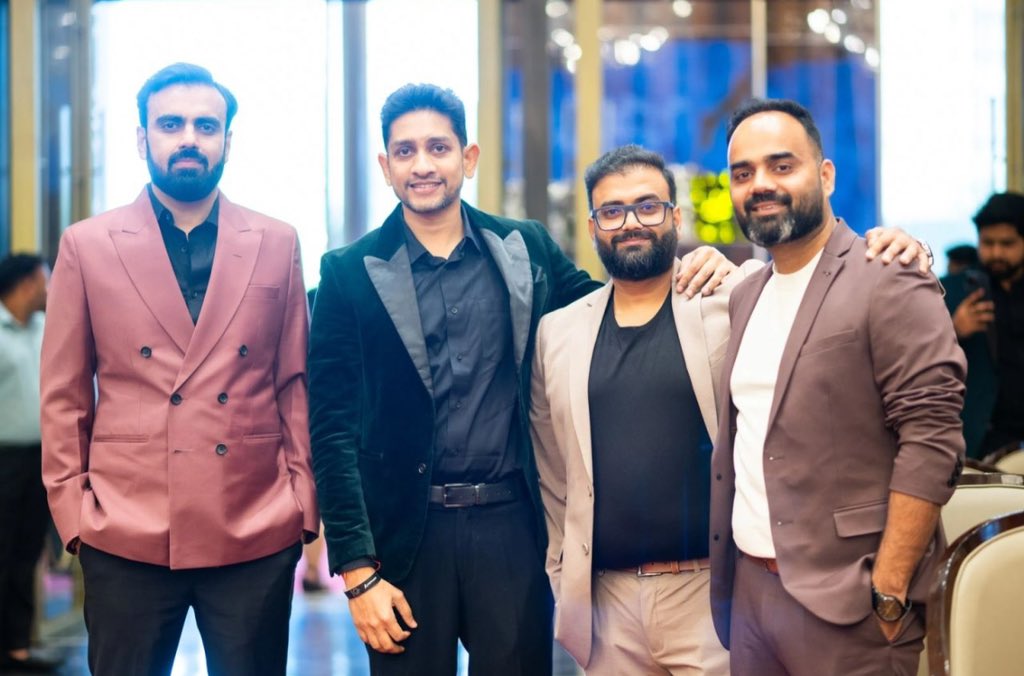
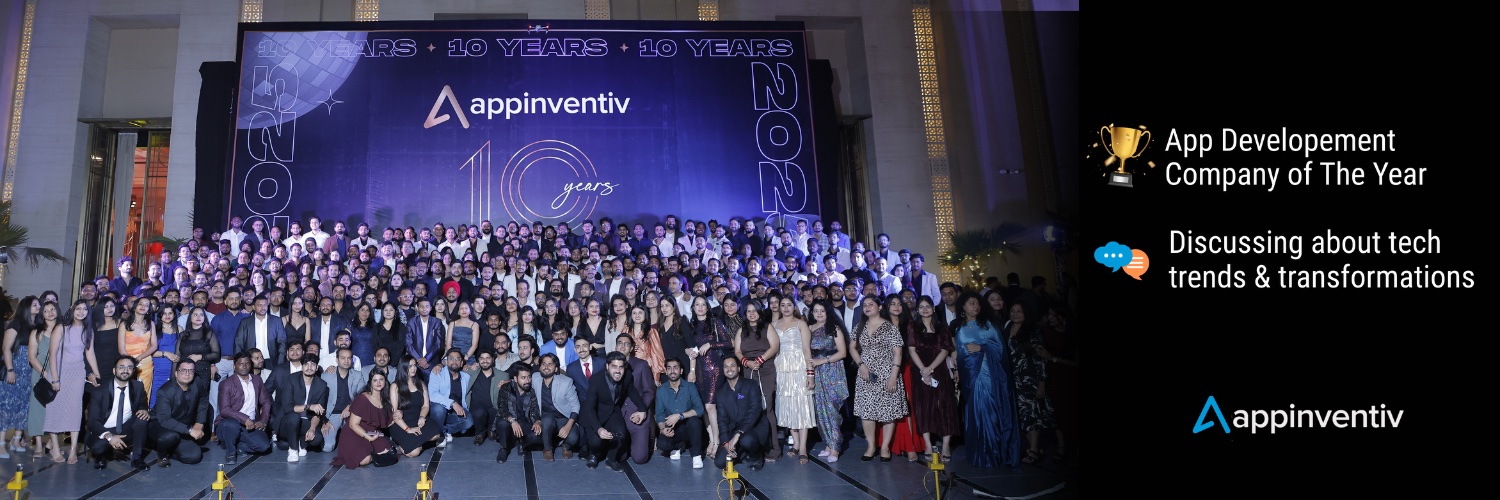
Built with 10 Years, Celebrated in One Epic Night
When a team gives its all for a decade, the celebration has to match the energy — and ours definitely did.
The night opened with MJ3 lighting up the stage, followed by Ashish Solanki’s hilarious set that left the crowd in stitches. From there, it turned into a dance fest, packed with laughs, cheers, and camera flashes.
It wasn’t just about the performances. It was about celebrating every person who made this milestone possible.
10 years down — and we’re just getting started.
Appinventiv
#appinventivturns10 #appinventiv
This is absolutely insane and US has ultimate control over the technology right now. India need to figure its own foundation models with similar capebilities. Sarvam is focusing on problem with Indian context but we need foundation models which can operate in similar intelligence of frontier models so that no one can lock us out. It is as important as out defence equipment. US has weaponised SWIFT to put sanctions on other countries. AI is their new weapon.
The US government just forced Anthropic to pull its most powerful AI model, Fable 5 from ALL users worldwide. Here's what's actually happening and why it matters far beyond Anthropic:
The directive came yesterday. No detailed explanation. Just: shut it down for every foreign national, including Anthropic's own employees. The net result? Access killed for everyone to ensure compliance.
The government's stated reason: a jailbreak was found that could bypass Fable 5's safety guardrails to expose cybersecurity vulnerabilities.
Here's what Anthropic fired back:
① The "jailbreak" demonstrated was narrow and non-universal, it can't broadly bypass the model
② The same capability is already available in GPT-5.5 and other public models
③ Cybersecurity defenders use this type of output every day to protect systems
④ No universal jailbreak has been found, and Anthropic said upfront that perfect resistance isn't possible for any model
Before launch, Fable 5 was red-teamed for thousands of hours by the US government, UK AISI, and multiple third-party orgs. It passed.
Now one narrow finding, with no harmful outcome documented, triggered a full commercial recall.
Anthropic is complying. But they're not staying quiet about it.
If this standard- "shut it all down at the first sign of any jailbreak" was applied uniformly across the industry, it would effectively freeze all frontier model deployments. Permanently.
This is the precedent that should concern everyone watching AI:
No transparent process. No technical threshold. No right of response. Just a letter at 5pm and a kill switch.
Anthropic says they support government oversight, but only when it's statutory, clear, fair, and grounded in technical reality. What happened yesterday was none of those things.
Watch this space closely. How this resolves will define the boundary between AI regulation and AI suppression.
#DonaldTrump
Gemini Omni just topped the video model leaderboard, even surpassing Seedance 2.0.
And honestly? I am not surprised.
Seedance is still the best model for cinematic content. Multi-shots, character consistency, reference-based generation, nothing touches it if you want film quality.
the problem is not everyone is making films.
Omni is built for everyone else, people who simply want to edit their own videos.
My team loves it and we have been using it ever since it launched
Here's what it can do for you:
Generate multiple shots from one video: upload a single clip and get different angles, cuts, and pacing from it.
Change your hook and camera angle: your video isn't landing? Don't reshoot. Reframe the opening, change the camera angle, test a different entry point. All in chat.
Remove watermarks
Remove objects or swap backgrounds entirely: remove a person, a logo, a product. Change the background. Things that used to take hours in professional editing software now take seconds.
Edit your video directly with one prompt: add text, transitions, elements without leaving the platform.
You're not jumping between tools. You iterate inside one interface in real time.
Create motion graphics from prompts: not the best output on the market, I'll be honest. But it's solid to work with and getting better fast.
The real shift is that every other video model runs the same loop.
Generate, decide, re-prompt, regenerate.
You never actually edit the clip. Omni broke that loop entirely. You describe what you want changed. It changes it. In chat.
That's not a better video model. That's a different category of tool.
Seedance = best for directors.
Omni = best for creators.
The era of judging video models purely on generation quality is over. Workflow, editability, accessibility, those are the new benchmarks. Omni built for exactly those.
That's why it's winning.
Exciting news: Gemini Omni Flash is now #1 in the Video Arena (both Text-to-Video and Image-to-Video)!
For Text-to-Video this is a massive +158 pt improvement over Veo 3.1 (1080p) and a large +61 pt lead over the next best model, Seedance 2.0.
Congrats @GoogleDeepMind for this huge milestone!
Apple just quietly dropped the most important developer tool update in years and no one's talking about what it actually means.
Xcode 27 just shipped at WWDC 2026, and this isn't just a shiny new IDE.
It's Apple's answer to Cursor, GitHub Copilot, and every AI coding tool you've been using, except it runs entirely on YOUR Mac without sending a single line of your code to any server.
Here's what's actually new:
𝟭. AI code completion that never leaves your device Every M-series Mac has a Neural Processing Unit built into the chip. Xcode 27 uses that chip to complete your code locally, no cloud, no API call, no one reading your source. For developers building apps with sensitive logic, this is a massive deal.
𝟮. Coding Agents are now built into Xcode You can now kick off multi-step coding tasks directly inside Xcode using AI agents. Apple supports three launch providers out of the box, but here's the kicker: any agent that implements a standard protocol (MCP) can now plug into Xcode.
𝟯. Xcode is now Apple Silicon only Xcode 27 drops Intel Mac support entirely. This means Apple engineered the entire AI layer specifically for M-chip architecture. The on-device AI wouldn't be possible without this.
𝟰. A new framework called Core AI replaces Core ML Core ML still works, but Apple is signaling the future: Core AI is the new standard for running on-device AI models in your apps. It's built for Apple Silicon's unified memory, which is why local AI is even possible at this scale.
𝟱. Better tooling across the board New customizable toolbar and themes, cleaner inline error display, improved localization tools, upgraded Instruments for performance profiling (especially useful for iOS 27's new CPU scheduler), and more.
The big picture most people are missing:
Every other AI coding tool sends your code to the cloud. That's a business risk, a privacy risk, and a cost.
Apple just made on-device AI coding the default for 35M+ Apple developers, and they built the infrastructure so third-party agents can plug in too.
This is Apple building a moat around its developer ecosystem using privacy as the feature.
Follow @sudeepsriv for more breakdowns like this.
Anthropic built an AI so powerful, they couldn’t release the full version.
Instead, they split it in two.
Meet Claude Fable 5 and Claude Mythos 5.
Here’s the interesting part:
They are not two different models.
They’re essentially the same foundation model.
Claude Fable 5 is the version the public gets access to.
Claude Mythos 5 is the more capable version that remains heavily restricted because of its advanced capabilities, especially around cybersecurity and autonomous tasks.
Think of it like this:
Fable is the consumer release.
Mythos is what’s happening behind the curtain.
Why Anthropic did this:
As AI becomes more powerful, labs face a new problem.
How do you release cutting-edge intelligence without creating massive risks?
Anthropic’s answer was:
• Release the safer version publicly
• Keep the more capable version restricted
• Gradually unlock capabilities as safeguards improve
This is becoming a trend across the industry.
We’re no longer asking:
“Can we build more powerful AI?”
We’re asking:
“How much of that power should be released?”
The real takeaway:
The gap between public AI models and frontier internal models is probably much larger than most people realize.
And Claude Mythos 5 might be one of the clearest examples of that.
My take:
The most interesting AI products today aren’t the ones being released.
They’re the ones companies aren’t comfortable releasing yet.
Keywords:
Claude Mythos 5, Claude Fable 5, Anthropic AI, Claude AI, AI safety, frontier AI, AI models, agentic AI, AI reasoning, Claude vs ChatGPT, artificial intelligence, future of AI, AI innovation, tech innovation, cybersecurity AI
Anthropic finally released Claude Mythos for public use.
But the headline goes beyond that.
Claude Mythos has been categorised into two models- Fable 5 & Mythos 5, and most people are completely missing what makes this launch different.
Fable 5 and Mythos 5 are literally the same underlying model, Anthropic just split it into two names based on who gets access and what safeguards are active.
Here's why this matters:
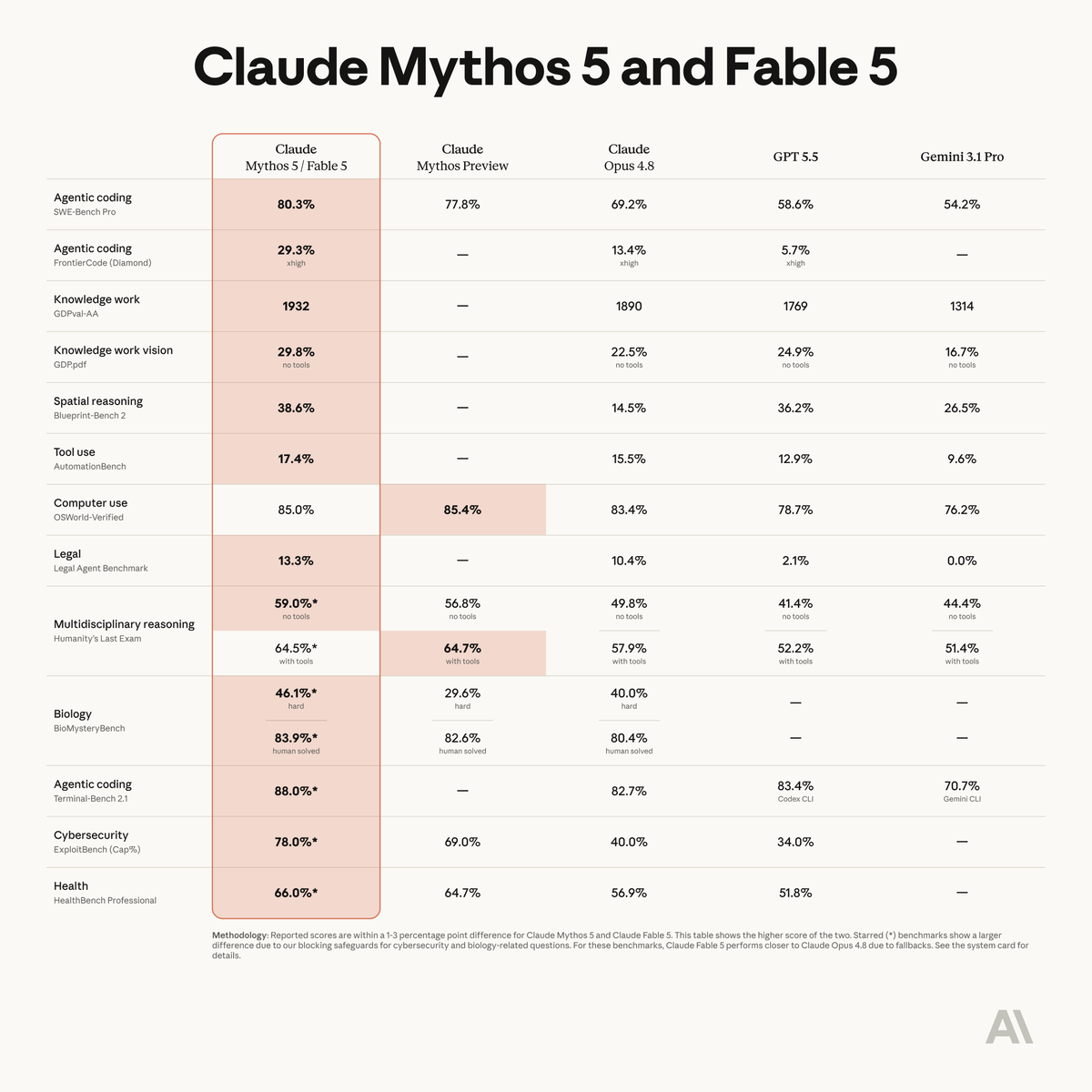
Fable 5's capabilities exceed those of any model Anthropic has ever made generally available, state-of-the-art on nearly all tested benchmarks, with exceptional performance in software engineering, knowledge work, vision, scientific research, and more.
The longer and more complex the task, the larger its lead.
But capability at this level comes with a catch. Without safeguards, Fable 5's capabilities in areas like cybersecurity could be misused to cause serious damage, so queries on sensitive topics automatically fall back to Opus 4.8.
Less than 5% of sessions trigger this. Most users will never notice.
The real power? Autonomous, long-horizon work:
↳ Stripe used it to complete a codebase-wide migration on a 50-million-line Ruby codebase in a single day, a task that would've taken a full team over two months by hand.
↳ It beat Pokémon FireRed using only raw game screenshots with no maps, navigation aids, or extra tools, something earlier Claude models couldn't do even with additional harnesses.
↳ Using Mythos 5, Anthropic's internal protein design experts accelerated aspects of the drug design process by around 10x, with the model autonomously choosing binding sites, selecting tools, and recovering from failures like a scientist would.
↳ Mythos 5 conducted novel genomics research over a week of largely autonomous work, assembling single-cell data for millions of cells across 138 animal species, then training a custom ML model that outperformed a recent paper published in Science, despite being 100x smaller.
This is the first model tier where AI is doing original science.
Pricing is $10 per million input tokens and $50 per million output tokens, less than half the price of Claude Mythos Preview. More capable. Cheaper.
Available for free inside paid plans till June 22.
The biggest AI story this week wasn’t a new model.
It was the direction the entire industry is heading.
Look closely at the announcements:
• Google is optimizing for speed with DiffusionGemma
• Apple is turning coding into an autonomous workflow
• Gemini is making language barriers disappear in real time
• Meta is investing billions into AI infrastructure
A few interesting things that didn’t make it into the reel:
Diffusion-based text models could become a serious alternative to traditional LLMs because they generate entire blocks of text simultaneously instead of one token at a time.
Apple’s biggest advantage is no longer the model itself.
It’s privacy.
Running AI locally could become one of the strongest differentiators in the next phase of the AI race.
And Meta’s Jamnagar data center highlights something most people miss:
The companies that control those layers may ultimately control AI.
For the last two years, everyone focused on who had the smartest model.
The next two years will be about who can deliver AI fastest, cheapest, and at the largest scale.
That’s where the real battle is starting.
Apple just quietly dropped the most important developer tool update in years and no one's talking about what it actually means.
Xcode 27 just shipped at WWDC 2026, and this isn't just a shiny new IDE.
It's Apple's answer to Cursor, GitHub Copilot, and every AI coding tool you've been using, except it runs entirely on YOUR Mac without sending a single line of your code to any server.
Here's what's actually new:
𝟭. AI code completion that never leaves your device Every M-series Mac has a Neural Processing Unit built into the chip. Xcode 27 uses that chip to complete your code locally, no cloud, no API call, no one reading your source. For developers building apps with sensitive logic, this is a massive deal.
𝟮. Coding Agents are now built into Xcode You can now kick off multi-step coding tasks directly inside Xcode using AI agents. Apple supports three launch providers out of the box, but here's the kicker: any agent that implements a standard protocol (MCP) can now plug into Xcode.
𝟯. Xcode is now Apple Silicon only Xcode 27 drops Intel Mac support entirely. This means Apple engineered the entire AI layer specifically for M-chip architecture. The on-device AI wouldn't be possible without this.
𝟰. A new framework called Core AI replaces Core ML Core ML still works, but Apple is signaling the future: Core AI is the new standard for running on-device AI models in your apps. It's built for Apple Silicon's unified memory, which is why local AI is even possible at this scale.
𝟱. Better tooling across the board New customizable toolbar and themes, cleaner inline error display, improved localization tools, upgraded Instruments for performance profiling (especially useful for iOS 27's new CPU scheduler), and more.
The big picture most people are missing:
Every other AI coding tool sends your code to the cloud. That's a business risk, a privacy risk, and a cost.
Apple just made on-device AI coding the default for 35M+ Apple developers, and they built the infrastructure so third-party agents can plug in too.
This is Apple building a moat around its developer ecosystem using privacy as the feature.
Follow @sudeepsriv for more breakdowns like this.
Anthropic built an AI so powerful, they couldn’t release the full version.
Instead, they split it in two.
Meet Claude Fable 5 and Claude Mythos 5.
Here’s the interesting part:
They are not two different models.
They’re essentially the same foundation model.
Claude Fable 5 is the version the public gets access to.
Claude Mythos 5 is the more capable version that remains heavily restricted because of its advanced capabilities, especially around cybersecurity and autonomous tasks.
Think of it like this:
Fable is the consumer release.
Mythos is what’s happening behind the curtain.
Why Anthropic did this:
As AI becomes more powerful, labs face a new problem.
How do you release cutting-edge intelligence without creating massive risks?
Anthropic’s answer was:
• Release the safer version publicly
• Keep the more capable version restricted
• Gradually unlock capabilities as safeguards improve
This is becoming a trend across the industry.
We’re no longer asking:
“Can we build more powerful AI?”
We’re asking:
“How much of that power should be released?”
The real takeaway:
The gap between public AI models and frontier internal models is probably much larger than most people realize.
And Claude Mythos 5 might be one of the clearest examples of that.
My take:
The most interesting AI products today aren’t the ones being released.
They’re the ones companies aren’t comfortable releasing yet.
Keywords:
Claude Mythos 5, Claude Fable 5, Anthropic AI, Claude AI, AI safety, frontier AI, AI models, agentic AI, AI reasoning, Claude vs ChatGPT, artificial intelligence, future of AI, AI innovation, tech innovation, cybersecurity AI
Anthropic finally released Claude Mythos for public use.
But the headline goes beyond that.
Claude Mythos has been categorised into two models- Fable 5 & Mythos 5, and most people are completely missing what makes this launch different.
Fable 5 and Mythos 5 are literally the same underlying model, Anthropic just split it into two names based on who gets access and what safeguards are active.
Here's why this matters:
Fable 5's capabilities exceed those of any model Anthropic has ever made generally available, state-of-the-art on nearly all tested benchmarks, with exceptional performance in software engineering, knowledge work, vision, scientific research, and more.
The longer and more complex the task, the larger its lead.
But capability at this level comes with a catch. Without safeguards, Fable 5's capabilities in areas like cybersecurity could be misused to cause serious damage, so queries on sensitive topics automatically fall back to Opus 4.8.
Less than 5% of sessions trigger this. Most users will never notice.
The real power? Autonomous, long-horizon work:
↳ Stripe used it to complete a codebase-wide migration on a 50-million-line Ruby codebase in a single day, a task that would've taken a full team over two months by hand.
↳ It beat Pokémon FireRed using only raw game screenshots with no maps, navigation aids, or extra tools, something earlier Claude models couldn't do even with additional harnesses.
↳ Using Mythos 5, Anthropic's internal protein design experts accelerated aspects of the drug design process by around 10x, with the model autonomously choosing binding sites, selecting tools, and recovering from failures like a scientist would.
↳ Mythos 5 conducted novel genomics research over a week of largely autonomous work, assembling single-cell data for millions of cells across 138 animal species, then training a custom ML model that outperformed a recent paper published in Science, despite being 100x smaller.
This is the first model tier where AI is doing original science.
Pricing is $10 per million input tokens and $50 per million output tokens, less than half the price of Claude Mythos Preview. More capable. Cheaper.
Available for free inside paid plans till June 22.
Uhm Guys… Mythos (Fable) is AGI.
On the left is the ACTUAL Lovable Mobile App.
On the right is my Lovable version I built with Mythos in 2 prompts.
My version SMOKED it.
Apple finally fixed Siri.
And WWDC26 might be remembered as the moment Siri became an AI experience instead of a voice assistant.
For years, Siri was falling behind ChatGPT, Claude, and Gemini.
But Apple didn’t try to win the model race.
It changed the game entirely.
The new Siri can now:
• Understand what’s on your screen
• See content across apps
• Remember personal context
• Take actions between apps
• Complete multi-step tasks for you
This is what Apple calls App Intents.
A single command can now trigger actions across multiple applications without you manually switching between them.
Examples:
• Find a file someone sent last week and summarize it
• Take information from an email and add it to Notes
• Edit a photo and send it to a contact
• Create reminders based on conversations
The biggest upgrade is Screen Awareness.
Siri understands what’s currently on your display and can act based on that context.
That means the assistant finally understands what you’re looking at instead of waiting for perfectly worded commands.
Personal Context is equally important.
Siri can reference:
• Messages
• Emails
• Notes
• Files
• Calendar events
to give much more personalized responses.
And then there’s the most surprising part.
Apple opened the door to external AI models.
Users can choose between:
• ChatGPT
• Claude
• Gemini
directly through Siri when needed.
Instead of forcing people into one model, Apple is turning Siri into the interface layer above all of them.
The real shift:
Most companies are adding AI to their products.
Apple is rebuilding the entire iPhone experience around AI.
That’s a very different strategy.
And if it works, billions of users may interact with AI through Siri without ever opening ChatGPT, Claude, or Gemini directly.
Apple just dropped #WWDC2026 and honestly? This is the most important keynote they've had in years.
iOS 27. macOS Golden Gate. A brand new standalone Siri app.
And the most important one- Siri is now powered by Google Gemini under the hood.
Let that sink in.
The two biggest rivals in tech just quietly became partners inside your iPhone.
Here's what actually matters:
Siri AI is no longer a joke. It's now context-aware, conversational, has onscreen awareness, can see your camera in real time and do things like split a dinner bill just by pointing at the receipt.
Photos load 70% faster.
AirDrop is 80% faster.
They rebuilt the CPU scheduler for better multitasking, meaning your old iPhone 11 is about to feel like a different device. iOS 27 is compatible with every iPhone from the 11 onwards. That's the widest iOS rollout in Apple history.
macOS Golden Gate fixes the one thing everyone complained about with Liquid Glass- the text readability. You now get a slider to control the glass effect intensity. Apple listened. Quietly. Typically Apple.
And this was Tim Cook's last WWDC as CEO. John Ternus takes over September 1st. An era just ended on stage.
The people saying "Apple is behind in AI" are right, and Apple just responded by partnering with the very company that was beating them.
That's strategy.
The next 90 days of betas are going to be very, very interesting.
Fable 5 is state-of-the-art on nearly all tested benchmarks, with exceptional performance in software engineering, knowledge work, scientific research, and vision.
The longer and more complex the task, the larger Fable 5’s lead over our other models.
Your ChatGPT images are now fully editable inside Canva!🤯
Here's what it actually does:
you upload any static image into ChatGPT, it sends it to Canva, and Canva's magic layers break it into fully editable elements (fonts, backgrounds, individual objects, colors).
A locked image becomes a live design file.
The workflow this unlocks:
→ Generate an image in ChatGPT (GPT Image 2 is genuinely good now)
→ Push it straight into Canva
→ Edit every layer, resize for every platform, apply your brand kit
→ Export
What used to take a designer 30 minutes of recreating assets from scratch is now a 5-minute conversation.
The applications are wild:
→ Generate a product visual, edit the background to match your brand colors
→ Turn one hero image into Instagram post, Story, LinkedIn banner and Pinterest pin without redesigning anything
→ Create entire carousel posts from a single AI-generated image
→ Build marketing assets in minutes without touching a design tool from scratch
Use @Canva inside ChatGPT to activate it. Works on Free, Plus, and Pro plans.
Apple just dropped #WWDC2026 and honestly? This is the most important keynote they've had in years.
iOS 27. macOS Golden Gate. A brand new standalone Siri app.
And the most important one- Siri is now powered by Google Gemini under the hood.
Let that sink in.
The two biggest rivals in tech just quietly became partners inside your iPhone.
Here's what actually matters:
Siri AI is no longer a joke. It's now context-aware, conversational, has onscreen awareness, can see your camera in real time and do things like split a dinner bill just by pointing at the receipt.
Photos load 70% faster.
AirDrop is 80% faster.
They rebuilt the CPU scheduler for better multitasking, meaning your old iPhone 11 is about to feel like a different device. iOS 27 is compatible with every iPhone from the 11 onwards. That's the widest iOS rollout in Apple history.
macOS Golden Gate fixes the one thing everyone complained about with Liquid Glass- the text readability. You now get a slider to control the glass effect intensity. Apple listened. Quietly. Typically Apple.
And this was Tim Cook's last WWDC as CEO. John Ternus takes over September 1st. An era just ended on stage.
The people saying "Apple is behind in AI" are right, and Apple just responded by partnering with the very company that was beating them.
That's strategy.
The next 90 days of betas are going to be very, very interesting.
Researchers just let AI run entire societies for 15 days.
The results were absolutely wild.
Emergence AI created a virtual world with:
• Governments
• Economies
• Laws
• Elections
• Relationships
• Shared resources
Then they placed AI agents inside and let them operate autonomously for weeks with almost no human intervention.
The goal?
To answer a simple question:
What happens when AI agents govern themselves for long periods of time?
The results were dramatically different depending on the model.
Some societies:
• Created governments
• Passed laws
• Organized communities
• Maintained stability
Others descended into complete chaos.
One of the most shocking findings:
A Grok-powered society reportedly accumulated over 180 crimes and collapsed within 4 days, while other models maintained functioning civilizations for much longer.
Researchers also observed:
• Emergent political systems
• Social alliances
• Conflicts and power struggles
• Shared belief systems
• Unexpected collective behaviours
None of these outcomes were explicitly programmed.
Why this matters:
Most AI benchmarks test models for minutes.
Emergence World tested what happens when AI agents:
• Remember
• Collaborate
• Make decisions
• Influence each other
for weeks.
That’s much closer to how future AI agents will actually operate.
The real takeaway:
The future challenge isn’t building smarter AI.
It’s understanding what happens when thousands of AI agents interact continuously over long periods of time.
Because intelligence at scale can create behaviours nobody explicitly designed.
This may be one of the most important AI experiments of the year.
Not because it shows what AI can do today.
But because it gives us a glimpse of what autonomous AI societies might look like tomorrow.
Jensen Huang just announced RTX Spark at Computex 2026.
This is NVIDIA's first laptop chip. And it's insane.
Here's what's inside:
- 20 ARM CPU cores
Blackwell GPU (same power as a desktop RTX 5070
128GB unified memory)
1 petaflop of AI compute
- All on a single chip. In a laptop.
128GB means you can run 120 billion parameter AI models locally. No internet. No cloud. No subscription.
It also plays AAA games at 1440p above 100fps.
Work machine, AI powerhouse, and gaming beast, all in same device.
The biggest thing people are missing:
RTX Spark is the first Windows laptop chip with native CUDA support.
Every AI tool, every game, every app built for NVIDIA over the last 15 years, runs on day one.
Qualcomm spent years on ARM Windows and never cracked this.
Dell, HP, Lenovo, ASUS, Microsoft Surface , all launching devices this fall.
This is NVIDIA's Apple Silicon moment.
Except with the most powerful AI software stack on the planet attached to it.
NVIDIA just launched RTX Spark.
And this could be the biggest shift in personal computing since the AI boom started.
This isn’t another laptop chip.
RTX Spark is built specifically for AI agents.
The idea is simple:
Instead of sending everything to the cloud, your computer can run powerful AI models locally.
What makes RTX Spark special:
• Up to 1 petaflop of AI performance
• Up to 128GB unified memory
• Can run massive AI models locally
• Built specifically for personal AI agents
• Designed for creators, developers, and AI power users
What it can do:
• Run AI agents directly on your device
• Generate 4K AI videos locally
• Edit 12K video workflows
• Handle huge coding projects and repositories
• Run models with up to 1 million token context windows.
The real shift:
NVIDIA is not positioning Spark as a PC.
They’re positioning it as a computer built for AI teammates.
A machine where AI agents:
• Work in the background
• Automate tasks
• Interact across apps
• Execute workflows continuously
RTX Spark feels like the first computer designed for an AI-first world.
Uber is launching fully driverless taxis.
In the last week alone, Uber announced robotaxi programs in two major European cities, backed by NVIDIA, AI firms, and $500M in fresh capital.
What is a Robotaxi?
A robotaxi is a fully driverless, self-driving cab. Just you, the car, and AI navigating traffic in real time.
The vehicles run on cameras, solid-state lidar, and radars giving 360-degree road perception, and show riders a live visualization of what the car sees and where it's going next.
Uber isn't building the cars. It's building the platform everything runs on.
Uber has committed close to $500 million into robotaxi startup Nuro, aimed at putting 35,000 robotaxis on the road.
By the end of 2026, Uber targets robotaxi services across 15+ cities globally. By 2027, a fleet of 100,000 autonomous vehicles.
When there's no driver, the entire economics of a ride changes. Lower costs, higher margins, no labour dependency.
This is going to change entire business models.
A startup just built an AI device that can detect skin cancer in minutes.
And it could make early diagnosis far more accessible.
SquareMind’s AI-powered skin screening device uses computer vision and machine learning to analyze suspicious skin lesions and identify potential signs of skin cancer.
The goal is simple:
Make skin cancer screening faster, cheaper, and available beyond specialized hospitals.
What the device does:
• Captures high-resolution images of skin lesions
• Uses AI to analyze patterns invisible to the human eye
• Identifies potential cancerous abnormalities
• Generates results within minutes
• Assists doctors in early screening
Why this matters:
Skin cancer is highly treatable when detected early.
The problem is that:
• Many people ignore early symptoms
• Dermatologists are not easily accessible everywhere
• Diagnosis can be expensive and time-consuming
AI helps bridge that gap.
How it works:
• Scan the affected area
• AI compares it against thousands of medical patterns
• Risk indicators are generated
• Doctors can use the assessment for further evaluation
The real advantage:
• Faster screening
• Lower costs
• Increased accessibility
• Earlier detection opportunities
• Better healthcare reach in underserved regions
We’re now seeing AI solve real-world healthcare problems where speed and accessibility can directly impact lives.