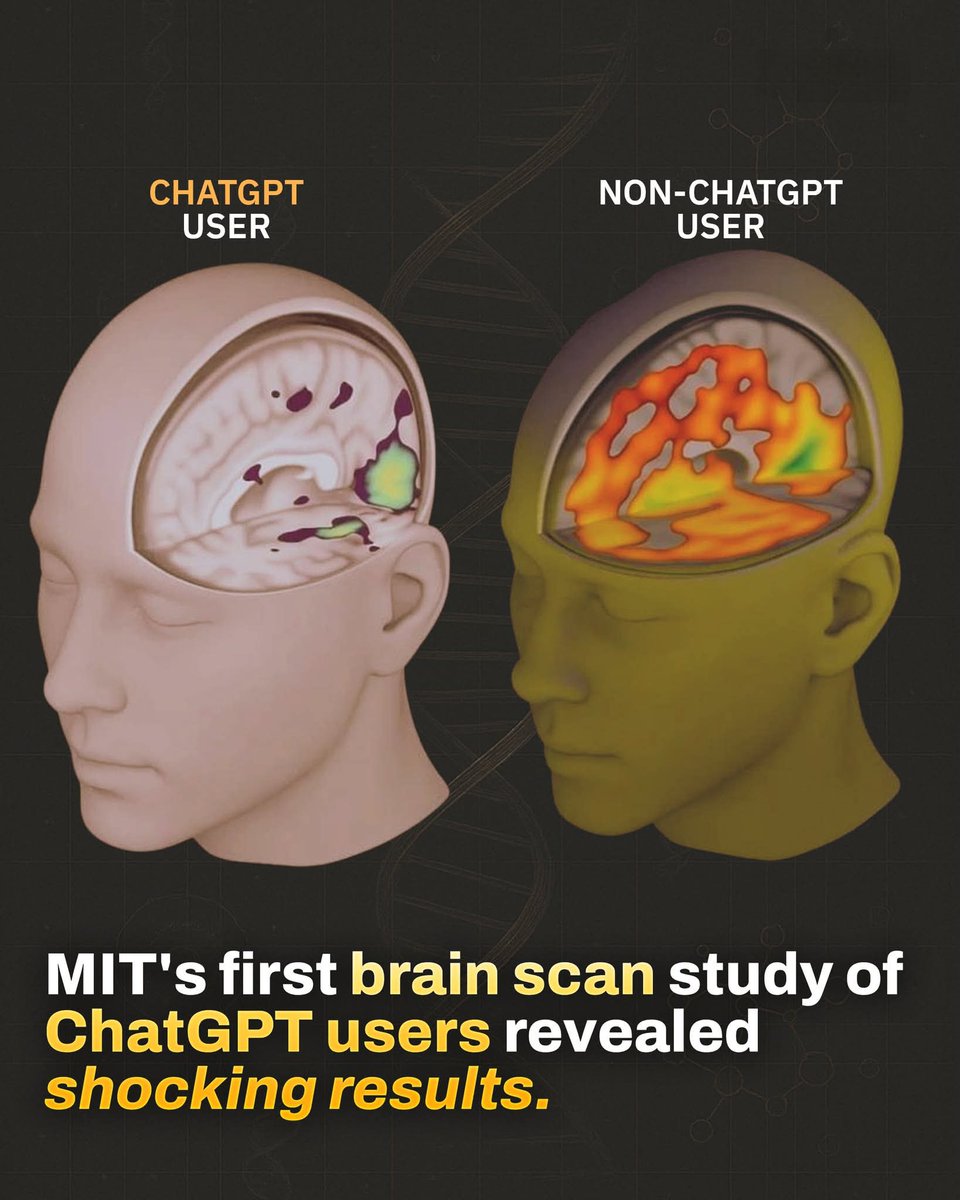
🧠 MIT recently completed the first brain-scan study on ChatGPT users—and the results are deeply revealing.
Rather than boosting brain function, prolonged AI use may be dulling it.
Over four months of cognitive data suggest we might be measuring productivity all wrong ⤵️
In MIT’s study, participants had their brains scanned while using ChatGPT.
→ 83.3% of users couldn’t recall a single sentence they’d written just minutes earlier.
→ In contrast, those writing without AI had no trouble remembering.
Brain connectivity dropped sharply—from 79 to 42 points.
→ That’s a 47% drop in neural engagement.
→ The lowest cognitive performance among all user groups.
Even after stopping ChatGPT use in later sessions, these users showed continued under-engagement.
→ Their performance remained lower than those who never used AI.
→ This suggests more than dependency—it’s cognitive weakening.
Beyond the scans, educators flagged the writing itself.
→ Essays were technically solid, but often called “robotic,” “soulless,” and “lacking depth.”
Here’s the paradox:
→ ChatGPT makes you 60% faster at completing tasks…
→ But it reduces the mental effort required for learning by 32%.
The top-performing group?
→ Those who began without AI and added it later.
→ They retained the best memory, brain activity, and overall scores.
Using ChatGPT can feel empowering—but it may quietly offload your thinking.
→ You gain speed, but lose engagement.
→ You get answers, but stop learning how to think.
The takeaway isn’t to avoid AI—but to use it intentionally.
→ Use it to assist, not replace your mind.
→ Build cognitive strength—not dependency.
MIT’s early study on AI and the brain lays out the stakes. The way we use these tools matters more than ever.
What happened in IISER Kolkata is both heartbreaking and worrying. We need to be more sympathetic and vigilant. Time to monitor mental wellness in educational institutions more systematically by dedicated team of trained professionals, rather than committees of Professors.
We have openings for two postdoc positions in synthetic organic chemistry. The first position focuses on the development of new chemical methods and reagents (with targeted synthesis applications) as well as a structure-based drug discovery program in oncology.
Prepare to have your mind expanded!🤩
Join us for unmissable session featuring speakers Prof. Akkattu T. Biju @ATBijuLab, Prof. Alakananda Hajra @ahajra_lab, Prof. Moumita Majumdar @Moumita_CHEM & Prof. Santosh J. Gharpure @sjgharpure
Can’t wait to be inspired!😇 #ISCHA2024
This is amazing to be able to test for 4 different viruses in a single, low-cost, in-home rapid test. This type of technology should be accelerated for review. The impact on early, appropriate treatment & breaking transmission could be remarkable.
Three chemistry heroes!
Jennifer Doudna (left), Carolyn Bertozzi (middle) and Frances Arnold (right) have all been awarded the #NobelPrize in Chemistry. Doudna does research on genome editing, Bertozzi works on click chemistry and Arnold works on enzyme engineering.