Silicon Valley's robotics boom in full effect.
A new breed of startups is raising massive funding rounds to push AI-powered machines into daily life. Venture capital is pouring into companies developing both the brains and bodies of next-gen machines for everything from household assistance to lights-out manufacturing.
Mountain View-based Sunday Robotics just announced it raised $165 million in a Series B round led by the tech-focused investment firm Coatue Management with participation from Tiger Global Management, Benchmark, and Bain Capital Ventures. The funding will go toward accelerating the development and production of its wheeled home humanoid robot, Memo. The war chest is pretty substantial for a young robotics firm; it's more than 1X Technologies had in 2024 as it prepared to launch its NEO humanoid.
Former Google DeepMind engineer Tony Zhao dropped out of a Stanford University doctorate program in 2024 to launch Sunday with fellow Stanford researcher Cheng Chi. The startup is now valued at $1.15 billion.
Part of the funding will toward paying so-called "memory developers" to perform everyday activities while wearing sensor-equipped gloves that capture hand movements and manipulation data. The contract workers earn between $30 to $60 an hour while recording tasks like folding laundry or loading a dishwasher. The activities generate training data that feeds Memo's AI robot brain.
Sunday Robotics plans to ship about 50 robots to beta users by late 2026. They're targeting pricing between $5,000 and $10,000 once production scales. The robots currently cost about $20,000 apiece to build.
In nearby Palo Alto, Rhoda AI just emerged from stealth after raising about $450 million in Series A funding. It's already a unicorn with a valuation of $1.7 billion.
The startup is developing a system called FutureVision, which it describes as a robotics intelligence platform to help machines run reliably in unpredictable environments like factories and warehouses. Rhoda trains its models on hundreds of millions of Internet videos to give its robots an understanding of how objects move and interact in physical reality.
The startup was founded by Jagdeep Singh, a serial deep-tech entrepreneur who previously launched QuantumScape and Infinera. The Series A found was led by Premji Invest with participation from Khosla Ventures, Temasek, Mayfield, Capricorn Investment Group, and technology backer John Doerr.
Also in Palo Alto, Mind Robotics just announced it raised $500 million in a Series A found led by Accel and Andreesen Horowitz. Its valuation is already $2 billion.
Spun out of the EV manufacturer Rivian last year, Mind Robotics says it's building both the hardware and software for industrial robots to automate factory work like component assembly, wiring harness installation, and material handling. The startup is using real manufacturing data collected from Rivian's production lines to train its machine-learning models.
🚨 15 Minutes Inside This Capsule… And You Come Out Completely Clean!
It may sound like science fiction, but in Japan a futuristic “human washing machine” is turning heads around the world. Inspired by a concept first shown at the Expo '70 Osaka, engineers have created a modern pod that can wash and dry your entire body automatically.
Built by Science Co., Ltd., the capsule surrounds you with thousands of tiny microbubbles that gently remove dirt from the skin. Smart sensors check things like heart rate while AI adjusts the water temperature, pressure, lighting, and even relaxing sounds. In just about 15 minutes, the machine washes, rinses, and dries you — no scrubbing needed.
The technology is gaining attention and some experts believe it could one day help elderly people, hospitals, and assisted living centers where bathing safely can be difficult.
Imagine this… instead of stepping into a shower, you simply step into a machine that does everything for you.
Would you try it? 👀
Robotics just hit a dexterity milestone 🤯!
Sharpa Robotics demonstrated autonomous dual-hand apple peeling using its new MoDE-VLA system.
Using human-like dexterous hands with tactile sensing, the robot can feel contact and adjust its grip while rotating and peeling the apple.
While the system achieved 30% success, the 73% peel completion rate shows robots are starting to master the fine, contact-rich manipulation needed for real world tasks.
🚨 India has unveiled Avataar, its first amphibious drone capable of operating both in the air and underwater.
This drone can 👇🏻
• Fly like a regular UAV
• Land on water and dive underwater
• Conduct maritime surveillance and inspections
• Map underwater structures and infrastructure
Renault Group has deployed the Calvin-40, a humanoid robot developed by a French startup, Wandercraft, at its Douai factory to haul car tires.
Renault has taken a stake in Wandercraft and plans to deploy 350 more Calvin robots over 18 months.
India is quietly rolling out one of the most ambitious public AI compute programs in the world.
Through the IndiaAI Compute Portal, startups and researchers can access subsidized GPUs at ₹65/hour ($0.77). More than 38,000 GPUs are already live under the national AI mission, with additional capacity planned — aimed at lowering the barrier to entry for startups, academia, and public-sector labs.
A year ago, sustained training runs were out of reach for many Indian AI teams. Today, the government is treating compute like shared infrastructure: pooled, subsidized, and broadly accessible.
It’s not cheap enough for frontier-scale training but it could materially expand who gets to experiment, build, and ship.
This is one of the most interesting AI infrastructure experiments happening right now and it’s worth paying attention to.
Well done INDIA !
I grew up reading Byomkesh Bakshi and Feluda: two legendary Bengali detective series that almost no one outside India knows.
Now all ~70 novels are translated to English and free to read on https://t.co/BptYoi1cTo.
My goal: build the world’s internet library. Every great book, in English, free forever.
We shipped 10x more books in the last 48 hrs. Follow @grandoldbooks for more.
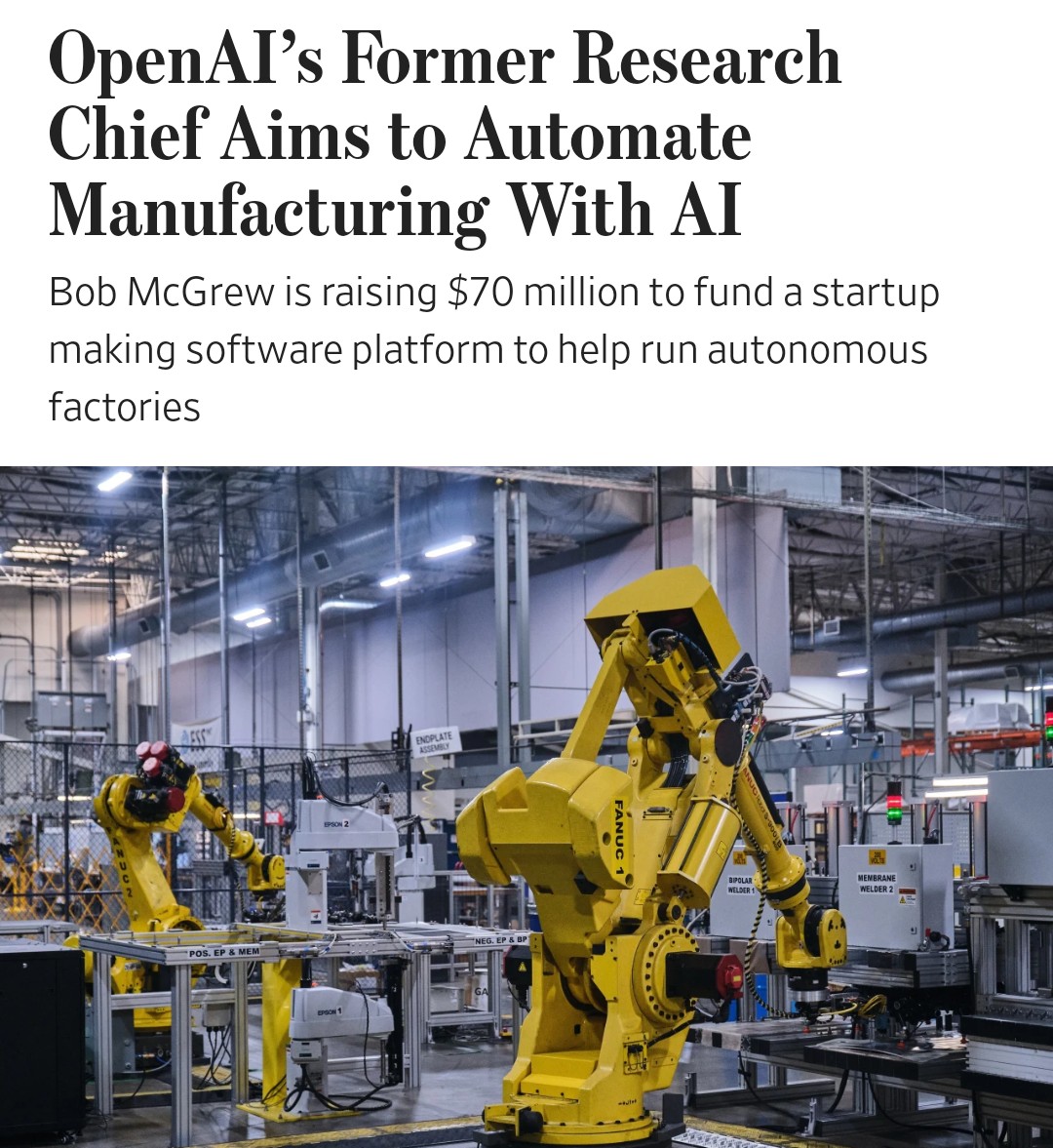
OpenAI's former chief research officer Bob McGrew is raising $70 million for a new startup named Arda. He is building an AI/video model platform that will use video of factory operations to train robots to run those factories autonomously.
Clone’s Protoclone is a musculoskeletal android engineered around an anatomically based human skeletal structure. It incorporates more than 1,000 artificial muscle actuators (Myofibers), polymer-based bones with articulated joints and ligaments, and a hydraulic vascular system for force transmission. The platform integrates depth cameras, inertial and pressure sensors, and onboard computing powered by NVIDIA Jetson Thor to enable sensor-driven visuomotor control.
Credit: @clonerobotics
#robotics #robots #engineering #technology #android #Protoclone
While the world’s attention has been fixated on Elon Musk’s long-promised Optimus robot and the high-stakes AI race between the US and China, Hyundai Motor has emerged as a leader in humanoid robots. Read more: https://t.co/aGu964iTw9
📷️: Hyundai Motor, Tesla
This is HUGE: Scientists are developing memory crystals and DNA storage that could preserve human knowledge for billions of years without using a single watt of electricity.
New “immortal” storage technologies could eliminate the need for power hungry data centers. Researchers can now store hundreds of terabytes on glass memory crystals that last billions of years, or encode vast archives inside synthetic DNA.
Researchers led by University of Southampton Professor Peter Kazansky are developing 5D laser written silica glass, often described as a memory crystal that can hold about 360 TB on a single 5-inch disc and survive extreme heat, radiation, and time itself without electricity.
Meanwhile, Imperial College London Professor Thomas Heinis highlights DNA as an ultra-dense storage medium capable of preserving enormous amounts of data in microscopic form, though costs remain prohibitively high.
“Unlike hard drives that fail within years, these materials could preserve human knowledge for geological timescales while consuming zero power during storage.”
Microsoft has also demonstrated both memory-crystal (glass) and DNA storage systems in research projects ..some big stuff is about to come.
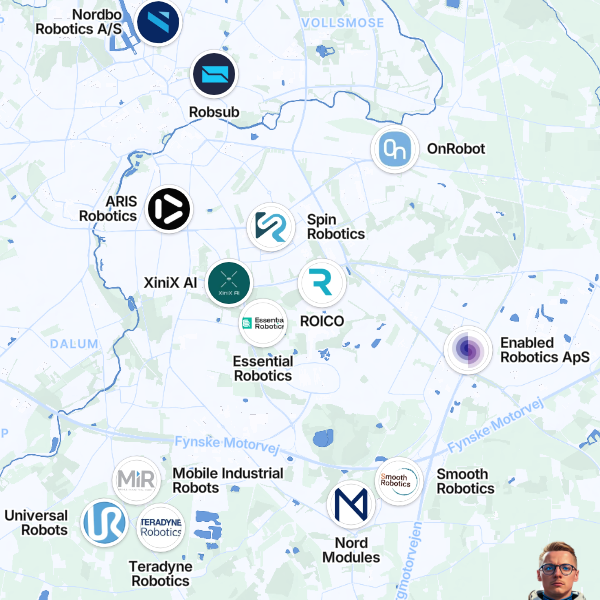
Danish city of robotics! 🇩🇰
When I arrived in Odense in 2024, the first thing I saw was robots. Lots of them.
Cleaning robots greeted me at the station, an autonomous one trailing advertising banners rolled past, and a few minutes later I spotted UR robots playing tic-tac-toe in a shop window.
Odense is one of Europe’s strongest robotics ecosystems, especially for collaborative and industrial robots.
At the center is the Syddansk Universitet - University of Southern Denmark (SDU), which has a leading robotics research department and works closely with startups. Many founders and engineers come directly from SDU labs, making it easy to turn research into real companies.
A major boost to the ecosystem came from the success and acquisitions of Universal Robots and Mobile Industrial Robots. 💰
Their global growth, and later acquisitions created serial founders and angel investors, capital recycled back into new startup, and a strong global reputation for Odense robotics!
Also startup supporting initiatives like Odense Robotics that help with global commercialization and partnerships (hello Rasmus Festersen 👋🏻).
Because of this, more robotics startups can now be incubated locally, supported by experienced mentors who have already built and scaled global robot companies.
What companies are in their ecosystem:
→ Universal Robots builds collaborative robotic arms (cobots) for flexible industrial automation and was acquired by Teradyne for ~$285M
→ Mobile Industrial Robots (MiR) develops autonomous mobile robots (AMRs) for internal logistics and was acquired by Teradyne for ~$148M
→ Teradyne Robotics is the robotics division of Teradyne
→ OnRobot provides plug-and-play end-of-arm tooling (grippers, sensors, screwdrivers) for collaborative robots and has raised ~$55M+ in funding
→ ROICO develops robotic solutions and automation systems for industrial painting applications
→ Spin Robotics builds collaborative robot torque tools for automated screwdriving in manufacturing
→ Enabled Robotics develops mobile manipulator robots combining AMRs with robotic arms for flexible logistics automation
→ Nord Modules A/S designs modular top modules for autonomous mobile robots to expand logistics functionality
→ Smooth Robotics ApS develops automated welding solutions for collaborative robots
→ Essential Robotics builds autonomous solutions for healthcare
→ XiniX AI develops AI software and vision solutions for robotics and industrial automation
→ ARIS Robotics develops advanced robotic systems for industrial and research applications
→ RobSub builds underwater robotic systems and ROV solutions for marine applications
→ Nordbo Robotics develops force-torque sensor technology and adaptive control software for robots
I highly recommend visiting Odense for everyone that has an interest in robotics. A must-visit place! 🦾
What city should be next?
~~
♻️ Join the weekly robotics newsletter, and never miss any news → https://t.co/GoA3ZuwoPB
An Indian startup is leading a parallel Bio-Hybrid revolution that the German startup actually cited as a model for biological scaling.
Loopworm (based in BLR, founders are IIT-R alums), started in insect-based feed & has pivoted into using silkworms as living bioreactors to produce recombinant proteins & vaccines.
Just as the German company uses insects as living platforms for sensors, Loopworm uses them as living platforms for chemical manufacturing. They bypass traditional stainless steel lab reactors entirely. This reactor-free approach is the same philosophy SWARM Biotactics uses to bypass robotics factories.
In Germany, prototypes of bioelectronic insects for military purposes were unveiled
The company SWARM Biotactics has developed a technology that combines living insects with neural interfaces, AI, and sensors, turning them into autonomous reconnaissance platforms.
The project has progressed from concept to application within a year, with field tests already completed.
The advantage of such systems over drones is their high mobility, low noise levels, and ability to access hard-to-reach places.