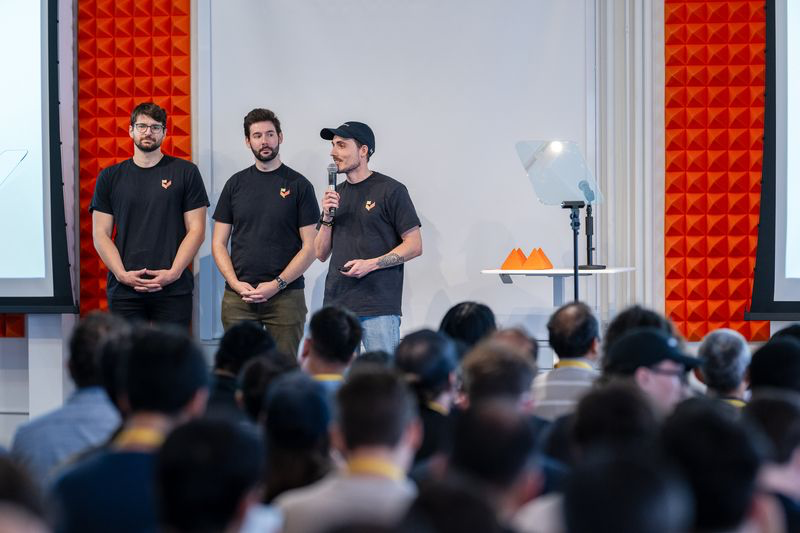
I'm 30. I built an AI startup called @GojiberryAI doing over $5M ARR in one year. Got accepted into YC.
No one wants to hear this, but there's no magic distribution channel.
We got there by experimentmaxxing one channel at a time, based on our MRR level.
$0 → $6k MRR: pure outbound. Cold email + LinkedIn, using our own early product on ourselves. No brand, no audience — just us reaching out to people showing intent and starting conversations. Ugly, manual, effective.
$6k → $25k MRR: Reddit. Our first real acquisition breakthrough. We posted educational breakdowns in SaaS subreddits and pulled 10M+ organic views. Traffic quality wasn't amazing, but the volume flooded our trial funnel for months. Cost: basically zero.
$25k → $75k MRR: content + free blueprints. All-in on LinkedIn content, YouTube, motion-design videos, and giving away our internal systems as free "blueprints." Content got the reach, blueprints earned the trust, and a chunk of readers converted. This is where founder-led content started compounding.
$75k → $150k MRR: partnerships + X. We added Twitter, B2B influencers, sponsored newsletters, and a lifetime affiliate program that became a major lever. We also joined YC around here — the intensity went vertical.
$150k+ MRR: paid + hiring. Meta ads, Google ads, influencer agencies, and our first serious hires: growth, sales, engineering, product.
To get to $1M+/month, it’s mostly going to come down to hiring the right people and putting the right structure in place.
Here's the part people miss: none of these stages replaced the last one. They stacked. Outbound never stopped. Content never stopped. We just added the next lever once the current one was clearly working.
If you take one thing from this: don't chase five channels at once.
Beat one until it works. Then add the next.
Yuval Noah Harari: AI could destroy humanity without killing a single human being.
"My biggest fear is that it's not a specific scenario like AI creating a virus or killer robots."
"It's really that in five or 10 or 20 years, all humans will just have no idea what is happening anymore."
"Our reality will just collapse. We won't understand finance, we won't understand politics, we won't understand science."
"There are still clouds and trees and cats, but the systems that control the world are way beyond our understanding."
My favorite feature of Granola is multi lingual. Its summaries are still in English.
So if your customers get into a foreign language midway during the call, you don't need to panic. Meeting summaries will still capture them.
Bisleri Water not fit for consumption
Product declared unsafe and on compliant with prescribed bromate limits
PAH also detected
PAH indicates the water isn’t safe and polluted
Both are classified as carcinogens
@fssaiindia Issues a notice
Polo shirts started with late-19th century British polo players, hence their name. They were often worn in colonial India, where players needed something lightweight and breathable for play. By the turn of the 20th century, they made their way onto European tennis courts, where René Lacoste most famously wore them during his championship games. After retiring from professional tennis, Lacoste founded a company in 1933 and sold cotton-piqué shirts decorated with a snapping crocodile, a nod to his nickname.
After World War II, golf became popular in the United States, fueled in part by suburbanization and a growing middle class with lots of leisure time. As Americans moved out of urban centers and into sprawling suburbs, golf courses became more accessible, allowing more people to take part in what had once been a relatively exclusive pastime. For these recreational golfers, the comfortable, lightweight knitted shirts already associated with aristocratic sports such as polo and tennis were a natural choice.
Our standards of respectable dress are often simply a reflection of bourgeois tastes and customs. Thus, it was natural for the polo shirt to eventually drift into professional white-collar spaces. By the end of the 20th century, the polo shirt was coded as "business casual." This class dynamic explains why clothing associated with more working-class sports, such as football and basketball, were denied the same respectability.
I personally don't think you need a certain body type to wear a polo shirt, although I don't care for the basic cotton piqué variety. I also dislike "performance" polos made from slick synthetic fabrics and featuring micro-prints. To me, they look like clothes you'd put on a child.
To me, a polo looks better when it's made from a finer knitted material and has a more distinctive collar, such as a skipper collar or one with a collar stand. This allows the collar to behave more like a shirt collar. You can also get something with texture, though those are significantly less appropriate for business settings.
The best way to understand menswear is not to think of styles rising and falling based purely on what makes men look good, but through the lens of power, politics, and aspiration. The polo migrated from colonial polo fields to European tennis courts to American golf courses, giving it a pedigree that allowed it to be understood as "business casual." Since we live in a world where men aren't supposed to wear a coat-and-tie, but also not more interesting casualwear, many reach for the same "respectable" uniform: chinos and polos.
A lot of bad GTM decisions are actually good decisions made at the wrong stage.
Adding more info to the GTM list below:
-At $0 ARR, your biggest problem is figuring out why anyone would buy.
-At $100K ARR, it's finding more people who buy for the same reason.
-At $1M ARR, it's making that acquisition repeatable without the founder doing everything.
-At $10M ARR, it's figuring out how far you can scale before CAC, conversion, or retention starts breaking.
These are four completely different marketing problems.
Yet I constantly see founders hiring someone who scaled a company from $10M to $50M and expecting them to figure out the first 10 customers.
Or copying a $20M ARR company's channel mix when they haven't even figured out which customers stick around.
A tactic can be absolutely right and still be six months too early.
writing with ai is a tragic mistake because you're telegraphing to your readers that you have 0 confidence in your thoughts or in your ability to structure those thoughts. but perhaps even worse is the confession that you dont ENJOY writing that much and would rather outsource it
If you don't lean into in-person in B2B you're ngmi.
It's where the highest concentration of truth lives.
Things I've done that work:
- small steak dinners
- lunch 'n learns
- 30-40 person dinner + activity + speaker
- tradeshows with a booth
- tradeshows without a booth
- happy hours around tradeshows
- attend competitor user conference
- fly key customers/pipeline to your office
- suites or tickets to games
- ask a customer to come to a prospect onsite
- take customers + prospects from same city to a workout class a brunch
- customer advisory board all day events
- ask customers to host us and prospects in their office to give a sneak peek of upcoming product releases
- use a 3rd party provider to book, set up and get net new prospects to a dinner in various cities
The list goes on. There is no excuse not to be getting out of your building!