LaTeX on Sundial that auto-compiles
In Sundial, agents automatically resolve compilation issues. AI changes are also marked as suggestions in the LaTex file, for your review
Inkling is pretty good at audio => text
Here we're fine-tuning it to turn voice memos into markdown diffs.
After a few rounds of SFT on our dataset it outputs cleaner diffs and avoids classic formatting mistakes.
Output tokens went down ~2-3x vs baseline, which is the largest gap we've seen fine-tuning models.
For context, this is part of our work to create a better way to collaborate with models on text documents.
What if your agent watches a product doc for changes and immediately updates it in your codebase?
When I change a line, Claude updates the code to match it:
Reviewing agentic work matters more than ever.
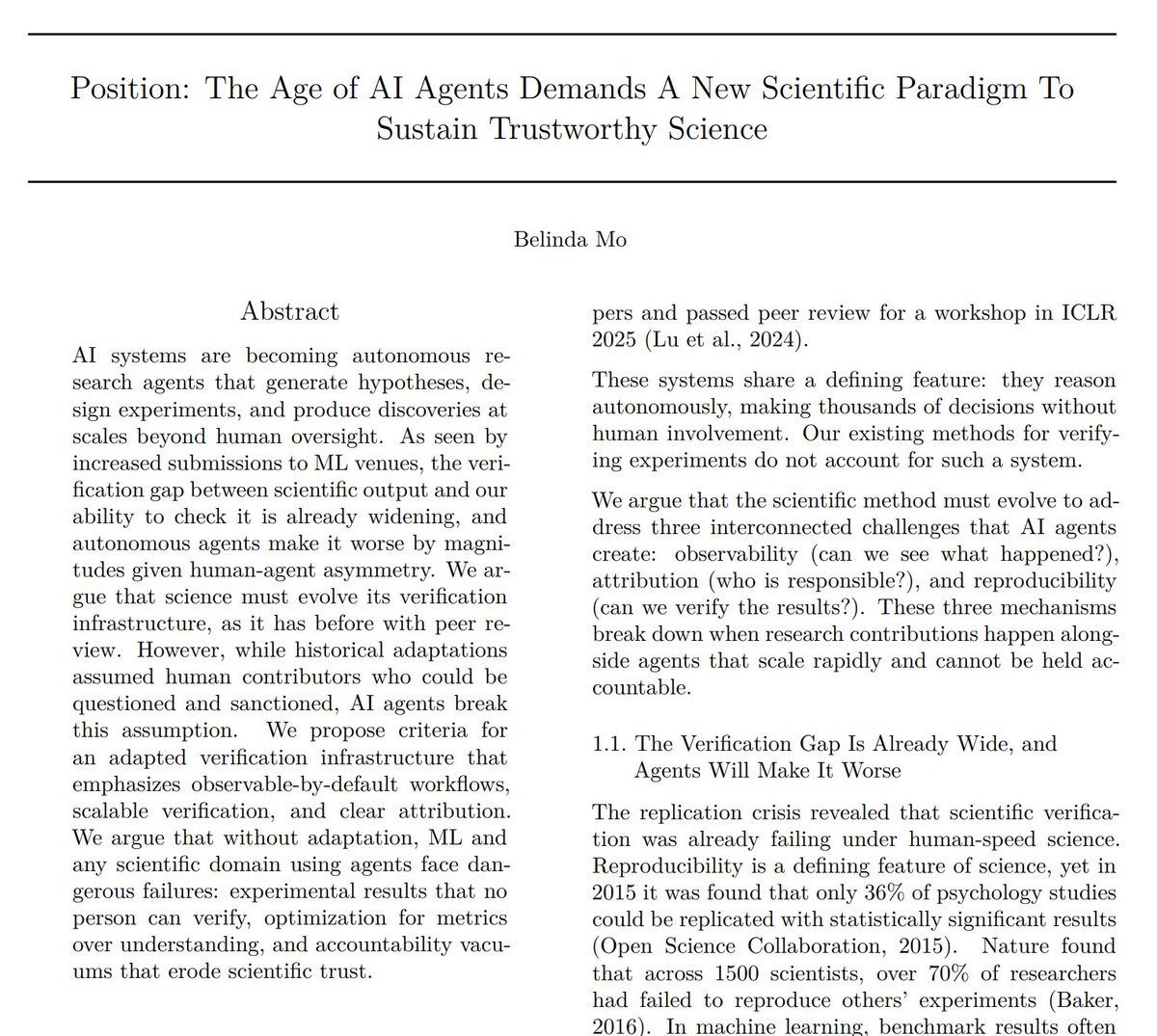
As AI agents do more of the research, the bottleneck becomes reviewing the work. My ICML position paper argues that science in the age of agents needs three things: observability, attribution, reproducibility.
Introducing Sundial!!
A brand new text editor built from the ground up for working with agents.
Here, we're using Sundial to co-write a new Sundial feature.
The mission of Long Horizon Research is to increase communication (bits / second) between AI agents and people, so every person can go from thought to reality.
more 👉👉
Long Horizon Research's first product is Sundial, a collaborative workspace that feels as familiar as your favorite document editor, but where you can also launch and review your AI agent's edits. 👉
Today we're introducing Sundial, a new kind of document editor built for human-agent collaboration at scale.
Agents should be a force multiplier our intentions. The bottleneck is not generation anymore, but supervision and review.
Building the right systems of record will be key to keeping humans at the center of knowledge work.
1/ "I kept having the same experience with AI coding agents: they'd make a mistake, I'd correct them, and later they'd make the exact same mistake again." — gwangee on Hacker News
That's exactly what "Self Improvement" by @PeterSkott (173K installs) fixes. It logs errors, corrections, and lessons so your agent stops tripping over the same stuff twice.
@PeterSkott 4/ Honest take:
✅ Stupidly simple concept. Surprisingly effective.
✅ One of the only skills focused on 𝘱𝘳𝘰𝘤𝘦𝘴𝘴, not output
⚠️ Works best when you actually correct the agent rather than re-prompting from scratch
We're co-hosting one of the largest hackathons of the year with @agihouse_org on March 14.
Come if you want to build:
- New agent skills to turn your workflows into reusable playbooks
- Skill benchmarks to measure and improve them
- Self-improving skills for continual learning with just a filesystem
- Skill orchestration and metaskills
We'll have speakers from @sundialhub, @GoogleDeepMind , @xai, Adept AI, @inworld_ai, @moonlake, @benchflow_ai, @LaudeInstitute, @skillbossAI and more.
OpenClaw has 226k stars and 10k+ skills!!
But 90% of agent skills are barely useful. Vibe-coded with the wrong context, they don't work or make things worse.
However, when they're built well, skills save you so much time and energy. That's why they're used internally across teams at the major research labs. @bcherny@OfficialLoganK@kevinweil
We need way more high-quality, vetted skills.
Come to the first agents skills hackathon:
https://t.co/sFAOgUUotw