New in The Atlantic:
@dgrobinson resigned this week. He was among the longest-tenured employees at OpenAI—and oversaw safety reports on 12 frontier launches.
He is very worried: “The time for trial and error is over.”
You can read his essay here:
https://t.co/DQlszrc0ru
First author of this paper here. Just want to give a special shoutout to @a1zhang’s RLM work since the general takeaway is very similar. The RLM work showed that a minimal code-mode harness can handle large inputs without needing external tools our harness components. We show that the natural generalization that makes *all* inputs (incl. user prompt instructions) and the REPL history itself variables in the REPL lets you do even more without external tools/harness components, such as very long-horizon tasks and self-improvement!
Update on previous post about CK Conjecture:
We now release an end-to-end Lean formalization, which was developed using a workflow involving a variety of AI models. The computational tasks were run on Google's distributed computing infrastructure. These systems assisted with reasoning, Lean formalization, generator development, orchestration, debugging, and verification audits. The Lean formalization is available here with 50 millions of line (maybe a record?): https://t.co/ZR3EaeKtwZ. The complete formal proof was checked end-to-end by Lean's kernel.
We also provide a self-contained expository note: https://t.co/KSO0U34Bpn explaining the reduction to a low-dimensional inequality and the ideas behind the key lower bounds.
@mirrokni@mirrokni is there a way for me to reach out to you privately? I’m currently unable to DM you here. Couldn’t find your email, if email is best my email is matthho at stanford dot edu. Thanks!
@mirrokni super excited to see what the convex combination of insights from the multiple approaches will look like + implications for other related problems
Some thoughts on AI and Theory.
1. To a first approximation, theoretical computer science has been organized around a few major open questions. Much of our work has been motivated by developing approaches to answer these questions.
2. Such “problem-motivated” work has often led to theory-building focused on identifying a general principle that unifies a class of theorems. But much of that theory-building also involved proving new, difficult theorems.
3. Thus, while it’s true that problem-solving was strongly correlated with building understanding, drawing connections, and eventually developing general theories, it would be disingenuous not to admit that our community, perhaps disproportionately in retrospect, focused on and celebrated problem-solving. This was not arbitrary, and was quite defensible. Being able to make progress on central technical questions usually correlated with taste, creativity, persistence, and depth of understanding. Much of our reward structure therefore implicitly relied on the fact that producing an important proof was good evidence that someone possessed these harder-to-observe qualities.
4. It seems likely that we will soon have AI tools available to us that can prove many such theorems in a short time. The cost of obtaining proofs for well-posed mathematical questions will likely fall dramatically. The “scarce” intellectual work will likely shift both upstream: to questions, models and theories, definitions, and conjectures, and downstream: to interpretation, synthesis, explanation, and theory-building.
5. But as long as we believe in humans being meaningfully in charge of our collective decisions and fate, building human understanding of our science (and of science more generally) will remain an essential goal. I plan to expand on this important aspect soon.
6. Historically, finding a solution to an important problem and understanding its significance, implications, and connections were entangled. Finding a proof usually required researchers to discover the right concepts along the way. A dramatic reduction in the time and effort required to prove theorems could break that coupling. We could end up with many more true statements and proofs without a commensurate increase in understanding.
Converting an abundance of proofs into human understanding may become one of the central challenges of our field.
7. As a result, I expect the high-level goals of theoretical computer scientists to change. In fact, the advent of powerful theorem provers might help us construct new theories and explore new models far more easily and rapidly, and significantly expand the domains where our models and theories apply. In that sense, the space for theoretical work may significantly expand rather than contract.
8. There’s a high human cost to the disruption that we are likely heading into. Many in our field, and in mathematical communities more broadly, are coming to terms with it. The range of opinions and reactions among mathematicians and theoretical computer scientists is a natural part of this evolution in our thinking as we collectively work through it.
Some concrete efforts (including one at @SimonsInstitute) are already underway to think through the immediate scientific and institutional questions arising during this transition.
@DimitrisPapail@eyal_eg Coincidentally, I also am in the process of simplifying a very large certificate-based information theory proof. Wonder if this is a sign of how many proofs in IT will be approached by AI, kinda a pain to formalize
@prz_chojecki@RequestyAI I'm trying to dm you (have a question about prompt for Fable, can elaborate more), but can't seem to due to Twitter blocking me--would it be possible to dm me?
@julianboolean_@alexisgallagher How can you be sure of the correctness of the proof without an understanding of the components of the proof and without a formalization? Have found that Pro still makes mistakes at pro level reasoning, eg assuming compactness when it cannot be assumed etc.
@PunishedPhD@im_walkin_here @kushrayne @zanyfen in math, several decade-old open problems were solved because of the ability of LLMs to find old papers in which the problem was (or nearly) solved, but the author of the paper didn't put it in the abstract (sometimes in different languages too!)
@thsottiaux it's so good at deriving candidate intermediate inequalities in certain proofs, by using LP/SDP solvers to search for matching coefficients. very strong at math.
@jdlichtman@richa_lq@andrew_n_carr@ilyasut i do think performing good lossy compression is an important part of intelligence. learning good abstractions to me is about distilling the parts that are important and shared between concepts and throwing out the rest.
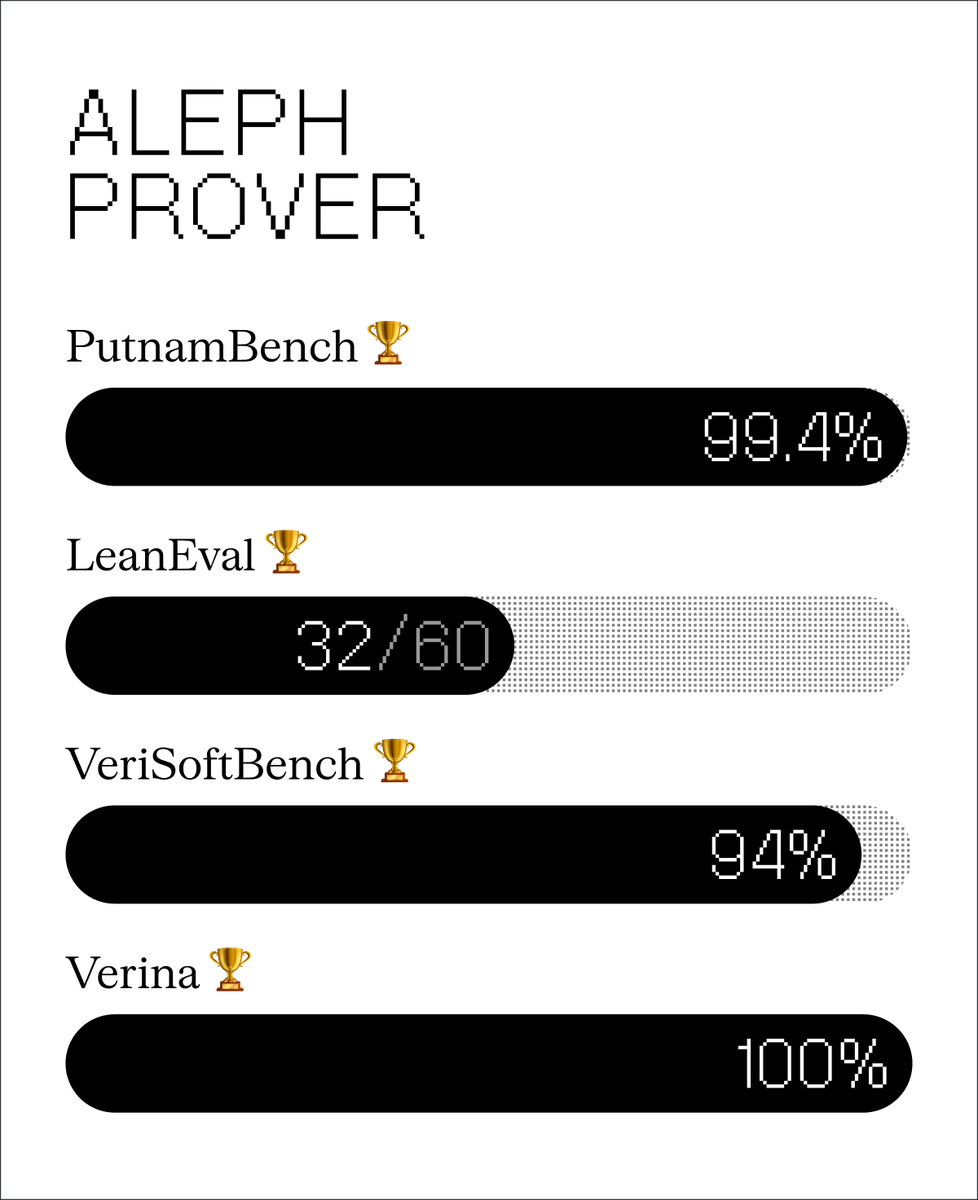
Aleph, our fully autonomous AI agent system for formal verification, aced all major theorem proving benchmarks including PutnamBench, VeriSoftBench, and Verina
This could have covered the entire budget of the National Science Foundation for 10 years.
Instead, Trump wants to reduce the NSF budget by 50% ($5B a year instead of $9B), which would decimate the American scientific research ecosystem, dramatically reduce the number of PhD graduates, and destroy the technology innovation flywheel.
@agniv_s@OpenAI yeah a couple of months ago i would use gpt 5.4 for formalization and it would randomly output hebrew or hindi sometimes in its lean code, quite funny