📢 𝐉𝐔𝐒𝐓 𝐈𝐍: Navitas Showcases 𝟖𝟎𝟎𝐕 AI Data Center Power Solution in NVIDIA MGX Ecosystem - $NVTS $NVDA
👉 𝐊𝐞𝐲 𝐇𝐢𝐠𝐡𝐥𝐢𝐠𝐡𝐭𝐬:
➤ Navitas participated in NVIDIA’s 𝐌𝐆𝐗™ Partner Ceremony at COMPUTEX 2026.
➤ Company showcased an 𝟖𝟎𝟎𝐕-𝐭𝐨-𝟔𝐕 DC-DC power delivery board for AI servers.
➤ Solution eliminates the traditional 𝟒𝟖𝐕 intermediate bus converter stage.
➤ Powered by 𝐆𝐚𝐍𝐅𝐚𝐬𝐭™ technology with targeted 𝟗𝟕.𝟓% peak efficiency.
➤ Design enables 𝟐𝟏𝟎𝟎 𝐖/𝐢𝐧³ power density and ultra-thin form factor.
➤ Navitas’ 𝐆𝐚𝐍 and 𝐒𝐢𝐂 technologies support next-generation AI factory infrastructure.
➤ Collaboration with NVIDIA aims to accelerate scalable, high-efficiency 𝐀𝐈 𝐝𝐚𝐭𝐚 𝐜𝐞𝐧𝐭𝐞𝐫𝐬.
💬 𝐄𝐱𝐩𝐞𝐫𝐭 𝐒𝐭𝐚𝐭𝐞𝐦𝐞𝐧𝐭:
“As AI workloads continue to scale and drive unprecedented demand for compute, power delivery has become one of the most critical challenges in enabling next-generation gigawatt AI factories,” said Chris Allexandre, President and CEO of Navitas.
“Through our collaboration with NVIDIA within the MGX™ ecosystem, Navitas is delivering GaN and SiC power technologies that enable megawatt-scale AI server racks with higher power density, a smaller system footprint, and improved thermal performance, helping accelerate the transition to more efficient and scalable AI infrastructure.”
GF Securities Overseas Electronics & Communications
CCL: Orthogonal backplane adopts PTFE material
NVIDIA has confirmed PTFE as the primary material choice for the Rubin Ultra orthogonal backplane. Below is the related analysis.
Orthogonal backplane officially adopts PTFE material:
According to our supply-chain checks, the previous M9 + Q-glass fabric solution failed to meet the required electrical performance standards. As a result, PTFE was ultimately selected as the core material for the orthogonal backplane.
1. PTFE offers excellent high-frequency transmission characteristics, with lower signal loss, enabling support for 337G and above SerDes signal transmission on the Rubin Ultra platform.
2. Traditional PTFE material is relatively soft, making drilling prone to burr formation and creating mass-production challenges. However, the newly developed silicon dioxide (SiO₂) filler-modified PTFE significantly improves mechanical rigidity. This material has already passed electrical performance tests and mass-production feasibility validation.
PTFE gradually replacing traditional glass-fiber materials:
PTFE CCL no longer uses glass fiber fabric. The production process involves coating hydrocarbon resin onto the PTFE surface, then directly laminating it with copper foil.
According to our checks, the unit price of modified PTFE material is around RMB 150,000 per ton. Each sheet of CCL consumes around 800 grams of PTFE, and the selling price of a full PTFE CCL sheet can reach RMB 2,500.
At present, the final design scheme for the orthogonal backplane has not yet been finalized. Candidate solutions include 78-layer and 108-layer structures, using a hybrid lamination combination of PTFE CCL / M9-Q glass fabric / ABF-filled CCL. The final design is expected to be determined in July.
Review of beneficiaries across the PTFE supply chain:
We expect Shengyi Technology (600183 SH) to become the primary supplier of PTFE CCL. Taiflex Scientific (8039 TT) is still in the product certification stage and is likely to become the secondary supplier.
On the upstream raw-material side, Dongyue Group (0189 HK) is currently Shengyi Technology’s core PTFE raw-material supplier. Daikin (6367 JP) and Haohua Chemical Science & Technology (600378 CH) are potential raw-material suppliers.
Based on preliminary order estimates, the PTFE CCL TAM for the 2027 Kyber platform could reach RMB 8 billion. Subsequent volume ramp-up of the Feynman platform should further drive demand.
Due to the complexity of the manufacturing process, midplane-related products are expected to begin mass production by the end of 2026.
The new process is also positive for PCB manufacturers. In current HLC PCB products, the ratio of total PCB value to CCL material value is around 2–2.5x. Under the new design, this ratio is expected to rise to 3–3.5x, significantly increasing the product value for PCB manufacturers.
NVIDIA QUIETLY DROPPED A $249 BOX THAT REPLACES YOUR $200/MONTH OPENAI SUBSCRIPTION WITH $2 IN ELECTRICITY
it's called the jetson orin nano super. smaller than a wallet, runs at 25 watts, does 70 trillion ai operations per second. runs llama 3, mistral, gemma and deepseek locally with no api fees and no data leaving your house
a developer running automations and coding assistants pays $200 a month to openai. the same workload on this box costs $2 a month in electricity and breaks even in 10 weeks
install ollama with one command. change one line in your code. point it at localhost instead of openai. everything else works identically
7 billion parameter models handle 80% of what people use chatgpt for. summarization, drafting, coding, document q&a, automation pipelines. total monthly cost drops from $200 to $22
cloud subscriptions keep getting more expensive and rate limits keep getting tighter. the people who set this up in 2025 are going to look very smart in 2027
bookmark this and read the article below
Interview with a $MSFT employee on why cooling has become one of the most complex problems ( $AMZN, $GOOGL ):
- The expert explains that $MSFT, when expanding capacity, almost always stays close to its existing regional footprint, with fiber connectivity of no more than 60 kilometers between data centers being the core technical constraint. Any new region requires at least three data centers in close proximity, and when choosing partners for those builds, the preference is strongly toward companies already in existing relationships.
- According to the expert, GPU demand at $MSFT is showing no signs of slowing, with large cluster projects continuing to grow. Each new GPU generation brings more performance but also significantly higher power requirements, jumping from 23-40 kilowatts per rack today to around 120 kilowatts for next-generation hardware like $NVDA's Vera Rubin, a shift that makes many existing facilities unable to handle the load without expensive retrofits.
- The expert explains that GB300s cannot be air-cooled and that liquid cooling became the standard starting with the GB200 generation. The challenge this creates is that not all equipment is designed for liquid cooling, with some networking and server components still requiring traditional air cooling. As a result, data center designers have to accommodate both systems simultaneously, which the expert sees as one of the ongoing challenges in the market.
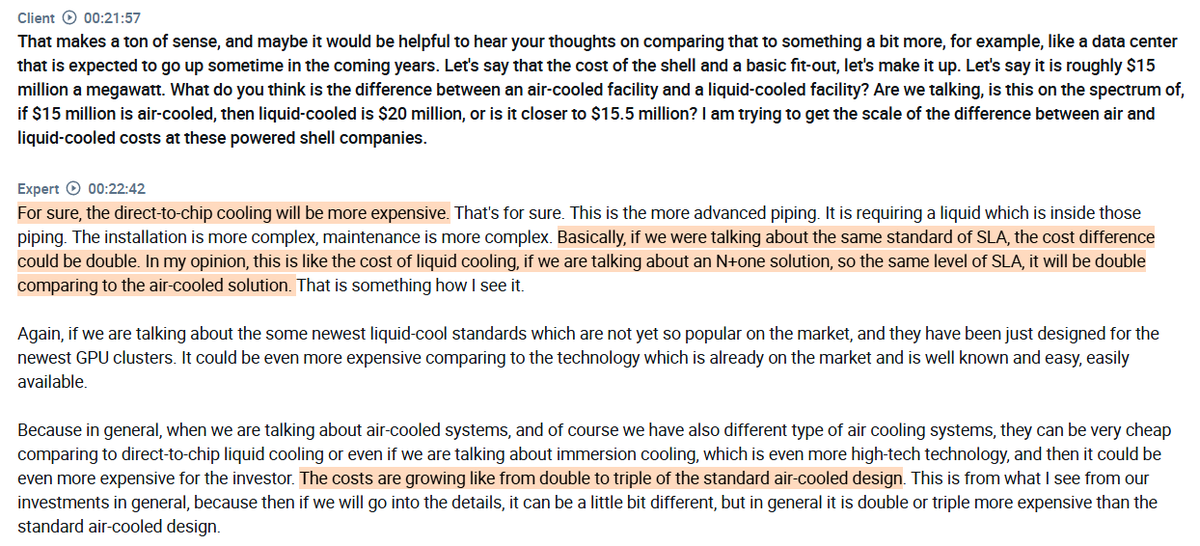
- The expert estimates liquid cooling as roughly double the cost of an air-cooled setup at the same SLA standard, due to more complex piping, installation, and maintenance requirements. For newer standards built specifically for the latest GPU clusters, costs can climb even further, with immersion cooling reaching two to three times that of a standard air-cooled design.
- The expert puts GPU depreciation at 3-5 years for current generation deployments, compared to 7-8 years for older cluster technology, driven by two factors. First, each new GPU generation delivers such a significant performance jump that older hardware becomes inefficient quickly, with a single new rack potentially replacing ten older ones in terms of compute output. Second, there is still uncertainty around how GPUs will hold up after 3-4 years of continuous intensive use, particularly for training workloads running around the clock, which adds another layer of risk.