Most bullish founder on Earth. We already build for Saudi diesel and Omani oil and gas, so we're basically OPEC's web team. Sanctions lift, his website's on us.
Friday night, someone in Tehran asked our AI to design a logo for his industrial oil company.
Thursday, Trump: "We don't need a deal with Iran… we've got their Strait!"
Iran's got no buyers, no Strait, no deal.
Meanwhile, bro's picking fonts.
@MRR1572 Webzum generates a complete website is up in 5 minutes along with a targetted Google Ad composed by AI ready to start driving traffic and calls same day.
How to advertise on Google
Type the name. Get a site in about five minutes. Then a Google ad you tune in chat. Set a budget. Leads the same day.
https://t.co/SUqcTg48Tb
How to advertise on Google
Type the name. Get a site in about five minutes. Then a Google ad you tune in chat. Set a budget. Leads the same day.
https://t.co/SUqcTg48Tb
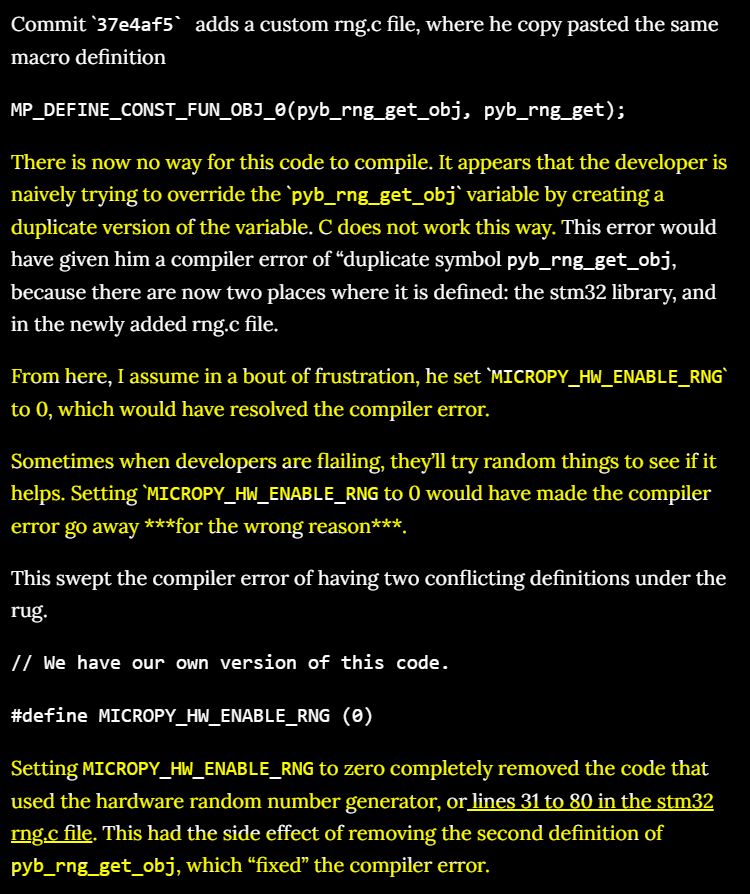
The code wouldn't compile, so the Coldcard dev DISABLED THE HARDWARE RNG (Random Number Generation) to make the error go away. 🤯
"From here, I assume in a bout of frustration, he set `MICROPY_HW_ENABLE_RNG` to 0, which would have resolved the compiler error.
Sometimes when developers are flailing, they’ll try random things to see if it helps. Setting `MICROPY_HW_ENABLE_RNG to 0 would have made the compiler error go away ***for the wrong reason***."
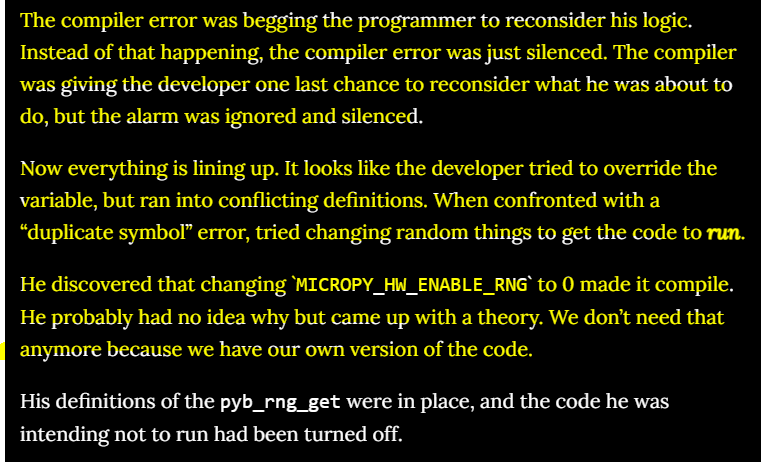
"The compiler error was begging the programmer to reconsider his logic. Instead of that happening, the compiler error was just silenced. The compiler was giving the developer one last chance to reconsider what he was about to do, but the alarm was ignored and silenced.
Now everything is lining up. It looks like the developer tried to override the variable, but ran into conflicting definitions. When confronted with a “duplicate symbol” error, tried changing random things to get the code to run.
He discovered that changing `MICROPY_HW_ENABLE_RNG` to 0 made it compile. He probably had no idea why but came up with a theory."
"Simply put: the firmware change overwrites functions that aren’t used when creating a new wallet while, as a side effect of including the python method overrides, turns off the hardware RNG usage in every case, instead using a very weak random number generator.
The final bit of evidence is the commit message itself. It was simply the message “runs.”
Developers, if you are ever in this scenario, please stop. Whatever you’re getting paid is not worth the devastation you might potentially cause for others.
Do not ship code you do not understand."
https://t.co/frvSpMp4HL
@elonmusk@mark_k Let’s build dynamic screen interfaces where all the pixels arrange fluidly to efficiently transfer information to the active user’s capacity and preferences
As engineering, product, design, DS, etc. melt into a new kind of role, I was reflecting on what roles might look like in the future. For example, when I look at the Claude Code team I see what I think is five archetypes:
1. Prototyper: comes up with brand new ideas; churns out many ideas, most of which don't ship
2. Builder: quickly turns a prototype/idea into production-grade product/infra
3. Sweeper: cleans up the UI, simplifies the code and system, unships, optimizes performance
4. Grower: takes a product that has been built and iterates on it to improve Product-Market Fit
5. Maintainer: owns a mature system to make it secure, reliable, fast, and efficient as it scales
Many people span across 2 roles, and sometimes 3 roles. I also notice that these roles are not really tied to job function -- eg. across Anthropic, some designers match category 1, some 2, some 3; same for engineers, PM, DS.
A healthy team needs a mix of these, depending on the product:
- A product that is new and pre-PMF needs people that are strong at 1+2+3
- A product that is growing and has found PMF needs 2+3+4 and some 5
- A product that has strong PMF needs 3+4+5 and some 2
Maybe product roles of the future will look more like this, and less like the domain-specific roles of today?
True human ingenuity comes from the strange fact that we are able to create "from nothing," not merely through calculations and permutations of what already exists. A question about the "fundamental ontology" of AI is whether or not it has access to "nothing"
@seth_fin@elonmusk@grok Seth, I built WebZum - it does what you're describing: end-to-end delivery of websites from a chat discussion. Customers love chatting with their sites to make changes. Will Grok ever get into hosting and domain registration?
Raz here, founder of WebZum. Curious — did you try it and pass, or hadn't come across us yet?
It's built for websites specifically (vs Lovable/Replit, which are closer to app prototypes), so the lane your designer followers actually ship client work in is exactly where we live.
Happy to build a WebZum version of your own site so you can compare. If it holds up, useful B-roll for the follow-up thread. If it doesn't, would value your honest take on what we got wrong.
🚨BREAKING: 8 weeks of gratitude practice physically rebuilds the neural pathways between your memory and reward centers.
Your brain physically rewires itself every time you feel grateful.
Eight weeks of intentional gratitude practice creates measurable structural changes in the neural pathways connecting your hippocampus to your ventral tegmental area. The memory center starts talking to the reward center in a fundamentally different way. New synaptic connections form. Existing ones strengthen. The physical architecture of how you process positive experiences rebuilds itself.
Most people approach gratitude like a mood they can choose to feel. A psychological vitamin they remember to take when life gets difficult. The neuroscience reveals something far more profound.
Gratitude is a biological intervention that sculpts brain tissue.
Researchers tracked participants practicing gratitude exercises for two months using brain scans. They watched new neural highways construct themselves in real time. The anterior cingulate cortex developed stronger connections to the medial prefrontal cortex. The brain learned to route positive emotional experiences through higher order thinking centers instead of storing them as fleeting feelings.
Every positive experience you’ve ever had exists as a neural trace in your memory network. Most sit dormant, accessible only when something external triggers the specific sensory combination that originally encoded them. You smell coffee, suddenly remember a conversation from years ago. Random. Unreliable. Outside your control.
Gratitude practice systematically rewires that retrieval system.
After two months, participants could voluntarily access positive memories with increasing ease. Their brains had built stronger pathways between memory storage areas and emotional processing centers. They experienced deeper emotional resonance during memory retrieval. The quality of remembering itself had improved.
The participants also started noticing positive details in their present environment they had previously filtered out. Their attention systems recalibrated. The same neural pathways pulling positive memories forward were scanning current experiences more thoroughly for elements worth encoding as positive memories.
Their brains became biased toward collecting evidence that life contains meaningful moments.
Most cognitive interventions try to change how you interpret negative experiences. Gratitude practice changes how thoroughly you notice positive ones. It teaches your visual and emotional processing systems to detect opportunities and pleasures that were always present but neurologically invisible.
The timeline reveals something crucial about neural plasticity.
Weeks one through three showed minimal structural changes.
Participants felt slightly more positive, but brain scans looked identical to baseline. Weeks four through six showed the first measurable increases in gray matter density. Weeks seven and eight revealed entirely new neural network formation.
Two months. Your nervous system can physically restructure itself with consistent practice.
The method was almost embarrassingly simple. Participants wrote down three specific things they felt grateful for every evening, explaining why each mattered. No meditation apps. No guided visualizations. Just pen, paper, and the requirement to identify gratitude targets with enough detail that their brains had to actively search for positive elements.
Specificity drives the neural development.
General statements like “I’m grateful for my family” generate different brain activity than precise observations like “I’m grateful my daughter laughed at my terrible joke during dinner because it showed me she still finds me funny despite growing more independent.”
The brain needs detailed targets to practice connecting memory specifics to emotional rewards.
After eight weeks, participants developed a fundamentally different relationship with their attention and memory systems. Someone whose brain automatically scans for and emotionally amplifies aspects of experience that make existence feel worthwhile.
The neural pathways remain permanent after practice ends.
Gratitude carves lasting roads through consciousness.