I have tried this a few times
But the overhead of understanding the diagram (and fixing slop) is huge for complex systems
Consistent domain language, condensing functionality into deep modules and READING ACTUAL CODE is better
Google Brain founder, Andrew Ng:
"Prompting will be dead in 6 months. Loops and Graphs are what's replacing it."
In 1 hours at Stanford he shows what the best engineers build instead, and how you start building it today.
Everything a $500 course sells you is in the first 10 minutes. Free.
Watch it, then read the guide below on how to build a system that improves itself.
i worked closely with Jalal over the past couple of years on agents - he built tons of cool harness features that in hindsight were months ahead of its time
definitely worth a follow if you want to see cool tips and tricks on agentic engineering from real builders
Google just dropped a 1-hour course on Graph Engineering: from agents to Loops to full automation
00:00 – Build your first AI agent
08:24 – Build agent memory
28:34 – Agentic loops
40:04 – How to build MCP
1:00:22 – Graph engineering
This 1-hour watch replaces any $500 course you could pay for.
Watch it, then try your first graph with the step-by-step guide below
Andrew Ng just released a 1-hour course on building agentic knowledge Graphs from scratch:
• 00:00 - Introduction to agentic knowledge Graphs
• 03:07 - Construction of agentic Graphs
• 14:00 - Architecture of multi-agent systems
• 23:00 - Building agentic graphs with Google ADK
• 01:06:03 - Why Graphsare the future of agentic AI
Worth more than 10 articles on loop engineering.
Watch it today, then read how to become a graph engineer in the article below.
Anthropic engineer:
"You're not supposed to prompt Claude. You're supposed to build a system that prompts itself."
In 45 minutes, she breaks down how Anthropic builds agents that remember, learn from their mistakes, and get smarter with every run.
Worth more than any paid course you'll find on building agents.
Watch this and bookmark
Ex-Google engineer just dropped 1-hour course: loops, self-improving AI, memory systems - from scratch:
00:00 - the self-building agent
03:01 - soul.md runs everything
30:16 - RAG memory: pull 20 messages, not 2,000
31:48 - the loop that knows when to stop
35:14 - find the bug, fix the prompt
50:22 - how Claude compresses your memory
1 hour of his guide beats any paid agent course
watch & bookmark - then read Karpathy's loop method below
Stop hand-tuning agentic RAG in the dark.
autonomous-agentic-rag is a code-backed walkthrough for building a self-improving agentic RAG pipeline around healthcare trial-design workflows.
It helps you study the full optimization loop by wiring knowledge stores, specialist agents, a 5D evaluator, director-level diagnosis, SOP mutation, and Pareto comparison into one notebook-style project.
Key features:
• Multi-source RAG base – uses PubMed abstracts, FDA guidance, ethics notes, FAISS vector stores, and DuckDB for structured clinical data
• LangGraph agent guild – planner, regulatory, medical, ethics, cohort analyst, and synthesizer roles share one workflow state
• Local model routing – assigns Ollama-served models to planner, drafter, SQL coder, director, and embedding jobs
• 5D evaluation gauntlet – scores outputs for rigor, compliance, ethics, recruitment feasibility, and operational simplicity
• Evolution + Pareto loop – diagnoses weak SOPs, proposes mutations, tests candidates, and compares trade-offs
It’s open-source (MIT license).
Link in the reply 👇
Claude Code team just dropped a free course on loop engineering with Fable 5:
00:00 - how Claude Code works under the hood
05:01 - the agentic loop explained
16:21 - the feature 99% of devs miss: auto mode
19:01 - why voice beats typing
32:34 - auto code review with draft PRs
58:39 - Fable 5 for non-code work
this free course replaces every paid Claude Code tutorial
watch today, then read the article below on loop engineering by Karpathy
How to setup your Claude code project?
TL;DR
Most developers skip the setup and just start prompting. That's the mistake.
A proper Claude Code project lives inside a .𝗰𝗹𝗮𝘂𝗱𝗲/ folder. Start with 𝗖𝗟𝗔𝗨𝗗𝗘.𝗺𝗱 as Claude's instruction manual. Split it into a 𝗿𝘂𝗹𝗲𝘀/ folder as it grows. Add 𝗰𝗼𝗺𝗺𝗮𝗻𝗱𝘀/ for repeatable workflows, 𝘀𝗸𝗶𝗹𝗹𝘀/ for context-triggered automation, and 𝗮𝗴𝗲𝗻𝘁𝘀/ for isolated subagents. Lock down permissions in 𝘀𝗲𝘁𝘁𝗶𝗻𝗴𝘀.𝗷𝘀𝗼𝗻.
There are two .𝗰𝗹𝗮𝘂𝗱𝗲/ folders: one committed with your repo, one global at ~/.𝗰𝗹𝗮𝘂𝗱𝗲/ for personal preferences and auto-memory across projects.
The .𝗰𝗹𝗮𝘂𝗱𝗲/ folder is infrastructure. Treat it like one.
The article below is something I wrote three months ago, and it is still very much relevant.
It is a complete guide to 𝗖𝗟𝗔𝗨𝗗𝗘.𝗺𝗱, custom commands, skills, agents, and permissions, along with how to set them up properly.
met an anthropic engineer making $1.2M a year.
asked him how he ships alone at the pace of a full team.
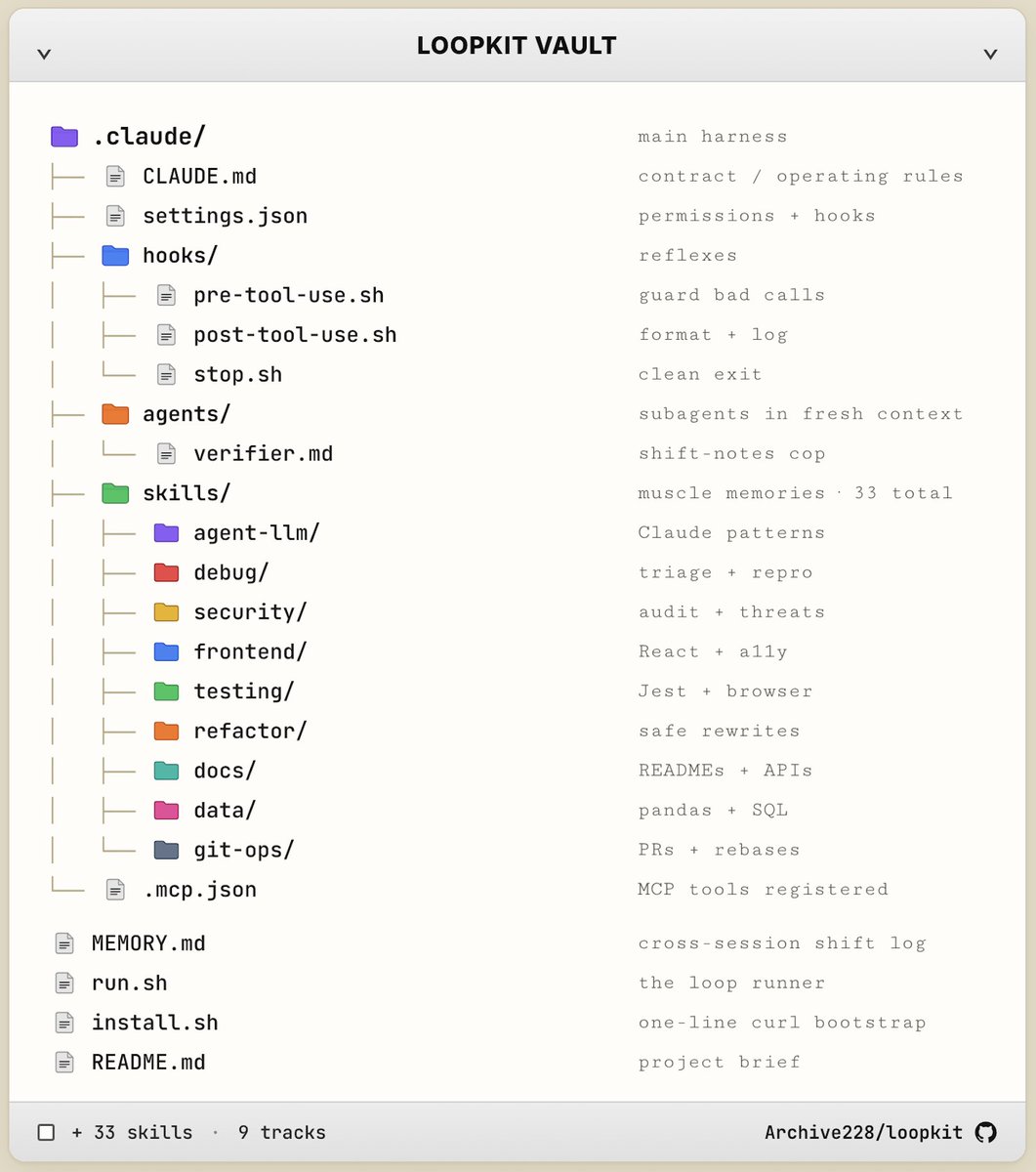
he didn't answer. sent me his .claude/. one folder.
SAME MODEL - DIFFERENT RESULT.
everyone's still picking between opus and sonnet like the model is the ceiling. it isn't.
the real lever is what the model wakes up into:
CLAUDE.md → hooks → verifier subagent → skills → mcp → memory → shift notes.
you stop chatting with the model.
you write the folder once. the folder runs the model.
- CLAUDE.md - the contract
- settings.json - the permissions
- hooks/ - the reflexes
- agents/verifier - the shift-notes cop
- skills/ - 33 muscle memories
- .mcp.json - the tools
- MEMORY.md - the shift log
that's the stack.
full breakdown in the article below. bookmark before he realizes i posted it.
$META CEO Mark Zuckerberg told employees in an internal town hall that AI agent development over the last four months has not “accelerated in the way we expected.” - Reuters
🚨 A senior Anthropic engineer just dropped an 11-page PDF on "Loop Engineering" for agentic systems.
The core idea: stop prompting your coding agent. Design the system that prompts it instead.
Here's what the playbook covers:
🎢 The 4-layer stack Prompt engineering -> Context engineering -> Harness engineering -> Loop engineering. Each layer automates one more thing you used to do manually.
🔁 5 moves every loop needs Discovery, handoff, verification, persistence, scheduling. Skip any one and the loop either breaks or runs blind.
2️⃣ The generator/evaluator split An agent grading its own output will praise it every time. The fix is a separate evaluator agent that starts from doubt, runs the code instead of reading it, and rejects until proven otherwise.
💲 4 silent costs Verification debt, comprehension rot, cognitive surrender, token blowout. None of them sound an alarm while the loop is running.
A real-world benchmark
Stripe's pipeline merges 1,300+ machine-written PRs per week. Reliability comes from the quality of the constraints, not the size of the model.
The closing line from the paper is the one worth saving: two people can build the exact same loop and get opposite outcomes six months later. The difference is one or two checkpoints that decide who is actually in control.
Build the loop. But build it like someone who intends to stay the engineer.
#AgenticAI #LoopEngineering #AIEngineering #ClaudeCode #DataScience #LLMOps
Practice Rust with exercises designed to bridge the gap between tutorials and real-world projects.
- Three parts per chapter: examples, exercises, and practices
- Covers async/await, threads, sync primitives, and standard libraries
- Every exercise has a solution; difficulty ranges from easy to super hard
- Read, edit, and run all exercises online
Anthropic engineer: "You're not supposed to prompt Claude. You're supposed to build a system that prompts itself."
Loops.
Most builders are doing this wrong:
No memory file, so every loop starts from zero.
No sub-agent split, so one agent tries to do everything.
No stop condition, so loops run forever and bill you in your sleep.
Most builders are missing at least two of the three.
Watch the video first.
Then read this - everything you need to know about Loops in 2026, in one place.
Bookmark this before it gets buried.
Head of DevEx at Warp: "Your agent needs to learn how to learn"
The hardest part of designing an AI feedback loop isn't the AI - It's the humans
"50% of our social mentions get skipped automatically - and that saves us more time than anything else"
in just 25 minutes, Anthropic engineer revealed how she designs self-learning agent systems:
Loops + dynamic workflows + routines
That’s worth more than a $500 course on loops engineering
Web scraping will never be the same.
(100% open-source visual search at scale)
PixelRAG is a retrieval system that skips HTML parsing completely.
Instead of scraping a page into text and embedding chunks, it screenshots the page and retrieves the image. A vision-language model reads the answer straight off the pixels.
Why that matters: parsing is where web RAG quietly loses information.
- A single HTML-to-text parser can drop 40%+ of a page.
- Tables, charts, and layout get flattened or thrown out.
- Swapping parsers alone can move accuracy ~10 points on the same docs.
PixelRAG indexes the page a person actually sees. The team built a visual index of all of Wikipedia, 30M+ screenshots, and it still beats the strongest text RAG baseline by 18.1% on text-only QA.
The repo also ships a Claude Code plugin that gives Claude eyes.
It lets Claude screenshot any URL and read the rendered page instead of scraping the DOM. So you can hand it a live page, an arXiv paper, or your local site and ask what it actually looks like.
One setup script. No MCP server, no backend.
How the pipeline works:
- Renders each document (web, PDF, image) to image tiles.
- Embeds them with Qwen3-VL-Embedding, LoRA fine-tuned on screenshots.
- Builds a FAISS index and serves a search API.
A stronger reader model lifts accuracy with no re-indexing, since the index is just pixels.
Everything is open-source under Apache-2.0.
GitHub repo: https://t.co/qun9TjAdmw
Talking about RAG, I recently wrote an article on a new approach that makes retrieval much more efficient by cutting corpus size by 40x, reducing tokens per query by 3x, and improving vector search relevance by 2.3x.
The article is quoted below.
Building software with AI is not all about prompting.
Adding rule-based checks and tests makes results safer and more reliable.
In this in-depth tutorial, @sumit_analyzen teaches you how to use a practical coding loop technique to get better results from AI.
https://t.co/uBuvz0Jz9s
Karpathy's prediction about RL is coming true now!
He called reward functions unreliable and argued that a single reward number is too low-dimensional to teach an agent what "good" means for complex tasks. To solve this, Agents need a knowledge-guided review as a higher-dimensional feedback channel.
Every major AI lab trains models with RL today (OpenAI, Anthropic, DeepSeek).
And their key bottleneck has always been the reward functions.
GRPO by DeepSeek worked well for math and code because the environment gave a binary signal.
But for real agent tasks, someone still has to hand-code the scoring function. That takes days and breaks every time the pipeline changes.
RULER (implemented in OpenPipe ART, 10k stars) addresses the exact problem Karpathy identified.
The reward criteria are defined in plain English, and an LLM evaluates each trajectory against that description to provide feedback for training.
I trained a Qwen3 1.4B agent that plays 2048 using GRPO with this exact workflow.
In this case, the agent saw the board, picked a direction, and RULER evaluated the outcome, all from this natural language definition.
You can see the full implementation on GitHub and try it yourself.
Here's the ART Repo: https://t.co/XeTppNyX9p
(don't forget to star it ⭐ )
Just like RLHF replaced manual rankings and GRPO replaced the critic model, natural language rewards are replacing hand-coded scoring functions.
RL reward engineering is now prompt engineering.
I wrote a full walkthrough on OpenPipe's ART, the agent RL trainer built on GRPO, including how RULER replaces manual reward engineering with automatic LLM-graded rewards.
The article is quoted below.