🌟 We're proud to share that we've been named a Silver Winner in the 6th Annual The Anthem Awards for AI Excellence in Health!
Following our Bronze win last year, we're especially grateful to receive this recognition for a second consecutive year.
🌍 Selected from more than 2,500 entries across 43 countries, this year's award recognizes our work alongside Muhimbili Orthopaedic Institute, George Washington University, and @ChildrensNatl to advance neurosurgical training in Tanzania through AI-powered surgical video analysis.
This recognition reflects the dedication of our team and collaborators, and our shared commitment to making surgical expertise and training more accessible where they're needed most.
🎉 A huge congratulations and thank you to everyone who has contributed to this work, and to our community for supporting us throughout the Anthem Awards!
🔗 Read more about our recognition and the work behind it: https://t.co/Rrz51Cs3YF
📢 New research exploring how surgeon-guided AI could make surgical skills assessment more scalable is now available online ahead of print in the International Journal of Surgery! The paper, ‘Surgeon-in-the-Loop: Expert-Guided Machine Learning Framework,’ includes contributions from members of the SDSC team.
📝 Traditional assessments rely on experienced surgeons reviewing procedures and evaluating technical performance. While essential for surgical training, this process takes time and often provides feedback only after a procedure is complete.
🔁 Our research presents a framework that uses expert surgeon evaluations to train AI models to assess surgical performance continuously, with potential applications in surgical education, quality improvement, and eventually real-time clinical feedback. Rather than replacing expert judgment, we want to make that expertise more accessible, which will help more surgeons benefit from timely, meaningful feedback.
👏 Congratulations to Recai Yilmaz, Aaron Muna, Margaux Masson-Forsythe, Eduardo Torres-Rodriguez, Hasan Syed, Rolanda del Maestro, Chima Oluigbo, Robert F. Keating, and Daniel Donoho for their contributions to advancing surgeon-guided AI research!
🔗 Read more: https://t.co/xSgHJfFg0P
🌟 Please join us in welcoming Ali Chamani, our new Head of Partnerships at SDSC!
Ali joins us from KARL STORZ, where he led strategy for emerging surgical technologies and helped bring new platforms from concept into clinical practice. He brings extensive experience connecting health systems, clinicians, and technology companies, with a focus on turning promising innovations into practical solutions.
🩺 As SDSC continues to grow, so does our commitment to building a global network of partners who share our vision for the future of surgical care. In his new role, Ali will lead our partnerships strategy, strengthening relationships with surgeons while expanding collaboration with academic medical centers, health systems, and research institutions worldwide. His work will help more institutions contribute surgical data, put SDSC's tools into the hands of their surgeons, and advance joint research and training initiatives.
At the heart of these efforts is a shared belief: meaningful innovation in surgery depends on bringing clinical expertise, research, and technology together.
We're excited to have Ali helping us build those connections and expand the impact of our work.
🤝 Interested in partnering with SDSC? Whether you're looking to contribute surgical video, collaborate on research, or explore how our tools can support your institution, we'd love to hear from you.
Learn more: https://t.co/yHP9PWCPac
#SurgicalAI #SurgicalResearch #GlobalSurgery #HealthcareInnovation
⏰ Last call! Today is the final day to vote for SDSC in the Anthem Community Voice Awards!
We're honored to be recognized as a Finalist again, in the 6th Annual @anthemawards for AI Excellence in Health, celebrating our work bringing surgical AI into clinical practice in Tanzania.
This recognition reflects a much larger collective effort. From advancing surgical AI research to supporting training and education across the globe, our work is made possible by the surgeons, researchers, institutions, and collaborators who share our belief that surgical expertise should be accessible to everyone.
📢 Now, we need one final show of support from our community!
🗳️ Vote for SDSC in the Anthem Community Voice Award and help us bring greater visibility to the people and partnerships advancing surgical care worldwide. Voting closes tonight, October 29, at 11:59 PM PT.
🔗https://t.co/fojtD0IT3S
Thank you for being part of this journey and helping us move our mission forward!
#AnthemAwards #SurgicalDataScience #HealthcareAI #GlobalSurgery #SocialImpact
🔁 Neurological changes can happen quickly, even between routine bedside exams. While these assessments are essential to patient care, continuous monitoring could help clinicians recognize important changes sooner.
🩺 In our latest Data Science Roundtable (DSRT), Dr. Rui Feng, incoming neurosurgery attending at Mount Sinai, shared how her team is using AI-powered pose estimation to track patient movement and better understand neurological function.
Drawing on more than 5,000 hours of patient video, her team's research is helping lay the groundwork for “neuro-telemetry,” bringing continuous neurological monitoring closer to clinical practice.
🎥 Catch the full session: https://t.co/EwC4LTymxP
💡 Watch our past DSRTs: https://t.co/shhNtQjgse
—
🤝 Bringing experts together to share research, exchange ideas, and advance the use of AI in surgical care is central to SDSC's mission. It's also why we're honored to be recognized as an @anthemawards Finalist for Best Use of AI (Nonprofit / Health).
🌟 Help us celebrate the community making this work possible. Vote for SDSC in the Anthem Community Voice Awards before October 29!
🗳️ Vote here: https://t.co/Q2nTPghkeI
🏆 We're an Anthem Awards Finalist again!
We're thrilled to announce that Surgical Data Science Collective (SDSC) has been named a Finalist in the 6th Annual @anthemawards , recognizing our work bringing surgical AI to the real world in Tanzania!
🩺 In collaboration with Muhimbili Orthopaedic Institute (MOI), @GWnsgy , and @ChildrensNatl Hospital, we worked to bring AI-powered surgical video analysis into a clinical setting in Dar es Salaam, supporting neurosurgical training and education.
🌍 Our work in Tanzania demonstrates that surgical AI doesn't require perfect infrastructure. By adapting to bandwidth limitations, working alongside local technical teams, and ensuring hospitals retain ownership of their data, we're helping make advanced surgical analysis accessible in more healthcare settings.
🩺 It's an important step toward our vision of a globally connected surgical learning network, where expertise can be shared regardless of geography or resources. We're honored to have this work recognized among more than 2,500 submissions from around the world, and grateful to the surgeons, researchers, and collaborators who made it possible.
🗳️ Now we need your support! Help us celebrate this milestone by voting for SDSC in the Anthem Community Voice Award before October 29.
🔗 Vote for SDSC: https://t.co/Q2nTPghkeI
🌿 For Aisha and Stephano, learning that their newborn son Onore needed surgery was only the beginning of the journey to get him the care he needed.
🩺 Onore was born with hydrocephalus, a treatable condition that can lead to severe disability or death without timely care. His story is deeply personal, but the barriers his family faced in accessing treatment are shared by families around the world.
🌍 Across Africa, roughly 1,974 neurosurgeons serve 1.3 billion people. The expertise to treat conditions like hydrocephalus exists. The challenge is making sure that expertise can reach the children who need it.
That is a challenge our partners at @NeuroKids50 have been working to solve for years by supporting locally led surgical teams with training, mentorship, equipment, and stronger systems of care.
Through our work together, NeuroKids and SDSC are exploring how surgical video and AI can help that expertise reach even further.
In Part 1 of our latest blog series, we share Onore’s story, the history of ETV-CPC (a procedure pioneered in Uganda), and why expanding access to surgical expertise has to be part of the global health conversation.
👉 Read more: https://t.co/EtkR1XrChP
☝🏼 Expanding access to surgical expertise starts with making more of that expertise available to learn from. Share your surgical video with SDSC and use the Surgical Video Platform (SVP) to help turn individual surgical experience into knowledge that can support research, training, and better access to surgical expertise around the world. Learn more: https://t.co/BxjXxqxJJk
#Hydrocephalus #Neurosurgery #PediatricNeurosurgery #GlobalHealthEquity
🌟 Are you a medical student or resident that is curious about the future of AI in surgery?
On Monday, October 5th at 2pm Eastern, SDSC is hosting an introductory session for those interested in surgical innovation, AI, research, and the growing role of surgical video in education and clinical care.
We’ll discuss:
🔹 What Surgical Data Science is and why it matters
🔹 How AI and surgical video are already being used in training and research
🔹 A walkthrough of SDSC’s free Surgical Video Platform
🔹 Opportunities for students and residents to get involved early through research, collaboration, and innovation initiatives
👉 You don’t need a technical background or prior AI experience to join. If you’re interested in where surgery is headed over the next decade, this session is for you.
📆 Monday, October 5th
⏰ 2:00 PM EST Introductory Zoom Session with the Surgical Data Science Collective (SDSC)
🔗 Video call link: https://t.co/zQQUKSurL1
Feel free to share with your classmates, co-residents, and anyone interested in the intersection of surgery and emerging technology.
#surgicalvideo #datascience #research #AIinMedicine
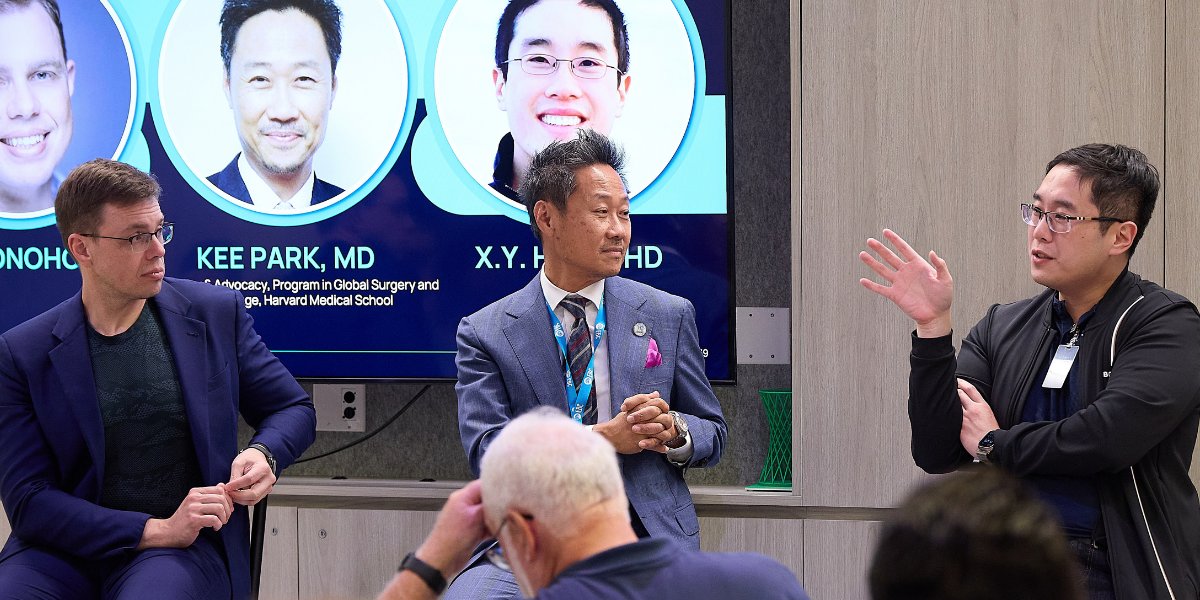
🗣️ Last week, we brought together surgeons, computer scientists, and researchers in NY to discuss a deceptively difficult question: how do we know when AI actually understands surgery?
💡 The evening sparked a lot of thoughtful discussion about where surgical AI is today, and what it will take to move the field forward. One thing is clear: better surgical AI starts with better surgical data. Our Founder, @ddonoho , opened with the clinical motivation behind SDSC’s work and why understanding the context of surgery matters. Our CTO @genuinebombayit , and Senior ML Engineer Jack Cook provided an in-depth look at how we’re teaching AI to identify patterns in surgical video and distinguish what the surgeon is doing from what the camera happens to see.
🩺 The goal is bigger than recognizing what happens in an operation. It’s understanding the patterns of surgery well enough to better quantify surgical processes and decision-making, and evaluating how specialized surgical models compare with today’s frontier AI models.
🌟 We were also joined by @XYHan_ and Dr. Kee Park, who helped us widen the conversation beyond what's possible today and the challenges we still need to solve to move surgical data science forward.
Every surgical video contains information about technique, decisions, anatomy, instruments, actions, and outcomes. Bringing more of that information together across surgeons, institutions, procedures, and geographies gives researchers the opportunity to build and evaluate AI on a much broader picture of surgery.
👉 That’s why we’re building the Surgical Video Platform (SVP). If you or your institution record surgical video, we’d love to work with you. Contributing de-identified video can help create the diverse evidence base needed to develop, test, and improve the next generation of surgical AI. Try it for yourself: https://t.co/BxjXxqxJJk
And if our work sparked an idea for a research collaboration or another way we could work together, we’d love to hear from you: https://t.co/yHP9PWChkE
👐 Thank you to everyone who joined us in New York, shared their perspective, and helped push the conversation forward.
#SurgicalAI #SurgicalTraining #SurgicalEquity
🌟 The future of AI in healthcare doesn’t have to be a choice between humans and machines.
In a letter published in @Telegraph , SDSC Founder Dr. @ddonoho makes the case for a different vision of AI in healthcare: “AI should develop human expertise, not replace it.”
🩺 In surgery, that means turning what happens in the operating room into something others can learn from: giving surgeons better feedback, enabling them to learn from thousands of procedures beyond those they personally witness, and making specialist knowledge available far beyond the hospitals where it originates.
Surgical expertise already exists around the world. The opportunity is to build the infrastructure, partnerships, and AI tools that allow more people to benefit from it.
👉 Read Dan’s letter in The Telegraph: https://t.co/anlTi8x2DO
If your institution records neurosurgical or other minimally invasive procedures, your video could help answer research questions we haven't yet been able to ask at scale. Contribute surgical video and collaborate with us. 👉 https://t.co/yHP9PWChkE
#SurgicalAI #GlobalHealthEquity #AIforGood
“One person cannot surround an anthill.”
🌟 What might this principle of Hunhu/Ubuntu teach us about building AI for health?
Our latest blog by Kate Wilson (SDSC Senior Adviser, Strategy and Business Development) looks at SDSC’s partnership with Ethiopia’s Federal Ministry of Health, Addis Ababa University, Black Lion Hospital, and St Paul’s Hospital. Seven months after signing our Memorandum of Understanding, the partners are demonstrating what locally grounded, human-in-the-loop surgical AI can look like.
🤝 The Ministry leads governance and coordination. Ethiopian surgeons contribute clinical knowledge, validate the models, and ensure that feedback reflects local surgical practice. SDSC combines Ethiopian and global surgical video data to build AI tools whose insights trainees can access for free through the Surgical Video Platform.
The people who will use and be affected by AI should help shape how it is built.
🔹 Help us advance how surgical expertise is shared, measured, and applied across OB-GYN. If your institution performs gynecologic surgery, we'd love to collaborate. Contribute surgical video, explore AI-powered analysis through our Surgical Video Platform (SVP), and help advance the future of surgical research, education, and patient care.
👉 Learn more about partnering with SDSC: https://t.co/yHP9PWChkE
📖 Read the full blog: https://t.co/NhnNAW2LUF
#SurgicalAI #GlobalHealthEquity #AIforGood
🌟 Are you a medical student or resident that is curious about the future of AI in surgery?
On Monday, October 5th at 2pm Eastern, SDSC is hosting an introductory session for those interested in surgical innovation, AI, research, and the growing role of surgical video in education and clinical care.
We’ll discuss:
🔹 What Surgical Data Science is and why it matters
🔹 How AI and surgical video are already being used in training and research
🔹 A walkthrough of SDSC’s free Surgical Video Platform
🔹 Opportunities for students and residents to get involved early through research, collaboration, and innovation initiatives
👉 You don’t need a technical background or prior AI experience to join. If you’re interested in where surgery is headed over the next decade, this session is for you.
📆 Monday, October 5th
⏰ 2:00 PM EST
Introductory Zoom Session with the Surgical Data Science Collective (SDSC)
Video call link: https://t.co/zQQUKStTVt
Feel free to share with your classmates, co-residents, and anyone interested in the intersection of surgery and emerging technology.
#surgicalvideo #datascience #research #AIinMedicine
2/ 🌟 Help us advance how surgical expertise is shared, measured, and applied across OB-GYN. If your institution performs gynecologic surgery, we'd love to collaborate. Contribute surgical video, explore AI-powered analysis through our Surgical Video Platform (SVP), and help advance the future of surgical research, education, and patient care. Partner with us: https://t.co/yHP9PWChkE
#WomensHealth #SurgicalAI #GynecologicOncology #GlobalSurgicalEquity
1/ 👩🏾👩🏼🦰👩🏻👩🏼 September is Gynecologic Cancer Awareness Month, bringing attention to the five main types of gynecologic cancer and the millions of women affected around the world.
Treatment can look very different depending on the cancer, the patient, and the stage of disease. And when surgery is part of that treatment, access to specialized expertise matters. Disparities in access to minimally invasive surgery and high-quality surgical training persist across OB-GYN globally.
Expertise, however, can be difficult to scale.
🖥️ Surgical AI can help address this gap by turning existing surgical video into a resource for learning, feedback, and improvement. At SDSC, we’re building AI tools that learn from surgical video to help make gynecologic oncology expertise easier to study, share, and learn from across institutions and geographies.
👉 Swipe through to learn more about the global challenge and why expanding access to surgical knowledge matters.
🌟 SDSC founder @ddonoho recently joined @FRANCE24 to talk about our work with surgeons in Tanzania and the role AI can play in expanding surgical capacity.
One of Dr. Donoho's points gets right to the heart of why we’re there: Tanzania already has exceptional surgeons doing incredibly complex work, so how do we take the excellence that exists in a few hands and spread it as broadly as possible?
🖥️ Surgical video is part of the answer. Through our work with colleagues in Tanzania and Children's National Hospital, we’re looking at how AI can help surgeons learn from existing expertise, including in particularly challenging neurosurgical procedures.
🌍 Dr. Donoho also touches on something that matters enormously as surgical AI develops: local data matters. A model built on generalized surgical knowledge still needs to be tested with local hospitals, surgeons, procedures, and data to know whether it actually works in that setting.
Our work in Tanzania grew out of years of relationships, including Dan’s friendship with Dr. Hamisi Shabani and their efforts to bring together the country’s neurosurgical community. Those relationships ultimately helped lead to SDSC’s first program in Tanzania at Muhimbili Orthopaedic Institute.
🩺 The technology may be new. The goal is much more fundamental: help more surgeons learn from great surgeons, so more patients can access great surgical care.
📺 Watch the France 24 segment (timestamp at 8:55): https://t.co/K3r96XNEMS
#SurgicalAI #GlobalSurgery #Neurosurgery #GlobalHealthEquity
🗣️ Here’s a paradox: surgery has spent thousands of years evolving, while one of its most important systems has barely changed at all.
We’ve gone from saws and hammers to surgical microscopes, laparoscopes, and human-assisted robots.
🌟 Anesthesia transformed what was possible.
🌟 Antiseptic technique made it safer.
🌟 Imaging changed what surgeons could see.
👴🏻 Yet the fundamental way surgical expertise gets passed from one person to another remains stubbornly ancient: Stand next to someone who knows what they’re doing. Watch. Learn. Practice. Repeat.
The apprenticeship model has produced generations of extraordinary surgeons. But therein lies its inherent limitation: expertise is difficult to spread when learning depends on physical proximity to an expert.
☝🏼That’s an enormous problem given five billion people worldwide lack access to safe, timely, affordable surgical and anesthesia care.
What if surgical knowledge no longer had to stay in the room?
Every recorded procedure contains information about how surgery is actually performed: phases, instrument choices, technique, efficiency, moments of action and correction. Computer vision gives us new ways to capture and structure that information so it can be studied, compared, and shared. After thousands of years of teaching surgery largely one surgeon at a time, we have an opportunity to make knowledge transfer multidirectional and global.
🩺 Cameras changed what a surgeon’s hands could do. Data can change who gets to learn from the best hands in the world.
Our latest blog explores surgery’s oldest bottleneck, and why we may finally have the tools to do something about it.
🔗 Read: https://t.co/gxbZt0VLwj
If you have surgical video or are interested in partnering with SDSC to help make surgical knowledge more accessible, measurable, and useful around the world, we’d love to collaborate.
#SurgicalAI #GlobalHealthEquity #SurgicalEducation
2/ 🌟 Help us advance how surgical expertise is shared, measured, and applied across OB-GYN. If your institution performs gynecologic surgery, we'd love to collaborate. Contribute surgical video, explore AI-powered analysis through our Surgical Video Platform (SVP), and help advance the future of surgical research, education, and patient care.
👉 Learn more about partnering with SDSC: https://t.co/yHP9PWChkE
#OBGYN #WomensHealth #SurgicalAI #GlobalHealthEquity
1/ 👩🏾👩🏼🦰👩🏻👩🏼 Today is #InternationalDayofObstetricsandGynecology, and in honor of this, let’s think about what progress in women’s surgical healthcare should look like.
🤝 Over the past several decades, minimally invasive techniques have transformed what is possible in gynecologic surgery. But the ability to learn, assess, and improve those techniques remains highly dependent on where someone trains, who they train with, and what resources are available to them.
Surgical video presents an opportunity to change that.
🖥️ Every recorded procedure contains information about how an operation was performed: the techniques used, the decisions made, the sequence of actions, and the ways surgeons respond to complexity. With the right clinical frameworks and AI tools, that video can become more than a record of an operation. It can become a source of objective feedback, shared evidence, and continuous learning.
🩺 Disparities in access to minimally invasive surgery and high-quality surgical training persist across OB-GYN globally. Surgical AI can help address this gap by turning existing surgical video into a resource for learning, feedback, and improvement.
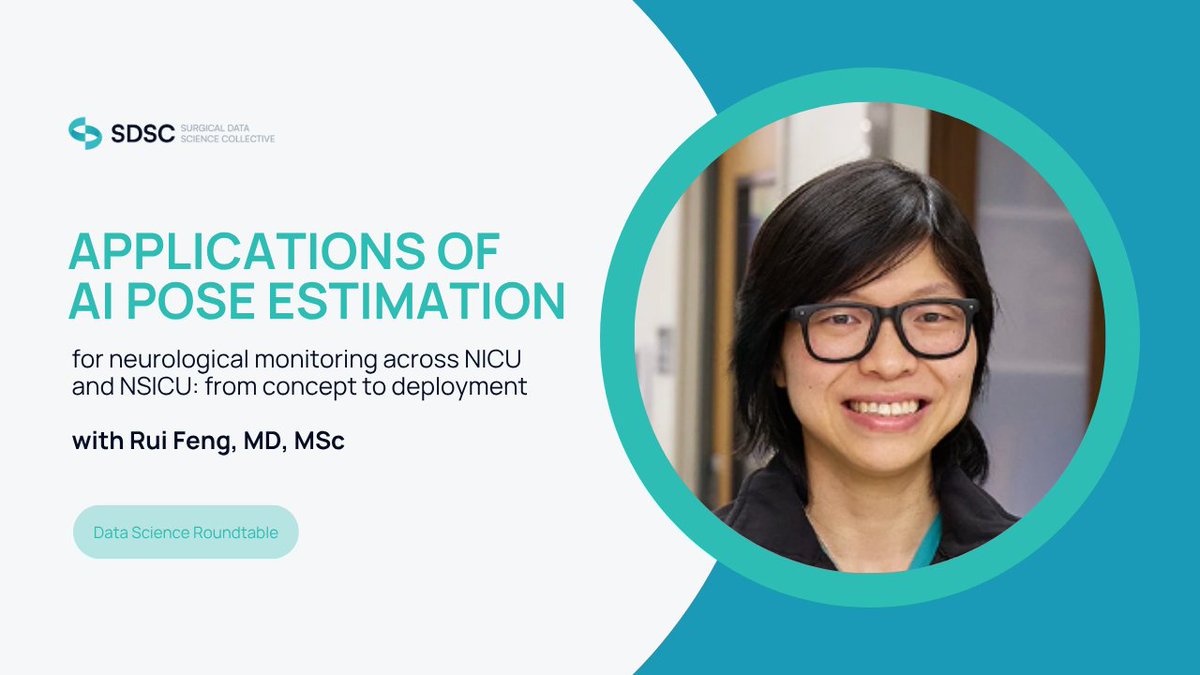
📣 Reminder: Our upcoming Data Science Roundtable with Dr. Rui Feng is tomorrow, August 26!
Join us for a discussion on “Applications of AI pose estimation for eurological monitoring across NICU and NSICU: From concept to deployment”
🩺 Rui Feng, MD, MSc is a skull base surgery fellow at Thomas Jefferson University, following completion of her neurosurgery residency at the Icahn School of Medicine at Mount Sinai. She earned her undergraduate degree in Neuroscience and Psychology from the University of Toronto, a Master of Science in Clinical Neuroscience from University College London, and her medical degree from the Icahn School of Medicine at Mount Sinai.
Dr. Feng's clinical and research interests center on skull base surgery, neurocritical care, and the application of artificial intelligence to improve neurosurgical practice. As a Mount Sinai Health System TL1 Postdoctoral Scholar, an NIH-funded program supporting the next generation of clinician-scientists, she developed novel AI-based approaches for neurological assessment in the neurosurgical intensive care unit. Her research explored the use of computer vision and pose-tracking technology to enable more objective, continuous monitoring of neurological function, with the goal of improving patient care and clinical decision-making.
Following her skull base fellowship, Dr. Feng will rejoin the faculty at Mount Sinai as a neurosurgery attending, where she will further advance her clinical research and academic initiatives.
📅 Wednesday, August 26, 2026
⏰ 12:00–1:00 PM Eastern
👉 Register: https://t.co/dDv42BUhb7
🗣️ Our Data Science Roundtables bring together clinicians, researchers, engineers, and others interested in advancing surgical and medical AI. Join the conversation, and if you're interested in collaborating with SDSC on surgical video, AI, or research, we'd love to hear from you.
🤝 Collaborate with SDSC: https://t.co/yHP9PWCPac
#Neurosurgery #NeurocriticalCare #MedicalAI #AIforGood
🧠 “If tools are the nouns of surgical video, gestures are its verbs.”
Throughout #NeurosurgeryAwarenessMonth, we've been exploring what it will take for AI to move beyond simply seeing surgery toward actually understanding how an operation unfolds.
🩺 Last week, we mentioned that surgery unfolds over time. Identifying a surgical instrument is useful, but it tells us only what is present. A grasper can be visible without grasping. Scissors can enter the field without cutting. To recognize what is actually happening, a model needs temporal context. It needs to interpret instruments, motion, tissue response, timing, and surgical action together.
Our latest research, from Zhuang-Fang Yi, Sandeep Angara, Shauna Otto, John Zhu, Jack Cook, and Margaux Masson-Forsythe, brings that question into sharper focus. Our team tested whether AI could recognize surgical gestures such as grasping, dissecting, coagulating, cutting, clipping, and suturing, and importantly, follow those actions across an uninterrupted operation.
The results reinforce a theme we've seen repeatedly in our research: surgical experience matters. In the continuous-video benchmark, the three surgery-aligned systems outperformed the general-purpose frontier models. Our purpose-built MViT Multi-task model achieved 79.0% agreement with expert annotations, followed by SurgMotion at 75.3% and LEMON at 69.2%.
🧐 Why does this matter for neurosurgery?
If we want AI to eventually support objective surgical metrics, education, research, and performance improvement, then models need to understand the actions and temporal structure that make an operation an operation.
We’re building AI that doesn't just look at surgical video, but can begin to read it.
🤝 And building that capability requires surgical data, clinical expertise, and collaboration across specialties and institutions. If your institution records neurosurgical or other minimally invasive procedures, we'd love to work with you. Contribute surgical video, bring us your research questions, and help build the foundation for clinically meaningful surgical AI.
👉 https://t.co/yHP9PWChkE
📖 Read more: https://t.co/m3lyRhmN8Q
#SurgicalAI #SurgicalVideo #SurgicalDataScience