We are continuously running a campaign for the release of Sourav Das and Ashutosh Ranka.
However, andhbhakts are attempting to get our account suspended through mass reporting.
Don't let our voice be suppressed! Please Retweet and Follow to support us! 🇮🇳✊
#cjp_पार्टी
🏆 We're an Anthem Awards Finalist again!
We're thrilled to announce that Surgical Data Science Collective (SDSC) has been named a Finalist in the 6th Annual @anthemawards , recognizing our work bringing surgical AI to the real world in Tanzania!
🩺 In collaboration with Muhimbili Orthopaedic Institute (MOI), @GWnsgy , and @ChildrensNatl Hospital, we worked to bring AI-powered surgical video analysis into a clinical setting in Dar es Salaam, supporting neurosurgical training and education.
🌍 Our work in Tanzania demonstrates that surgical AI doesn't require perfect infrastructure. By adapting to bandwidth limitations, working alongside local technical teams, and ensuring hospitals retain ownership of their data, we're helping make advanced surgical analysis accessible in more healthcare settings.
🩺 It's an important step toward our vision of a globally connected surgical learning network, where expertise can be shared regardless of geography or resources. We're honored to have this work recognized among more than 2,500 submissions from around the world, and grateful to the surgeons, researchers, and collaborators who made it possible.
🗳️ Now we need your support! Help us celebrate this milestone by voting for SDSC in the Anthem Community Voice Award before October 29.
🔗 Vote for SDSC: https://t.co/Q2nTPghkeI
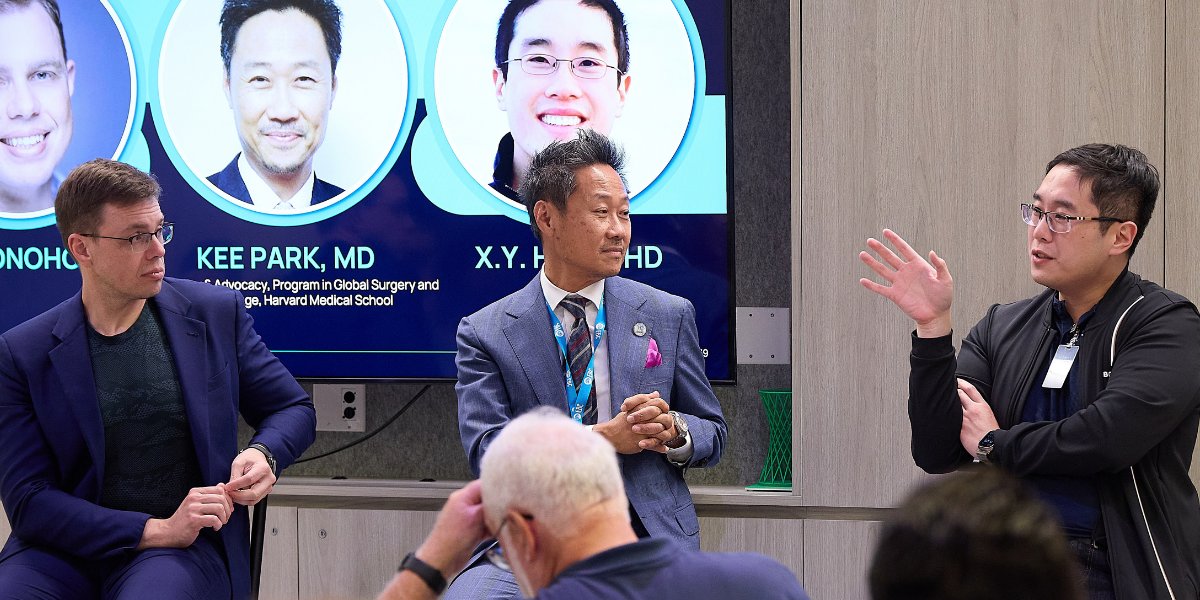
🗣️ Last week, we brought together surgeons, computer scientists, and researchers in NY to discuss a deceptively difficult question: how do we know when AI actually understands surgery?
💡 The evening sparked a lot of thoughtful discussion about where surgical AI is today, and what it will take to move the field forward. One thing is clear: better surgical AI starts with better surgical data. Our Founder, @ddonoho , opened with the clinical motivation behind SDSC’s work and why understanding the context of surgery matters. Our CTO @genuinebombayit , and Senior ML Engineer Jack Cook provided an in-depth look at how we’re teaching AI to identify patterns in surgical video and distinguish what the surgeon is doing from what the camera happens to see.
🩺 The goal is bigger than recognizing what happens in an operation. It’s understanding the patterns of surgery well enough to better quantify surgical processes and decision-making, and evaluating how specialized surgical models compare with today’s frontier AI models.
🌟 We were also joined by @XYHan_ and Dr. Kee Park, who helped us widen the conversation beyond what's possible today and the challenges we still need to solve to move surgical data science forward.
Every surgical video contains information about technique, decisions, anatomy, instruments, actions, and outcomes. Bringing more of that information together across surgeons, institutions, procedures, and geographies gives researchers the opportunity to build and evaluate AI on a much broader picture of surgery.
👉 That’s why we’re building the Surgical Video Platform (SVP). If you or your institution record surgical video, we’d love to work with you. Contributing de-identified video can help create the diverse evidence base needed to develop, test, and improve the next generation of surgical AI. Try it for yourself: https://t.co/BxjXxqxJJk
And if our work sparked an idea for a research collaboration or another way we could work together, we’d love to hear from you: https://t.co/yHP9PWChkE
👐 Thank you to everyone who joined us in New York, shared their perspective, and helped push the conversation forward.
#SurgicalAI #SurgicalTraining #SurgicalEquity
🧠The next constraint in surgical AI is not necessarily the model…it could be the data we give it.
We've seen extraordinary advances in general-purpose AI.
🩺 But surgery is an extraordinarily specialized visual environment. Models need to distinguish instruments, anatomy, actions, phases, and subtle variations in technique across different procedures, surgeons, institutions, and patient populations.
That requires something the internet cannot readily provide: high-quality surgical video.
And not simply more of the same video. Useful surgical AI requires data that represents the diversity of surgery itself.
💡 For #NeurosurgeryAwarenessMonth, this matters because the AI systems we eventually ask to understand neurosurgery will only be as useful as the surgical experience represented in the data used to develop and evaluate them.
At SDSC, we've spent years building the infrastructure, partnerships, clinical expertise, and AI capabilities needed to turn surgical video into research data. But building useful surgical intelligence is inherently collective.
🫵🏽 That's where you come in. If your institution records surgical video, contribute it to research. Your cases could help researchers develop and evaluate the next generation of surgical AI.
👉 Contribute surgical video: https://t.co/yHP9PWChkE
#AIforGood #SurgicalAI #SurgicalEquity #SurgicalVideo
🤖 Most AI conversations today assume that bigger models, more data, and more compute will eventually solve everything.
Our latest research suggests surgery may be one of the clearest examples of why that assumption deserves scrutiny.
@XYHan_, alongside fellow researchers at the University of Chicago Booth School of Business and SDSC team members, evaluated whether today's leading vision-language models could understand surgical video without specialized training.
The results:
🔹 General-purpose foundation models struggled to reliably identify common surgical instruments
🔹 Fine-tuning improved performance, but significant errors remained
🔹 Scaling compute led to overfitting rather than better surgical understanding
🔹 A specialized computer vision model with roughly 1,000× fewer parameters outperformed much larger frontier models
🔹 The same pattern held across multiple surgical datasets
The takeaway is that medical AI is a domain where specialization matters. Beyond internet-scale training data, medical AI requires domain expertise, high-quality surgical datasets, rigorous evaluation, and close collaboration between clinicians and machine learning researchers.
At SDSC, that's exactly what we're building.
📖 Read the blog: https://t.co/V0AVmM6hA4
#SurgicalAI #MedicalAGI #ComputerVision #HealthcareInnovation
We benchmarked Fable on surgical tool detection so you don’t have to. At almost 2 cents/image, Claude Fable 5 still loses to a compact image classifier. Will frontier VLMs ever catch up in surgical perception? Read our paper to learn more: https://t.co/phY57sKZdo
@dhruv_rathee Dhruv - you are my hero! I am so in awe of your courage to stand up and speak the truth!!! I truly hope that you inspire today’s youth in India to see the light!
Many many blessings and best wishes to you in this work all the way from America! 🙏
CEO of Proprio, @aGabrielJones, was a guest on a recent episode of @twistartups. Jones discusses how #AI is influencing generational shifts in #medicine and how Paradigm approaches data capture and analysis.https://t.co/GVGrEiB8Y6
Join us at our headquarters in Seattle the week of SRS for our Launch Event September 7th 7:00-9:30pm. A unique opportunity for technology demonstrations featuring our light field-enabled navigation system. Surgeons, learn more, and register here. https://t.co/tGZDhwsw7m
So proud and excited about this critical milestone - this refuels our continued journey towards commercialization and ultimately improving patient outcomes!
#WeAreProprio
Today is an exciting day at Proprio! We are proud to announce $43 million in Series B #Funding to continue our mission of revolutionizing the future of #surgery. Read the full press release here: https://t.co/956xWz8mnk