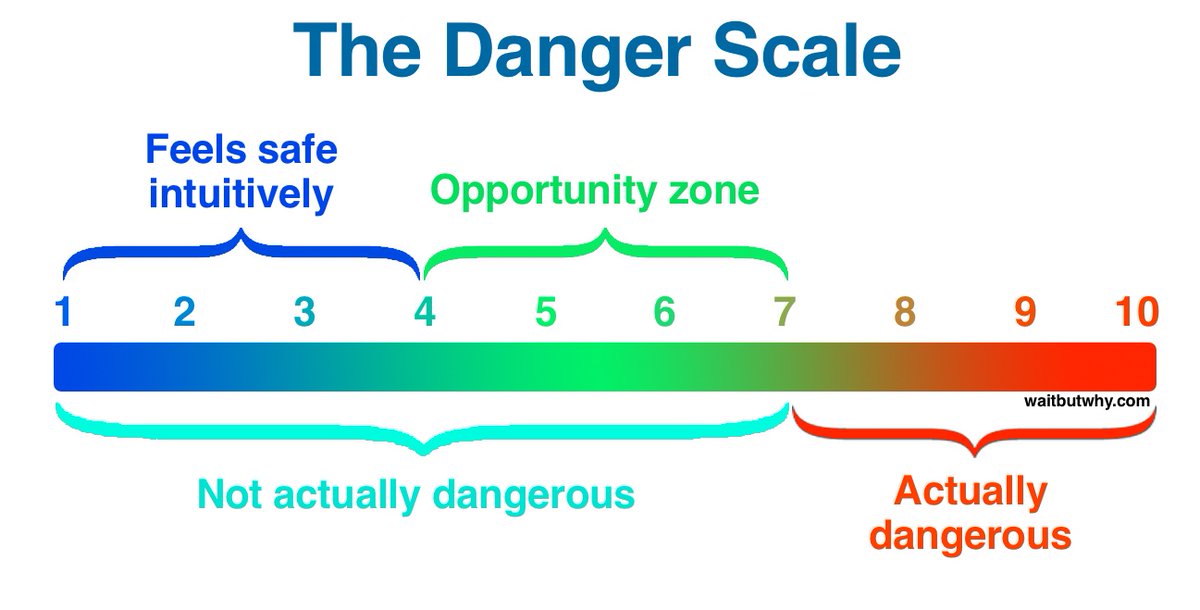
We evolved to live in small tribes and now live outside of our natural habitat, in an advanced civilization. One effect of this mismatch is that there are a bunch of things that feel dangerous to us that aren't actually dangerous, leading us to be way too risk averse. Like:
- Asking someone out on a date
- Trying something new even though you'll suck at it at first
- Quitting your job to start a company or try a career in the arts
- Putting your real voice out there on controversial topics
For primates living in a small tribe, rejection, embarrassment, failure, and criticism posed actual material dangers. These things are not dangerous today, but our software hasn't been updated. So we miss out on living our best life, hiding in the 1-4 zone of the danger scale. In a world of overly risk averse people, the epiphany that the 4-7 zone is actually a safe place to play is a superpower.
Promising work toward explainability of AGI via neuronal feature analysis. Like looking at the fingerprint of brain activity vs individual neurons. Clever.
https://t.co/RwyUfg6SYJ
The best class at Notre Dame, in my humble opinion, is the Art of Investing
I first met its professors, Rick Buhrman and Paul Buser, during their decade+ long tenure helping manage Notre Dame’s storied endowment, where they met and learned from just about every great investor alive (they often joke to me that they hosted Invest Like the Best before I did).
They invited me to teach their class one year, and it was unlike any other I’d ever encountered. Long sessions, with huge engagement and the deepest questions I’d been asked in a classroom.
What they teach about in their class is the many joys of compounding. Compounding dollars, sure, but also everything else. They focus on the components and inputs in the compounding equation and how students can apply the simple equation to their lives.
They brought in some of the worlds best operators and investors, from Mitch Rales to Jeff Wilke, to Ho Nam and Henry Ellenbogen and Anouk Dey.
I’ve now taught a section of the class for years. I’ve hired great people from it (👋 Gabi & Joanna). I love everything about it.
Then, Rick and Paul set off on a new adventure, to build an investing holding company called Sator Grove, where they now manage hundreds of millions for one of the most impressive shareholder bases I’ve ever seen.
They became large investors in my funds at Positive Sum. They are among my favorite partners.
And that brings us to the punchline. Earlier this year we all agreed it would be incredibly exciting to bring their class to the masses.
So, we are thrilled to announce the imminent launch of “The Art of Investing” podcast.
In the coming weeks, you’ll hear from Todd Combs, Ho Nam, and so many other exciting guest lecturers, including some who have never done a show in this format.
In the meantime, click the link below to hear the trailer and subscribe on your favorite player.
This furthers our mission at Colossus to bring the highest quality investing and business education to the entire world, at no cost.
We hope you enjoy the countless lessons in the Art of Investing!
https://t.co/Ntglocc2Ld
As the piece points out, it's a first approximation that cuts in 2 directions: a) the vaccines did a lot of good & b) NPIs did not.
I *highly* doubt that adjusting for age would change this. The age structure doesn't vary much from state to state anyway.
https://t.co/4zeHRE3AfK
@RecursionChris Similar gating factor in surgical technology. Large, high quality data sets don’t exist. We are building them but it will take a while.