@NielsRogge Isn’t this what humans do as well? Can’t training on multiple envs be compared to deliberate practice? When we want to learn computer use, we practice on differ configurations. If we want to practice building power point presentations, we practice it on different cases
@Livpure_India@LivpureSmart offers an extremely bad customer service. Every time I have a problem and I raise an issue on their app/whatsapp, they never get back on time. Yesterday I paid my monthly rental and but the machine didn’t work. I raised an issue today at ~9:30 AM and haven’t received any resolution yet. I don’t expect a prompt resolution for every service but this is water which we need everytime and purchasing bottled water is not a solution. Even tried calling them on +91 88007 62226 but to no avail. This is not the first time this has happened and the last time this happened, it took them a while to resolve this issue. Now please don’t tell me that I should reach out on email - if you have provided a contact number, then you should be available through it.
Very bad customer service @Livpure_India@LivpureSmart
Agreed. One way to build this skill can be to predict how an unseen diff would behave. Check out deep learning alchemy course from Stanford. They are allowing the use of coding agents in assignments but in quizzes they are testing students on their ability to predict behavior of some code diffs
@alokbishoyi97 you’ve got to invite @jaga_prasanna . He is a pro when it comes to inference. He can provide best practices for inference and will gain a lot of insights of what are the areas of improvement in present inference software
@juliarturc@benblainex@cerebras They released a video on their own channel explaining how deployment of trillion parameter models work
https://t.co/pK2ivKXUXu
@Jeremylongworth@ArtificialAnlys@Xiaomi Have you seen any cases where hosting models is economical than calling an API? I am talking for models in the same weight class
Context for readers - Arpit always posts top notch insights in s/w engg and has started working on AI recently but his insights on AI has the maturity of a seasoned pro. Goes to show that fundamentals and being hands-on always matter.
@suri_kunal_ml Production experience at Razorpay played a good role there apart from that me putting in massive effort in being hands-on when I come across a concept, plus a strong fundamental and first principles thinking never go out of fashion :)
@arpit_bhayani I don’t agree with the trace part. Telemetry, when implemented correctly, solves this issue. Langsmith by @LangChain handles this out of the box- you can of course do it with other telemetry tools as well, just that you will have to implement the whole flow yourself
@arpit_bhayani Hi Arpit, been following your posts for a long time. How did you manage to pivot to AI so quickly after a long time in databases? I understand that curiosity is a big part but my question is around identifying resources for learning
Just read Harness Engineering course by @sanbuphy . Still a long way to go but I can appreciate why creating harness is challenging and why @HamelHusain said data scientists have a huge role to play in this field
Day 7: Inference Engineering
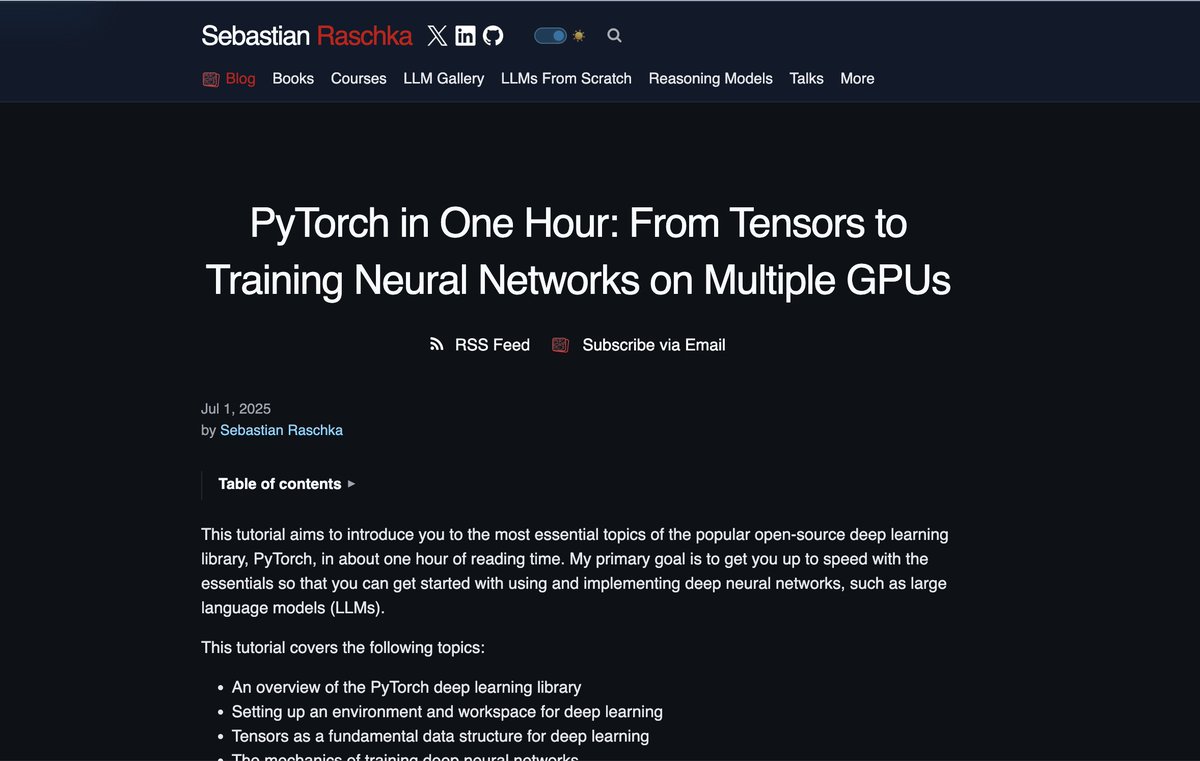
Went through a PyTorch refresher and remembered how to actually write the code that I stare at all day
https://t.co/EmtEv8lsAB
Sebastians blog is really really good for learning a lot of model-specific concepts for the first time.
Also did reading on SGLangs RadixAttention which is basically a really clever way of doing prefix caching in a Radix Tree data struct. https://t.co/NRz0hzjrFd
Third was just playing around more with vLLM tbh. Learning the difference between the GPU worker and GPU model runner (former handles actual GPU process/device itself i.e. memory, initialization, routing, communication w engine, etc.... later lives inside the worker and handles actual model execution path i.e. preparing tensors, KV, handling prefill & decode forwards, CUDA graphs, sampling, etc.)
vLLM (and SGLang) are such massive libraries and it really takes time to understand them and map them out. I am still very very far from understanding 1% of these libraries, but my strategy has been to deploy small models on them and learn what breaks when you change lines or try to trace the lifespan of a tensor through all the different files and paths. Its quite fun
@deedydas My hypothesis is that this could be attributed to changes in nutrition and environmental factors for children. I am more worried about India though - just 5 inches of growth over 34 years?!?!