And one more gentleman.
Someone needs to tell them it’s all demand - supply.
Jawboning the markets has limits. Just look at Trump and oil prices now.
https://t.co/T4zcpM4GQX
The way Indians “…grind on spelling-bee words like unlimited hours,” … is Not American culture.
anti-India perspective gaining traction in US.
@NGKabra
“Resentment of these immigrant communities is understandable, the two men explained, not in spite of the fact that so many South Asians have been successful academically and economically, but because of it. Indian culture, they maintained, places too much value on studying and academic excellence, and these values are a threat to American culture.” https://t.co/Vn3I4Yt72U
I was having dinner last night with a friend working in the chicken industry and I learned something that blew my mind.
Where do chicken farmers get their chickens? Most of us would say "from their existing chickens obviously, they breed and lay eggs."
That's what I thought too, but turns out I was dead wrong.
The reality is that the immense majority of meat chicken farmers in the world get their chickens from one of 2 companies: Cobb-Vantress, owned by Tyson Foods, or Aviagen, controlled by Germany's EW Group (the Wesjohann family).
They have a concept specific to the industry called grandparent stock: what you buy from these 2 companies is - essentially - a bunch of chickens with planned obsolescence.
The way it works is that each company keeps "pure" bloodlines on its own farms. Let's label them A, B, C and D. Those are the crown jewels - these companies' IP - and they never leave the building.
What they sell you are the "grandparents": chicks from those four lines, but each line in only one sex. You get A roosters but no A hens, B hens but no B roosters, C roosters but no C hens, D hens but no D roosters. Which means you can never breed more A, B, C or D birds yourself.
What you can do is cross them. A roosters with B hens give you the fathers, C roosters with D hens give you the mothers - these are the "parents". The parents then give you the chickens that actually end up on our plates, slaughtered at around 6 weeks.
And that's the end of the road. If you tried breeding those chickens, their chicks would be a complete genetic lottery: still chickens, sure, but without the genetic properties that make them commercially viable. They'd grow slower and less evenly, you'd have to sell them for way more than your competitors, and your business would be dead.
So you have to go back to Cobb or Aviagen for new grandparents. Forever.
Why buy grandparents at all, and raise 2 generations just to sell the third? The answer is scale. If you buy say 100 grandparents, each of them gives you around 50 parents, and each parent hen then gives you around 150 chicks: from those 100 grandparents, you have yourself some 600,000 chickens whose meat you can sell.
It makes no sense for these 2 companies to sell the final chickens directly. They'd have to hatch tens of billions of chicks a year and ship them all over the world. Much easier to simply sell the grandparents and let farmers do the multiplying and pay for the farms, the feed and the labor.
And, you knew this was coming, there is also a China angle here: as you can imagine, China isn't too pleased to be dependent on foreign companies for such a basic food item as chicken.
So China did what China does best: long-term planning. The Ministry of Agriculture and Rural Affairs launched a plan for "national broiler genetic improvement" (2021-2035), which aims for domestically bred breeds to make up at least 60% of the domestic market by 2035 (https://t.co/INHrS7YUpD).
And, of course, they're ahead of the plan. As of 2025, homegrown breeds held more than 30% of the market: halfway to the 2035 goal in just four years (https://t.co/hF0HvB6Q5y).
Can you escape all this as a consumer? Sure, you can buy organic or Label Rouge chicken, from slower-growing breeds raised for at least 81 days instead of 6 weeks, for two to three times the price.
Except, plot twist: the genetics behind most of those slow-growing birds come from a French company called Hubbard... which has belonged to Aviagen since 2018 (https://t.co/URsRSI3gI0)😅
And even if you could truly escape, you wouldn't want everyone to: we'd need vast new swathes of farmland, both for the chickens and their feed. Ironically, advocating for organic free-range chicken for everyone is one of the worst positions one can take for the planet's resources.
If you want to minimize your environmental footprint, the counterintuitive answer is to buy the cheapest supermarket chicken - or eat less meat, of course.
As my friend was saying last night, you may not like the way this industry works but, at the end of the day, it's what puts affordable protein on the plates of billions of people, using proportionally fewer resources than any other way of raising chicken.
@izakaminska Even all combined, will the fintech companies be able to absorb even a fraction of the total funds from All large banks in a so called ‘bank run’?
They may not be able to. At least not at high rate differentials to the banks.
A scenario can be simulated to verify.
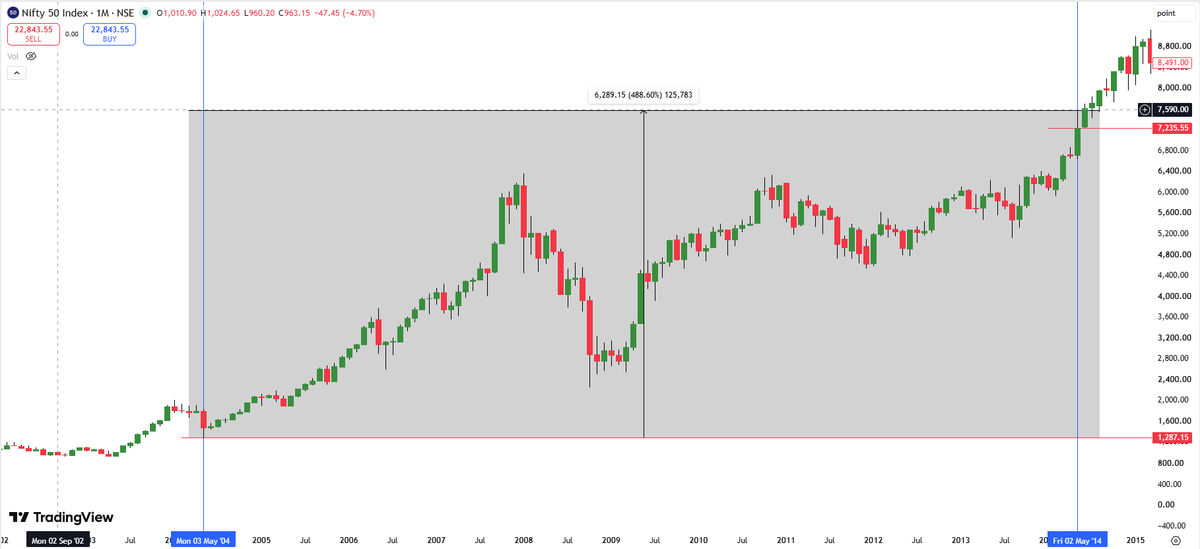
Manmohan Singh Era vs Narendra Modi Era
“Silent PM” vs “56-inch chest PM”
Put all political bias aside for a moment and judge both periods purely on the basis of data.
Manmohan Singh Era
May 2004 → May 2014
Nifty Return: +488%
CAGR: ~19.4%
STCG: 10% → 15%
LTCG: 0%
And yes, this period included the 2008 Global Financial Crisis.
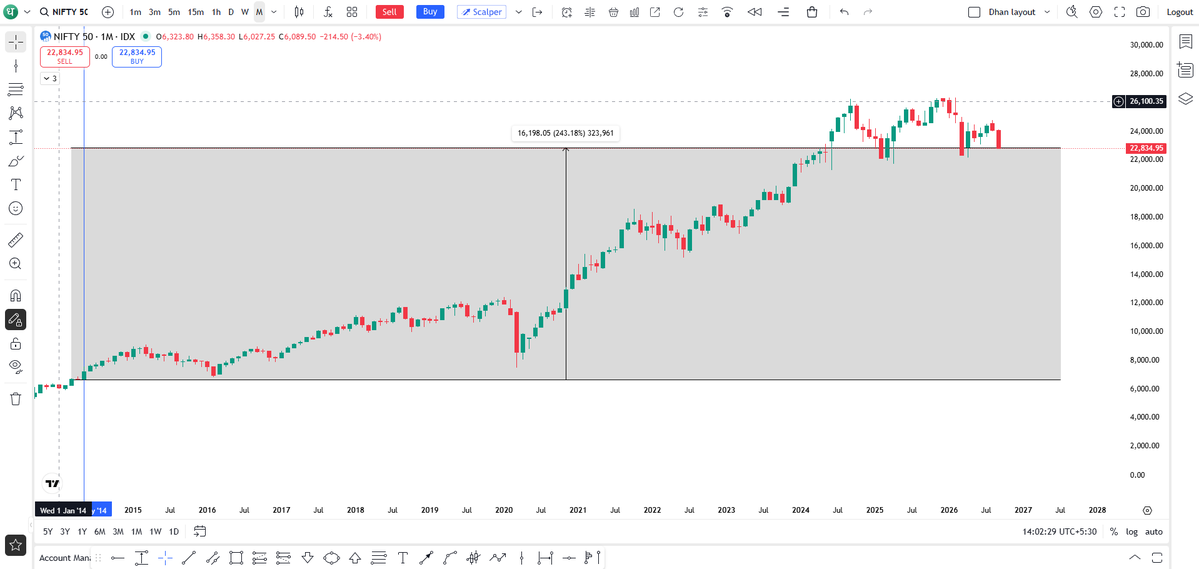
Narendra Modi Era
May 2014 → May 2026
Nifty Return: +243%
CAGR: ~10.8%
STCG: 15% → 20%
LTCG: 10% → 12.5%
Even from May 2014 to the subsequent peak, Nifty's return was around +296%, roughly 12.2% CAGR.
Manmohan Singh was called the “silent Prime Minister”.
Modi's government has built a much louder narrative around Viksit Bharat and Vishwa Guru.
But when it comes to the market, narratives are one thing.
Numbers are another.
Nifty is not a complete measure of a country's economic condition, but it is an important market indicator of how investors value corporate India.
I am not asking you to pick a political side.
Just look at the data.
What does it tell you about these two eras?
Comment your interpretation.
#Stockmarketcrash