China open-sourced a model that reconstructs any scene in 3D from a regular video, in real-time.
one camera. no LiDAR. 10,000+ frames without falling apart.
just walk around with your camera and watch the entire world get rebuilt in 3D at 20 fps.
→ runs at ~20 FPS on a single GPU
→ Stable over 10,000+ frames
→ Beats optimization-based methods on benchmarks
→ Works on drone footage, driving videos, indoor walkthroughs
100% open source.
Les #AiresÉducatives sont de petits espaces naturels gérés de manière participative par les élèves du CE2 à la terminale.
Vous souhaitez mettre en œuvre un projet d’aire éducative avec vos classes ? Les inscriptions sont ouvertes jusqu'au 30 septembre ⤵
https://t.co/riQ9kSk56G
AI can amplify good teaching or bad practice.
Andreas Schleicher's article keeps the focus on teachers: their judgment, care, creativity, and professional wisdom will matter even more in classrooms shaped by AI and change @SchleicherOECD@OECDEduSkills.
🧪 🤖 ChatGPT vient de réaliser quelque chose que les critiques de l'IA disaient impossible aujourd'hui : contribuer à une véritable découverte scientifique en laboratoire.
Pendant des années, les IA ont surtout servi à résumer des études ou à suggérer des pistes de recherche.
Avec GPT-5.4, des chercheurs affirment avoir obtenu quelque chose de beaucoup plus concret : l'identification d'un problème chimique, la proposition d'une solution inattendue, puis sa validation expérimentale.
L'idée proposée par l'IA était étonnamment simple : ajouter une petite quantité de TEMPO, un additif chimique bien connu, lors de réactions impliquant des sulfonamides primaires, des composés réputés difficiles à manipuler et souvent associés à de faibles rendements.
Les chercheurs ont ensuite lancé plus de 10 000 expériences automatisées. Les résultats ont été spectaculaires :
• 88 % des acides boroniques ont montré une amélioration du rendement
• 83 % des sulfonamides ont mieux réagi
• Le rendement moyen est passé de 16,6 % à 25,2 %
• Les réactions dépassant 30 % de rendement ont plus que doublé
Lorsque les expériences ont été reproduites dans un laboratoire traditionnel, les gains sont restés significatifs : 11 réactions sur 14 ont été améliorées, et 8 ont vu leur rendement plus que doubler.
Pendant des années, l'IA a été un assistant de recherche. C'est l'un des signes les plus clairs qu'elle commence à devenir un collaborateur de recherche.
I'm a cardiologist. Something just happened today that I genuinely did not see coming — and it could change the future of preventive medicine more than anything I've written about on this platform.
Midjourney — the AI company that became famous for generating images from text prompts — just announced a medical hardware division and unveiled a working prototype of a full-body scanner unlike anything that's ever existed.
It's called the Midjourney Scanner. And it works like this.
You step into a shallow pool of water. You stand on a platform that slowly descends — about two inches per second — through a ring containing roughly half a million tiny ultrasonic transducers, each the size of a grain of sand. Every one of them acts as both a speaker and a microphone, sending ultrasonic waves through your body from every angle and recording what comes back.
60 seconds later, you step out. The scan is done.
No radiation. No magnets. No claustrophobia. No IV contrast. Just sound, water, and an almost incomprehensible amount of computing power — roughly 2 petaflops processing 17 gigabytes per second of raw acoustic data — reconstructing a 3D map of your entire internal anatomy down to half a millimeter resolution.
Organs. Tissues. Blood vessels. Bones. Muscle. Fat distribution. All segmented by AI in real time.
As a cardiologist who has spent months writing about how the standard screening playbook misses the majority of future heart attacks — this is the technology I've been waiting for without knowing it existed.
Here's why this matters for the future of your heart.
Right now, getting a detailed look inside your cardiovascular system requires either a CT scan (radiation), an MRI (magnets, claustrophobia, 45-60 minutes, $1,000+), or a coronary CT angiogram (radiation, IV contrast, limited availability). These are powerful tools. I order them regularly and they save lives.
But they're reactive. You get them when something is already suspected. They're expensive. They're uncomfortable. And for most people, they happen once — maybe twice — in a lifetime.
Imagine instead: a 60-second scan with no radiation that you could repeat monthly or quarterly. Tracking cardiac structure over time. Watching body composition shift. Detecting changes in organ size, fluid distribution, or vascular architecture before symptoms ever develop. Building a longitudinal dataset of YOUR body that AI can analyze for patterns no single snapshot would reveal.
That's what Midjourney is building toward.
The company plans 50,000 scanners worldwide over six years, with capacity for a billion scans per month. The first location — the "Midjourney Spa" in San Francisco — opens at the end of 2027 with 10 scanners alongside saunas, cold plunges, and a gym. The scan costs a few dollars. The experience is designed to feel like wellness, not medicine.
The technology is built on Butterfly Network's ultrasound-on-chip platform — 40 modules per scanner — combined with Midjourney's own AI segmentation and reconstruction stack. David Holz, the founder, claims the system aims for image quality comparable to MRI in many aspects but at nearly 100x the speed with zero radiation.
Now the caveats — because I'm a physician and the caveats matter enormously.
This is a Gen 1 prototype. About a dozen people have been scanned so far. Current scan time is actually closer to 20 minutes, not 60 seconds — the system is bottlenecked by bandwidth and reconstruction algorithms. The 60-second target is aspirational for future hardware generations.
It is not FDA-cleared for diagnostic use. Midjourney is starting with body composition maps — a category below diagnostic imaging in the regulatory hierarchy. The path from "beautiful 3D body scans" to "clinically validated diagnostic tool that your cardiologist can act on" runs through years of clinical trials, comparative studies against MRI and CT gold standards, and FDA review.
No independent clinical validation has been published. The imaging claims come from Midjourney's own demonstrations. Comparative data against established modalities does not yet exist.
And the privacy implications of full-body internal scans at planetary scale — a billion scans per month — is a conversation that hasn't even started yet.
So I want to be precise. This is not ready for clinical medicine today. It may not be ready for years. Many ambitious medical hardware projects have failed in the gap between prototype and product.
But.
The fact that a working prototype exists — producing real segmented 3D anatomy from sound waves and compute alone — means the physics works. The engineering works. The question is no longer "is this possible" but "how fast can it be validated and scaled."
And if it is validated — if the resolution holds up against MRI, if the AI segmentation proves reliable, if the regulatory path clears — then what we're looking at is the most significant new imaging modality in 50 years.
For my entire career, preventive cardiology has been limited by the fact that seeing inside the body is expensive, slow, uncomfortable, and infrequent. We catch disease late because we image rarely. We image rarely because imaging is hard.
A 60-second, no-radiation, spa-based full-body scan that costs a few dollars would demolish every one of those barriers.
I've written about AI detecting inflamed arteries. About gene editing curing cholesterol. About GLP-1 drugs rewriting metabolic medicine. About cellular reprogramming reversing aging.
This is the missing piece: the ability to see inside every human body, routinely, safely, and affordably — so all of those interventions can be deployed before the disease arrives instead of after.
The company that taught AI to generate images from imagination just built a machine that generates images from the human body.
The future of medicine showed up today from the last place anyone expected.
Static PDFs are where interest goes to die. ⚰️ Interactive online textbooks are where learning happens. Which one are you putting on your syllabus this year? https://t.co/AP6ovLtBOp
#biology#science#3D#animation#Edtech#HigherEd
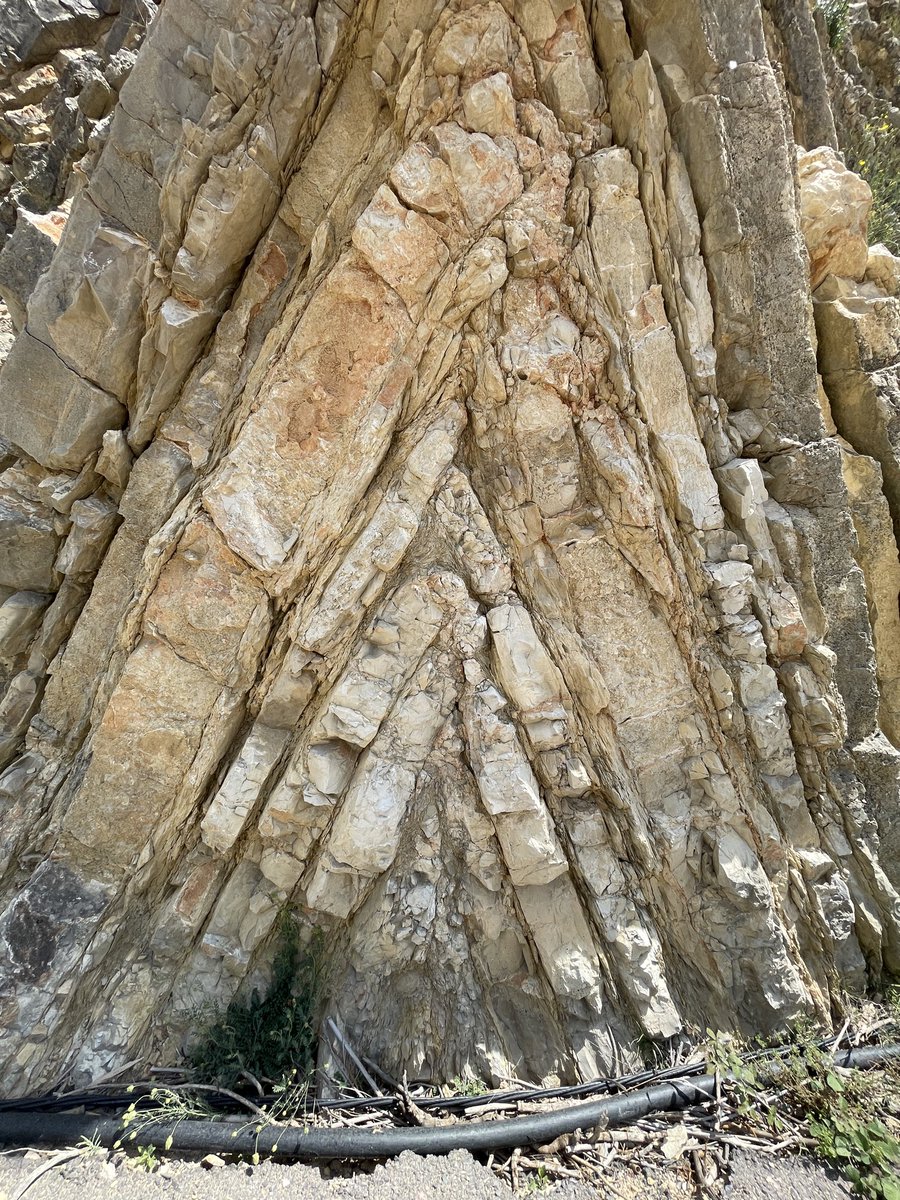
Une nouvelle petite balade virtuelle sur un affleurement géologique pour mes spé SVT, avec de beaux plis décimétriques, associés à des failles inverses et normales, dans des calcaire du Jurassique. À voir sur Sketchfab : https://t.co/Fu98LLBuOP.
📣 #TraAM 2026–2027 : Appel à projets
✅ Expérimenter
✅ Mutualiser
✅ Partager
Construire les ressources numériques éducatives d’aujourd’hui
➡ Personnels enseignants, membres du corps d’inspection, formatrices, formateurs : on vous attend, nombreux !
https://t.co/1wSoPFvmjW
Balade géologique virtuelle, sur un jolie affleurement calcaire. Avec l’échantillon qui va avec, pour la datation, Ammonites et rostre de Belemnite. Dommage de ne pouvoir y emmener les élèves. Parce que la géologie c’est la vie. Disponible sur skechfab : https://t.co/75XBjtk1UK
📢 Découvrez les nouveaux scénarios pédagogiques de l'#Édubase
Des pistes sont proposées en physique chimie, SVT et documentation pour développer l’esprit critique des élèves et leur permettre de progresser grâce à leurs productions écrites passées ⤵
https://t.co/ejs9094SP0
How long has that 'standard' textbook been in circulation? 🏛️ Give your students something current, curated, and built for 2026. Refresh your curriculum with one click. https://t.co/AP6ovLtBOp
#biology#science#3D#animation#Edtech#HigherEd#AcademicTwitter
Create components with AI ✨ Have you tried AI Builder? It’s a new way to create assets for your designs. If you prefer, you also have 45+ components ready to customize. Learn more here: https://t.co/gJUJ8iWaYW
We are back. After one year of quiet building.
Introducing GENE-26.5, our first robotic brain that takes a major step toward human-level capability.
For years, robotics has struggled to learn from the world’s largest and valuable data source: Humans.
Solving it means rethinking the whole stack from the ground up:
- A robotics-native foundation model.
- A 1:1 human-like robotic hand.
- A noninvasive data collection glove for motion, force, and touch.
- A simulator that turns weeks of experiments into minutes.
GENE-26.5 is trained across language, vision, proprioception, tactile, and action. We designed a set of tasks to test how far we can go with this new paradigm.
Fully autonomous, 1x speed, one model, same weights. (Enjoy with sound on)
We are approaching the endgame for robotics.
And this is just a beginning.
[Scénario pédagogique #édubase]
🔧Une “boîte à prompts” dédiée à l’histoire-géo : l’@actoulouse propose des ressources pour accompagner les enseignants dans l’usage des #IA
👉https://t.co/xD6U9mL1aS
🚨Google acaba de matar las apps de escaneo de documentos de terceros.
El nuevo escáner nativo de Drive hace capturas multipágina en tiempo real, detecta duplicados automáticamente y tiene modo continuo.
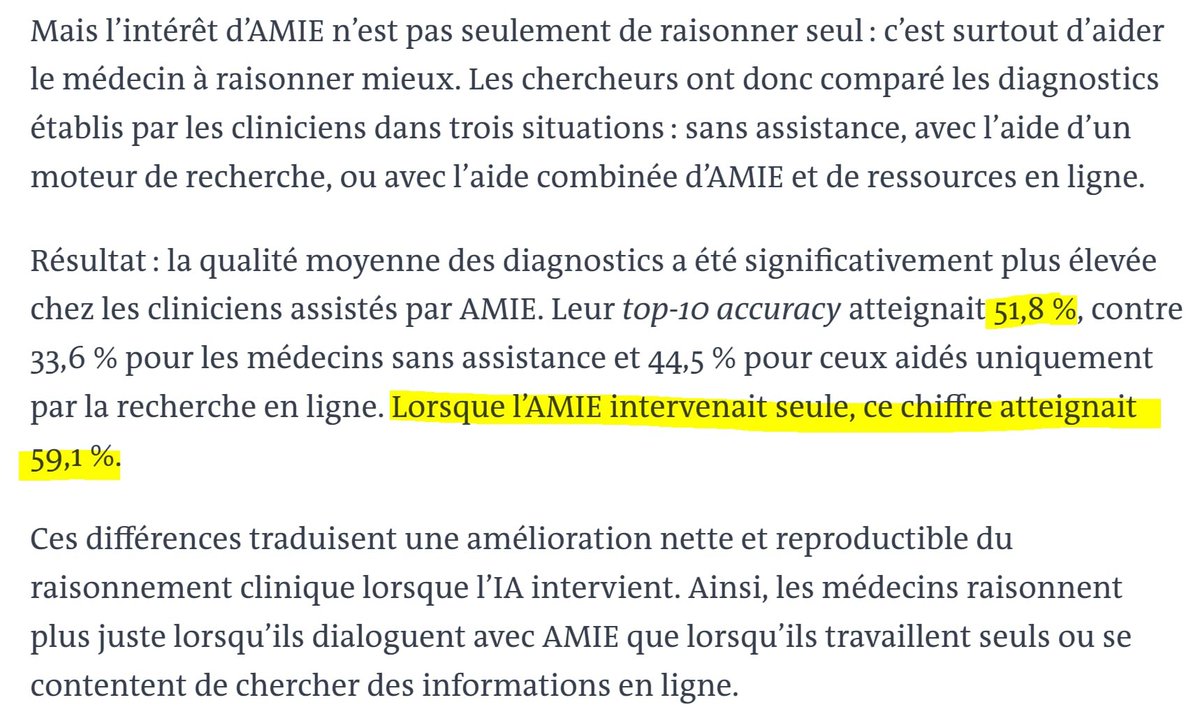
En effet, les études sur le modèle AMIE de Google DeepMind ont montré que la machine seule performait mieux que dans les cas des médecins assistés par l'IA. Peut-être en raison des biais humains (ancrage sur une 1re hypothèse) qui influencent ensuite l'IA.
https://t.co/VNM85mEJyw











![histgeo_edu_num's tweet photo. [Scénario pédagogique #édubase]
🔧Une “boîte à prompts” dédiée à l’histoire-géo : l’@actoulouse propose des ressources pour accompagner les enseignants dans l’usage des #IA
👉https://t.co/xD6U9mL1aS https://t.co/EWNozN3mVi](https://pbs.twimg.com/media/HFiIE5sXcAAd3zG.png)





