We'll be spending a lot more time trying to understand the outputs of language models. A few thoughts, tips & tricks:
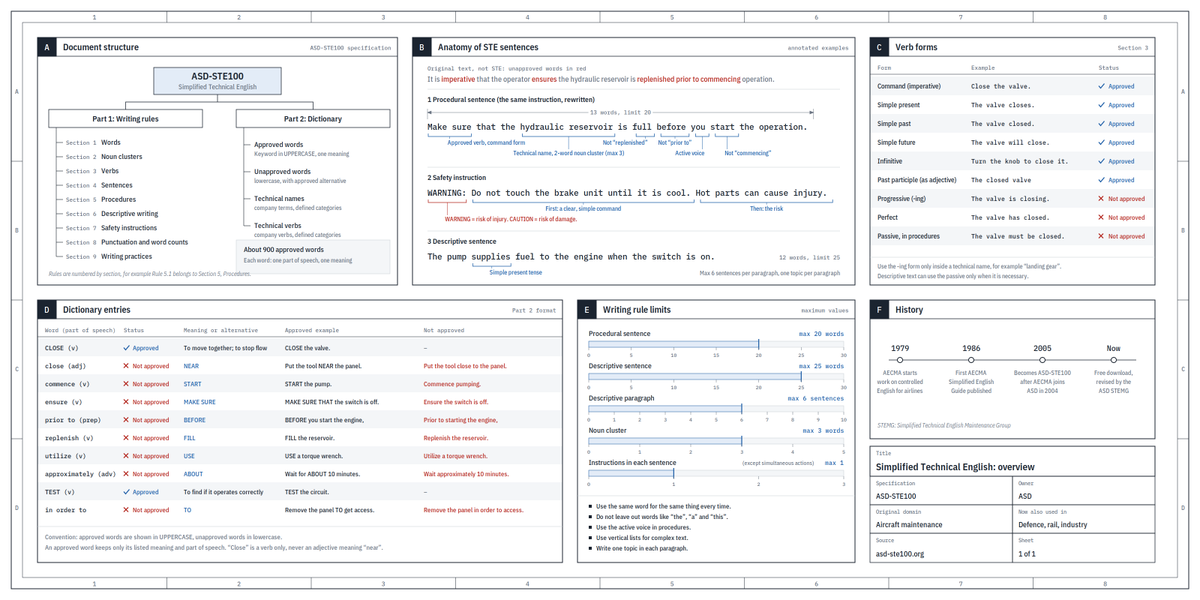
Writing. Something I've had success with: Ask your LLM to explain something in ASD-STE100, it's a controlled language specification originally developed for aerospace maintenance documentation. LLMs well-versed in this language and it comes with heavy constraints on clean writing style that I often find a lot more readable. Sometimes I've tried to soften it a bit e.g. ask for "80% of the way to ASD-STE100" because the spec is quite stringent. But even better:
Diagrams / images. Instead of writing, ask your LLM to create a diagram. These can be a lot easier to process, parse, and understand. But even better:
Web pages. Ask for output "in HTML" to get a beautiful, interactive webpage. LLMs are getting really good at frontend and can create beautiful experiences, animations, etc. But even better:
Explainer videos. The output format I am most bullish on is fully custom / bespoke explainer videos generated on any arbitrary topic. Experiment with things like "Create a 3b1b style video explainer on X. Use my ElevenLabs API key for audio narration". (you'd need an API key for the latter or you can ask your LLM to find you decent free alternatives that use your local compute). This is actually starting to work!
In summary:
- As LLMs get better, they will do more and more of the legwork autonomously, and a lot more of our work will rise up the abstractions into oversight and understanding.
- Luckily, LLMs can help here too because as intelligence and code are increasingly abundant, you can ask for large, custom, discardable software artifacts (e.g. web apps, video explainers) that would have never made sense to create before. Push the boundaries here and you'll be surprised.
First announced patient dosing of an in vivo prime editing treatment (to correct ATP7B H1069Q, one of the most common genetic causes of Wilson disease). There are now at least three prime editing clinical trials underway—for CGD (ex vivo, with positive clinical outcomes), for Wilson disease (in vivo), and for alpha-1 antitrypsin deficiency (AATD, in vivo).
Today in @NatureBiotech we report the use of phage-assisted evolution (PACE) to reprogram botulinum neurotoxin (BoNT) proteases to trigger cancer cell death. We evolved proteases to cleave procaspase-1 or gasdermin D, inducing cell death and slowing tumor growth in a highly drug-resistant mouse model.
https://t.co/OTUVxl1FpG
1/13
Amazing new work by @JShendure and coworkers uses a clever application of prime editing called DNA Typewriter to trace the lineage of a developing mouse from zygote to middle of day 14 at a single-cell level. See Jay’s beautiful tweetorial:
Today in @Nature we report how AI-guided redesign enhances protein evolution. Integrating ProteinMPNN sequence design with autonomous laboratory evolution, we establish a workflow to engineer enzymes with improved properties over those evolved from natural proteins. Redesigned starting points consistently evolve an expanded fitness landscape, reaching new function with higher activity, specificity, and stability than their natural counterparts.
https://t.co/pNlw6z1zvU
1/14
Today in @NatureBiotech we report a new suit of PE8 prime editor proteins. PE8 variants were developed from laboratory-evolved PE6 proteins using AI-guided protein redesign. This approach combines recent advances in computational protein design and directed evolution to increase prime editing efficiency, especially in transient therapeutically relevant delivery settings such as mRNA+pegRNA electroporation into primary cells, eVLP delivery of prime editing RNPs, and LNP-mediated mRNA+pegRNA delivery in mice.
https://t.co/bz6PalFvc4
1/11
Today in @NatBiotech, we report the directed evolution of structured RNA motifs that enhance the efficiency of prime editing. Iterated high-throughput pooled screens and mutagenesis of these small RNA elements improved transient pegRNA lifetime.
https://t.co/ZiytYXicaJ
1/11
I’m honored to have been presented the Franklin Institute Bower Award for Achievement in Science by Kyle and Nicole Muldoon, the parents of baby K.J. (Kyle Junior), alongside @kiranmusunuru and @AhrensNicklas. Video from the ceremony:
https://t.co/fPud2WTgvY
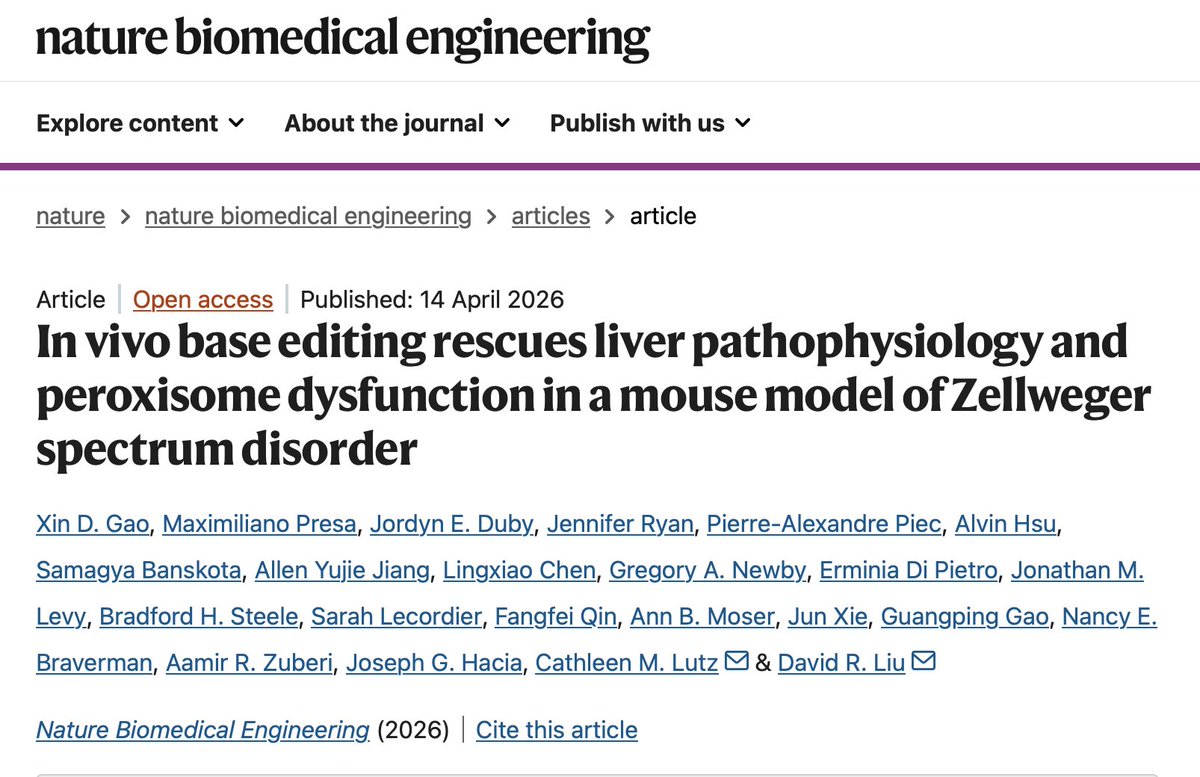
Today in @natBME we report an in vivo base editing strategy that corrects a common disease-causing mutation and rescues pathology in a mouse model of Zellweger spectrum disorder (ZSD) and restore peroxisomal function in patient derived cells. This work highlights the promise of precision genome editing for treating peroxisomal biogenesis disorders.
1/13
I'm honored to be included in the @washingtonpost Next 50, representing a remarkable community—scientists, physicians, caregivers, and the patients who inspire us—working together to bring the life-saving promise of therapeutic gene editing to those living with genetic diseases.
Profile by Carolyn Johnson:
https://t.co/bJ6nqTFWP1
https://t.co/1ZQEbKUIiF
Below is the story of the first patient treated with a prime-edited therapeutic, developed by @PrimeMedicine in a trial led by Dr. Élie Haddad and his team at CHU Sainte-Justine. This teenager suffered from chronic granulomatous disease (CGD), an immunodeficiency, and now—10 months after treatment—the patient is healthy, stable, and living with a functioning immune system. Tracy Attebury, whose story was previously told by @ginakolata@nytimes, was the second patient treated with a prime-edited therapeutic.
https://t.co/ZiVq1SmYsn
From @NatureBiotech: New rules spur cell and gene therapy trials in China
“Once proven safe and effective in investigator-initiated trials, therapies [in China] can then be given to patients as treatments, again without requiring national regulatory approval. And the hospital that made the therapy and conducted the trial can charge for the treatment, creating a financial incentive for hospitals to deploy high-quality cell and gene therapies.
This situation contrasts with that in individual European Union countries, for example, where regulations enable hospitals to deliver investigational cell therapies when few or no approved alternatives remain. But, unlike in China, national regulatory approval is usually needed to go ahead with testing…
In the United States, the process is more onerous. Hospital-developed cell therapies destined for patients require an Investigational New Drug application approved by the US Food and Drug Administration, with some exceptions for compassionate use.”
@US_FDA@HHSGov
https://t.co/UVLks7nncL
🚨🚨 La CIA tradujo en secreto un artículo soviético: los parásitos y el cáncer se comportan bioquímicamente de forma casi idéntica...Los mismos antiparasitarios (Myracil D, análogos de la guanina) eliminaron a la vez la esquistosomiasis y los tumores en el laboratorio...
Esto se clasificó como confidencial y se guardó durante 60 años en una caja fuerte...
Investigaciones actuales exploran el uso de antiparasitarios como ivermectina y fenbendazol para combatir el cáncer, a raíz de las similitudes metabólicas observadas en el artículo de 1951...