9th century CE, Kashmir.
A literary theorist named Rudrata writes a 32 syllable verse in his poetics manual, the Kavyalankara. Read it row by row and it is a normal verse praising an army and its leader.
Now write it into an 8x4 grid and read it along a chess knight's path, every square exactly once, and the same verse comes out again. Syllable for syllable.
The verse (Kavyalankara 5.15):
सेना लीलीलीना नाली लीनाना नानालीलीली I
नालीनालीले नालीना लीलीली नानानानाली II
"I, a truthful, well-read man, a leader of a group, helpful to servants, praise the army which has as its leader a man who praises playful persons."
Mathematics shows how brutal this constraint is.
A knight's tour on the 4x8 board splits its 32 squares into two cycles of 15 plus two fixed squares. For the verse to read identically both ways, every square in a cycle must hold the same syllable.
So the entire verse could use at most four distinct syllables. Rudrata composed a grammatical, metrical, meaningful verse out of just se, na, li, le.
His contemporary, the poet Ratnakara, set a knight's-tour verse pair in canto 48 of his Haravijaya, a 4,351 verse epic on Shiva's victory over Andhaka. Scholars cite both Kashmiris as the earliest known knight's-tour solutions.
In 1759, ~900 years later, Leonhard Euler presented what counts as the 1st mathematical paper on the problem.
900 years before the puzzle got its 1st mathematics paper, Kashmir had already solved it in verse, in metre, with meaning.
P.S. A knight's tour is a chess puzzle: move a knight across the board so it lands on every square exactly once. On this 8x4 half-board that is 32 moves, no repeats.
Sources: G.S.S. Murthy, Resonance 25(8), 2020
Photo 1: Rudrata's 32 syllable verse on the board. Read the rows: one verse. Follow the knight from square 1 to 32: the same verse again. Only four syllables - se, na, li, le, because the maths allows nothing more. Grid from Rudrata's verse as tabulated on Wikipedia's Knight's tour page (path verified against G.S.S. Murthy, Resonance 2020)
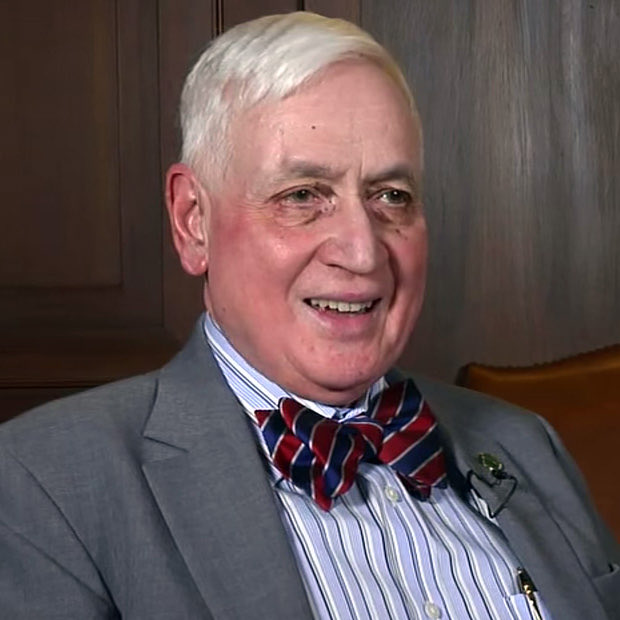
Photo 2: G.S.S. Murthy Ji, via IISc Connect (IISc alumni magazine)
Spare 420 seconds for this. It will change how you see the phone in your hand.
Strong piece by @vishalmisra Ji (Columbia CS prof. & the brain behind Cricbuzz, the man whose definition of net neutrality TRAI adopted) on what actually happened in 2016.
In 2016, India made a choice nobody noticed. TRAI ruled that a telco could give data away but could not decide which data was free. No zero rating your own apps while charging for the rest.
Then Jio arrived with a full stack of TV, music, cloud and messaging apps and could not wall any of it off. The only legal move left was to make the entire internet cheap.
The results, in numbers:
- Data: ₹226/GB in 2015. ₹7.51 today. A 97% fall.
- Usage: 0.27 GB / person / month in 2015. 26.7 GB now - 100x.
- 331M internet connections to 1,093M. Rural growing faster than urban.
- India: $0.26/GB. America: $12.37.
While others now promise to beam internet to India from space, India already built the world's cheapest internet on the ground - not with charity, but with one regulation that refused to let the internet become someone's private garden.
Over a billion Indians simply grew up assuming the internet was the internet.
India chose the whole internet. Worth your 7 minutes.
https://t.co/I3MuemfUer
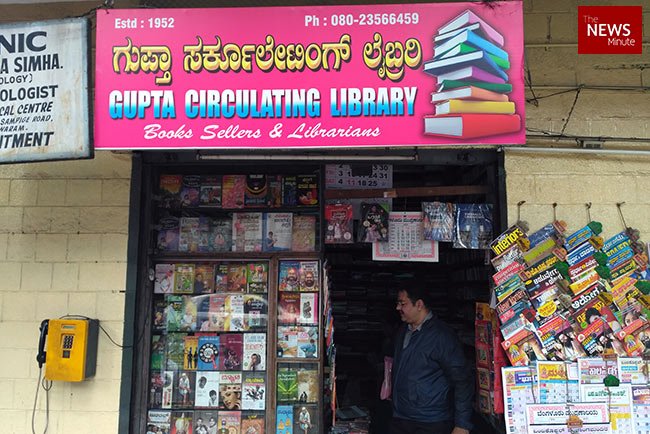
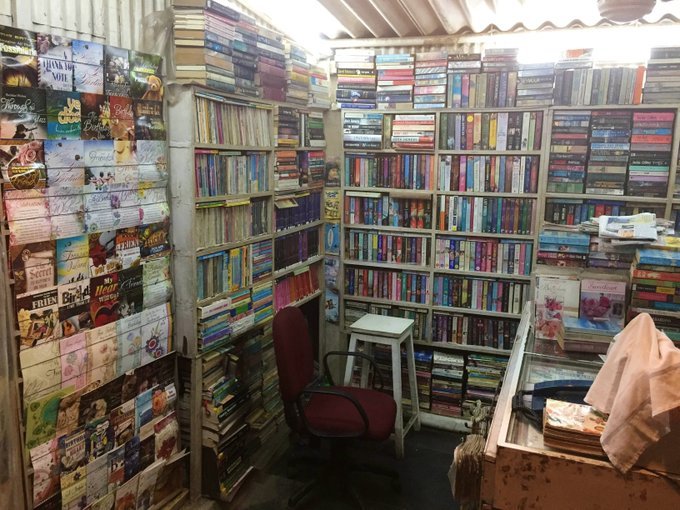
Circulating libraries were quite common once in most Indian cities, this is where my love for reading started. Browsing books, old musty smells, as a kid it was mostly comics for me- ACK, Tinkle, Indrajal, and books like Hardy Boys, Famous 5, Secret Seven.
As I grew up, that is where I started discovering the bestselling novelists, initially James Hadley Chase, Alistair McLean, later Perry Mason, Frederick Forsyth, Sidney Sheldon, Jeffrey Archer, Robert Ludlum, Ken Follet and a lot more.
My love for pulp fiction was thanks to these circulating libraries, not just English, even desi ones. Telugu had it's own pulp fiction in the 80s and 90s, thanks to writers like Yandamuri Veerandranath, Yerramsetti Sai, Malladi, and their novels were quite a good read.
Usually the circulating library owner, became quite good friends, would allow us to read magazines, especially the film ones, or even novels. Quite often would have long chats with the owner over the books.
Nowadays though the circulating libraries are slowly fading out, with reading habit itself declining. While some are still holding on, many have shut shop. Neverthless will always be a special memory.
How many of you experienced this?
He spent a decade at Texas Instruments helping make it the world's number one vendor of DSL modem chips.
Then he quit, put in his own savings, and started a semiconductor company in a garage with one other person. It took eight years before India saw what he had built.
His name is Himamshu Khasnis.
What pushed him out was a number he could not stop thinking about. By his own estimate, close to 45 percent of the world's chips were being designed in Bengaluru. But as he put it, "the intellectual property and the subsequent revenue remained with the USA."
India had more than a billion mobile phones, second only to China, and some of the largest cellular networks on earth. Every silicon chip inside that infrastructure was imported.
He founded Signalchip in 2010.
Chip design is slow, brutally expensive, and offers nothing to show for years. Sridhar Vembu of Zoho, who had started his own career as a wireless engineer at Qualcomm, backed him and stayed. A software founder funding silicon, through a decade with no product.
In 2015 came SCRF1401, India's first RF transceiver chip for 3G, 4G and WiFi.
Then in February 2019, Signalchip unveiled four chips it called the Agumbe family, India's first indigenous semiconductor chips for 4G LTE and 5G NR modems. They cover all LTE and 5G bands up to 6GHz, and they support positioning through NavIC, India's own satellite navigation system.
At the launch, India's Telecom Secretary noted that only around eight companies in the world could design and build chips like these. The team that did it was 40 people.
In October 2024, Khasnis stood at the India Mobile Congress explaining his chips to the Prime Minister, who asked detailed questions.
For years, Indian engineers designed a large share of the world's silicon and owned almost none of it.
Agumbe is Indian at the level that actually matters. The design, the patents, the ownership.
@signalchip
We're building the world’s largest open-access repository for documented heritage. And we are raising the capital to make this happen.
One mission: To redefine how ancient Indian manuscripts and inscriptions are preserved and accessible in the digital age. And offer true open-source DPI to scholars, institutions, and the world.
Mission: Beyond Digitization
Step 1: We are actively engineering the foundation—machine-readable knowledge graphs, Unicode-compliant cataloging, and standardized metadata schemas.
Step 2: This is where you come in.
We're looking for the visionary partners who can fund or build this with us.
Philanthropists, archival engineers, digital humanities pioneers, and tech builders.
If you're obsessed with where our history is headed, not just where it's been—we want to talk!
Open invitation: [email protected]
Support: https://t.co/8dDXvMTMiz
బహుముఖ ప్రజ్ఞాశాలి, భారతీయ ఇంజనీరింగ్ రంగంలో శిఖర సమానులు భారతరత్న డాక్టర్.మోక్షగుండం విశ్వేశ్వరయ్యగారి జయంతి సందర్భంగా ఆ మహనీయుని సేవలను స్మరించుకుంటూ.. వారి స్మృతికి నివాళులర్పిస్తున్నాను. ప్రపంచ దేశాల్లో భారత దేశాన్ని తలమానికంగా నిలబెట్టేందుకు ఎనలేని సేవలు అందిస్తున్న ఇంజనీర్లు అందరికీ ఇంజనీర్స్ డే శుభాకాంక్షలు.
#EngineersDay
Watch a Japanese train driver for one minute and you'll see something strange.
He points at the signal. Out loud, he calls its color.
He points at the speedometer. He calls the number.
He points at an empty platform. He announces it's clear.
Alone in the cab. No one is checking on him.
It's called shisa kanko. Pointing and calling.
Japanese railways discovered something about the human brain a century ago:
your eyes will lie to you. Your finger won't.
Seeing a signal is passive. Your mind can drift.
Pointing at it, naming it, hearing your own voice —
that forces the brain to actually process what's in front of it.
Studies found it cuts human error by about 85 percent.
New York's subway quietly copied part of it.
Their conductors now point at a marker at every single stop.
Japan looked at the most boring moment of a workday —
the ten-thousandth time you check the same signal —
and decided even that moment deserves full attention.
It looks ridiculous.
It has helped make Japanese trains among the safest machines on Earth.
Sometimes greatness is just refusing to do anything halfway.
Varāhamihira is known, when he is known at all, as an astronomer, the man behind the Pañcasiddhāntikā and the Bṛhat Saṃhitā, a court scholar in 6th century Ujjayinī who tracked planets and wrote on astrology.
Buried inside that same encyclopedic Bṛhat Saṃhitā, sandwiched between chapters on rainfall prediction and gemstone quality is Chapter 77: Gandhayukti, an entire treatise on the mathematics of perfume making.
In verse 17 of that chapter, Varāhamihira states that master perfumers of his era could produce 174,720 distinct varieties of scent using just 16 base ingredients.
That number is the output of an actual combinatorial method, laid out step by step....
He describes a structure called the gāndharṇava, a 4×4 grid of 16 aromatic substances, where a perfumer selects 4 ingredients at a time along any row, column, or diagonal of the grid, then blends them in specified proportions that can themselves be permuted.
One part, two parts, three parts, four parts, arranged in different orders...
Every distinct selection, every distinct proportion, every distinct order counts as a genuinely different perfume.
He is describing a formal permutation & combination system, applied to a fragrance industry, 16 centuries ago, the same branch of mathematics students now meet for the first time in a combinatorics / probability class.
It was serious enough that a 2nd structure in the same chapter, the kacchapuṭa, uses an actual magic square arrangement of the 16 ingredients to generate its own separate set of formulas.
In 2021, mathematicians and historians of science actually sat down and re-derived Varāhamihira's math from scratch, using modern combinatorial methods, to check whether his numbers were even correct.
Published in the Indian Journal of History of Science, their careful recomputation found that the raw gāndharṇava grid, worked strictly by row, column, and diagonal selection, yields 1,820 distinct combinations and that the larger, more expansive numbers cited in the text (including the often quoted 174,720 figure) come from a version of the calculation later expanded and, in places, corrected by a 10th century commentator named Bhaṭṭotpala, who was himself effectively peer reviewing and refining Varāhamihira's original mathematics centuries after it was written.
Sit with that for a second...
This is a genuine, multi-century chain of mathematical scholarship, original claim, later scholarly correction, modern peer-reviewed re-verification built entirely around the question of how many ways you can combine 16 ingredients to make perfume.
The Gandhayukti chapter goes further than the headline number too describing not just perfumes but hair dyes, incense sticks, scented bathing powders, and mouth fresheners, all treated with the same systematic, ingredient and proportion approach.
It is a full applied science manual for what was, at the time, a genuine royal industry, Varāhamihira notes elsewhere in the text that these fragrances were made specifically for royal households and aristocracy, a luxury economy sophisticated enough to warrant its own formal mathematics.
1 of India's most famous astronomers spent a chapter of his life's major work doing rigorous combinatorics on perfume, and that mathematicians were still checking his homework 1500 years later.
Want to learn to chant a difficult Sanskrit shloka - Use Vagbodhini. Type and shloka, it breaks it down to parts, teaches how to pronounce and gives you feedback on your chant. Works with multiple Indian Scripts. Try it out - Link in the first reply.
In 1963 the laser industry agreed on one thing. Gas lasers were laboratory toys. They topped out at about 50 milliwatts and they were never going to be useful for anything.
Every researcher at Bell Labs moved on to solid state lasers.
One man stayed on gas. He was 25, and he had been in America for 5 years.
His name is Kumar Patel.
He was born on 2nd July 1938 in Baramati, a town in what is now Maharashtra. He finished his engineering degree in telecommunications at the College of Engineering in Pune at the age of 19.
He went to Stanford, took a master's degree in 1959 and a doctorate in 1961, and joined Bell Laboratories the same year.
He has described the situation plainly. Everyone was talking about how wonderful lasers were, he said, but the problem was they did not produce enough power. And he was the only person there still working on gas lasers.
So he asked the question everyone else had stopped asking. Why can a gas laser not produce high power.
In 1963 he found laser action in carbon dioxide. In 1964 he worked out how to transfer energy efficiently between nitrogen and carbon dioxide molecules, and built the first gas laser that could produce high power continuously.
It is called the carbon dioxide laser.
Today it has more practical uses than any other laser in the world.
It is what cuts and welds and engraves metal, plastic and wood in factories. It is the laser scalpel used in surgery, because it can vaporise one layer of cells at a time and seal the small blood vessels as it goes. It is what is used in skin resurfacing and scar treatment. It is used in rangefinding and in measuring pollution in the atmosphere.
If you have ever had laser surgery, or worn something cut by machine, that is his invention doing the work.
He did not stop there. In 1969 he built the spin flip Raman laser, the first tunable infrared laser. In 1973 he made the first measurements of nitric oxide in the stratosphere, which became important evidence in understanding the hole in the ozone layer.
He spent 32 years at Bell Labs, then became vice chancellor for research at the University of California in Los Angeles, and later started his own company.
He was elected to the American National Academy of Sciences in 1974 and the National Academy of Engineering in 1978. He received the IEEE Medal of Honor in 1989. In 1996 the President of the United States gave him the National Medal of Science. In 1995 he was president of the American Physical Society.
In 2018 a laser surgery body created an annual award and named it the Kumar Patel Prize.
America has honoured him about as thoroughly as a country can honour a scientist.
In India, a boy from Baramati whose invention sits in operating theatres and factories all over the world is almost completely unknown.
He has a line about how he worked. Advances in science, he said, come not from solving problems, but from finding the right problems to go after.
In 1985, global software exports from India were an exercise in absurdity. If an engineer in Bangalore wrote code for an American client, they could not just hit Deploy.
They printed code onto magnetic computer tapes, boxed them up, drove to the airport, flew them 9,000 miles across the Atlantic, and waited weeks to find out if the build compiled.
Texas Instruments (TI) wanted to change everything. They wanted to build a direct pipeline between a newly rented facility at Sona Towers on Bangalore’s Miller's Road and their global headquarters in Dallas, Texas.
To do it, they needed a dedicated 64 kbps (YES, 64 kbps) satellite link.....
In 1985, 64 kbps was space-age. But the Indian govt did not even have a mechanism to allow a private, foreign company to own and operate international telecommunications equipment. International comms were strictly state-controlled.
Bureaucrats panicked. Ministries demanded security clearances, suspecting a massive dish pointing into the sky could be an espionage tool......
For months, Texas Instruments fought a war of attrition through Indian customs. When the giant dish finally cleared the port of Madras and reached Bangalore, the team faced another absurd reality: 1980s Bangalore’s road infrastructure could not handle the heavy, delicate components.
The dish that would spark India's digital leap did not arrive in a high-tech transport convoy. It was strapped onto a wooden bullock cart, pulled slowly through the streets by a pair of white oxen.
Once the dish was mounted on the roof at Miller's Road, engineers flipped the switch.....
An engineer in Bangalore typed a line of code into a terminal, hit enter, and watched as data beamed directly from the rooftop dish, bounced off a satellite in geostationary orbit, and landed in Dallas.
The code was compiled and executed on a mainframe in Texas, and the terminal output flashed back onto the screen in Bangalore in realtime.
It was the first time in Indian history that physical distance was obliterated by tech. The myth that critical engineering had to be performed locally in the West collapsed overnight.
The TI experiment proved the impossible was possible. But it exposed a brutal economic wall.....
Operating a private 64 kbps satellite link was mind numbingly expensive. In the late 1980s, a single half circuit cost ₹45 lakh per year in licensing and bandwidth fees alone, not including the millions needed for the physical earth station.
Only multi billion dollar Western giants could afford to build private pipes. Early Indian startups, the precursors to Infosys, TCS, and Wipro were completely locked out.
The dream of Indian IT was about to become an exclusive playground for foreign conglomerates.....
And then enters N. Vittal into the scene, the legendary Secretary of the Department of Electronics....
Vittal looked at the absurd cost of TI’s dish and realized something fundamental: Why force every small software shop to buy its own dish when the govt can build shared digital highways?
In 1991, amidst a crippling balance of payments crisis where India had to airlift its gold reserves to avoid default, Vittal walked into a high stakes meeting with Finance Secretary Bimal Jalan.
India’s total software exports that year were a modest $100M.
Jalan asked Vittal: "If I approve your wild demands: zero import duties on hardware, single-window clearances, and shared satellite gateways...what export numbers will you guarantee for next year?"
Vittal bluffed: "$400M".......
When Vittal announced the $400M target at a NASSCOM event later that week, the room filled with Indian IT founders dropped into a dead, terrified silence. Narayana Murthy and other industry leaders thought Vittal had signed their death warrants.
Vittal simply smiled and launched Software Technology Parks of India (STPI)......
STPI shattered every operational bottleneck holding back Indian talent:
- Instead of forcing companies to spend ₹45 lakh on private links, STPI built massive shared satellite antennas. Small startups could plug straight into the high-speed data pipe for a fraction of the cost.
- Vittal designated STPI zones as dutyfree import areas, shielding young coders from dozens of harassing tax inspectors and customs agents.
- Companies did not need to build in remote govt zones; they could set up anywhere talent existed.
Within years, the horse flew. The $400M target was crushed.....
What started on the back of a wooden bullock cart carrying a single satellite dish down Miller's Road became a multi billion dollar juggernaut that rewrote global tech history. 🙏🙏
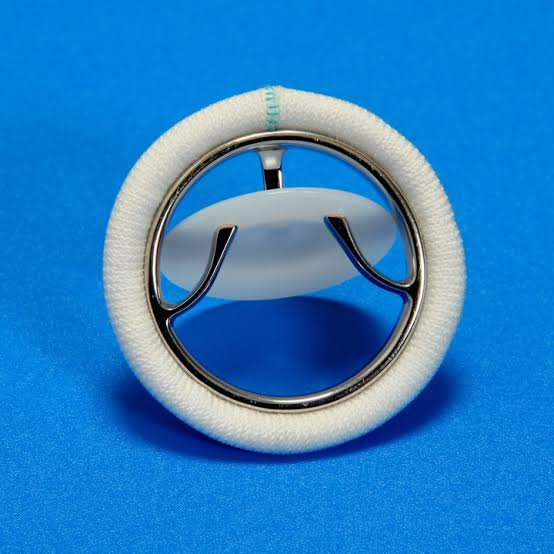
1 machine whistle-boils rice on an Indian stove; the other snaps shut 40M times a year inside a human ribcage to keep blood from flooding the lungs. This is the silent, terrifying origin story of how India’s most famous kitchenware company quietly took over cardiac surgery.
In the 1970s & 80s, Rheumatic Heart Disease (RHD) was a silent killer across India. Strep throat infections in children, if untreated, triggered autoimmune reactions that deformed the mitral & aortic heart valves. By their 20s, young men & women were dying of heart failure simply because their natural valves could no longer open / close properly.
The medical cure existed: replacing the damaged natural valve with a tilting-disc mechanical heart valve.
The economic reality was brutal: imported valves from Western manufacturers cost upwards of ₹55K, equivalent to yrs of salary for an average Indian household.
1000s of patients were left to die simply because of a price tag.
Dr. M.S. Valiathan, a brilliant cardiac surgeon trained at Johns Hopkins & Liverpool comes into the scene. In 1974, he took over as founding director of the Sree Chitra Tirunal Institute for Medical Sciences & Technology (SCTIMST) in Trivandrum. He vowed to build a fully indigenous, world-class mechanical heart valve at a fraction of the cost.
The team built a prototype using a single-crystal sapphire disc held in a metallic cage. During fatigue testing in custom pulsatile flow rigs, the sapphire disc suddenly shattered. If that had happened inside a human body, it would mean instant death. Back to the drawing board.
The team engineered a novel free-floating, plano-convex tilting disc made of Ultra-High-Molecular-Weight Polyethylene (UHMW-PE) housed inside a polished, integrally-machined metallic cage.
Because the disc rotates on its own axis as blood surges through, it continuously distributes wear evenly across its surface, giving it a theoretical lifespan of 50+ yrs (validated over 350M accelerated pulse cycles).
By 1989, the valve had passed extreme hydrodynamic testing, toxicological screening & animal trials in sheep. It was ready for human production.
Dr. Valiathan approached major Indian pharmaceutical & engineering conglomerates to license & manufacture the valve. They all said NO.
The corporate fear was simple: Product liability. If a machine tool / an engine part fails, a company loses money; if an artificial heart valve fails inside a patient's chest, you face catastrophic lawsuits & moral ruin.
That was when the TTK Group stepped forward.
TTK is known for Prestige pressure cookers, Skore products, or Fryums, but their leadership saw Dr. Valiathan's vision not as a high-risk liability, but as a moral duty. Using their expertise in high-precision metallurgy, micro-machining & quality control (originally built around pressure-vessel safety valves & seals), TTK established a dedicated, cleanroom medical manufacturing unit in Trivandrum.
In Dec 1990, at SCTIMST, Dr. Valiathan stood over an open chest in an operating theater. He implanted the very 1st production-grade TTK-Chitra Heart Valve into a human patient.
The patient survived, thrived & lived a healthy life for decades.
The TTK Chitra Heart Valve was brought to market at ₹12-20K, slashing the cost of open-heart valve replacement by 60%+ & putting life-saving surgery within reach of millions.
In 2001, the team won the National Technology Award for successful commercialization of indigenous technology.
To this day, while kitchen timers chime over Prestige pressure cookers across Indian homes, 200K+ TTK Chitra valves are opening & closing inside human hearts at 70 beats per minute, 100000 times a day, w/o missing a single pulse.
Taiwan solved tax evasion in 1951 with a trick so cheap it should embarrass every tax authority on the planet.
The problem was an all-cash economy full of small shops. A merchant pockets the cash, skips the receipt, and the sale never existed. Auditors can't catch what was never recorded, and hiring enough of them to watch every noodle stand costs more than the missing tax.
So finance chief Ren Xianqun flipped the incentive. Print a lottery number on every receipt. Draw winners every two months on live TV. Top prize today: NT$10 million, about $310K.
Suddenly the customer and the shopkeeper want opposite things. The merchant wants the sale off the books. The customer wants the ticket. And there are millions more customers than merchants. Every transaction now carries a built-in witness demanding the paper trail.
Year one, reported tax revenue jumped 75%, from NT$29 million to NT$51 million. Seventy-five years later, roughly 70% of Taiwanese still play. Convenience stores redeem the smallest NT$200 prizes at the register, so even a coffee receipt feels like a scratch card.
The elegant part is what the audit force costs. The prize pool runs about NT$7 billion a year, roughly $20 million. In exchange, the government gets 23 million unpaid auditors working every checkout line in the country, forever. No inspector general on earth delivers that coverage at that price.
Greece, Italy, Portugal, and Slovakia all copied it. The most effective compliance tool ever built looks like a game, and that's exactly why it works.
The Brahmin’s Prediction: How India Tracked Uranus Before the West
By @shreehistory
On the night of March 13, 1781, the German-born British astronomer William Herschel stood in the garden of his home at 19 New King Street in Bath, England, and pointed his telescope toward the constellation Gemini. He spotted an unfamiliar, slightly diffuse disc. He reported it to the Royal Society as a "comet." Within two years, the scientific community realized it was not a comet at all, but a new planet. History canonized this moment as the first time a planet was discovered in recorded history, and William Herschel was enshrined as the sole visionary who expanded the boundaries of our solar system.
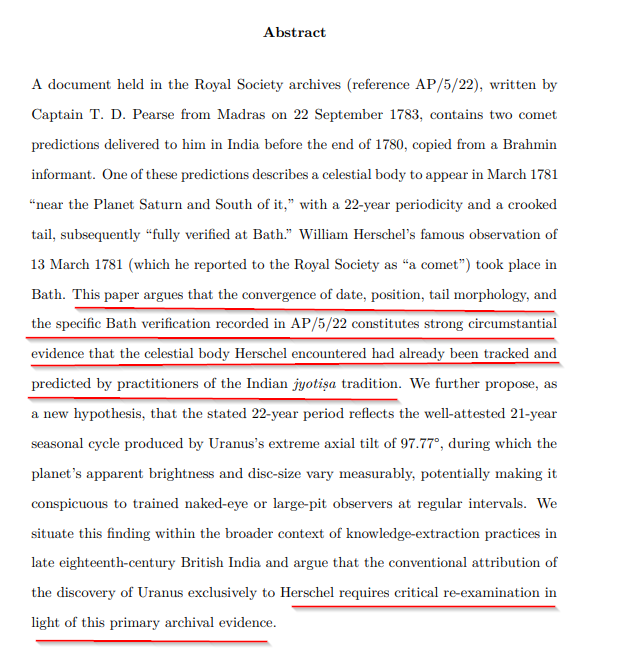
But what if the object Herschel encountered had already been tracked, classified, and predicted by practitioners of the Indian astronomical tradition long before his telescope was ever built?
Deep within the archives of the Royal Society itself, filed away and forgotten for over two centuries, lies a document that profoundly disrupts the conventional narrative of European scientific supremacy. The document is reference AP/5/22, a letter written by Captain T. D. Pearse from Madras on September 22, 1783. Filed under the mundane category of "Unpublished Letters," it contains explosive primary evidence that the celestial body we now call Uranus was under systematic surveillance by Indian astronomers long before the West claimed it. It lay hidden, till @shreehistory downloaded it OCRed it for cursive font and extracted the text and then connected the dots.
The Letter from Madras
Captain Pearse was a British officer stationed in India, deeply engaged in studying local culture. In his letter to the Royal Society, he transcribed two comet predictions that had been delivered to him by a "learned Brahmin" in or around 1780. Pearse explicitly stated that he had transcribed these predictions "before the End of 1780." This timestamp is the crux of the historical intervention. The predictions predate Herschel's observation by at least three months.
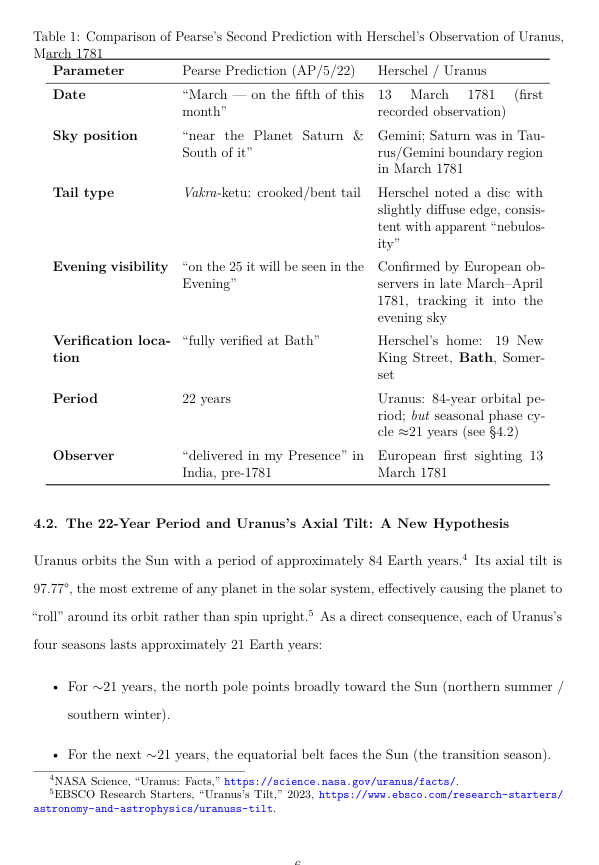
The second of the Brahmin's predictions read: "March, on the fifth of this month another Comet will appear of the kind called Wuckier or crooked from the Form of its Tail. It will appear six Ghurrees before Sun-rise, near the Planet Saturn and South of it. On the 25 it will be seen in the Evening. Its Period is twenty two years."
Later in the letter, Pearse casually notes the fate of this prediction: "I send you the copies of the other two predictions, one of which was fully verified at Bath."
The convergence of data is staggering. The prediction specifies the month of March, the exact proximity to Saturn, the evening visibility by the 25th, a crooked tail, and the specific verification location of Bath. This was not a lucky guess. The probability that a prediction composed in India before 1781 would correctly specify Bath, the month of March, the proximity to Saturn, and a 22-year period for an unknown celestial object, and that Herschel would then observe exactly such an object from Bath in March 1781 by pure chance, is vanishingly small.
The Sanskrit Taxonomy and the 108 Comets
The terms used by the Brahmin were not arbitrary. "Wuckier" is a direct transliteration of the Sanskrit word Vakra, meaning curved or crooked. In the Indian astronomical tradition of jyotisa, this refers to a specific class of comet known as Vakra-ketu, documented extensively in Varahamihira's Brhat-samhita from around 550 CE. The other prediction mentioned a "Dwudge" or flag-shaped comet, directly mapping to the Sanskrit Dhvaja-ketu.
The Indian system was not merely a collection of naked-eye myths. It was a highly sophisticated taxonomic project. Elsewhere in AP/5/22, Pearse records the Brahmin's promise to provide him with the tables of 108 distinct comets. This number is historically consistent with the ancient comet catalogues of Parashara, which classified celestial transients by tail morphology, rising direction, and crucially, periodicity.
The Brahmin informed Pearse that this catalogue was ancient received knowledge, written in the epoch preceding the current one. This implies a tradition of sustained, systematic tracking across many centuries, perhaps millennia. European astronomers like John Flamsteed and Pierre Charles Le Monnier had actually sighted Uranus before Herschel, but they catalogued it merely as a fixed star. They lacked the epistemological framework to recognize it as a moving body. The Indian tradition, by contrast, placed it within a named typology, assigned it a periodicity, and predicted its next appearance relative to Saturn.
The Secret of the 22-Year Cycle
Perhaps the most scientifically profound aspect of the Brahmin's prediction is the stated 22-year periodicity. Uranus has an orbital period of 84 Earth years. If the Indian astronomers were merely tracking the orbit, they would have recorded an 84-year cycle. Why 22 years?
The answer lies in the unique axial tilt of Uranus. The planet is tilted at a staggering 97.77 degrees, effectively causing it to roll around its orbit on its side. This produces four distinct seasons, each lasting approximately 21 Earth years. During these seasonal transitions, the geometry of the planet shifts from pointing its pole toward the Sun to pointing its equator toward the Sun. Modern science confirms that this transition causes measurable changes in the planet's atmospheric band structures, cloud features, and overall brightness.
The 22-year period recorded by Pearse was not an error. It reflects a new hypothesis: the Indian astronomical tradition was tracking the seasonal conspicuousness cycle of Uranus. They were observing a faint, slow-moving object that became notably brighter and more active in the sky roughly every 21 to 22 years. This requires a level of naked-eye observational discipline and data retention over centuries that the West has historically refused to imagine was possible in the Global South.
The Colonial Archive and the Erasure of Knowledge
The Royal Society received this letter in 1783. It was never read to the Society. It was never published in the Philosophical Transactions. It was filed away in the archive, buried in the vaults of the very institution that was simultaneously celebrating William Herschel's "discovery."
This archival suppression is emblematic of the broader history of colonial knowledge extraction. As historians of colonial science have documented, British intermediaries systematically collected indigenous technical knowledge, transformed it into European frameworks, and failed to credit the original sources. The year 1783, the date of the Pearse letter, marks the exact opening of the era where British scientific institutions in India began actively incorporating native knowledge into the matrix of imperial power without granting authorship.
Herschel himself wished to name the planet Georgium Sidus after the British monarch, King George III. It was a cosmic naming ceremony that mirrored the British assertion of hegemony over the Indian subcontinent. The Brahmin tradition, which had tracked this object within its own sophisticated taxonomy, received no acknowledgement then and has received none in two centuries of historiography.
Reclaiming the Cosmic Ledger
The paper authored by @shreehistory, drawing upon this buried primary evidence, does not seek to erase Herschel's telescopic achievement. It seeks to contextualize it. The history of astronomy owes a reckoning with the contributions of the Indian jyotisa tradition.
The conventional Eurocentric discovery narrative is historiographically incomplete. The object known as Uranus had been engaged with, tracked, and predicted by South Asian practitioners long before a European telescope was trained on Gemini. The truth of this history, preserved for over 240 years in the Royal Society's own archives, demands a critical re-examination of how we assign credit for human discovery.
The era of relying solely on the colonial archive to define the limits of indigenous knowledge is over. The time has come to read the Brahmin's predictions not as exotic curiosities, but as the rigorous scientific records they truly are.
All rights reserved. You must get written permission if you want to republish. Twitter users can share, repost, like, comment but please provide attribution to @shreehistory who did all this research.
Paper is in preprint and can be accessed from my site.
https://t.co/WpJ7h9EK6U
Newly published: A landmark book on Indian mathematics
I am honoured to be one of the first recipients of this new book by Prof. K. Ramasubramanian of IIT Bombay. “The Elusive Ratio and the Advent of Calculus in India” is the result of meticulous multidisciplinary research in mathematics and Sanskrit.
Prof. Ramasubramanian is a renowned scholar of both Sanskrit and mathematics (he holds a doctorate in Theoretical Physics, a master’s degree in Sanskrit, and a bachelor’s degree in engineering). He has authored three books on Indian mathematical treatises—“Gaṇita-Yukti-Bhāṣā”, “Tantrasaṅgraha”, and “Karaṇapaddhati” (all published by Hindustan Book Agency and later by Springer Verlag).
In his latest book, running to around 450 pages, Prof. Ramasubramanian documents and explains the development of approximations of and expressions for pi (π, “the elusive ratio”) given by Indian mathematicians over hundreds of years. It starts with Vedic ritual geometry and the Śulbasūtras, covers the seminal contributions of Āryabhaṭa and Brahmagupta, and culminates in the infinite power series for π given by Mādhava of Saṅgamagrāma. The book thus traces the lineage of mathematical ideas that predated some aspects of modern calculus, developed in Europe, by three hundred years. The book offers an accurate account of the history of mathematical ideas in India: there is no hyperbole, no tall claim, and no sweeping history in the book. It situates the Sanskrit works in their historical and intellectual context, presents the Sanskrit verses and text, and explains their meanings with detailed diagrams, tables, and notes.
The book is a must-read for students and scholars of the history of mathematics and Indian Knowledge Systems. I congratulate Prof. Ramasubramanian and the publisher, Garuda Prakashan, for bringing out this landmark book. I also thank Prof. Ramasubramanian for sending me a complimentary copy.
Bibliographic details: K. Ramasubramanian. “The Elusive Ratio and the Advent of Calculus in India”. City of Gurugram: Garuda Prakashan Pvt. Ltd., June 2026. ISBN 978-93-476-9139-3. Paperback.
For the last 15 years, I've always had one dream and desire which was to make Indian history interesting for everyone.
In that time period, I have tried writing blogs, long-form posts, stories and threads, to do exactly that.
Some worked, most didn't. But with every post, I always had this nagging question.
Why is Indian history always taught with a tunnel vision. Why is it so fragmented?
Why do we always learn things from the perspective of one empire, kingdom, king or invader.
Why do we never see an all India view of history?
I mean most of us struggle if we are ever are asked this question
1. What was the true extent of the Mughal Empire at its peak?
2. Who were the Cholas' contemporaries in North India?
3. While Muhammad Ghori was fighting the Second Battle of Tarain, who ruled Thanjavur?
4. While Harsha ruled Kannauj, who ruled Assam?
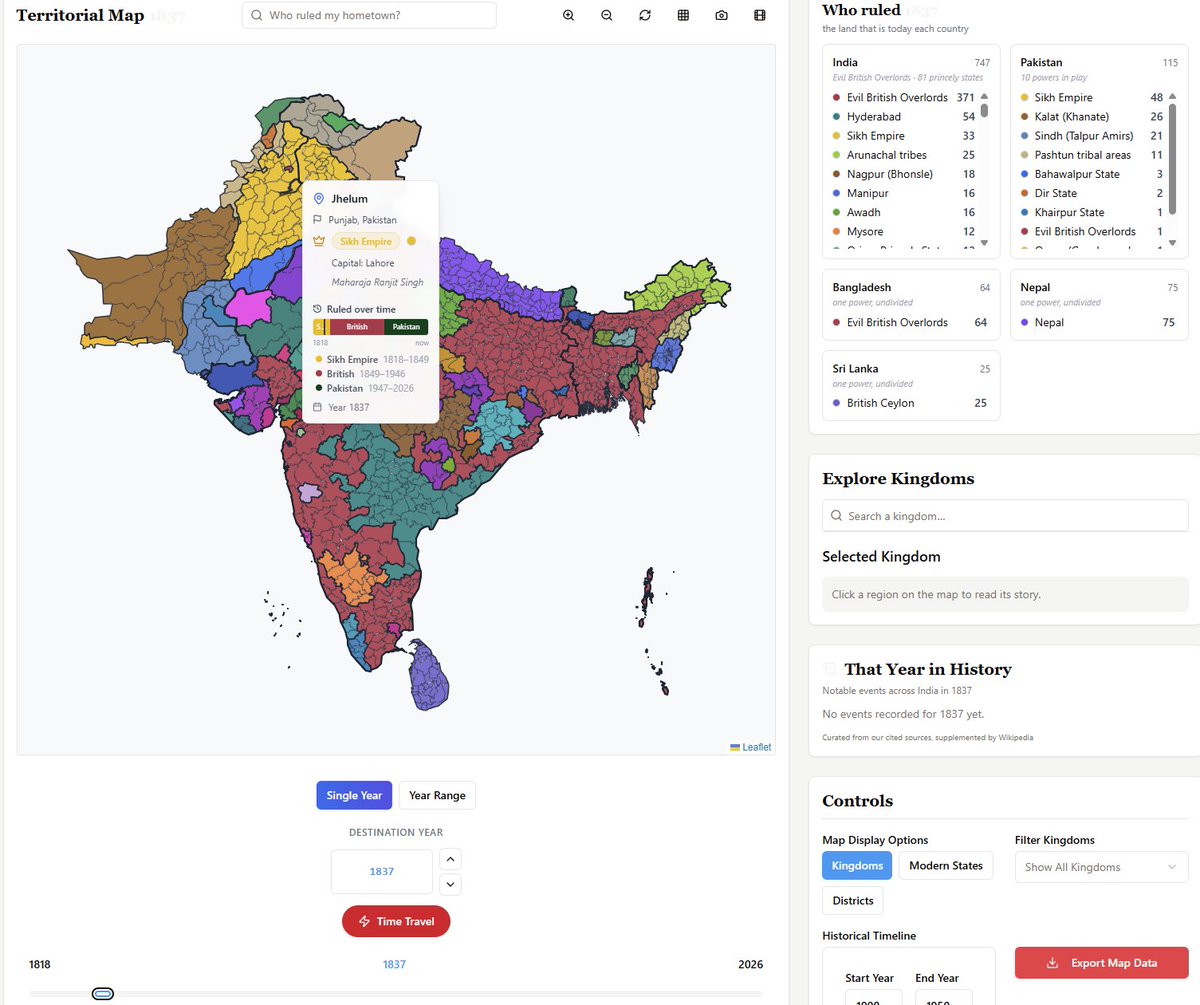
I have always wished there was a simple way to see the political map of India for any year in Indian history.
I have always wished there be a place where
1. One Could Select any year and instantly see who ruled every part of the Indian subcontinent.
2. One could Discover the important events that happened in that year
3. One could select a time period, say 1700 - 1947, and see how the Indian subcontinent evolved in that period.
4. How did one tiny red dot in West Bengal, from a tiny red dot in Europe, somehow came to rule an entire subcontinent of 400 million people,
For years, that idea remained just an idea and a dream because
1. I didn't know how to build a website.
2. I couldn't afford to hire someone who could.
Then Claude Came along.
Thanks to generous support and heavy lifting by Claude, over the last few months, that 15-year-old idea is slowly transforming into a reality.
And today, it has reached a position, where I'm excited to share with all of you, the first sneak peek of https://t.co/6ph2s9Zzl9
It is my attempt to create an interactive historical atlas of India that lets you travel through time and explore the political history of the subcontinent, one year at a time.
This is my attempt to make history interactive and fun.
I'd love to hear what you think.