Augmented Reality is the natural interface for robotics.
Not only for giving commands, but also to visualise hardware data (like LiDAR) natively in 3D.
@specs AR glasses, @UnitreeRobotics Go2 Lite quadruped, @dimensionalos OS for the robot
A man photographed the Sun every day from the same point and at the same time for three years. He then combined all the frames into a single image showing the path the Sun follows across the sky throughout the year.
A beautiful way to explain chaos theory
10 pendulums begin almost identically, separated by only 1 degree, yet over time their motion becomes completely different.
[🎞️thebrainmaze]
Emilia Clarke reveals she dreamed her dying father came to say goodbye at the exact moment he passed, while she was stuck on a flight with no way to reach home
"This was 2016. The Wi-Fi didn't exist in planes. So I'm just going to be sitting on this flight for like 10 hours and I can't contact anyone"
"So I was like, 'I'm going to imagine that I'm in the hospital. What could get into a hospital? A butterfly.' And I imagine that I'm fluttering around my dad being like, 'I'm coming home. Hold on. You're going to be fine'"
"And then I somehow fall asleep. And in a dream I'm in my airline seat and my dad's hospital bed is next to me and he just turns and said, 'I just came to say goodbye'"
"And I land and my mom sends me a text saying, 'Don't rush.' So I knew that he had passed and he passed at the time that I was having the dream"
"And we open the house and this butterfly is flying around the room"
BREAKING 🚨: China becomes the second nation to recover an orbital rocket’s first stage, after the US
The Long March 10B booster hovered on its engines, then dropped straight into a net at sea
Fun fact.
July 8, today, turns out to be the day that most people around the planet experience daylight at the same time.
This means, 99% of Earth's 8 billion residents will be on the sunlit side of Earth at the same time.
A butterfly successfully hatched aboard China's Tiangong space station without any human assistance or special radiation shielding.
The insect emerged from its chrysalis inside a small sealed capsule that functioned as a miniature ecosystem. The capsule reached the station aboard a Kuaizhou cargo mission in December. It contained plants microorganisms and sufficient environmental controls to support the butterfly through its full metamorphosis.
The chamber maintained a temperature of about 86 degrees Fahrenheit or 30 degrees Celsius. After hatching the butterfly lived for several days in orbit. It moved around normally even in the absence of gravity.
This outcome is notable because butterflies rely on orientation balance and coordinated movement for flight. Scientists were uncertain how the insect would navigate or behave in microgravity after emerging. Previous space missions including one on the International Space Station in 2009 had seen butterflies complete metamorphosis. This Chinese experiment however operated with far fewer supports.
The capsule lacked radiation shielding full spectrum lighting advanced temperature controls and any ongoing human care once in orbit. The butterfly had to manage inside a compact self contained habitat.
The experiment raises broader questions about whether small ecosystems can operate independently away from Earth. As humans plan longer space missions and potential space agriculture insects may play key roles in pollination and maintaining natural cycles. Understanding how such miniature systems function in orbit could inform the design of future space farms.
water scarcity problem is getting solved before even it started..
CHINA JUST UNVEILS SOLAR DESALINATION BREAKTHROUGH
- They developed a 3D photothermal material that converts seawater into freshwater using only solar energy, with no external electricity.
- This material absorbs 90.2% of sunlight, cuts evaporation energy nearly by 50% and achieves an 8.5× higher evaporation rate than previous designs.
- A 0.75 m² outdoor prototype produced over 20 liters of safe drinking water per day, enough for about 10 people, while meeting WHO water standards.
- New system also irrigated a 5 m² test farm growing spinach, corn, and Chinese cabbage, demonstrating potential for both drinking water and agriculture.
- Researchers estimate that after about 2 years of operation, the production cost of freshwater could become lower than commercial bottled water.
Proud to share my latest project: a 65 hour exposure of the shockwave from a supernova. You’re seeing it rip through other star systems.
Any planets within 10LY of the star would have been destroyed!
I knew it would be fascinating. I didn’t know it would be so beautiful.
When you start a chess game, you have 20 possible moves available. After the first full move (White then Black), there are already over 400 possible positions. By the third move, that number jumps to around 8,900, and after the fourth it reaches nearly 200,000.
By the time you get to move #40, the total number of possible games explodes to roughly 10⁴⁰, a number comparable to the total number of atoms in the observable universe.
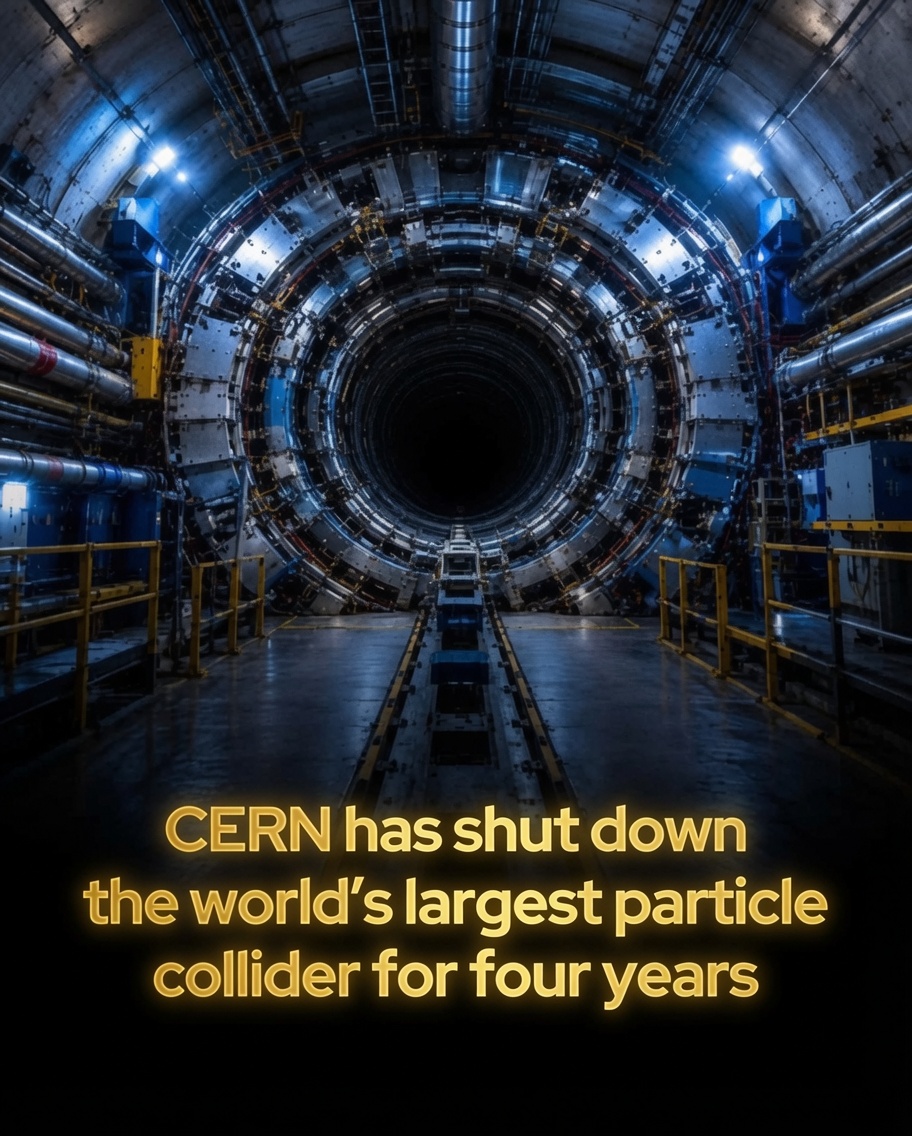
CERN has officially powered down the worlds largest particle collider.
The Large Hadron Collider known as the LHC is a 17 mile or 27 kilometer underground ring near Geneva Switzerland. It accelerates particles to nearly the speed of light and collides them. In 2012 this facility enabled scientists to discover the Higgs boson. This particle relates to the field responsible for giving mass to other particles.
The machine has now entered what CERN calls Long Shutdown 3. It is scheduled to resume operations around 2030 as the High Luminosity Large Hadron Collider.
The primary aim of this upgrade is not to enlarge the collider significantly. Instead it focuses on improving the machines ability to generate high quality data.
In particle physics luminosity measures the rate of particle collisions over time. Higher luminosity increases opportunities to detect rare phenomena that may point to new physics beyond current understanding.
Currently the LHC detectors record about 60 proton proton collisions per bunch crossing. Following the upgrade this figure is expected to increase to between 140 and 200.
Throughout its operational life the upgraded collider could generate approximately 380 million Higgs bosons. This represents a substantial rise from the roughly 55 million produced since the LHC began operations.
A key objective involves detecting rare events where two Higgs bosons are created simultaneously. Such observations could provide deeper insights into the behavior of the Higgs field and offer information about conditions in the early universe following the Big Bang.
The project includes replacing major detector components installing advanced timing systems and upgrading roughly 0.75 miles or 1.2 kilometers of magnets and other infrastructure within the LHC.
CERN has confirmed that this work poses no risk of destroying the universe. Natural cosmic rays produce far more energetic collisions than those at the LHC. These rays have bombarded Earth and objects in space for billions of years without incident.
Scientists say they have built a cell from scratch for the first time that can feed, grow and replicate like a natural cell. This breakthrough in synthetic biology could usher in an era of made-to-order organisms that function like living machines. https://t.co/weTPfCIQi8